
Keyword research.
Often abbreviated as AKS or AKW
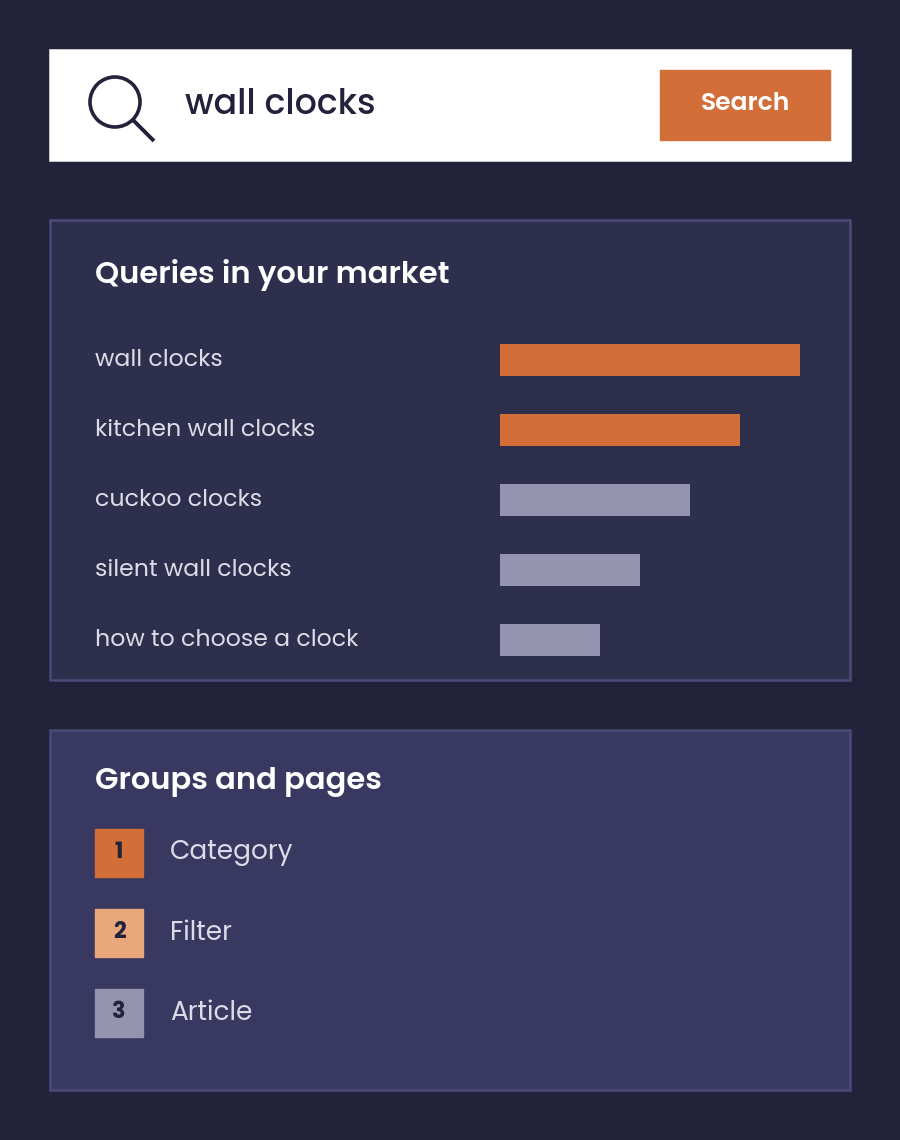
We find out what people in your industry search for and how often. You get a table of queries divided into groups, with a page on your website assigned to cover each group.
What is keyword research for?
Do you want to open an online shop in a particular segment? Do you have an online shop that nobody visits? Do you need to know what is popular in your industry, what the competition looks like and how competitive the industry is overall? Are you creating new content for your website?
Keyword research helps you in all of these situations. You can target the keywords people search for in your industry to optimise your website effectively. You will discover opportunities and gain a better understanding of users and of your part of the market.
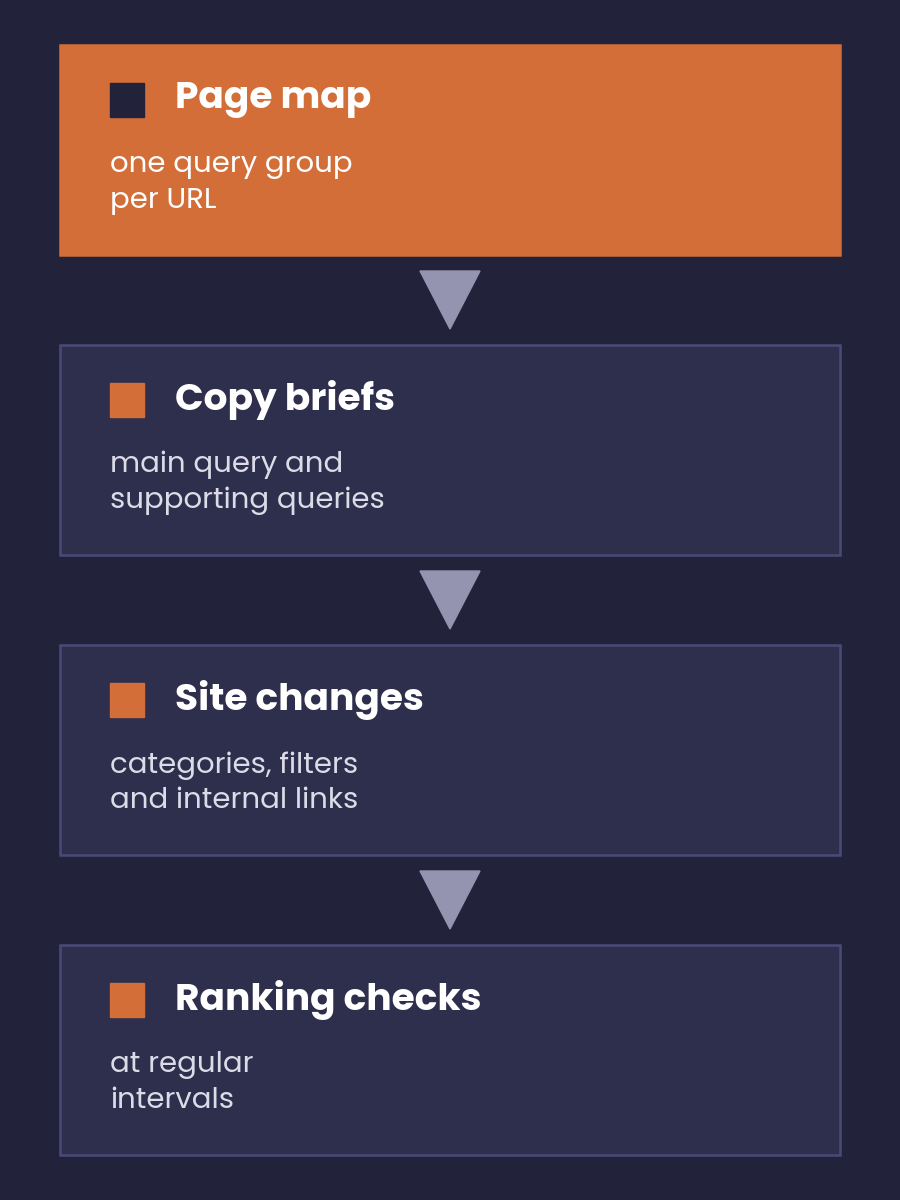
Keyword research is one of the main documents and outputs used to design a website’s architecture and optimise SEO activities. That is why at IdeUp we do not deliver it as a bare table of search volumes. We assign each group of queries to a specific page on your website, so you can commission texts and changes straight from the output.
What you get from us
The output is a table of queries and a page map. Both are based on data about your website and on what people in the Czech Republic actually search for.
List of queries
All the queries people use to search for your products or services. Without other companies’ brands or words that mean something different in another industry.
Search volume and seasonality
How many people search for a query and in which months. We take Czech search volumes from Marketing Miner, which also includes data from Seznam (the Czech search engine) and Sklik. Ahrefs underestimates smaller Czech queries, so we use it mainly for competitor analysis.
Groups by intent
Queries for which Google shows the same results belong in one group. For each group you know whether the searcher wants to buy or is still just looking for information.
Assignment to pages
Each group gets one URL, either existing or new. This means two of your pages will never target the same query.
Priority order
The order is not determined by search volume alone. A smaller query with clear purchase intent often ranks above a large informational one, because it brings in customers.
Competitor overview
We show you who currently ranks at the top of Google for your queries, which pages bring them traffic and which pages you are still missing.
Where does keyword research help?
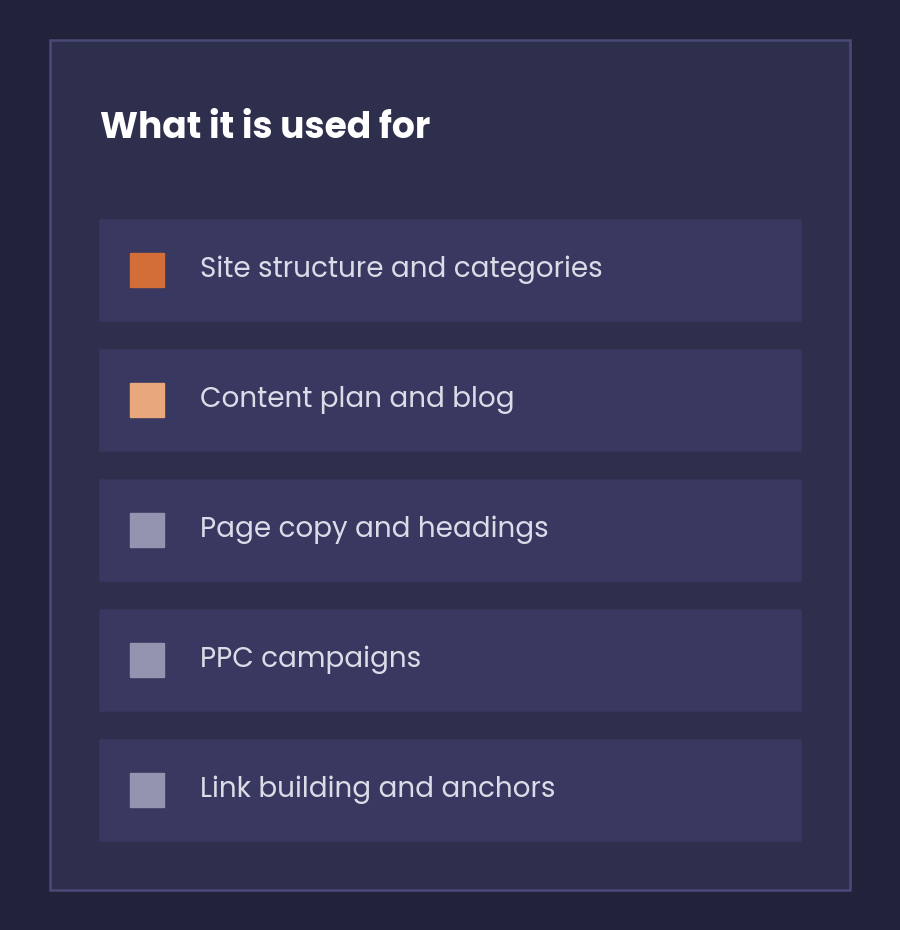
In most segments, well-prepared keyword research is a basic and essential document, not only for subsequent SEO work but also for other online marketing activities such as social media marketing, content marketing, link building, paid advertising (Pay Per Click, PPC) and so on. Above all, however, at the very start keyword research helps you create your website’s architecture and structure.
Whether you are building a new website for your company or starting SEO on an existing one, you cannot do without keyword research. It gives you important information about which queries from your industry people use when searching and how often they search for these phrases. This also reveals suitable opportunities for including these keywords in your website content, for creating a suitable website architecture and for building backlinks.
Keyword research has the biggest impact on online shops, because demand rarely matches the way the product range is divided. People search for “kitchen clocks”, while the website has a Clocks category and a room parameter. The research shows where a category or filter page is missing before it costs you traffic.
How does Google work?
The algorithm of Google, the largest search engine in the Czech Republic, has fundamentally changed its approach to website content and overall website structure. Search algorithms are becoming ever more intelligent and are better able to simulate the behaviour and expectations of real website visitors. Simple optimisation techniques, where it was enough to use a keyword several times, are long gone.
Google monitors user interaction on websites and tries to select the best results for given search queries. That is why SEO and content creation are no longer about using exact keyword forms. On the contrary, search engines value varied text, the use of different forms of a keyword (declension, conjugation), the use of synonyms and high informational value of content.
You need to focus on writing web content primarily for people, and search engines will reward this with better positions in search results. Pay attention to search intent, where you try to serve the most suitable page with an answer for a given search term.
Keyword research is your map and guide to structuring your website and creating categories, blog articles, anchor texts and other landing pages. It helps you translate your business into a form that is understandable to search engines and, above all, to the people who use them.
That is why we do not guess intent from behind a desk. For each group, we look at which pages Google currently shows for it. If the first page contains only guides and you want to sell, we will tell you before you have the page written.

How we do keyword research
The process is the same for a small website and for an online shop with thousands of products. Only the volume of data differs. Most of the work is not in collecting data but in sorting queries into groups and mapping them to the website structure.
01
Your input
Send us your main competitors and the products or services you want to sell. We will ask for access to Search Console, which shows the queries your website already appears for.
02
Collection and cleaning
We collect queries from Search Console and from competitor websites, and add search volumes from Marketing Miner. Then we remove everything that does not belong to you.
03
Intent and groups
For each query, we look at which pages Google shows for it. Based on this, we combine queries into groups and determine the page type for each.
04
Map and priorities
Each group gets a target URL and a place in the priority order. You will see which pages to update and which to create.
05
Handover
We hand over the table and the page map so that you can commission work from them even without us. If you wish, we can expand your website structure based on them straight away, or design a new one.
How to work with the output
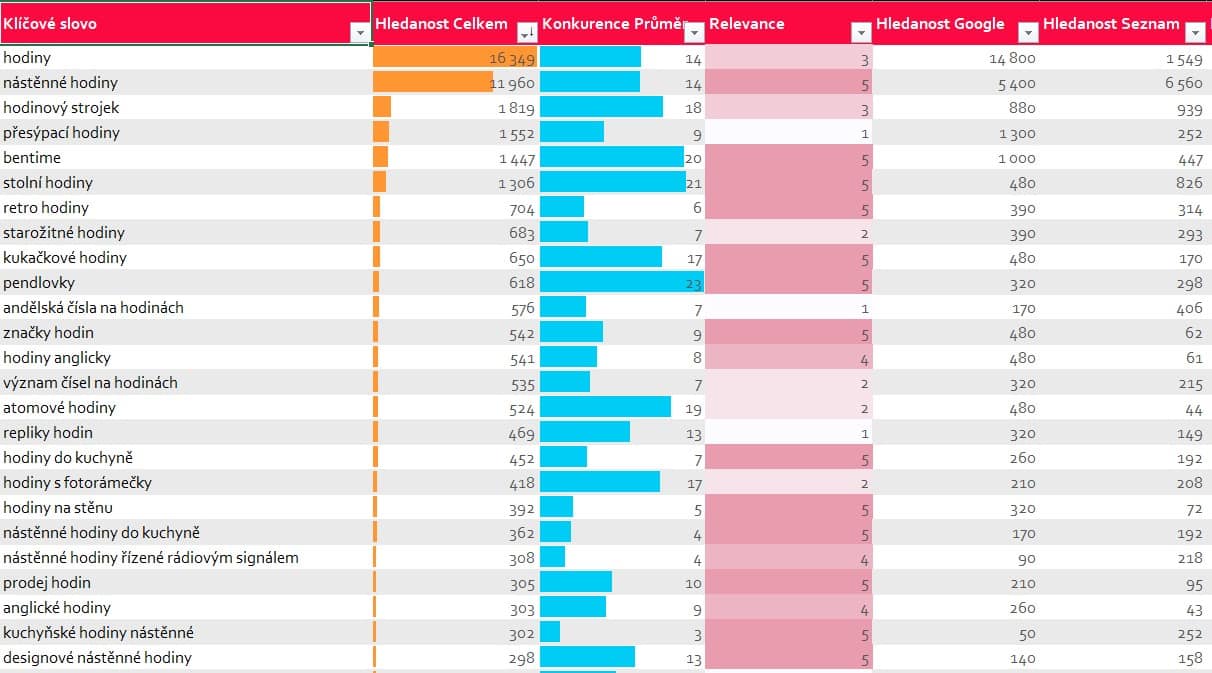
The table has columns for the main query, supporting queries, total search volume, intent, page type, target URL, status and priority. Each row is therefore a task: either update an existing page or create a new one. Alongside them you keep the raw data from the tools, for example search volumes for Google and Seznam separately.
A copywriter gets the main query for the heading and the supporting queries the text should cover. An online shop manager can see which categories and filter pages are missing. For PPC campaigns you take the queries with purchase intent, and for link building the natural link texts (anchor texts).
Because each group has only one URL, there is no keyword cannibalisation, where two of your pages compete for the same query and Google picks the worse one.
However, keyword research is not a document you read once. You need to keep working with it and reflect it in your website structure. Demand changes and new products bring new queries, so at a minimum you should review the map once a year. If you wish, we can monitor this for you and check at regular intervals how your website performs for individual queries.
When you can do the research yourself and when to hand it to us.
For the query “analýza klíčových slov” (keyword research), Google currently shows seven guides and articles in the top ten, with the rest going to Wikipedia and Keyword Planner. You will not find an agency page there, as most people want to do the research themselves. For a smaller website with a clear offering, this is possible, and you will find the process in our guide keyword research step by step.
Outsourcing it makes sense for an online shop with hundreds of categories and filters, or before a redesign. There, what matters is the sorting and mapping to the structure, not the data collection, and for a large online shop it means weeks of work, not an afternoon with a tool.
Do you have an older table that is sitting unused? You do not have to start again. We will build on it and add what it usually lacks, namely query groups with target URLs.
What builds on the research
You can start working from finished research straight away. These services of ours build on it.
Ongoing website optimisation based on the page map. We then measure every change against the queries from the research.
Category texts and articles written for the main and supporting queries from the research. We choose a copywriter from our network to match your industry.
Not sure whether you need full research? Start with a consultation. We will go through your website and data and show you where the greatest potential lies.
What our clients say about us
Rated 5.0 out of 5 on Google. All reviews
★★★★★
“Our cooperation with the IdeUp agency is long-term and always at a very professional level. I appreciate their proactive approach, clear communication and high-quality work. Everything ran without unnecessary delays. They are reliable, communicate quickly and understand what they are doing. I can recommend them as a reliable partner for online marketing.”
Michal Hardyn
Google review, translated from Czech
★★★★★
“Working with this marketing agency was very pleasant and professional. I appreciate their clear communication, quick feedback and fair approach. I recommend them to anyone looking for a reliable partner in online marketing.”
Tereza Gultová
Google review, translated from Czech
★★★★★
“High-quality services, precise results, quick communication, pleasant manner. Definitely recommended”
Jan Barák
Google review, translated from Czech
Questions about keyword research
Answers to the questions people search Google for about keyword research.
How much does keyword research cost?
We confirm the price in advance based on the scope. The main factors are the size of your website and how many markets and languages you cover. You approve the scope and price before we start.
How long does keyword research take?
For a small website it usually takes two to three days; for an e-shop with thousands of products it is more like two to three weeks. Collecting the data takes the least time. Most of the work is sorting the queries into groups and assigning them to pages.
Can I do keyword research myself?
For a smaller website, yes. Google’s Keyword Planner and Search Console are enough, and both are free. We describe the process in a guide on our blog. Help pays off where there are thousands of queries and the structure of the whole website is at stake.
How do I find out which keywords my website appears for?
The most accurate source is the Performance report in Google Search Console. It shows the queries your website appears for, with clicks and average position for each one. This is the first data we use in our research, because it is real, not estimated.
How often should keyword research be updated?
At a minimum, review the site map once a year and add new queries. It pays to do this sooner if you expand your product range or before a redesign. Search demand changes, and an old spreadsheet stops matching what people are searching for.
Let's map your industry
Tell us about your website and what you want the research to solve. We will get back to you with a proposed scope and confirm the price in advance.