
B2B marketing.
Which strategies work in B2B marketing?
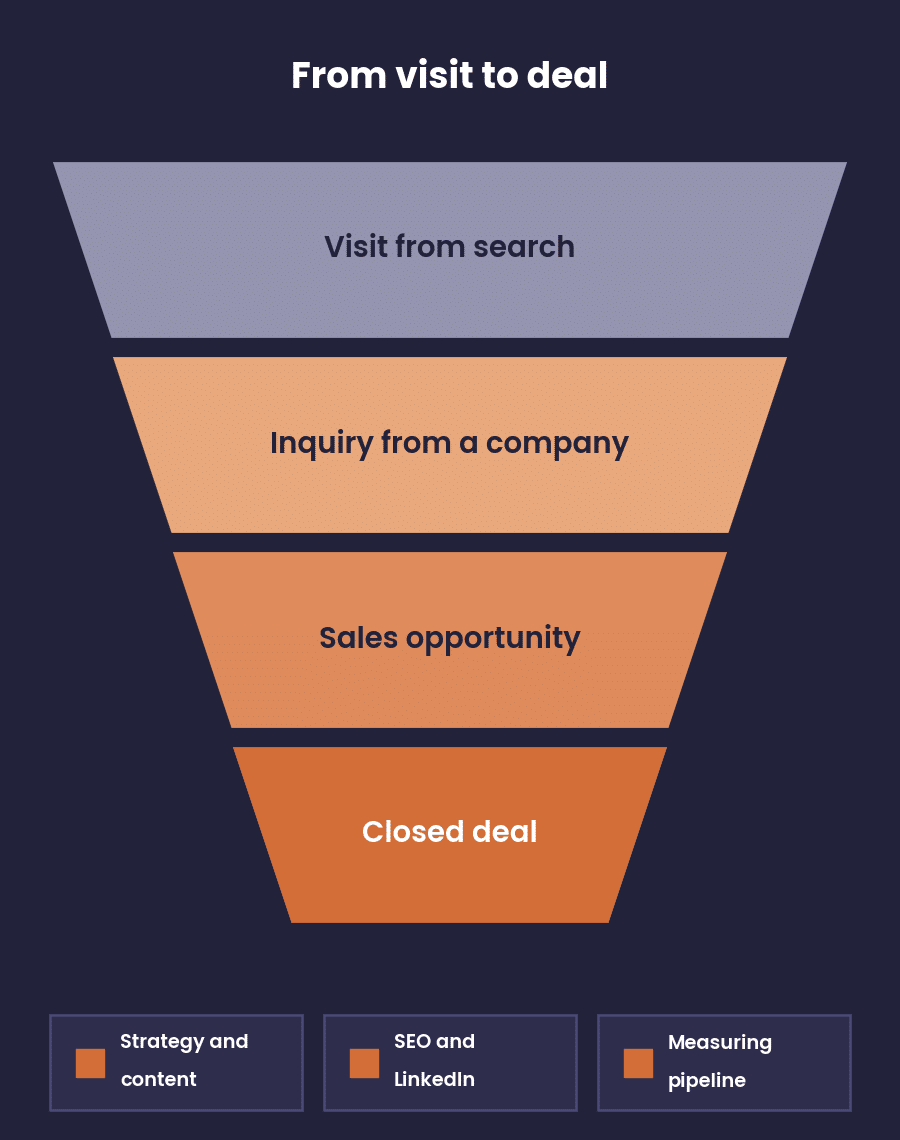
We help companies that sell to other companies. We build strategy, content, SEO and LinkedIn so that they generate business opportunities, not just visits.
What is B2B marketing?
B2B marketing (business-to-business) differs fundamentally from B2C (business-to-consumer) marketing. That, at least, is what one group says. The main difference is that instead of reaching end consumers, B2B marketing targets other companies. This calls for a specific approach that takes into account the different needs and motivations of business customers.
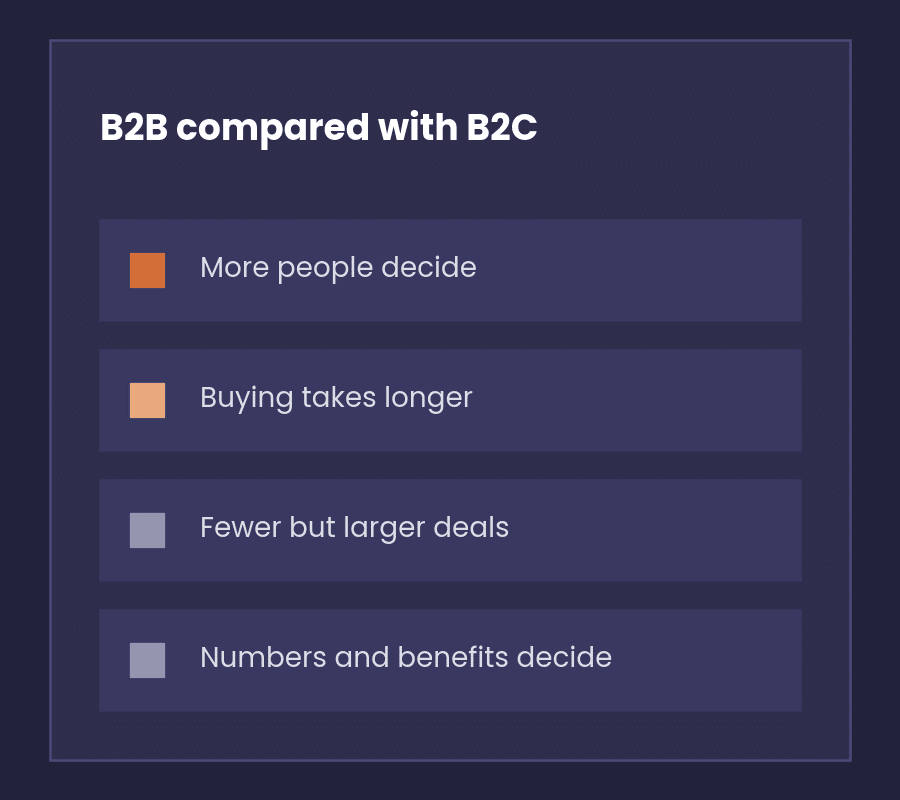
Unlike the B2C market, where customers often buy emotionally and on impulse, companies in a B2B environment approach purchases rationally and strategically. Several people (so-called decision makers) are usually involved in the decision, and the process is often longer and more complex. Here, marketing has to focus on demonstrating the specific benefits and value that the product or service will bring to the customer’s business. Put simply, how it can help them make money.
Then there is a second group of marketers who say that B2B and B2C are very similar and that strategies work in much the same way. Our view lies somewhere in between. A buyer or a director responds to a clear story just like an online shop customer does. But they have to justify their choice to colleagues and management, and for that they need arguments.
B2B companies close far fewer transactions than in a B2C environment, but in much larger volumes. That is why communication must be targeted and persuasive, and must clearly demonstrate the value the partnership will bring.
That is why at IdeUp we do not mix campaigns and copy for businesses with those for consumers. If you sell to both, each group gets its own message and its own measurement. You will find a detailed comparison of B2B and B2C, including differences in pricing and legislation, in our glossary.
What we take on in B2B marketing
We can run all of your marketing, or just the part that nobody in your company is responsible for today. We base every activity on who buys from you and how long they take to decide.
Strategy and target companies
We describe which companies you sell to, who makes the decisions there and what sets you apart from the competition. When there are only a few target companies, we prepare outreach for each one separately (account-based marketing).
Case studies and materials that your contact will forward to colleagues and management. We address each role in the buying team with different arguments.
In B2B, few people search, but those who do have a specific problem. We find the queries your customers type in and create pages for them.
LinkedIn for companies and people
We set up the company page, but we put most of the work into the profiles of the owner and the sales team. Posts under a personal name tend to reach more people than a company page.
Enquiries and lead generation
Downloadable materials and email sequences that turn a visitor into a contact. Plus a process for working with contacts who are not ready to buy yet.
Measuring business opportunities
We set up measurement so that you know where each enquiry came from, and which enquiry each deal came from. We evaluate opportunities, not visits.
Who B2B marketing with us makes sense for
Working with us pays off most for companies that sell a higher-priced product or service to other companies, where several people are involved in the purchase decision. This could be a manufacturer, a distributor, a software company or a provider of professional services. The industry matters less than how your customers buy from you.
You will get the most out of us in these situations.
- You have a salesperson or a sales team who can close enquiries, but not enough of them come in.
- Your website does not bring in enquiries, or you do not know where they come from.
- Your marketing is sporadic and lacks a plan to base decisions on.
- You are preparing a new product or entering a field where nobody knows you yet.
B2B also includes manufacturers of consumer goods who sell through retail chains and wholesalers. For them, B2B marketing concerns their trade customers, meaning content and arguments for retail chain buyers. Consumers are then reached through a separate B2C campaign.
How to approach a B2B marketing strategy?
The main goal of a B2B strategy is to understand decision-making processes within companies and create a strategy that reaches the key people with decision-making authority. Simply by mapping out its marketing and acquisition, a company gains an edge over its competitors.
1. Define your target audience. B2B marketing targets a narrower audience, mainly managers, buyers and business owners. The first step is therefore to understand thoroughly who your potential customers are. Find out what problems they need to solve, what product or service they are looking for, and who has the final say in the decision within the company.
However, it is not enough to market only to the most senior people. Companies also have groups of influencers who can have a significant say in the decision. The technical specialist assesses whether the solution will work, finance keeps an eye on the return, and the user will work with it every day.
2. Identify the purchase motivation. Companies in a B2B environment buy products or services to increase their own efficiency, quality or profitability. The motivation is not personal satisfaction but economic advantage and return on investment. Of course, there are also status purchases, but they are rare. Your marketing strategy should therefore highlight the specific benefits your solution brings, in a form that is persuasive and easy for companies to understand.
3. Create a value proposition. A successful B2B marketing strategy must deliver a clear value proposition. This means you have to explain clearly and specifically what problem you solve, how your solution delivers value and how you are better than the competition. B2B customers value precision and facts. Avoid generic phrases and focus on what really drives the decision.
4. Choose the right marketing channels. Unlike B2C, where mass advertising works, in B2B direct communication and targeted outreach matter more. You will also need to capture people who are dealing with specific problems.
Focus on the channels your customers use most often. These may be trade publications, SEO, conferences, LinkedIn, email marketing, or personal meetings and relationships. Every channel should be used to build a long-term relationship and trust.
5. Decide how you will recognise success. In B2B, enquiries are few and a deal can come months later. Before you start, agree with sales what counts as a qualified enquiry and where its source will be recorded. Otherwise, decisions about channels are made based on traffic, which says little about revenue in B2B.
We will write up the answers to these five points with you on a single page, so that it can guide decisions as you go. In our article on the one-page marketing strategy, we show what such a page looks like and which seven questions it answers.

How we work together
We start with a conversation with sales and with data, not with a campaign. Our B2B consulting is led mainly by Patrik Pilous, who has focused on B2B marketing for a long time. The process is the same whether we take on all of your marketing or just part of it. What we mainly need from you is someone from sales for the initial conversation and the regular reviews.
01
Initial conversation
We discuss who you sell to, how enquiries come in today and where sales get stuck. We will ask for access to Google Search Console, which holds data on how people find your website in search, to your analytics and, where relevant, to your CRM.
02
One-page strategy
We write down the target companies, the roles in the buying team, the key messages, the channels and what we will measure. You approve it before any money is spent.
03
Implementation
We prepare content, pages for search, LinkedIn and email sequences. Your team can handle part of it, with us providing the briefs and review.
04
Review with sales
We regularly go through how many opportunities were generated and from which channels. Based on that, we shift time and budget.
We measure business opportunities, not clicks
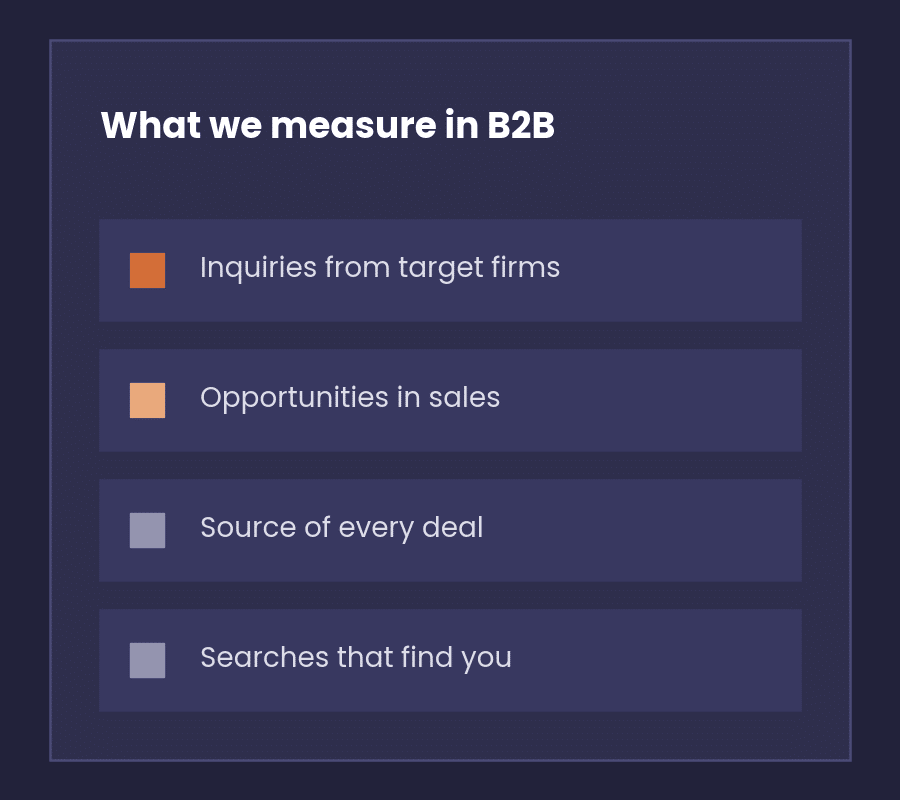
Anyone who evaluates B2B marketing by traffic is making decisions blindly. A few visits from companies that could buy from you are worth more than thousands of visits from anywhere. That is why we set up measurement so that it ends with the deal, not with the click. We mainly track four things.
- Enquiries from companies that match your target audience, not the total number of completed forms.
- Business opportunities, what stage they are at and how long they have been there.
- The source of each deal, meaning the channel through which the company first heard about you.
- The search queries you appear for, and whether they match what you sell.
We agree with sales on what counts as a qualified enquiry right at the start. Marketing and sales then talk about the same numbers and do not argue over whose deal it was. We discuss which metrics make sense when the market is small in our article B2B lead generation in a small market.
When an agency won't help you.
We say this openly right at the start. If your sales team does not have the capacity to handle more enquiries, marketing will only add contacts that nobody calls. In that case, it is better to strengthen sales first and only then bring in enquiries.
Nor can we help anyone who expects their first deals within a few weeks. Decision-making in companies takes time, and content and SEO need time before they show results. And if you sell to a handful of customers you know personally and are not looking for new ones, it pays to invest more in your relationship with them than in marketing.
What clients say about working with IdeUp
Rated 5.0 out of 5 on Google. All reviews
★★★★★
“We have worked with IdeUp for a long time, and always at a very professional level. I value their proactive approach, clear communication and high-quality work. Everything ran without unnecessary delays. They are reliable, communicate quickly and understand what they are doing. I can recommend them as a reliable partner for online marketing.”
Michal Hardyn
Google review, translated from Czech
★★★★★
“Working with this marketing agency was very pleasant and professional. I value their clear communication, quick feedback and fair approach. I recommend them to anyone looking for a reliable partner in online marketing.”
Tereza Gultová
Google review, translated from Czech
★★★★★
“Quality services, precise results, fast communication, a pleasant manner. I definitely recommend them”
Jan Barák
Google review, translated from Czech
What companies ask before they start with B2B marketing
Short answers to what companies want to know before we start working together.
What is the difference between B2B and B2C marketing?
B2B marketing targets companies, B2C targets end consumers. In B2B you sell to fewer customers for larger amounts, prices tend to be individual and a salesperson often closes the deal in person. Marketing therefore looks for the right companies rather than the widest reach, and it measures sales opportunities, not the number of orders.
How much does B2B marketing with IdeUp cost?
We confirm the price in advance based on the scope. It mainly depends on which channels we take over and how much content needs to be produced. You approve the scope and the price before we start work.
Do we need our own marketer?
No. We can run your marketing entirely, or work with your marketer or salesperson, whom we provide with a strategy and a brief. From your side, we mainly need someone from sales who knows the customers and knows what really comes up in meetings.
Is B2B marketing only online?
No. Trade fairs, conferences, specialist media and face-to-face meetings still work in B2B, and online channels should complement them. You can use content from your website at a trade fair or after a meeting too, and tracking shows you which channel brought in the deal.
How long does it take for B2B marketing to show results?
It depends on how long your customers take to decide, and on the channel. LinkedIn outreach or a campaign brings first responses sooner than content and SEO, which need more time. We give a specific estimate after the initial conversation, once we know your market and starting point.
Let's discuss your B2B marketing
Tell us who you sell to and what you currently do in marketing. We will get back to you with a proposal for the next steps and confirm the price in advance based on the scope.