

After hundreds of texts have passed through my hands, I have collected the common mistakes that I keep correcting again and again. What are they and how do you fix them? At the end, I will also add a few tips on how to create better texts.
Where people most often go wrong
Let whoever has never committed a single one of these mistakes cast the first stone. A copywriter’s job is to make each mistake only once and to learn strategies for avoiding them effectively. So what should you pay particular attention to, especially if you are just starting to write articles?
1. Text structure and headings
Every text must have a clear and logical structure so that the reader can find their way around it. A well-structured text means you have a clear idea in your head of how the individual parts follow on from each other. It also means that it is not just a jumble of random paragraphs that you have stuck together.
Achieving this requires the right heading hierarchy. Headings and subheadings determine where each topic logically belongs. You will usually start with more general topics and move on to more specific ones, and you must adapt the headings and their levels to this. Topics that are logically on the same level will have headings of the same level, while topics that expand on others or are subordinate to them in some way will have lower-level headings.
No heading should stand alone either. Of course, you can have a main H2 heading followed by several H3 subheadings. Even so, the H2 heading should be followed by at least one sentence that introduces the reader to what comes next.
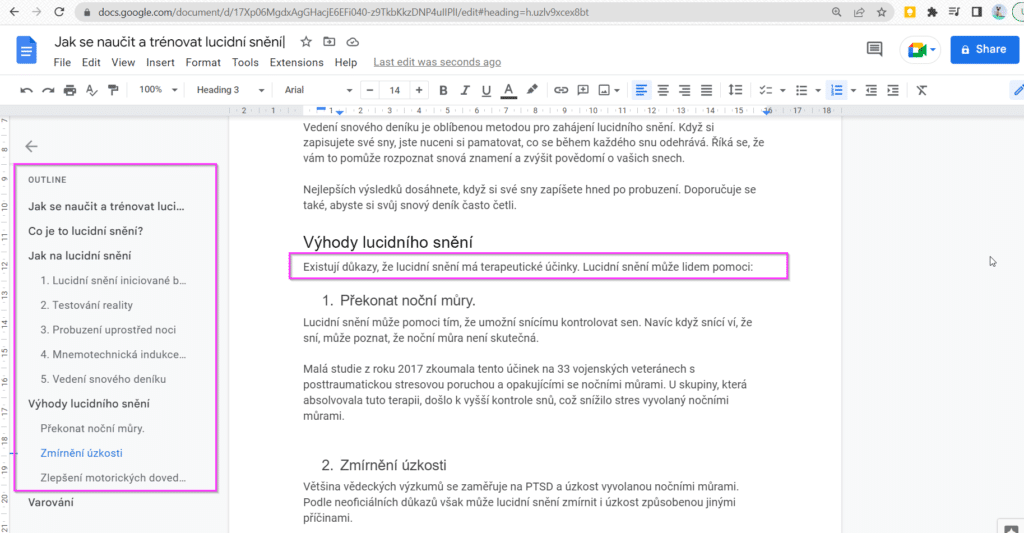
💡 Tip: Although this topic may seem simple, a great many editors get it wrong. Really think about your heading levels. It helps to write down the individual headings and create a table of contents from them. In some editors (e.g. Google Docs), you can see the headings and their levels on the left-hand side while you write.
Notice the mistake in this example:


“Don’t chase him” is one of the strategies for dealing with him being online and not messaging, so logically this heading must be one level lower than the heading that sums up all these strategies.
2. A consistent look across the website
It often happens that several editors write for one website. However, the reader must not be able to tell at first glance who wrote which article. The whole website must feel consistent. A few rules for the visual formatting of text serve this purpose. (Sometimes these rules also concern the text itself, e.g. addressing readers informally or formally.)
Study these rules and, until they become second nature, perhaps print them out and keep them near your computer. They might cover the formatting of “Tips” or quotations, image alignment and so on.
💡 Tip: When checking your text before submitting it, focus specifically on these things. Do several different rounds of checking. In the first round, check the text and grammar; in the second round, go through all the images to see whether they are aligned correctly. In the third round, use the Ctrl + F keyboard shortcut to check whether you have left any incorrectly formatted Tips anywhere.
3. Grammar
Knowing the language you write in is a basic requirement for working in copywriting. Texts containing spelling mistakes look unprofessional, and the reader can easily start to doubt whether they can trust the information in the text at all.
The most common mistakes involve:
- Commas in sentences,
- Commas or full stops in lists,
- Subject–verb agreement,
- Agreement of nouns with adjectives or pronouns,
- Incorrect declension of foreign words.
💡 Tip: Write down your mistakes. Everyone makes mistakes, but only those who consciously try to eliminate them improve. If your problem is mě/mně, ji/jí or commas, focus specifically on that area.
The best helper is the Internet Language Reference Book (Internetová jazyková příručka), which you can find here: https://prirucka.ujc.cas.cz/ Use it whenever you are not completely sure. And if you really want to improve, write down the result of your search somewhere.
💡Tip: Once you have finished, always copy your text into Google Docs or another editor and check whether any words are underlined. It is a very quick check that can reveal certain typos.
4. Typos
Typos are a sign that you have not read your text back and checked it properly. Full stop.
We all make typos. But it is just as important to read your text back before submitting it. Pay particular attention to the first paragraph, where the reader decides whether the article is good enough to spend another 5 minutes of their time reading. What impression does an article with typos make? Would you keep reading a text with mistakes right at the start, or would you look for something that seems more trustworthy?
💡 Tip: Ideally, write your texts directly in WordPress or another content management system, which can sometimes do a basic proofread (though not always, and not perfectly). It will never catch every mistake, but it manages quite a lot of them. To be safe, copy the text from WordPress into a Google Docs document. When you see the text laid out a little differently, other mistakes that had been hiding until then may pop out at you. You can do the same on a mobile device, where your article will again look slightly different.
5. Style
Overlong sentences, clumsy sentences, repeated words, repeated ideas, paragraphs the reader has to read several times to understand what you meant. Often an editor starts a sentence, then pauses, rearranges things a little in their head and finishes a different sentence. The beginning and end then do not fit together. Sometimes the editor is not entirely clear on the topic themselves, so they cannot explain it clearly to others.
Style also includes internal consistency in the text. If you choose to write “filosofie” in one paragraph, do not write “filozofie” in another, even though both variants are correct. Are you speaking only to women, or to women and men at the same time? Do you address readers informally or formally, or do you use an inclusive “we”, which implies that you are joining your readers? Whichever you choose, you must be consistent throughout the text, and one of your checks should definitely focus on this as well.
💡 Tip: Always do one check of your text out loud. If you actually read your text aloud, you will easily spot the clumsy parts: either they will not sound right or you will stumble when trying to read them.

6. Writing about yourself instead of the reader
Many texts list what a company does, how long it has existed and what it is proud of. The reader, however, mainly wants to know what changes for them. Compare “Our software has automatic backups” with “You will never lose a day’s work if your computer fails”. The first sentence describes a feature. The second describes a benefit the reader can picture.
A related mistake is a text with no clear next step. If you want the reader to book a call, sign up or buy, say so plainly, in a place they cannot miss. A page that ends without telling the reader what to do leaves the decision to chance.
Checking
Although it has been said several times already, I cannot resist repeating it once more in summary: “Always check your text! The quality of your text is your calling card!”
Of course everyone makes mistakes, but it is hard to find an excuse when a text contains the same type of mistake every time. Watch out above all for mistakes such as typos and badly worded sentences, which only show that no check took place and that your work is sloppy.
Do not treat the editor-in-chief as someone who is there to correct your mistakes. Part of your job is to submit texts that are in order. If you have someone who points out problem areas, that is your opportunity to improve, not to shift responsibility for accuracy onto someone else.
1. After a few days
Once you have finished your text, it is usually hard to find mistakes in it. You still remember what you meant, and you can easily miss that it will be unclear to someone else. Other mistakes are just as hard to find when the text is too fresh for you.
Take a few days’ break from it. Leave the article as it is and feel free to check it a week later. By then you will have forgotten half of what you wrote, and the text will feel less familiar. You will then find the problem areas more easily.
💡 Tip: Try imagining, for example, that someone else wrote the text and your job is to grade it. Be the strictest teacher you can and actively look for what is wrong.
2. Read your text out loud
You will find most of the problem areas in your text simply by reading it out loud. Do not underestimate this check. It helps you catch sentences that sound wrong, clumsy constructions and even repeated words.
3. Focused checking
Concentrate when checking, and if you know which area gives you trouble, focus only on that. If you know you forget commas in sentences, devote one check entirely to commas and actively go through sentence by sentence to see whether you have them right. If you check everything at once, you are more likely to overlook something. When you focus on one area, you have a better chance of being thorough.
4. Check several times (and check everything)
If this article gives you the impression that you should check your text several times, that is exactly right. It often happens that one check is not enough and that even eagle eyes miss some mistakes. Two checks are the minimum (!): one out loud and one focused on the correctness of the text.
Ideally, get into the habit of checking any text you send out into the world, not just articles but also messages and emails. Autocorrect can cause unwanted mistakes, but ultimately it only means you did not read the text before sending it.
Remember that the emails you send also say a lot about you. And what might it mean when a copywriter has a mistake in an email?

4. Use internal links
Linking is a very important part of creating content for the internet. Hyperlinks show readers other ways to find information and topics related to the article. Every article should have at least 3 internal links. Find out more in the article what anchor text is and how to create it.
💡 Tip: An internal link leads to another page on the website you are writing for. For example, on the webychytre.cz website I can link to keywords for selling in copywriting. The anchor text clearly matches the target URL, and the reader can imagine what the article will be about. An external link looks the same at first glance, but it points to another website. An example is a link to a copywriting internship.
Tips for better writing
Having error-free articles is a great start, but at some point it is time to start improving and creating better texts. Which strategies can help you make your articles better and better?
1. What text would you want to read as a reader?
First of all, try to put yourself in the reader’s shoes. What kind of information is someone looking for when they click on this headline? What kind of information is someone looking for when they search for these keywords? What would you want to know about the topic if you were searching for it?
An article should always be comprehensive enough and cover different perspectives and points of view. Do not be afraid to add information beyond the basics, but make sure the reader can easily find the “core” information.
Make the article visually interesting so that it is easy to navigate. Again, imagine what you would want if you were your own reader.
When you are looking for a recipe, do you really want to read a two-page essay on the history of the dish first? Or do you want the cooking instructions to be one solid block of text, so that when you need the next step you have to read the whole recipe from the beginning?
Or would you prefer the ingredients in a bulleted list and the most important points highlighted in bold, so that you can easily find your way and see where you are and what to do next? And would you not rather read about the history of the dish while everything is bubbling nicely on the hob and you have a moment to take an interest in the history, which you can then share with the others at the table?
2. Shorten the text
A common problem with texts is that they are inconsistent and long-winded. In the first draft, this is perfectly fine. That is how the final text is born. Sometimes a piece of information appears more than once or in several different places. Sometimes it is there twice. Sometimes the information is not yet logically organised.
During the second reading, a copywriter should organise all the information, delete repetitions and polish the sentences so that they are to the point, clear and easy to understand. This also means going through and deleting all the unnecessary words we use in speech but that have no place in writing. For example, avoid overusing the word “so” or words like “some” or “certain”.
If the second version is not shorter than the first, you have done something wrong. Your texts should contain all the necessary information, but at the same time they should not have any superfluous, meaningless words or sentences. (Readers judge the quality of the information and how it is presented, not the number of words and characters.)
On the other hand, long deductive articles are desirable. On most websites, a longer article is better than a shorter one. However, it must be packed with information and not just keep repeating the same thing in slightly different ways.
3. Use the Yoast SEO check
You have surely noticed that WordPress rates your text based on two groups of parameters. The first is SEO, which you must meet and follow: filling in the keyword, the meta description, images with correct captions, internal links and so on.
The second is the “readability” of the text. Keep in mind that the rating is based on English, but it can still be useful to us in many respects. Overly long sentences are just as much of a problem in English as in Czech. So definitely respect this indicator.
The “passive voice” rating is just as useful. The passive voice works a little differently in Czech than in English and is generally not a major problem, but when you click on the “passive voice” indicator, you will see that it highlights sentences where you use the verb “to be”. Writers fall back on it because it is easy and they do not want to make the effort to find a more precise verb.
Examples where the verb “to be” can easily be removed:
- “The lifespan can be more than 50 years.” (Životnost může být i více než 50 let.) can be changed to “The lifespan can exceed 50 years.” (Životnost může přesáhnout 50 let.)
- We often write in the future tense unnecessarily instead of using the punchier and shorter present tense. “They will be able to calculate it for you.” (Oni budou schopni vám to spočítat.) becomes “They will calculate it for you.” (Oni vám to spočítají.)
- In Czech, you can form the passive voice using a reflexive verb. Change “bude postaveno” (will be built) to “se postaví” (gets built).
- Phrases like “it is necessary”, “it is good”, “it is important” … ideally cross them out straight away and find a more personal rewording, or use the imperative instead.
There will be many more examples, and most of them will surely be worth the effort of finding a punchier expression than a paraphrase with the verb “to be”.
How to write better copy step by step
The tips above work best as part of a routine. Here is a simple process you can repeat for every text:
- Define one goal. Decide what the reader should know, feel or do after reading, and keep only what supports it.
- Describe the reader. Write down who they are, what problem they have and what might make them hesitate.
- Collect material first. Gather facts, examples and answers to likely objections before you start, so the draft does not stall.
- Outline the headings. Build the structure before you write the sentences.
- Write a fast first draft. Do not edit while writing. At this stage, finishing matters more than polishing.
- Cut and sharpen. Replace vague words with concrete ones and make sure you can back up every claim.
- Test the result. Ask someone from your target group to read it and tell you what they understood and what they would do next.
For example, if you are writing a product page for a $50 desk lamp, your goal may be a purchase, your reader someone who works late at home, and their main doubt whether the light will tire their eyes. Your copy should answer that doubt directly instead of listing every technical detail.
Copywriting skills worth developing
Grammar and careful checking are the foundation, but good copy rests on a wider set of skills. You can practise each of them on purpose.
- Research. Understanding a topic and an audience well enough to say something useful and accurate.
- Clarity. Explaining complex ideas in short, plain sentences.
- Empathy. Seeing the topic through the eyes of someone who knows less than you or has different priorities.
- Persuasion. Building an argument, supporting it with evidence and handling doubts honestly.
- Self-editing. Cutting your own text without feeling attached to every sentence.
- Adaptability. Switching tone between a technical B2B page, a newsletter and a social media post.
A practical way to train these skills is to rewrite texts you admire in your own words, think about why the adverts you remember work, and keep a file of headlines and opening lines that caught your attention.
Frequently asked questions about how to write better copy
How can I write better copy?
Start with one clear goal and a precise idea of who your reader is. Write a quick first draft, then cut repetition and vague words. Focus on what the reader gains rather than on what you offer, and end with a clear next step.
What are the most common copywriting mistakes?
The most frequent ones are a confusing structure, typos, overlong sentences and an inconsistent style. Beyond the text itself, writers often describe features instead of benefits and forget to tell the reader what to do next.
What copywriting skills do you need?
You need a good command of the language, research skills and the ability to explain things simply. Empathy for the reader, persuasion and strict self-editing are just as important. Being able to adapt your tone to different formats helps you work for a wider range of clients.
How do you improve your copywriting skills?
Write regularly and ask for honest feedback on your texts. Keep a list of your own recurring mistakes and check for them on purpose. Studying copy you find effective and rewriting it in your own words also helps you understand why it works.



Leave A Reply