
GEO optimisation.
Generative Engine Optimisation (GEO) is optimisation for appearing in AI models such as ChatGPT.
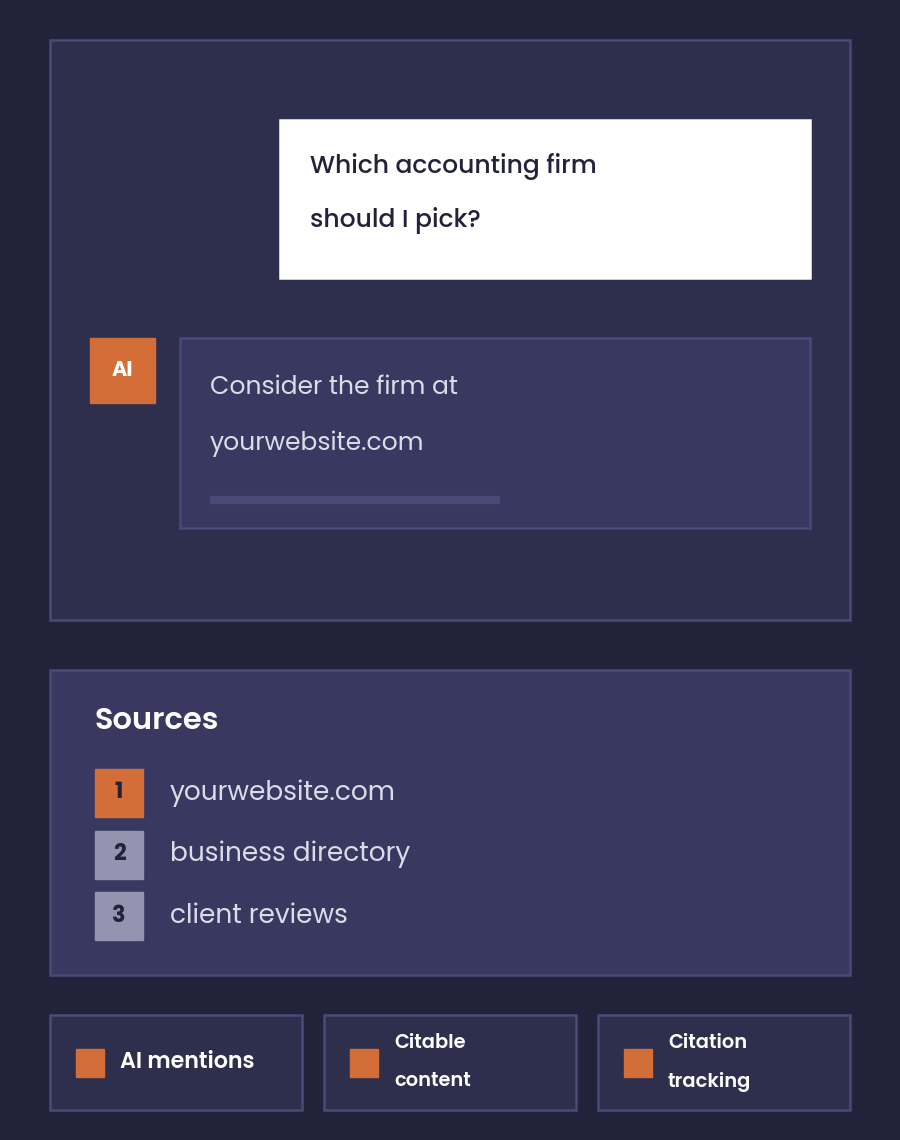
We find out whether AI assistants mention you and whom they recommend instead of you. Then we adjust your website and content so they have a reason to cite you.
What is GEO?
GEO means optimising content for generative AI models. While traditional SEO targets search engines (Google, Seznam (the Czech search engine) or Bing), with GEO we aim to make AI models and assistants (ChatGPT, Gemini, Perplexity) correctly interpret and cite your company or offering when generating answers.
Naturally, you also want to appear in answers to questions you have a solution for. If someone asks about the best sports car and you are Mercedes, you want the AI model to recommend Mercedes sports cars.
GEO optimisation for AI today targets AI Overviews and AI Mode in Google as well as standalone assistants such as ChatGPT or Perplexity. Each of these tools chooses its sources slightly differently, so we track them separately.
In practice, it comes down to two things. That AI tells the truth about your company, meaning the correct services and prices. And that it mentions you in queries where the customer is still choosing a supplier or shop.
Why GEO matters
AI assistants are becoming “competition” for traditional search engines. Users often get an answer straight from AI without clicking through to a website. If your brand is not properly optimised for GEO, it may be overlooked or misrepresented in AI answers.
Misrepresentation tends to be subtle. The model quotes a price from an old price list, offers a service you no longer provide or confuses you with a company with a similar name. The customer has no way of telling.
This is important to monitor and respond to. When ChatGPT recommends your competitors, it is important to map out why. We look for the answer in the sources the model drew on and in what your competitors have there and you do not.
For informational queries, some clicks are lost because the answer sits right above the results. Where people are choosing a supplier or product, they still click through, just more often from a link in the AI answer. That is why you want to be among its sources.
Who GEO makes sense for
Companies whose customers ask for advice before buying get the most out of GEO. If your website does not yet have even basic SEO, start there, as GEO builds on it.
Services where a supplier is chosen
For example, an accounting or law firm. The customer asks AI whom to contact and gets a short list of names. You want to be on it.
Online shops with comparison queries
People ask which product to choose. AI responds with a comparison and cites the pages that describe the differences best.
Brands AI writes about inaccurately
The model lists an old offering or a closed branch. We find where the error comes from and get the correct information to where the model looks for it.
Websites with falling clicks
Impressions in Search Console are rising, clicks are falling. This often means people are getting the answer directly above the results.

GEO vs SEO
SEO has a clear goal: to get your website as high as possible in search results and win user traffic, which is easy to measure in Google Search Console (Google) or Google Analytics. It is about keywords, their density, context, relevance, brand and a well-built backlink profile.
Domain (and brand) authority and content relevance are important, because they decide whether a user clicks on your link in the SERP (the list of links in search results). Put simply, SEO is a battle for position in the results and for bringing visitors to your website.
GEO works slightly differently. It is not about whether you appear first on Google, but whether your brand, a link to your website, case studies and information appear in an answer generated by artificial intelligence. It cannot be measured as well or as precisely as SEO results.
On your side, the key factors are quality, factual accuracy and text structure, so that AI can easily read, understand and use it. GEO therefore aims to get your data into AI answers directly, without the need for a click, but also into references. Instead of links, it focuses much more on the brand.
Link building is still important in optimisation for AI models, but its form is changing. We focus more on associating keywords with the brand and on the brand itself. GEO is also closer to PR than SEO was, but in principle not that much changes.
Without SEO, however, GEO has nothing to stand on. According to the Google Search Central guide, only a page that Google has in its index and can show with a snippet can make it into Google’s AI features.
Talk as relevantly as possible about the topics you want to be visible for
If you want to appear in AI models, you need to influence and get into the data AI models base their decisions on. Look at which sources the models draw on and what they say about you or your competitors. Visibility share, brand and brand associations all matter.
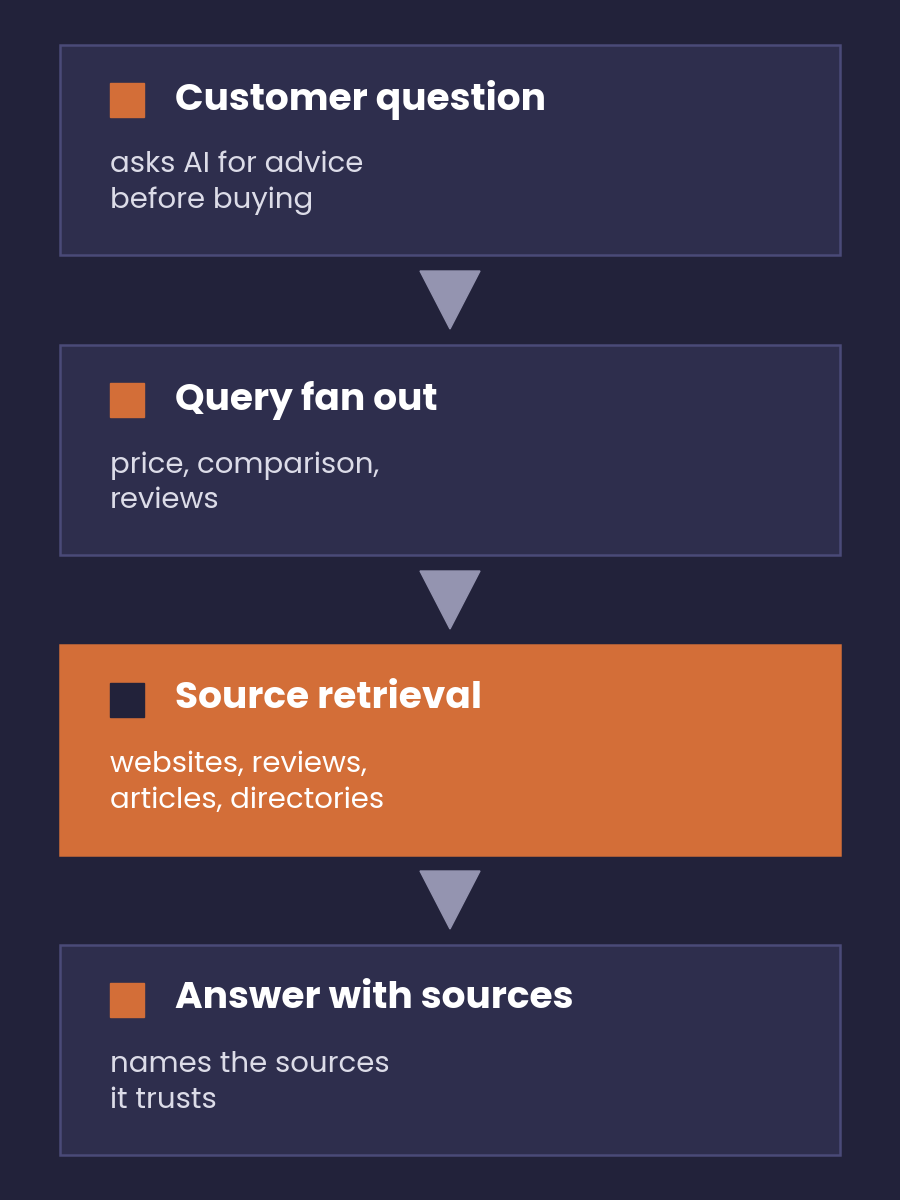
Google describes how it works on the inside. The model breaks a query down into a number of related sub-questions and looks for sources for each one separately, which Google calls query fan-out. Someone asking about an accounting firm gets an answer made up of prices and client experiences.
For your website, this means a simple brief. You need a clear answer to each of these sub-questions. What the price is made up of, who the service is for and who it is not for, and how you differ from the competition.
The other half of the work happens outside your website. It is not a hard rule, but it has been shown repeatedly that models more often mention brands that other trustworthy websites also write about. That is why GEO also includes work with the media and reviews. What works with Google and what is still guesswork is covered in our article on AI Overviews in Google.
How we approach GEO
We start with measurement, not changes. Without a baseline, it would be impossible to tell whether the work changed anything. An audit also makes sense on its own if you just want to know where you stand in AI answers.
01
AI visibility audit
We put together the queries your customers enter and run them in Google and in assistants such as ChatGPT or Perplexity. We record whether AI mentions you and which pages it builds its answer from.
02
Website and content changes
We add answers to questions missing from your website and make your company details consistent. We do not write a separate version of texts for AI, as Google’s own guide says it does not need one.
03
Mentions outside your website
We suggest where you should be written about and on what topic, typically in industry magazines and on review sites. We do not do paid comments in discussion forums.
04
Monthly measurement
We run the audit queries again and you get the results in a table compared with the previous month. We adjust priorities based on it.
What GEO does not include.
A lot of advice is emerging around optimisation for AI that sells well and does little. Google itself refutes some of it in its guide. You do not pay us for these things.
- An llms.txt file and other files for AI. To appear in Google’s AI features, you do not need any new machine-readable files or special markup.
- Special structured data for AI. It is useful for rich results, but there is no schema designed for AI. We explain why we implement it anyway under structured data.
- Chopping texts into pieces. You do not need to split text into small blocks or write in a special style just for AI.
- Paid mentions. According to Google, artificially created mentions do not help as much as they seem to. We build on mentions that have a reason to exist.
This is what Google says about its own search. Less is known about how ChatGPT or Perplexity select sources, so for them we trust measurement, not guides.
What GEO does include is a basic technical check. If your website’s robots.txt or firewall blocks search engine and AI assistant bots, they have no way to load and cite your pages.
How we measure visibility in AI answers
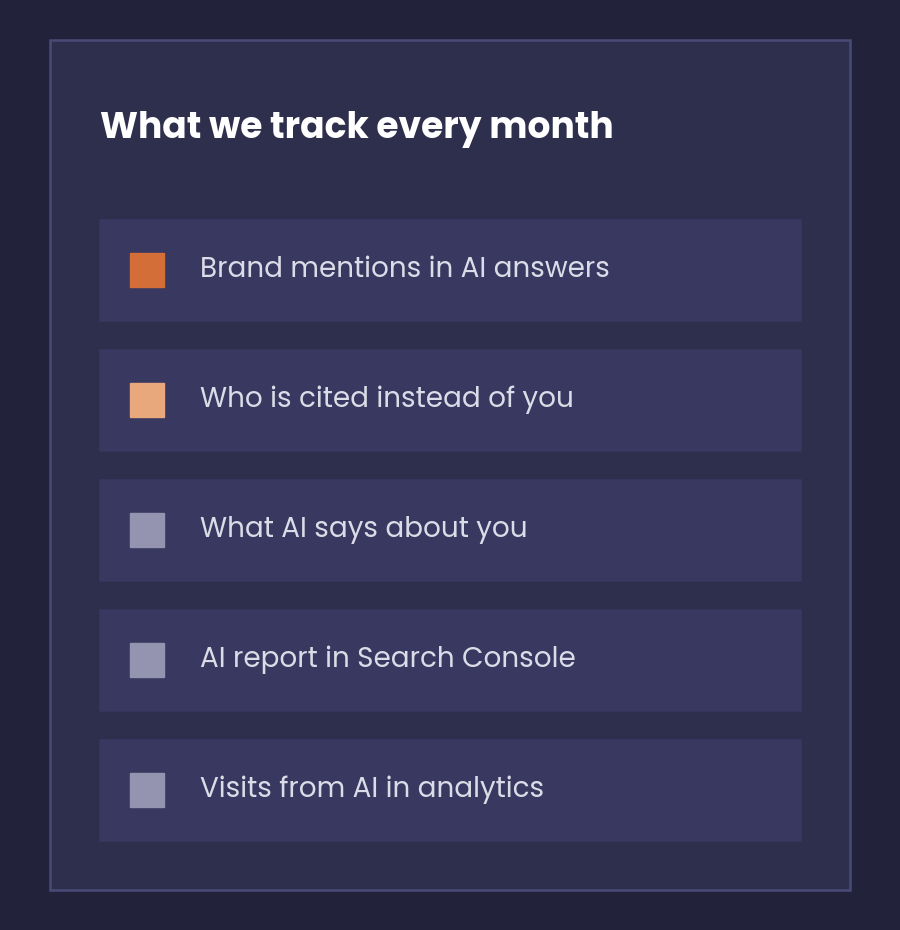
For Google, we have had data directly in Search Console since 31 August 2026. For websites with enough impressions, the generative AI performance report shows how many times the website appeared in AI Overviews and AI Mode and which pages they were. We compare it with the pages’ regular performance so you can see where AI answers are taking clicks.
There is no single report like this for other assistants. So we work with a set of queries your customer would enter and run them in all tools once a month. For each answer, we record whether AI mentioned you and whom it cited instead of you.
AI answers vary from query to query and from day to day, so we track the trend over several months, not a single snapshot. We add visits from links in AI answers from Google Analytics, which also shows whether they led to an order or an enquiry.
It does not have the precision of SEO measurement. We know whether and how often AI mentions you. We do not know how many people read the answer and how many remembered your name.
What we combine GEO with
GEO does not work on its own. It relies on a website Google knows, content that is worth citing and mentions from other websites.
A technically sound website with content for searched queries. AI Overviews draw on it too, so ongoing search engine optimisation is the foundation GEO builds on.
Links and mentions from industry websites strengthen your brand in search and in AI answers. We look for websites where a mention also makes sense to the reader.
Texts an answer can be extracted from. The answer right below the heading and your own figures instead of generic sentences you can find anywhere.
Not sure whether to tackle GEO now? In a consultation, we will go through where AI mentions you and tell you whether it is worth getting into.
What our clients say
Rated 5.0 out of 5 on Google. All reviews
★★★★★
“We have been working with IdeUp for a long time, and always at a very professional level. I appreciate their proactive approach, clear communication and high-quality work. Everything ran without unnecessary delays. They are reliable, communicate quickly and understand what they do. I can recommend them as a reliable partner for online marketing.”
Michal Hardyn
Google review, translated from Czech
★★★★★
“Working with this marketing agency was very pleasant and professional. I appreciate their clear communication, quick feedback and fair approach. I recommend them to anyone looking for a reliable partner in online marketing.”
Tereza Gultová
Google review, translated from Czech
★★★★★
“Quality services, precise results, quick communication, pleasant manner. Definitely recommended”
Jan Barák
Google review, translated from Czech
Before you start with GEO
These are the questions companies ask when they are considering optimisation for AI.
Will GEO replace traditional SEO?
No. GEO builds on SEO, because AI in search draws on pages that Google knows and can display. Most of what works for AI answers also works for SEO. What changes is mainly the emphasis.
Do we need an llms.txt file or special markup for AI?
Not for Google. According to its guide on appearing in AI features, you do not need new files, special schema or text written only for AI. It makes more sense to put your budget into content that answers your customers’ questions.
Can you guarantee that ChatGPT will recommend us?
No, and honestly, nobody can promise that. The model’s operator decides which sources are selected, and the answers change continuously. What we can promise is that you will know where you stand in the answers, why your competitors are ahead and what to do about it.
When will changes show up in AI answers?
It depends on the tool. Assistants that search the web when answering, such as AI Overviews or Perplexity, take an updated page into account after it is next crawled. What a model remembers from training only changes with its next version.
How much does GEO cost?
We confirm the price in advance based on the scope. It depends mainly on the number of queries tracked and on whether you want only an audit or ongoing work on content as well. You approve the scope and price before we start.
Find out what AI says about you
Tell us which website it is and add two or three queries for which AI should recommend you. We will get back to you with an audit proposal and confirm the price in advance.