AI Overviews have appeared above the search results, and some queries no longer lead to a click on a website at all. Google answers the query itself and lists a few sources. The Google SERP is therefore partly changing from a search engine that sorts web pages and results like a librarian into a chat that writes answers directly, mainly to informational queries.
For companies and for us as SEO consultants, this raises a new question. It is no longer only about your position. It is about whether you are one of the sources the answer is built from, whether Google says what you want it to say and whether it recommends your preferred solution.
What AI Overview actually is
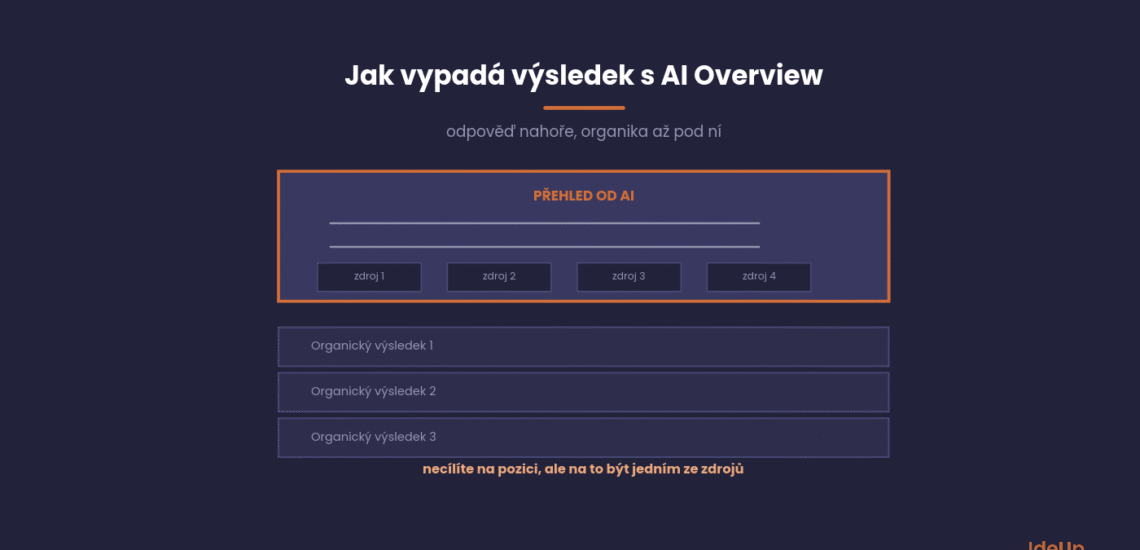
It is a block above the organic results in which Google answers the query in its own words and adds links to the sources it drew on.
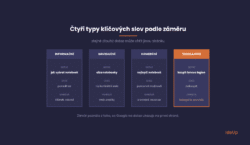
It does not appear for everything. It shows up most often for informational and comparison queries, and much less often for navigational queries and queries with clear purchase intent.
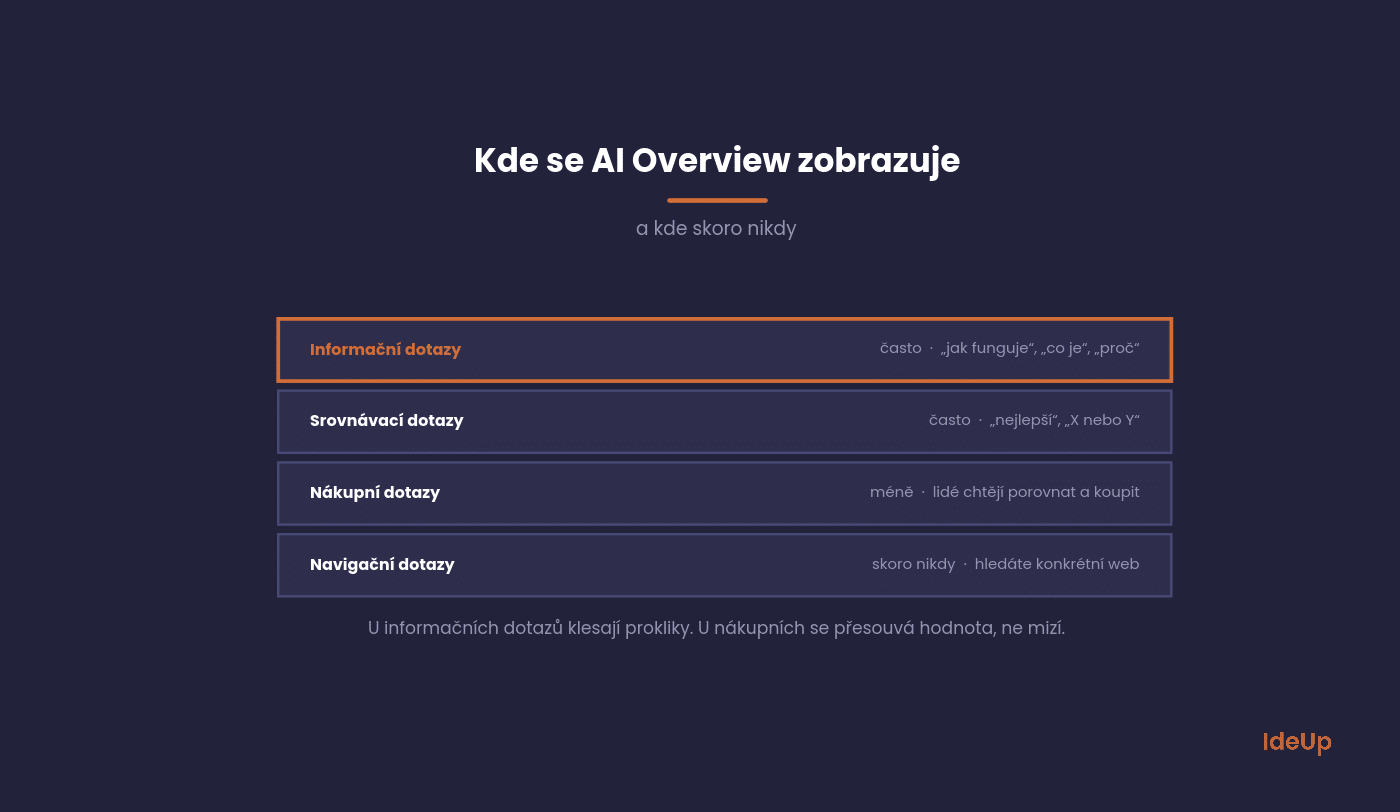
The practical impact is twofold. For informational queries, clicks are falling because people get the answer straight away. For queries where a purchase decision is being made, people often still click through, just from a different place.
This is linked to what is called GEO, or generative engine optimisation. The difference from classic SEO is that you are not aiming for a position but for being a cited source. Put simply, a company or an SEO consultant can no longer measure visits only in Google Search Console or Google Analytics.
What Google has confirmed
We will start with what is certain, because it is the only solid ground. The rest is observation and testing.
Google has published its own statement on this, and it contains one thing that surprises most people.
There is no special markup, meta tag or setting that lets you opt in to AI answers. Google explicitly says that the same rules apply as for regular search and recommends focusing on helpful content.
The second confirmed point is that AI answers draw on content that is publicly accessible and indexed. A page that Google does not have in its index cannot be cited.
Google covered this in more detail in its article on succeeding in AI search. Anyone looking for a list of technical tricks will be disappointed, and that in itself tells you something.
What is repeatedly confirmed in practice
The following points are not official recommendations, but they come up across tests and analyses often enough that we work with them.
Treat them as strong indications, not certainties.
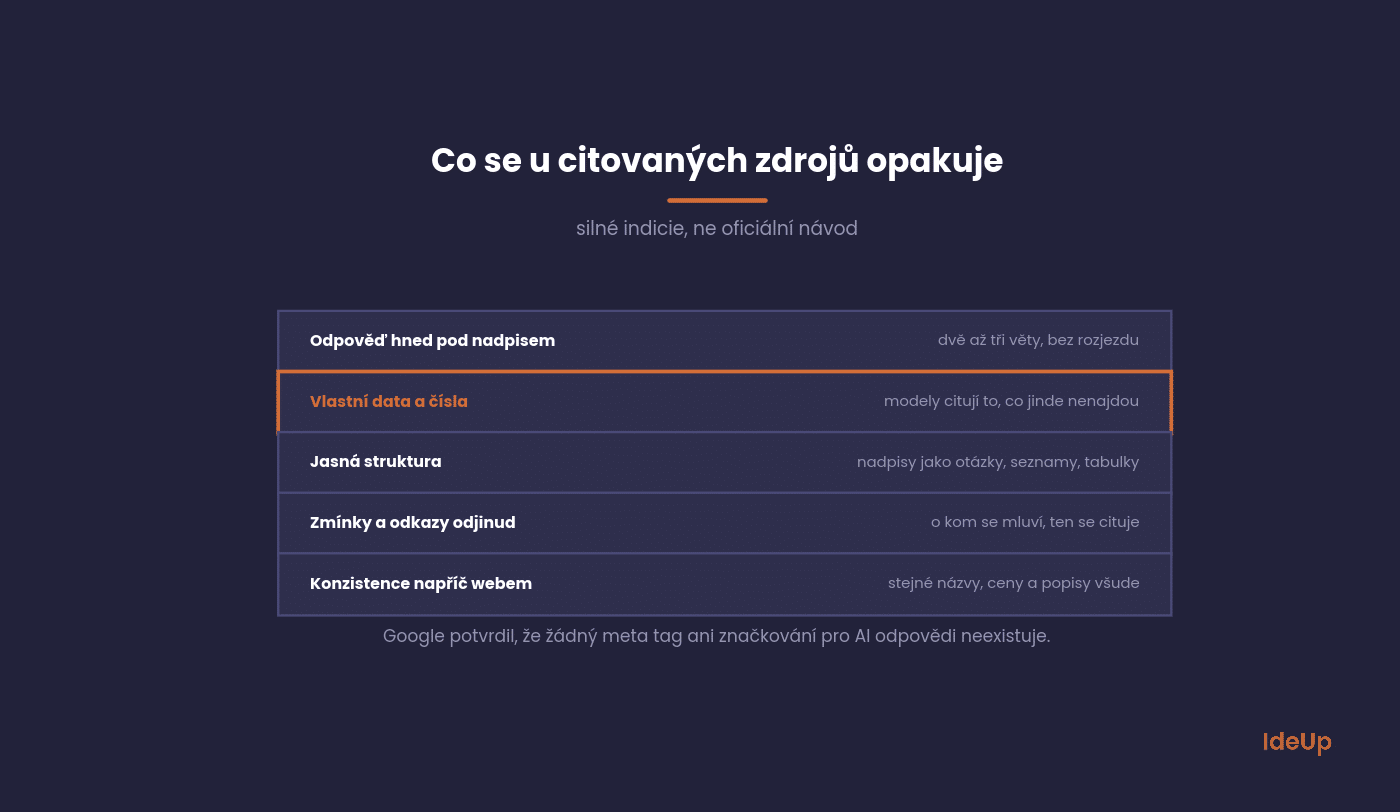
The answer right below the heading. A short answer of two to three sentences is easier to extract than a paragraph where the point only comes at the end.
Your own data and specific numbers. Models cite what they cannot find elsewhere. A generic text that retells what others have said has no reason to be a source.
Clear structure. Headings phrased as questions, lists, tables. Anything that gives content a machine-readable form.
Mentions and links from elsewhere. Sources that are discussed on trustworthy websites appear more often. It is the same logic we cover in backlinks and domain authority.
Consistency across the website. If the service name, prices and description differ from page to page, the model has nothing clear to take away.
What is still guesswork
This part is usually left out of articles about AI Overviews because it does not sell well. Yet it matters most if you want to avoid investing in nonsense.
For the following points, there is no reliable evidence yet.
That structured data helps directly. It makes sense for other reasons and will do no harm, but nobody has proven a direct effect on citations.
That there is an ideal length or format. Recommendations such as “write paragraphs of 40 words” are based on observations of small samples.
That appearances can be reliably controlled. Google changes how it displays results all the time, and what was true three months ago may not be true today.
The practical conclusion: do the things from the previous section, because they work even without AI. Do not invest in techniques built on guesswork.
How to measure where you stand
Search Console tells you almost nothing about AI Overviews. Clicks from them are counted together with regular clicks and cannot be separated.
The quickest method available is therefore manual. It sounds unprofessional, yet today it is the most reliable.
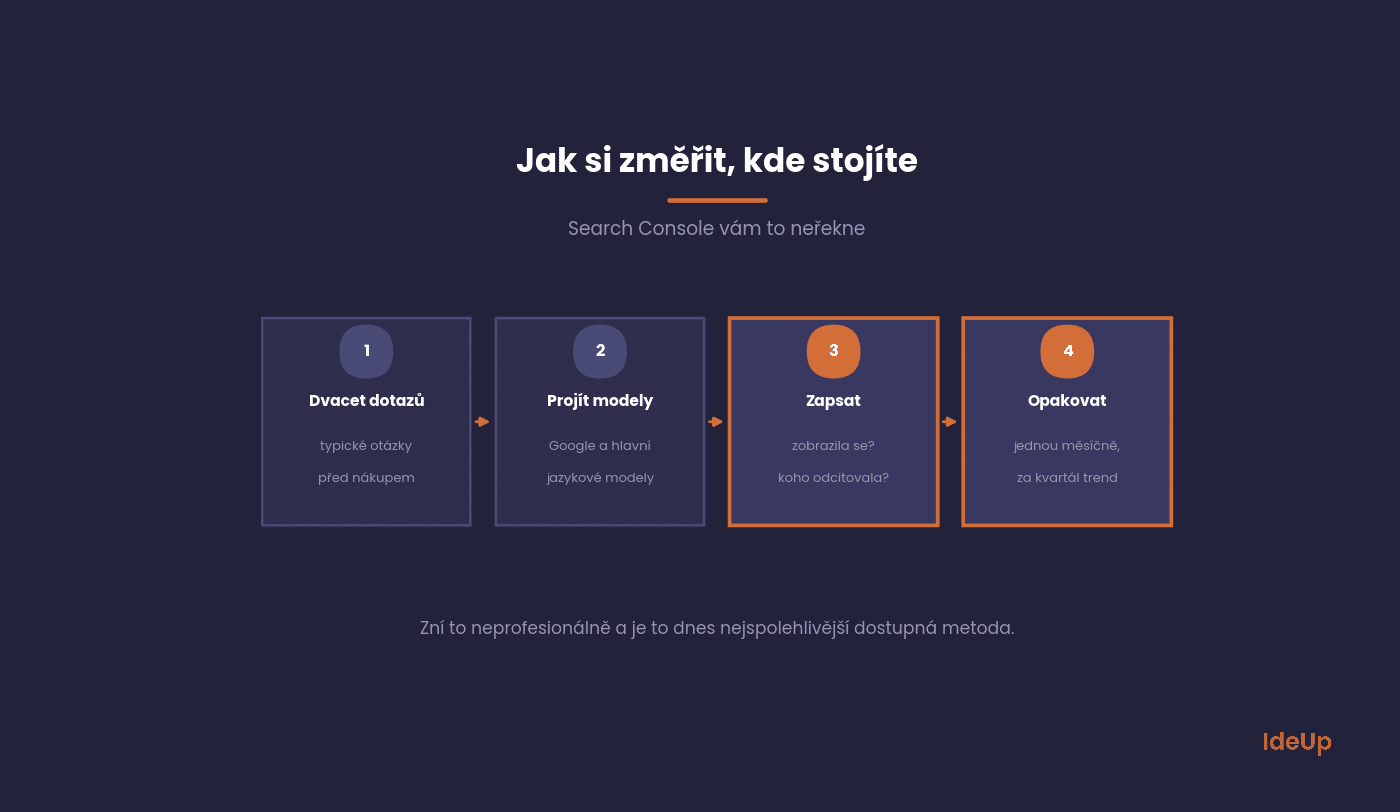
Put together twenty typical queries from your field, the ones a customer would search for before buying. Run them in Google and in the main language models.
For each one, note whether an AI answer appeared, whom it cited and whether you are among the sources. Repeat once a month.
After three months you have a trend and, above all, a list of competitors who appear instead of you. That is a more precise content brief than any tool.
What this means for content planning
It is not about stopping writing. It is about writing different things from those that make up most company blogs today.
Two types of content are losing their purpose, and two are gaining value.
Losing: definitions and general explanations that are the same everywhere. AI answers those and nobody clicks. Also texts written purely for volume.
Gaining: content with your own data, prices and experience. Also content where people need more than an answer, such as tools, calculators and decision aids.
In practice, this means shifting capacity from the number of articles to their depth. Ten texts with your own numbers will achieve more today than fifty generic ones.
Questions people ask about AI answers
Five questions we get from clients and from their in-house marketers.
For some of them, the honest answer is that nobody knows yet.
Will I lose traffic because of AI Overviews?
For informational queries, partly yes, and it is already happening. For queries with purchase intent, the impact is much smaller.
Track impressions and clicks separately. If impressions rise while clicks fall, that is a sign of exactly this effect.
Can I opt out of AI Overviews?
Yes, but at a price most companies do not want to pay. Opting out via nosnippet also limits how you appear in regular results.
In practice, it only makes sense for content whose value lies entirely behind a login or a paywall.
Will it help if I write a longer article?
Length on its own will not help. What helps is having something in the text that cannot be found elsewhere.
Ask yourself this about your own article: if a model read it, what would it cite? If nothing specific, it is a generic text.
Does the same apply to ChatGPT and other models?
Partly, yes. The principles of clarity and your own data are the same, but each model chooses its sources differently, and some search in real time.
That is why you should include several models in your measurement, not just Google. The differences between them tend to be bigger than expected.
Should I change my whole strategy because of this?
No. Most of what works for AI answers also works for classic SEO. The change is in emphasis, not direction.
Where you should change something is your expectations. Expect the ratio between impressions and clicks for informational content to keep getting worse.
Where to start
Write down twenty queries from your field and run them. Within an hour you will know whether Google and the models mention you or cite your competitors instead.
Then look at your most visited article and ask what could be cited from it. If nothing specific, you have your first task.
This is an area we cover as part of GEO and classic SEO, because the two cannot be separated yet. Want to know where you stand? Get in touch through our contact page.