Link building has a strange reputation on the Czech market. Half of companies see it as a necessary evil that you buy in packages, and the other half are afraid of it because of penalties. The reality is both more boring and more pleasant: it is work on relationships and content that can be done honestly, measurably and without risk. It just takes time.
This article explains which methods actually work today, what they cost and how to spot a link that will bring you nothing. If you are more interested in how links are measured and evaluated, start with the article on what the number of backlinks and domain authority mean.
What link building is and what to expect from it
Link building is the systematic process of getting links from other websites to yours. For Google, a link is a recommendation, a signal that someone stands behind you. That is why links are still among the strongest ranking factors for competitive queries.
What to expect: a gradual increase in your website’s ability to rank for harder queries. What not to expect: a sudden jump in traffic within a month. Links amplify what you already have. If your content is weak and your technical setup is broken, the weakness gets amplified.
Methods that work
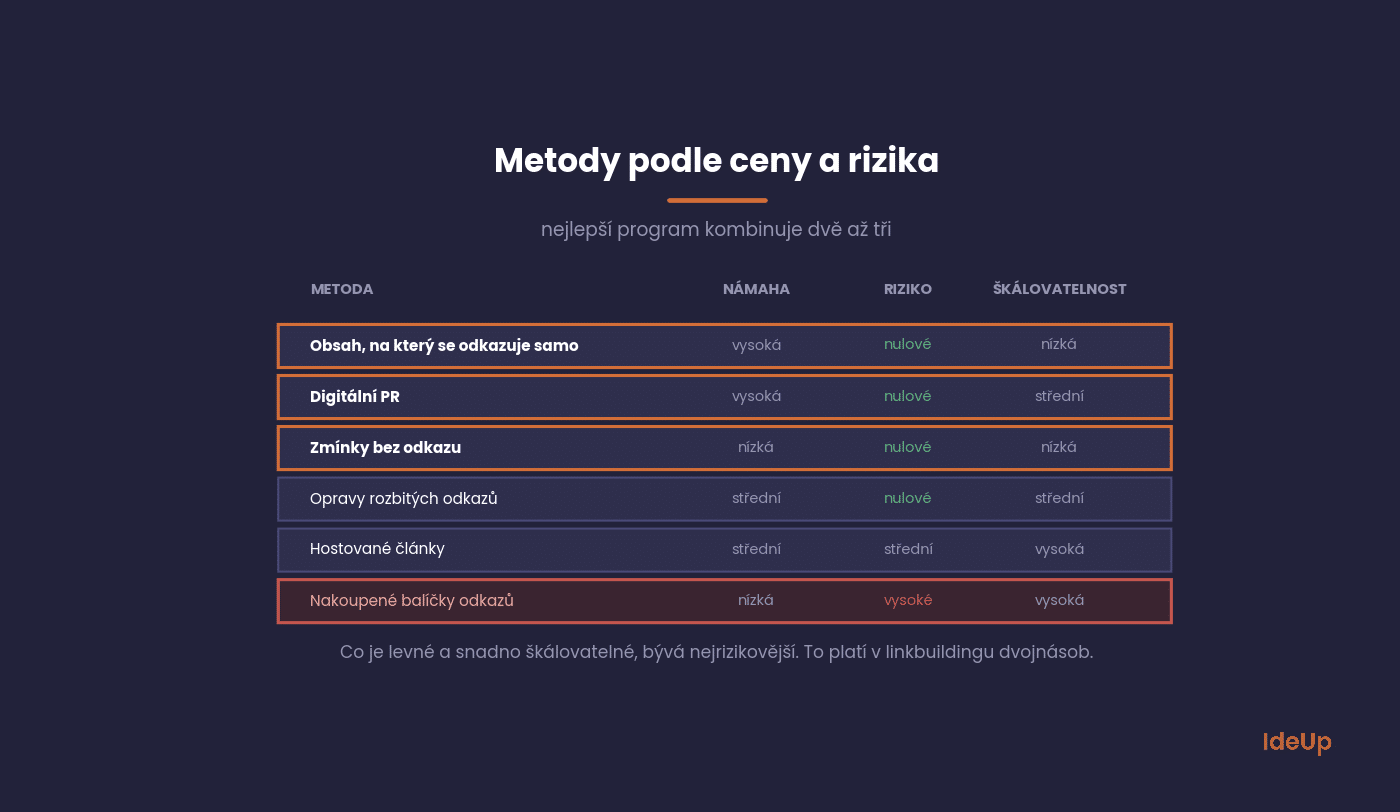
There are several methods, and they differ mainly in cost, risk and how easily they can be repeated. The best programme usually combines two or three, not just one.
Content that earns links on its own
Original data, research, calculators and overviews that nobody else in your industry has. The most expensive to produce, the cheapest to maintain and the only method that keeps working for years after you have paid for it.
Digital PR
A press release with a real message, an expert comment for an article, data for journalists. It brings links from media outlets that you cannot buy, and at the same time it builds your brand. It does require you to have something to say, though.
Guest posting
An article on someone else’s industry website. It works as long as the websites have their own readers. Once it is a network of sites set up to sell links, it is wasted budget.
Broken link building
You find pages that link to non-existent content in your field and offer a replacement. Laborious, but fairly successful and risk-free.
Unlinked mentions
Someone has already written about you but did not link. These are the fastest links available, because the relationship already exists. For established brands, you can collect more this way in a month than through outreach in a quarter.
Internal linking
It is not classic link building, but it belongs here because it is the cheapest way to strengthen a specific page. You already have the links, they just do not point where they should.
How link building outreach works step by step
Outreach is the part of guest posting, broken link building and digital PR where you contact other website owners directly. Most messages go unanswered, so your results depend more on preparation than on volume.
- Build a target list. Collect websites that cover your topic and have real readers. Sites that already link to your competitors are a good starting point.
- Find the right person. An editor or the author of a specific article replies more often than a general info address.
- Prepare something worth linking to. This could be a replacement for a dead page, a data point or a useful guide. Without it, you are only asking for a favour.
- Write a short, specific message. Mention the page you are writing about, explain what you offer and why it helps their readers. Leave out flattery and templates that could be sent to anyone.
- Follow up once. One polite reminder after about a week is normal. Repeated chasing damages the relationship.
- Keep records. Note who you contacted, when and with what result, so you do not send the same person the same request twice.
Broken link building in practice
Start with resource pages and older guides in your field, where dead links are most common. Check the outbound links on them, note those that return an error and look at what the missing page used to contain. If you have, or can create, a page that meets the same need better, you have a concrete reason to write to the owner. You are fixing a problem on their website, which is why this approach gets more replies than a plain request.
How much it costs
On the Czech market, the price of a single placed link ranges roughly from the low hundreds of CZK on small websites to tens of thousands of CZK on major media. The price alone tells you nothing, though, because you are buying very different things.
It makes more sense to think in terms of a monthly programme than a price per link. A realistic starting budget for a smaller company is usually a few thousand CZK per month, at a pace of three to five new referring domains. For a competitive e-shop, we are talking more about tens of thousands of CZK and a pace of ten or more.
Your budget should also include the work you do not see: choosing targets, vetting, writing articles and communication. In an honest programme, this is usually a bigger part of the cost than the placement itself.
How to spot a worthless link
Before you pay for a link, run five checks. It takes a few minutes and saves most unnecessary spending.
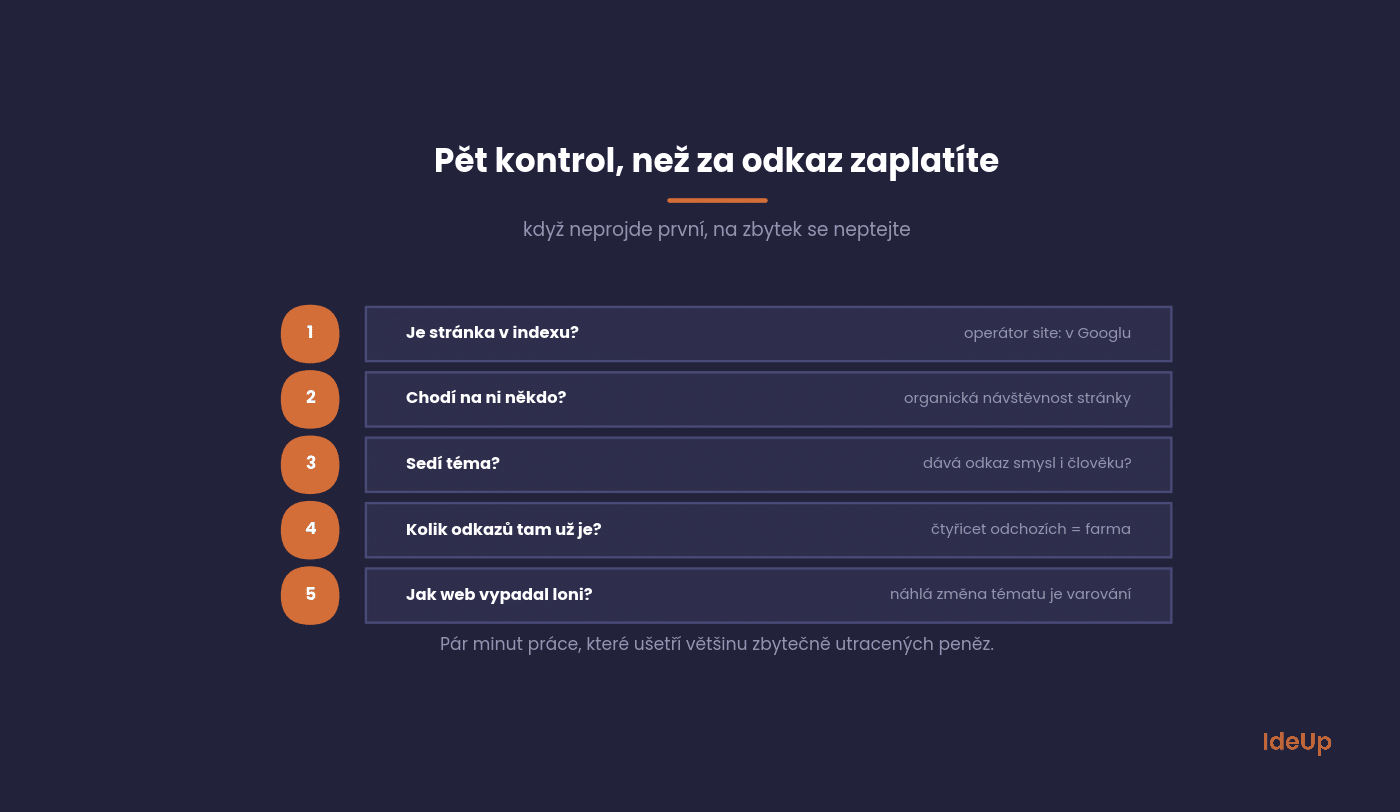
- Is the page indexed? A page that is not indexed will not pass on a link. You can check with the site: operator in Google.
- Does anyone visit it? A domain with a high score and a page with no visits is an empty shell.
- Is the topic relevant? A link from a cooking website to accounting software makes sense neither to people nor to Google.
- How many links are already on the page? If there are forty, all outbound, it is a link farm.
- What did the website look like a year ago? Websites bought to sell links can be recognised by a sudden change of topic and a sudden jump in the number of outbound links.
Where the line with breaking the rules lies
Google states it clearly in its spam policies: the problem is not that you pay for a link, but that a paid link passes ranking signals without being labelled. The solution is the sponsored or nofollow attribute.
In practice, this leads to one thing worth admitting openly. Most purchased links on the Czech market break this rule, and companies factor that in. The risk is not in a single link, it is in the pattern: hundreds of links from the same type of source, with the same anchor texts and at a suspicious pace. It is exactly this kind of profile that leads to a penalty or, far more often, to the whole investment being quietly devalued.
White hat link building versus risky shortcuts
White hat link building means getting links in ways that would hold up if a person reviewed them. Someone chose to link to you because your page helps their readers, and any paid placement is labelled. Black hat link building means private blog networks, mass link exchanges, automated comments and paid links passed off as editorial ones.
- White hat is slower and needs content and relationships, but the links keep their value and you can show them to anyone.
- Black hat can look faster and cheaper at the start, but the links can be devalued at any time, and cleaning up a bad profile often costs more than building a good one would have.
Grey areas, such as sponsored articles without labelling, sit in between. If you use them, keep them a small share of the total and never let them shape your whole profile.
Anchor text and how to stay out of trouble
The text a link sits on is the strongest signal and also the easiest to abuse. A natural profile mixes types and never pushes exact match on a single keyword.
As a rough guide, we use a distribution where most anchors are branded and naked URLs, roughly a quarter are descriptive and generic (“more here”, “this guide”) and only a few per cent are exact match on the target keyword. You will find a detailed breakdown in the anchor text entry in our glossary.
A realistic one-year plan
Link building cannot be done in bursts. A website that gains fifty links in a month and then nothing for six months looks suspicious. A website that gains five a month throughout the year looks like a website that is doing well.
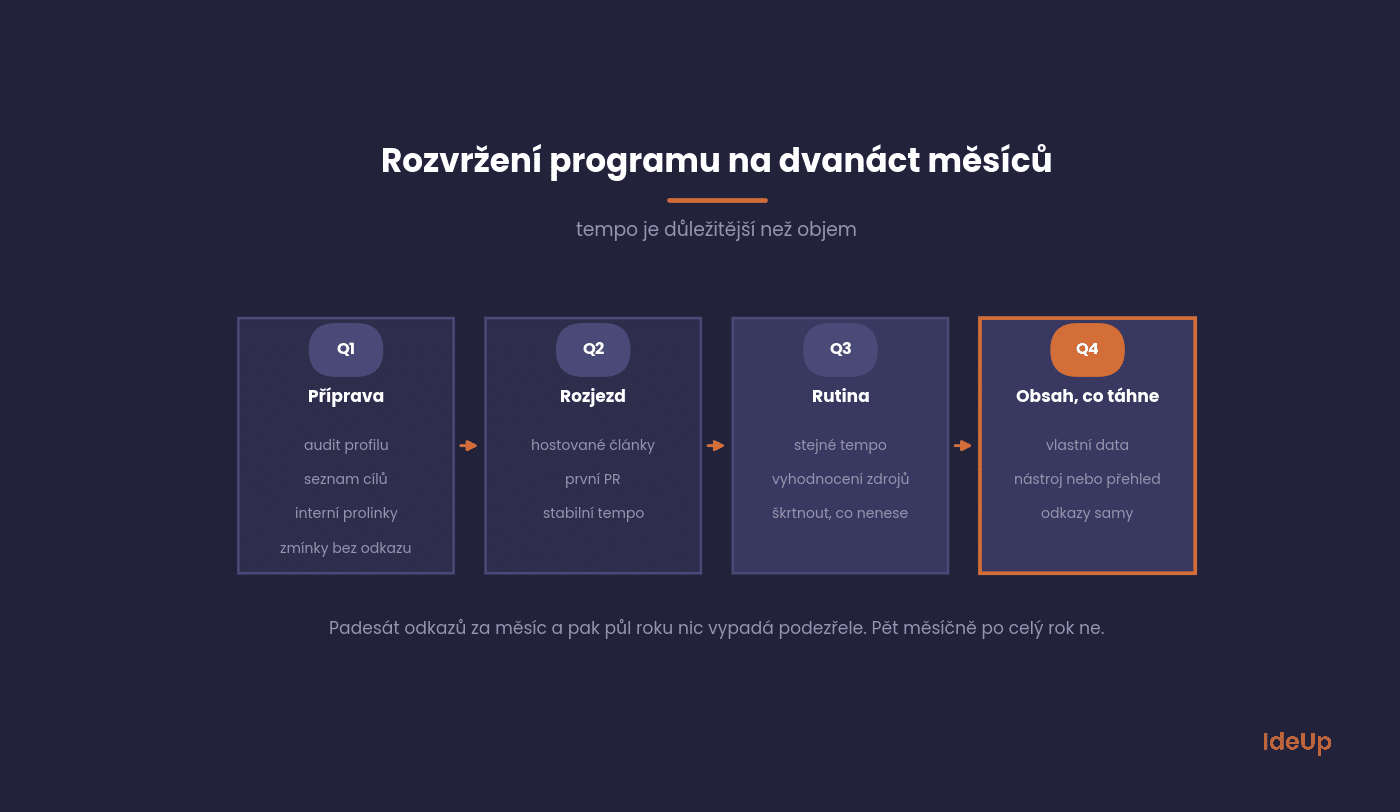
The first quarter is for preparation: an audit of your current profile, a list of domains that link to competitors but not to you, and fixing internal linking. Links from this period are mostly unlinked mentions and quick fixes.
The second and third quarters are routine: a steady pace, a mix of guest posts and PR, and ongoing evaluation of which sources actually moved the needle.
The fourth quarter is the time for content that earns links on its own. By then, you already know what works in your industry.
What to measure
Not the number of links. Track the number of referring domains and how it develops, the share of topically relevant sources, the anchor text distribution and whether links also point to commercial pages, not just the homepage. Add to that rankings for the queries you started link building for.
Common mistakes in a link building strategy
A link building strategy fails less often because of the wrong method than because of the decisions around it. Watch out for these:
- Linking only to the homepage. Pages that sell need their own links, otherwise they stay weak.
- Chasing metrics instead of readers. A high domain score on a site nobody visits is worth little.
- Starting before your content is ready. Outreach for a thin page wastes contacts you may need later.
- Copying competitors blindly. Their profile shows where you could get links, not what you should replicate, mistakes included.
- Stopping after three months. Links work with a delay, and a programme cut short often ends just before the results arrive.
Questions you ask us
Questions that come up in almost every meeting about links.
How long does link building take to show results?
The first movement for less competitive queries comes in two to four months. For difficult queries, expect a year. Anyone who promises faster results is usually buying in bulk and taking risks with your money.
How many links per month is a safe pace?
There is no universal number, because it depends on the size of your website and how others in your industry are growing. A guide: it should not be a pace that would look inexplicable for your domain.
Are directories worth it?
An industry directory that people actually use, yes. A directory set up to sell links, no. Traffic is what matters, not mere existence.
Can I do link building myself?
Unlinked mentions and internal linking, definitely. Outreach and PR require time and contacts, which is usually why companies outsource them.
What if I have already bought bad links?
Do not panic, and above all do not reject them in bulk through disavow. First get an overview of how many there are, where they come from and whether they affect anything at all. Most of the time, Google simply ignores them.
Where to start
Start with what is free: go through unlinked mentions of your brand and fix internal linking to the pages that make you money. This is usually the first measurable movement, and it costs nothing but time.
When you want a pace you can sustain, get in touch. At IdeUp, we run link building as a long-term programme with verifiable sources, not as package buying. We can work out whether it is the best use of your budget right now during SEO consulting.
Frequently asked questions about link building
What is link building in simple terms?
Link building is the work of getting other websites to link to yours. Each link acts as a recommendation and can also bring visitors who click through. The goal is links from relevant sites with real readers, not the highest possible number.
What does link building cost depend on?
It depends on the method, the quality of the target websites and how much of the work you do yourself. Placements on large media cost far more than on small industry blogs. Preparation, writing and outreach often make up a larger share than the placement itself, so plan a steady monthly budget rather than paying per link.
Is broken link building still worth it?
Yes, if your field has older guides and resource pages that point to pages which no longer exist. It is slow, because you have to check many pages to find a few good opportunities. In return, the links you get are relevant and carry no risk.
What should a link building outreach email contain?
It should give a clear reason for writing, name the specific page you have in mind and offer something that helps the recipient’s readers. Keep it short enough to read in under a minute. Details that show you know their website matter more than any template.