Artificial intelligence in marketing tends to be discussed in one of two ways. Either it will replace entire departments, or it is a bubble that churns out unreadable text. Both views miss the mark. The reality we see on client projects is more mundane: AI saves a few hours a week on specific tasks, and at the same time it is changing how people reach your website in the first place.
This article has two parts. The first covers tools and where they actually save time. The second covers what to do so that models mention you when someone asks them about your industry. In the long run, the second part matters more.
Where AI saves time and where it does not
Its usefulness can be divided quite precisely. Models are good at processing what you give them and poor at finding things out for themselves or making decisions for you.
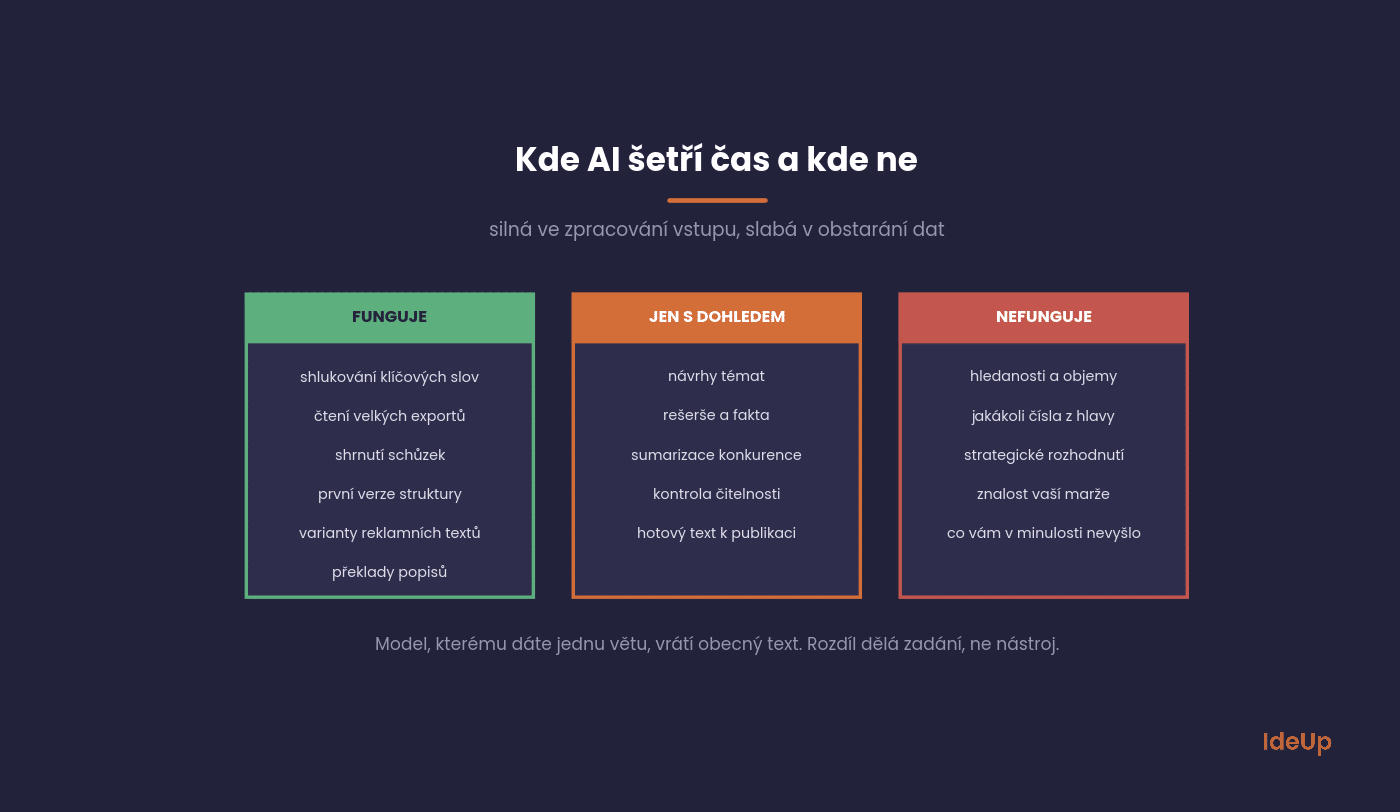
Where it works reliably
Clustering keywords into topics, reading large exports and spotting patterns in them, transcribing and summarising meetings, drafting the first version of an article structure, rewriting text in a different tone, generating ad copy variants for testing, translating product descriptions.
Where it helps, but needs supervision
Topic ideas, grammar and readability checks, summarising competitor content, research where you have to verify every figure. You use AI as a faster junior, not as a source of truth.
Where it does not work
Search volumes and any figures the model has no way of obtaining. A model will happily generate a search volume that sounds plausible and is made up. The same goes for strategic decisions, because it does not know your margin, your capacity or what has failed for you in the past.
The same split between processing and deciding applies to every channel. It helps to think about each one separately, because the risks differ.
AI in content marketing works best when you give it your own material. It can turn interview notes into an outline, turn one long article into a newsletter section and a few short posts, or check a draft against your style guide. The facts, opinions and examples still have to come from you, because that is what makes the content worth reading.
AI in social media marketing is useful for adapting one message to different platforms, shortening captions and summarising comments so you can spot questions that keep coming up. Avoid letting it reply to customers on its own. A wrong tone in public costs more than the time you saved.
AI tools for email marketing are often already built into the platform you send from. They help you write subject line variants for testing, prepare versions of one email for different segments and tidy up rough drafts. Who receives what, and how often, remains your decision.
The practical stack we use
There is no point paying for five subscriptions. It is more useful to have two tools you genuinely master, along with a clear rule on what you use them for.
A conversational model (ChatGPT, Claude, Gemini) for working with text and with the data you give it. An image tool, if you produce a lot of visuals. And above all, data from proper sources that AI has no say in: SEO tools for search volumes, Analytics for behaviour, accounting for margin.
The most common mistake we see is not in the tool. It is in the brief. A model given one sentence returns generic text. A model given the target audience, tone, structure, three samples of your writing and a list of what it must not say returns something usable.
Which AI marketing tools are worth considering
Lists of the top AI marketing tools go out of date within months, so it is more useful to know the categories.
- Conversational models for drafting, rewriting, summarising and working with data you paste in.
- Assistants built into tools you already use, such as email platforms, social media schedulers, design software and office suites.
- Image and video generators for drafts, mock-ups and variants of visuals.
- Transcription and meeting tools that turn calls and interviews into text you can work with.
Judge any tool with three questions. Does it handle a task you do every week? Can you check its output easily? And what happens to the data you upload, especially customer data? If the answer to the last one is unclear, keep sensitive information out of it.
Why looking only at Google is not enough
The second part matters more. Search has shifted from a list of links to an answer. Google shows AI overviews, people ask models directly, and some queries never lead to a click through to a website at all.
For companies, this means a second kind of visibility is opening up alongside rankings in the results. Either the model mentions and cites you in its answer, or it mentions your competitors. And this difference does not show up at all in a standard Search Console report.

Google has its own documentation on AI features in Search, and what it does not say is worth noting: there is no special markup or new meta tag. AI answers draw on content that is publicly accessible and well structured. In other words, the same rules apply as before, just with a higher bar for clarity.
What you can actually do
This discipline is called GEO, or generative engine optimisation. Practice is still settling, but a few things recur across projects often enough to be worth putting in place.
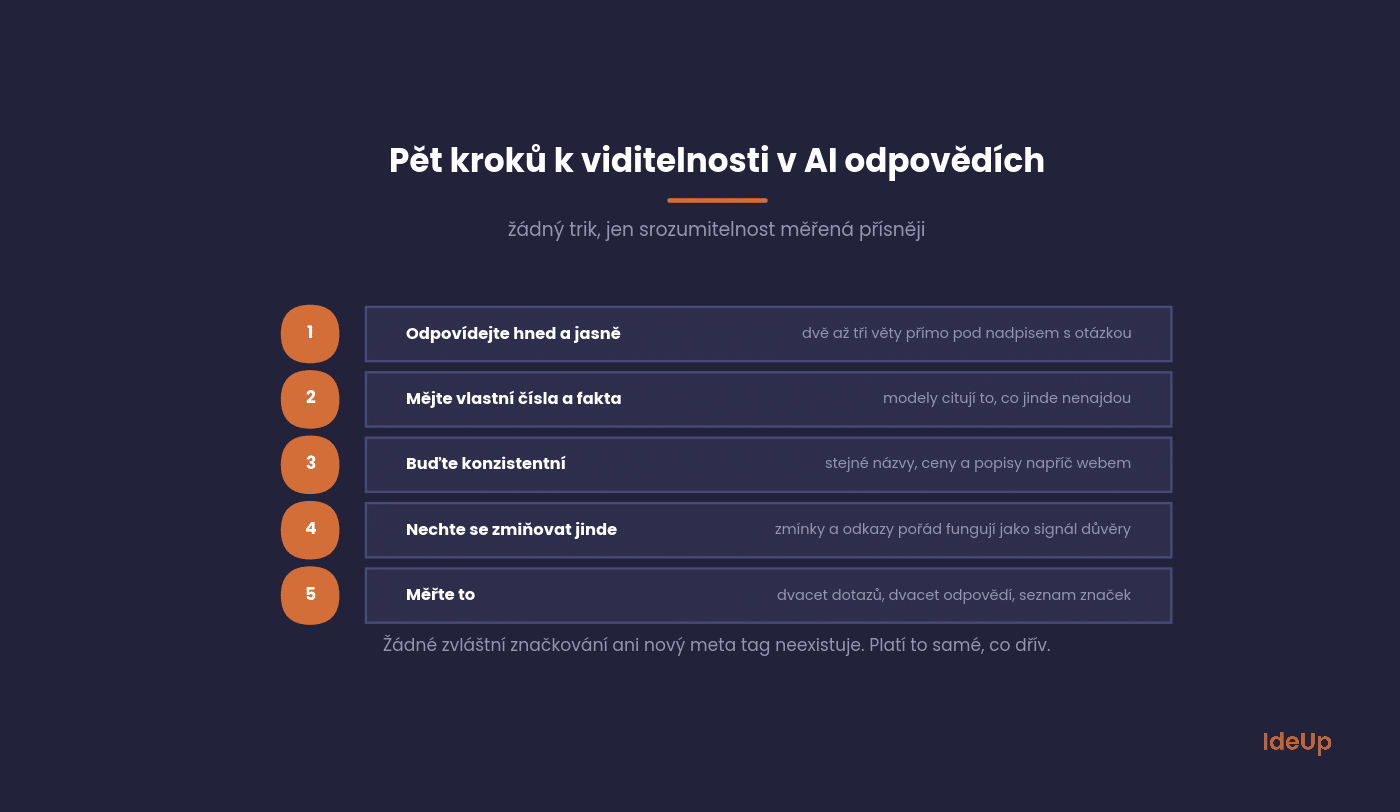
- Answer straight away and clearly. A short answer of two or three sentences directly below a question heading. A model can pick it up more easily than a paragraph where you only get to the point at the end.
- Include your own figures and facts. Models cite what they cannot find elsewhere. Your own data, price lists, comparisons and practical experience are the reason they turn to you.
- Be consistent across your website. When the service name, prices and description differ from page to page, the model has nothing to take away.
- Get mentioned elsewhere. Mentions and links from trustworthy sources still act as a signal of whom to trust. It is the same logic we describe in our article on backlinks and domain authority.
- Measure it. Ask models typical questions from your industry and record whom they mention. It sounds like an amateur method, but for now it is the quickest available way to find out where you stand.
Where sensible use ends
Generating content at scale and publishing it without editing is the fastest way to clutter your website with pages nobody cares about. Google explicitly does not target how content was created, but whether it is useful. The difference is that with generated content it is much easier to produce large amounts of useless material.
The practical rule we follow at IdeUp: AI may write the first draft and handle routine work, but it must never be the last to touch a text. Behind every published text there must be a person who has checked the figures and added what the model cannot know.
How to start using AI in marketing step by step as a team
When one person experiments, results depend on their habits. When a whole team uses AI, you need a few shared rules.
- Decide what data may go in. Write down which information can be pasted into which tool and what must stay out.
- Create shared brief templates. Store your audience description, tone and writing samples in one place so everyone starts from the same input.
- Name a reviewer for each output type. Someone has to be responsible for checking ads, emails and articles before they go out.
- Keep a log of failures. Note where the model got facts wrong or missed the tone. It shows you which tasks to stop delegating.
- Review the setup every quarter. Tools change quickly, and a task that did not work six months ago may work now.
The most common mistakes when using AI in digital marketing are predictable. Teams buy tools before they know which task they want to solve, measure output volume instead of results, and let unchecked drafts reach customers. A simple process prevents all three.
Questions we often hear
The questions you ask us most often about AI, ordered by how frequently they come up.
Does Google penalise AI-written content?
Not for how it was created. It penalises content created mainly to manipulate rankings that offers readers no value. The difference lies in usefulness, not in the tool.
How do I find out whether AI mentions me?
The simplest way is to ask. Put together twenty typical questions from your industry, run them through the main models and note who appears. There are also tools that already track this continuously.
Will I lose traffic because of AI answers?
For informational queries, partly yes, and it is already happening. For queries with purchase intent the impact is smaller, because people still want to compare and buy. Value is shifting, not disappearing.
Is it worth writing a blog when AI provides the answers?
Yes, but differently. Content that merely retells what is available everywhere is losing its purpose. Content with your own data and experience is exactly what models cite.
Which tool do you recommend to start with?
One conversational model on a paid plan. It will save more time than five specialist tools you only half learn.
What to do next
Pick three marketing tasks you do manually every week and try using AI for them for a week. If it saves you an hour, you have your answer. At the same time, run that simple visibility test: twenty questions, twenty answers, a list of the brands that appeared in them.
If yours is missing, that is your brief for next quarter. At IdeUp we work on this as part of GEO and traditional SEO, because for now the two cannot be separated. Get in touch via our contact page and we will review where you stand in AI answers.
Frequently asked questions about AI in marketing
What is AI in marketing?
It means using machine learning models, mostly language and image models, to support marketing work. In practice that covers drafting text, analysing data you provide, creating visual variants and personalising messages. The strategy, facts and final decisions still come from people.
How is AI used in digital marketing?
Most often for routine tasks across channels, such as writing ad variants, adapting posts for different platforms, preparing email versions for segments and summarising reports. It speeds up production and analysis. It does not replace knowledge of your customers and margins.
What are the top AI marketing tools?
There is no lasting ranking, because the market changes every few months. Most teams get the most value from one conversational model plus the AI features already built into their email, design and scheduling tools. Choose by the tasks you repeat each week, not by the length of the feature list.
Can AI write my marketing emails?
It can write good first drafts, subject line variants and versions for different audiences. You still need to check offers, prices and claims before sending. Decisions about who receives which email and how often should stay with you.