
Inbound marketing is a way of winning customers where people find you on their own at the moment they are trying to solve a problem. Instead of advertising that interrupts them, you offer them an answer in search, in an article, in a video or in an AI answer. You then keep working with those who show interest, all the way to a purchase.
It is often confused with content marketing. Content is only one part of it, though. Inbound also covers what happens to a visitor afterwards: how they leave you their contact details, how they move towards a decision and when sales takes over. You will find a short definition under the entry inbound marketing in our glossary.
Inbound is not for every company, and it is not cheap at the start. You put money into it months in advance, and it only starts to pay back once your content brings in enquiries that your sales team can close.
How inbound works in four steps
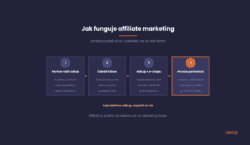
The methodology was named by the American software company HubSpot, which built its own marketing and product on it. It now describes the original funnel as a flywheel, because satisfied customers bring in more customers. In practice, four steps are enough. For each one, it helps to know what is measured.
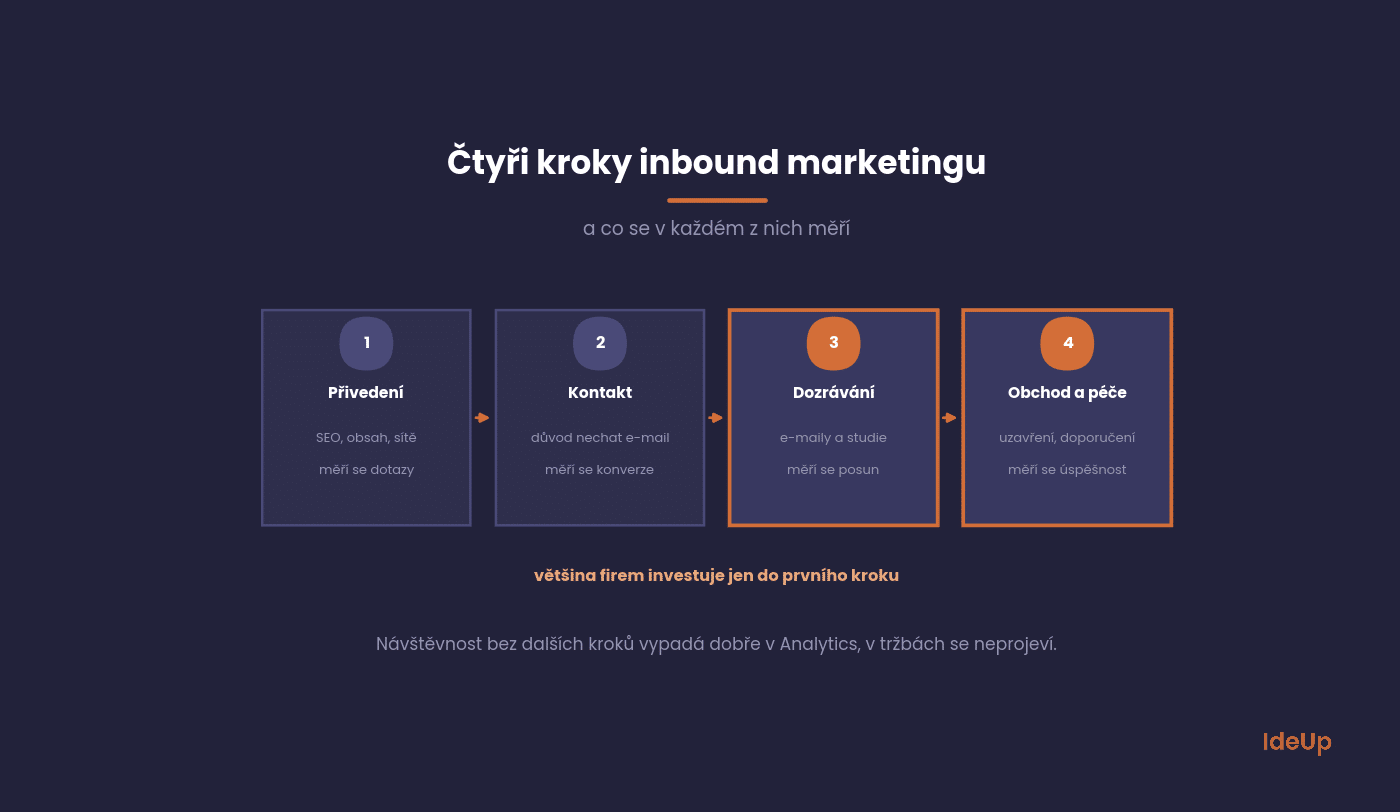
- Attract. Someone looks for a solution and finds your guide, comparison, video or social media post. This is where SEO and content marketing do the work. You measure the number of queries you appear for and the visits they bring.
- Contact. A visitor leaves you their email or phone number because they get something useful in return, such as a quote, a checklist or a consultation. You measure the share of visits that end in a contact.
- Nurture. People who are not buying yet receive content that helps them decide: emails, case studies, answers to objections. You cannot keep this up by hand, so you need an email tool with automation. You measure how many contacts move on to an enquiry.
- Sales and care. Sales takes over the enquiry. A satisfied customer then recommends you to others. You measure the close rate and the share of deals from referrals.
The most common mistake is stopping at the first step. The company writes articles and traffic grows, but the website gives no reason to leave contact details, and nobody follows up on the contacts that do come in. This kind of inbound looks good in Analytics but never shows up in revenue.
A few high-quality texts do more work than lots of average ones. Ten articles that simply repeat the top Google results will not bring in anyone who trusts you more than your competitors.
Inbound marketing strategies you can start with
A strategy here means a repeatable way of turning a customer’s question into a reason to contact you. These approaches tend to work well for smaller teams.
- Answer what sales hears every week. Collect the questions customers ask before buying and turn each one into a page or a short video. These topics bring in people who are already close to a decision.
- Publish honest comparisons. Compare your approach with the alternatives, including doing nothing. Readers trust a comparison that admits where you are not the best fit.
- Offer a practical tool. A calculator, template or checklist gives visitors a concrete reason to leave their email.
- Build one email sequence per objection. If customers hesitate over price, risk or implementation, write a short series that deals with each concern.
- Update before you add. Refreshing a page that already brings in visitors is often quicker than writing a new one.
Pick two or three of these and do them well before you add more. A strategy only counts if it ends with a clear next step for the reader.
Inbound and outbound differ mainly in money and time
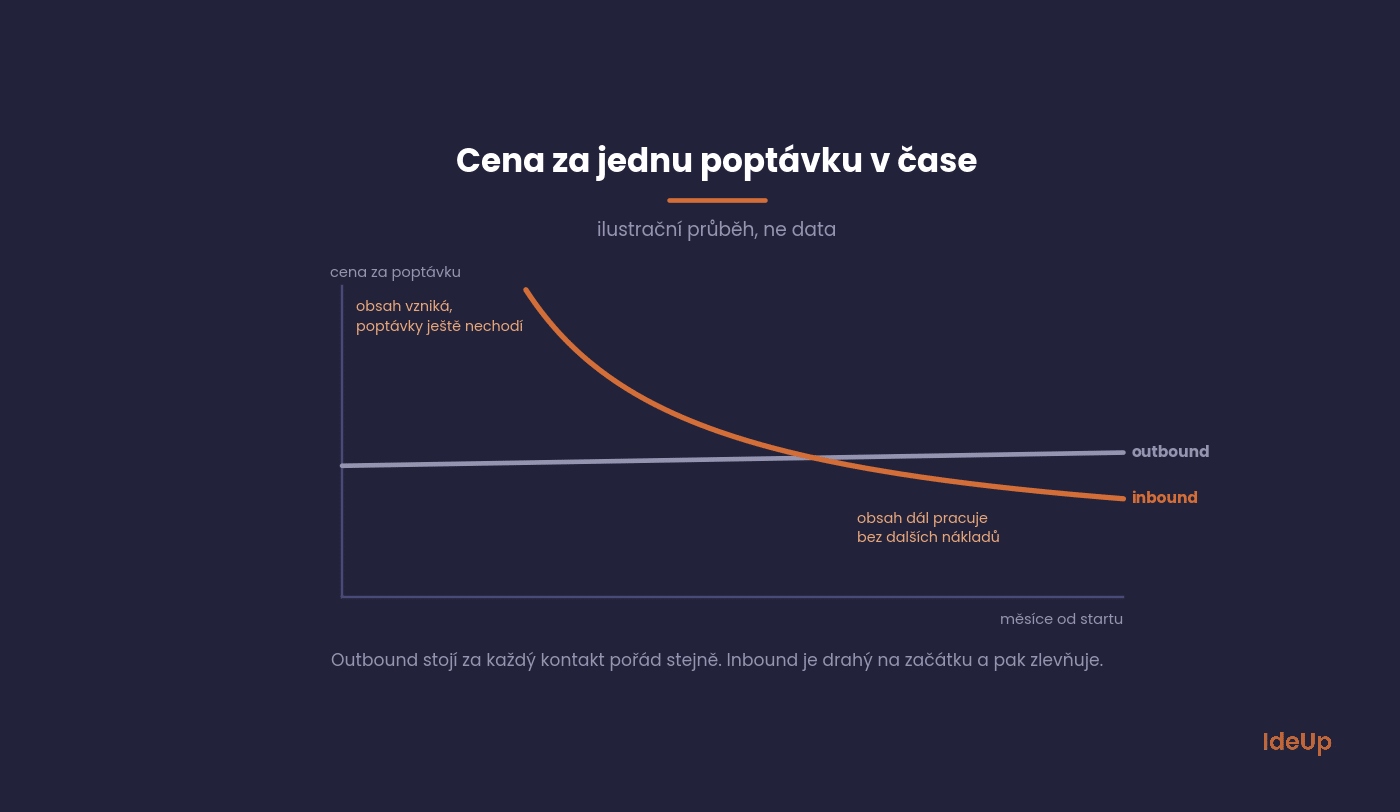
The textbook distinction is that inbound attracts customers and outbound pushes towards them. Outbound means advertising, phone calls, outreach and campaigns where the initiative comes from you. This split is simplified, because search advertising, for example, reaches people who are already searching. It is more useful to compare how the costs behave.
With outbound, you pay for every contact. Results come quickly, but they stop the day you switch off the budget. Inbound costs the most at the beginning, when content is being created and is not yet bringing anything in. However, an article that reaches the first page keeps bringing people in for months and then only costs maintenance. The cost of each additional enquiry therefore falls over time.
| Inbound | Outbound | |
|---|---|---|
| Who starts the contact | the customer, when searching | the company, when running a campaign |
| First results | in months | in days to weeks |
| After the budget stops | content keeps bringing people in | contacts stop coming |
| Cost of the next enquiry | falls over time | stays the same or rises |
| What it relies on | content, SEO and working with contacts | budget and targeting |
| Where it fails | nobody searches for the problem | the audience is saturated with ads |
Do not treat it as an either-or choice. A combination usually works best: paid campaigns deliver enquiries straight away while inbound grows in the meantime. You will find the other side defined under the entry outbound marketing.
Content marketing vs inbound marketing
Content marketing is the creation and distribution of useful material such as articles, videos, guides and newsletters. Its goal can be awareness, loyalty or education, and it does not always ask the reader for anything in return.
Inbound marketing uses content as fuel, but it is a whole system built around one aim, which is turning a stranger into a customer. It adds the parts content marketing does not have to include: offers that capture contacts, email nurturing, rules for judging which contacts are ready, and the handover to sales.
Here is a simple example. A software company publishes a guide to cutting cloud costs. As content marketing, success means the guide is read and shared. As inbound, the guide ends with an offer of a free cost review, the people who request it receive a follow-up series, and sales calls those who open the email about pricing. It is the same guide doing a different job.
You can do content marketing without inbound. You cannot do inbound without content.
When inbound pays off and when it does not
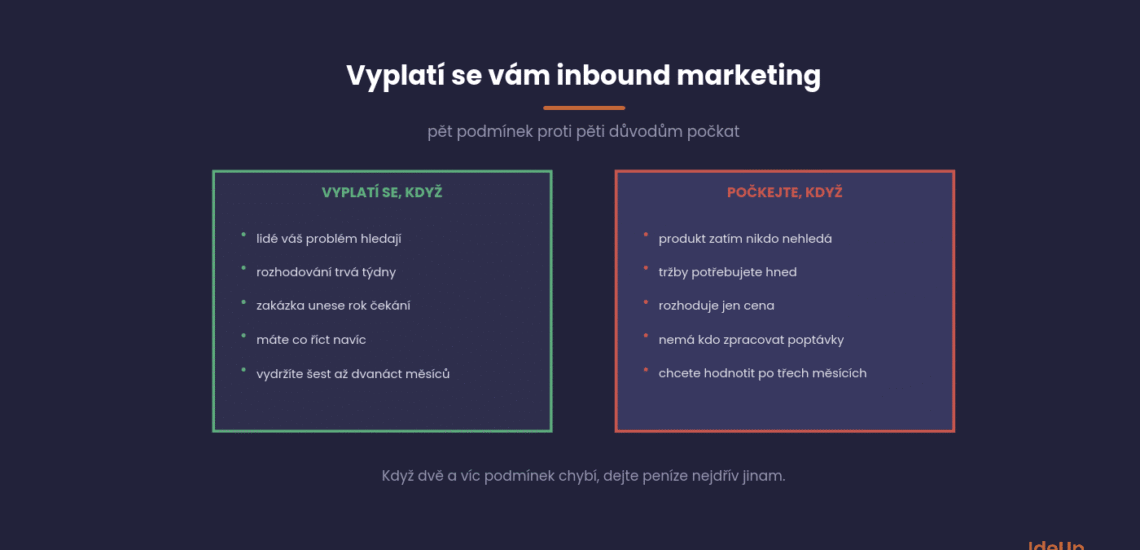
Inbound pays off for a company that meets at least four of the following five conditions. If two or more are missing, put your money elsewhere first and come back to inbound later.
- People search for your problem. In search engines or AI, there are queries that describe what you solve. Check this with keyword research before you write your first article. In B2B, even a few dozen searches a month are enough if the deals are large.
- The decision takes time. Before buying, the customer looks for information, compares and asks questions. This applies to services, technical products and more expensive goods, not to an impulse purchase costing a few hundred CZK.
- The deal can carry the wait. The margin from deals that content brings in during the first year must cover its costs. If one deal brings tens of thousands of CZK in margin, a few are enough. With cheap, low-margin goods, it only works at large volumes.
- You have something to say. Someone in the company can answer customers’ questions better than the top three results on Google. Without your own experience and data, you end up with content that is already on the internet.
- You can hold out for a year. You have the budget and the patience for six to twelve months before the first enquiries from content show up.
On the other hand, we do not recommend starting with inbound when demand, time or people are missing. The investment would not pay back, even if the content were excellent.
- You are selling something new that nobody is searching for yet. Demand first has to be created through advertising, PR or sales.
- You need revenue by the end of the quarter. Inbound is an investment for years, not a quick revenue boost.
- Only price matters. For goods that people choose on a price comparison site, content will not influence the decision.
- You have nobody to handle enquiries. A contact that waits a week for a reply goes cold.
- You want to judge the results after three months. In that time, inbound can only tell you whether content is being produced.
If the test fails, it is more honest to admit it straight away and put the budget into a channel that brings enquiries sooner. That is better than explaining a year later why the company blog is not bringing in enquiries.
How long inbound takes to pay back
In our experience, the first visits from search usually arrive after three months, and measurable enquiries from content after six to twelve. In highly competitive industries, it takes even longer. Treat shorter promises with caution.
You cannot read the payback period from traffic, though. It is calculated from a few figures that every company knows or can find out. We will show this using a model example of a B2B company. Plug in your own numbers.
| Assumption | Value in the model |
|---|---|
| Content and SEO costs | 30,000 CZK (about 1,400 USD) per month |
| Enquiries from content in months 1 to 5 | none |
| Enquiries from content in months 6 to 8 | 4 per month |
| Enquiries from content from month 9 | 8 per month |
| Close rate | one in four enquiries, i.e. 25% |
| Margin per deal | 40,000 CZK (about 1,800 USD) |
In this model, the cumulative margin from inbound deals overtakes the cumulative costs in the eleventh month. Over the full year, it delivers 440,000 CZK (about 20,000 USD) in margin against 360,000 CZK (about 17,000 USD) in costs, i.e. 80,000 CZK (about 3,700 USD) above break-even.
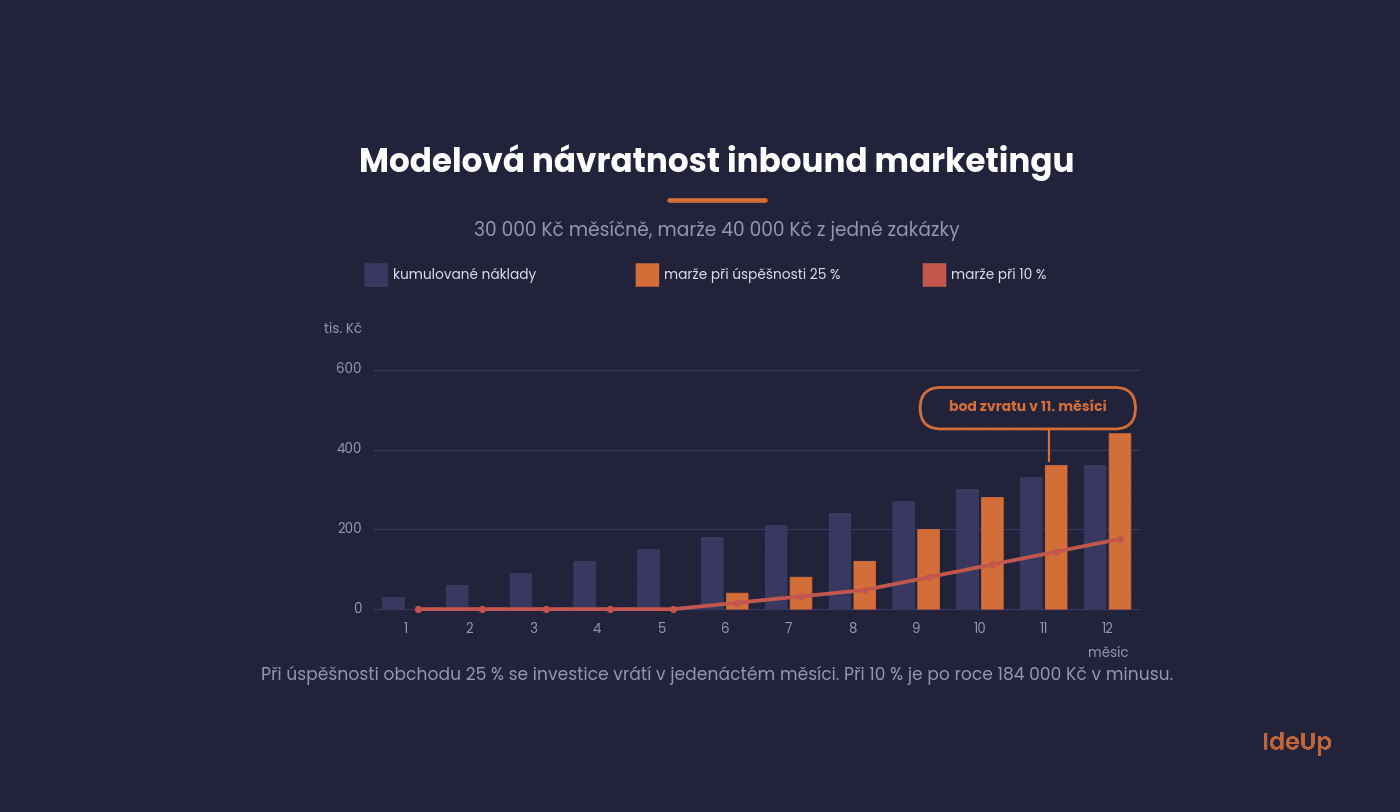
The biggest lever is the close rate. If sales closes only one in ten enquiries instead of one in four, i.e. 10%, the year brings 176,000 CZK (about 8,100 USD) in margin and inbound is 184,000 CZK (about 8,500 USD) in the red after twelve months. Before you raise your content budget, look at what is happening to the enquiries that are already coming in.
The difference compared with advertising shows in the second year. Content that already ranks well keeps bringing in enquiries, and the budget can be cut back to maintenance and a few new texts. In the same situation, advertising would still cost the same.
How to measure inbound so it does not get lost in the data
Inbound has a disadvantage in reports. Someone reads three articles, searches for the company name on Google a week later and calls. Analytics attributes the deal to a branded search or a direct visit, and the content does not appear anywhere. That is why tracking the last click is not enough.
We recommend tracking several figures at once and judging each over a different time frame. Traffic moves before enquiries, and enquiries move before customer acquisition costs.
| What to measure | Where to find it | When to evaluate |
|---|---|---|
| Number of queries the website appears for | Search Console, Google’s free tool | after three months |
| Contacts and enquiries from organic search and content | Google Analytics 4 with conversions set up | after six months |
| How the customer heard about you | a form field or a question from sales, recorded in the customer database (CRM) | ongoing |
| Searches for the company name | Search Console, branded queries | quarterly |
| Customer acquisition cost compared with advertising | customer database and accounting | after a year |
The cheapest of these is asking how the customer heard about you. One mandatory form field reveals deals that analytics would attribute to another channel, and it costs nothing.
A newer blind spot is AI answers. Some people get their answer directly from ChatGPT or in Google’s AI Overview and never visit the website. Mentions in AI answers can be tracked and influenced. We describe this under visibility in AI answers.
In B2B, you compete for a place on the shortlist
In our experience, many B2B companies still skip inbound. They rely only on their salespeople and give them no support from the brand or content. Yet the customer has gone through a large part of the decision before they even get in touch. They browse suppliers’ websites, compare them and arrive at the first meeting with a shortlist.
Inbound works differently here than in e-commerce. You are not competing for traffic, because there are usually only hundreds of relevant companies. You are competing to be on the shortlist when a company starts making a decision. The most valuable content is therefore content that helps people decide: solution comparisons, rough cost estimates, case studies and materials your contact person can use to convince management.
Inbound alone is rarely enough in B2B. It works well combined with targeted outreach to specific companies, where a salesperson sends them content you already have. We cover how to build this, from the target audience to the sales handover, as part of B2B marketing.
Common mistakes in B2B inbound marketing
- Writing for only one person. The person who uses the product and the person who signs off the budget often need different material. Prepare content for both.
- Asking for too much too early. A long form on the first visit puts off someone who is only getting their bearings. Ask for an email first and leave the rest for later.
- Treating every contact as ready to buy. Passing all contacts straight to sales wastes their time and annoys prospects. Agree in advance what makes a contact worth a call.
- Hiding the price completely. You do not need to publish a price list, but a rough range, for example whether projects start in the low thousands or the tens of thousands of USD, helps buyers decide whether to talk to you.
Can you do inbound without a blog?
Yes. The content can be a video, a webinar, a podcast, a calculator or a comparison table on your website. What matters is that it can be found where the customer is searching.
Text does have one advantage the other formats lack. It is the easiest to get into search results and AI answers, so do not leave it out entirely.
How much does inbound cost at the start?
Roughly tens of thousands of CZK a month for at least a year. The model above assumes 30,000 CZK (about 1,400 USD) for two to four solid articles a month, the technical basics of the website, measurement and an email tool. The exact amount depends on how much content you need and who writes it.
Add the sales team’s time for handling enquiries to the budget. It is the item most often forgotten in planning, and without it inbound will not pay off.
Does inbound work when people search with AI?
It does, but what it means to be found is changing. AI builds its answer from content that exists on websites, both your own and other people’s. A company with nothing useful written about it anywhere will struggle to appear.
However, clicks on simple definition queries are declining. The most valuable texts are therefore those with your own numbers and experience, which AI can cite along with the source’s name.
How to find out whether it will work for you
Start with the five-condition test and be strict with yourself. Then calculate your own version of the return using your real margin and sales success rate. If it turns out the investment will not pay back even within two years, the problem is not the content.
If both check out, do not start with a blog about everything. Choose the one topic with the highest demand, write five or six solid articles on it with a clear next step for the reader, and after six months evaluate enquiries, not traffic.
We will use keyword research to check whether there is demand in your field and tell you where it makes sense to start.
Frequently asked questions about inbound marketing
What is inbound marketing?
Inbound marketing is an approach where customers find you while they are trying to solve a problem, rather than you interrupting them with advertising. You attract them with useful content, collect their contact details, help them decide and then hand them over to sales. The aim is a steady flow of enquiries from people who already trust you.
What is the inbound marketing methodology?
The methodology describes how a stranger becomes a customer and then a promoter of your business. It is usually split into stages such as attracting, converting, nurturing and closing, with care for existing customers feeding the cycle again. Each stage has its own content and its own figure to measure.
What is the difference between inbound and outbound marketing?
With inbound, the customer starts the contact after finding your content. With outbound, you start it through advertising, calls or outreach. Outbound brings results faster, while inbound costs more at the start but gets cheaper per enquiry over time.
Does inbound marketing work for B2B companies?
Yes, it often works especially well in B2B, because buyers research suppliers thoroughly before getting in touch. Content that helps them compare options and justify the choice to management can put you on their shortlist. It usually works best combined with targeted outreach by your sales team.
USD amounts are approximate, converted at the Czech National Bank rate of 21.75 CZK per USD on 9 October 2026.


Leave A Reply