
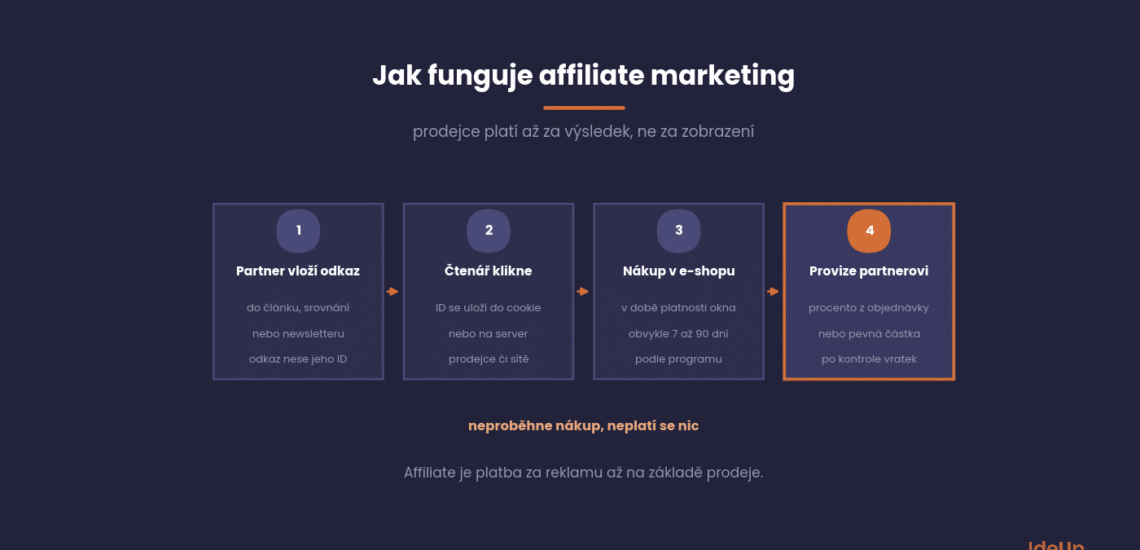
Affiliate marketing is a commission-based partnership between a seller and a partner. The partner recommends a product on their website, in a newsletter or on social media using their own tracked link. They only get paid when someone makes a purchase or fills in a form through that link. In Czech it is called a partner or commission system (partnerský nebo provizní systém).
So the seller does not pay for impressions or clicks, but for results. That is why affiliate marketing interests two groups: e-shops looking for another sales channel without paying upfront, and website owners who want to earn money from their content. At IdeUp we handle affiliate marketing from both sides, with e-shops and with content websites. The most common mistake is always the same. Both sides expect quick money and underestimate how many visits it takes to earn a reasonable commission.
How affiliate marketing works, the example of a skate e-shop
Technically, it always comes down to the same four steps, whether the partner is a blog, a price comparison site or an influencer.
- The partner receives their own link with an identifier from the seller and places it in their content.
- A reader clicks the link and the system remembers which partner they came from.
- The reader makes a purchase in the e-shop within the period during which the programme counts the click.
- After returns and cancellations have been checked, the commission is credited to the partner.
Mr Vonásek sells skates and does not want to pay for advertising upfront when he does not know what will work. So he launches an affiliate programme. Inline skating bloggers, a sports equipment review website and a few satisfied customers start linking to him. When someone buys skates through them, they receive the agreed commission, for example 8% of the price.
Mr Vonásek keeps handling orders and looking after customers. Others do the promotion for him, and he only pays them for completed sales. Affiliate marketing is essentially paying for advertising based on sales. You can find a breakdown of the link itself in the entry affiliate link.
Affiliate programme, affiliate network and partner, who is who
An affiliate programme is a single seller’s set of rules. It sets how much is paid and for what, how long after a click a purchase is credited to the partner, when commission is paid out and what is prohibited. Alza, Heureka, Notino and many smaller e-shops have their own programmes.
An affiliate network is an intermediary that brings together the programmes of many sellers in one place. A partner registers once, chooses programmes and receives a single payout. The seller, in turn, gains partners they would not find on their own, and the network handles tracking, invoicing and fraud checks for them.
A partner, also called a publisher or affiliate partner, is anyone who shares the links: a content website, a price comparison site, a coupon portal, a newsletter, a YouTuber or an influencer. In this system, the seller is called the advertiser.
Affiliate marketing compared with similar models
Affiliate marketing is often confused with referral programmes, sponsored content and paid advertising. They overlap, but each one pays for something different.
- Referral programme. Existing customers recommend the shop to friends and usually receive a discount or credit, not an ongoing commission.
- Sponsored content. The seller pays a fixed fee for a post or video regardless of how many sales it brings.
- Paid advertising. The seller pays for clicks or impressions and takes the full risk that visitors will not buy.
The main advantage of affiliate marketing is that payment follows results, so the seller does not pay for promotion that does not work. The disadvantage is less control. You cannot fully decide where and how partners present your products, and partners carry the risk that their work will not pay off. Many sellers combine several models, for example a fixed fee for an influencer plus a tracked link that earns commission on top.
Affiliate links look like an ordinary product link, except that they carry a parameter with the partner’s ID. After a click, this ID is stored. In the past it was stored only in a browser cookie, but today it is increasingly stored on the seller’s or network’s server as well. This so-called server-to-server tracking does not depend on the browser or on ad blockers.
Besides links, programmes also give partners banners, discount codes assigned to a specific partner or an XML product feed for price comparison sites. With a discount code, the commission is assigned based on the code used, so it works without cookies too, for example in a podcast or on Instagram.
What matters for the partner is the validity period, known as the cookie window. It tells you how long after a click a purchase still counts. Webnode’s is 90 days, while the Dognet network states that fashion usually has 7 to 14 days and electronics and home 30 to 45 days. If a customer decides to buy two months later, a partner with a short window gets nothing.
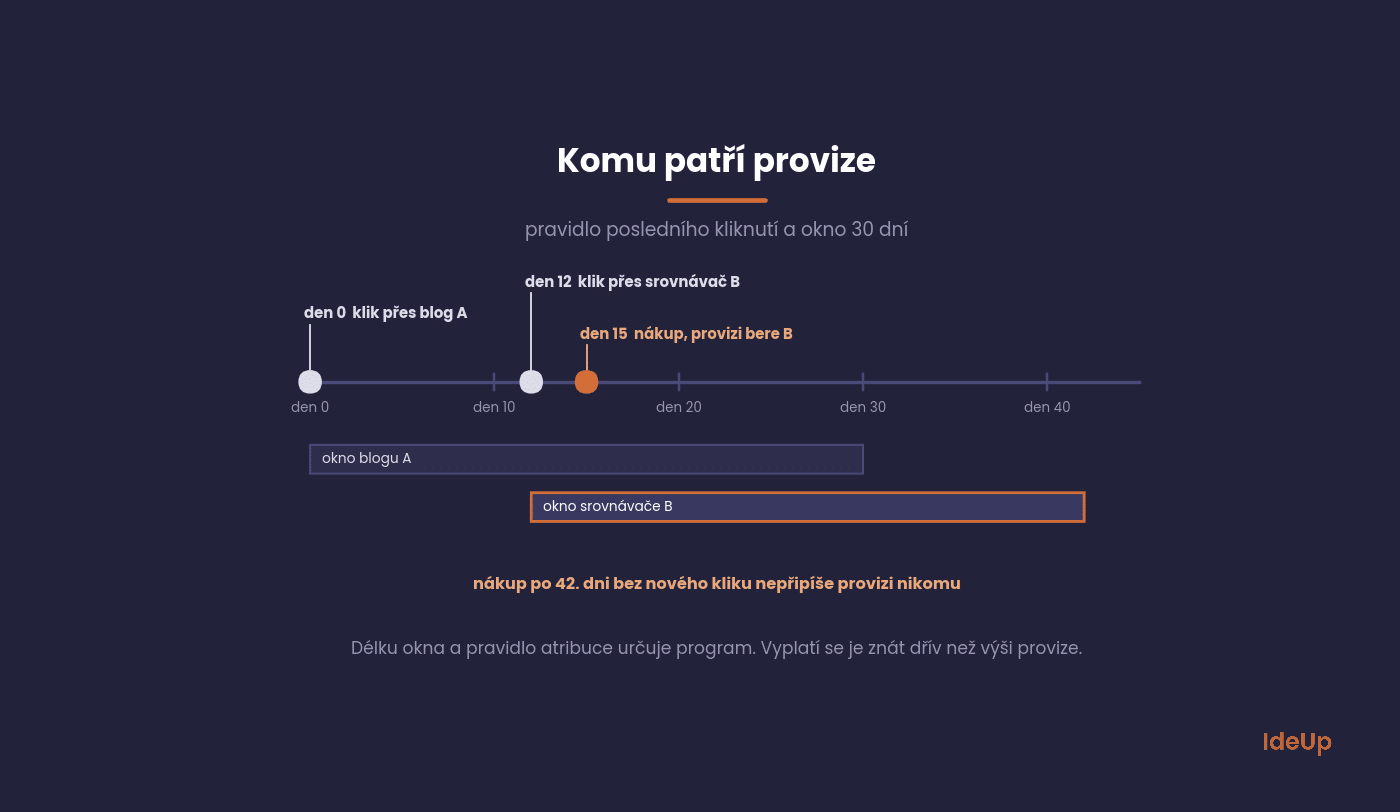
Attribution decides who the commission belongs to when a customer has clicked through several partners. The most common rule is last click. The commission goes to whoever the customer came through last, even if the product caught their interest elsewhere. Some networks can now also reward partners from the start of the purchase journey.
In addition, since 1 January 2022 a website may store cookies that are not necessary for it to function only with the visitor’s prior consent. This is laid down by the amended Electronic Communications Act (zákon o elektronických komunikacích), and affiliate tracking falls into this category of cookies. Visitors who refuse consent are not captured by classic cookie tracking. This is one reason why the figures in the programme interface and in your own analytics often differ.
Commission models, CPS, CPL, CPA and CPC
What gets paid for is determined by the commission model. For e-shops, payment per sale dominates, while for services and finance it is payment per contact acquired. The model also determines who bears the risk. The closer to the money the payment is made, the lower the risk for the seller and the higher it is for the partner.
| Model | What is paid for | Real-life example | Risk mainly borne by |
|---|---|---|---|
| CPS (cost per sale) | percentage of a completed order | Alza up to 7% depending on product type | partner |
| CPL (cost per lead) | completed form, registration, enquiry | insurance, finance, real estate | both sides |
| CPA (cost per action) | fixed amount for a specific action | Webnode 100 US dollars for the first annual package of a new website | both sides |
| CPC (cost per click) | click through to the e-shop | Heureka passes 70% of the click price to partners | seller |
For everyday goods, commissions are in single-digit percentages. For orders placed through its basket, Heureka pays by category, from 1.5% for mobile phones and computers up to 8% for clothing and fashion. Webnode states a usual range of 5 to 20% depending on margin. High-margin sectors can afford more, because the e-shop pays the commission out of its profit, not out of the price of the goods.
Czech affiliate networks and programmes that work today
Lists of programmes go out of date quickly. Mall.cz, whose affiliate programme used to feature regularly in overviews like this, ended on 31 March 2025 and moved under the Allegro marketplace. That is why we only list what we verified at the beginning of October 2026.
| Programme or network | Type | Commission and payout | What to watch out for |
|---|---|---|---|
| Alza | own programme | up to 7% depending on product type, payout from 500 CZK (about 23 USD) by invoice | coupon websites only 0.5%, cashback websites and brand bidding prohibited |
| Heureka | own programme | 70% of the price of clicks to e-shops, 1.5 to 8% for basket orders, payout from 1,000 CZK (about 46 USD) | monthly settlement |
| Webnode | own programme | 100 US dollars for the first annual package, 90-day cookie | payout only from 300 US dollars |
| eHUB, Dognet | Czech affiliate networks | commission set by each seller individually | one registration and one payout for all programmes |
| CJ (Commission Junction), Amazon Associates | US network and programme | depends on advertiser, market and category | make sense for content aimed at foreign readers |
Besides eHUB and Dognet, other networks operate in the Czech Republic, such as VIVnetworks, Affiliate Club and eSpolupráce. For a new website, it usually makes sense to start with a network. You can see in one place how much each programme pays and how long it keeps the cookie, and you do not have to keep track of ten contracts.
There is no single best affiliate programme in general. The best one is the one whose products your readers actually buy. A seller’s own programme is worth it for a shop you already link to regularly. Read the terms in full before placing your first link. Breaking the rules costs you your commission, and Alza’s contract also includes contractual penalties.
How to compare affiliate marketing programmes before you join
A high commission rate on its own tells you little. When you compare programmes, look at these points side by side.
- Product fit. Would your readers buy this product even without your recommendation?
- Approval rate. Some shops cancel a large share of commissions because of returns or unpaid orders. A lower rate with few cancellations can earn more.
- Payout threshold and method. A high minimum can mean you wait months for your first money.
- Allowed channels. Check whether email, social media, coupon codes or paid ads are permitted.
- Quality of the shop. Slow delivery or poor support reflects on you, because the reader followed your advice.
How much you can realistically earn from affiliate marketing
Less than the courses promise. Earnings are the product of four numbers: traffic to the pages with links, the share of people who click the link, the e-shop’s conversion rate and the commission on the average order. If just one of them is low, the result disappears.
A model example. A review website has 10,000 visits a month, 8% of visitors click an affiliate link, the e-shop turns 2% of those into orders, the average purchase is 1,500 CZK (about 69 USD) and the commission is 5%. That works out to 800 clicks, 16 orders, 24,000 CZK (about 1,100 USD) in revenue for the seller and 1,200 CZK (about 55 USD) for the partner.
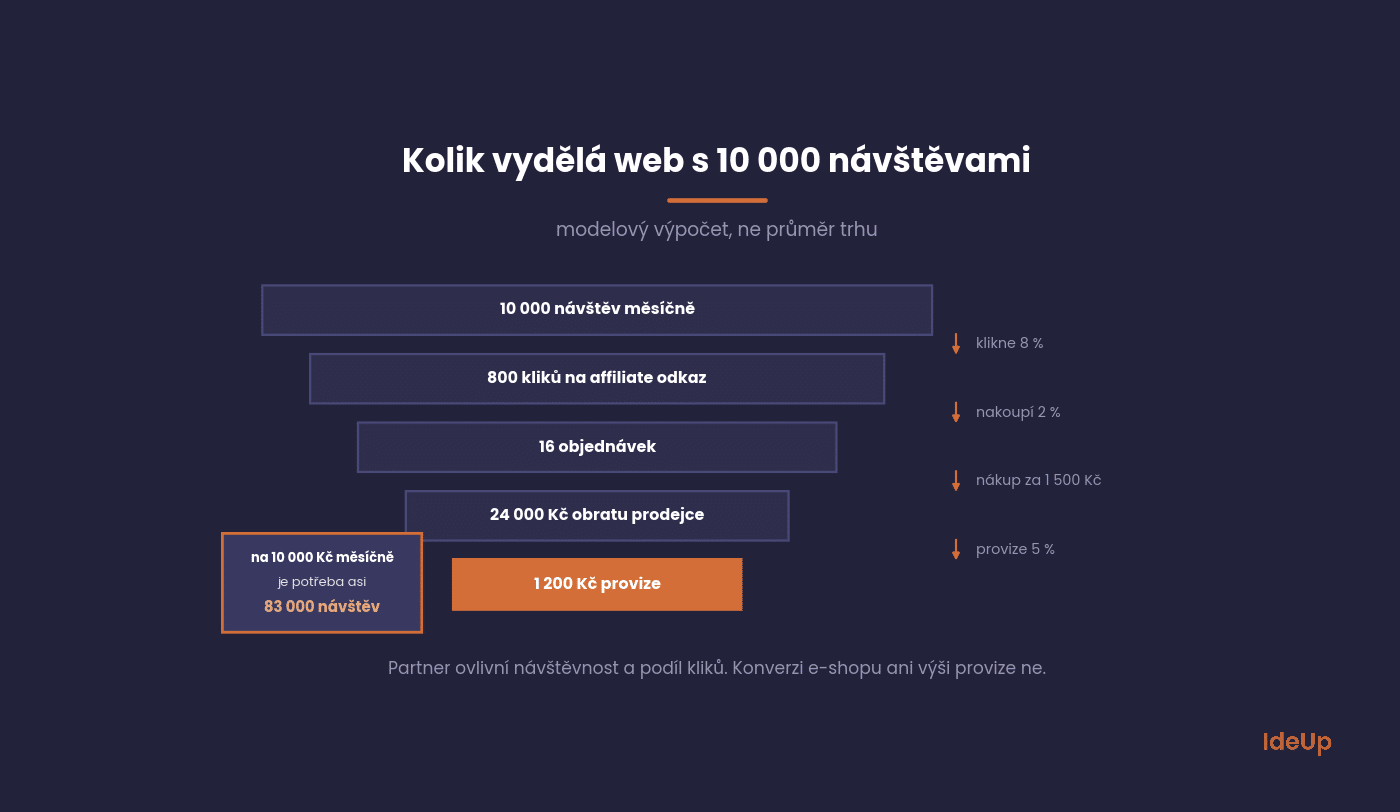
To earn 10,000 CZK (about 460 USD) a month, the same website would need roughly 83,000 visits. Passive income courses usually do not take this into account.
That is why affiliate marketing pays off mainly for websites that already have traffic, or for those targeting queries with clear purchase intent, such as comparisons and reviews of specific products. Big earnings do exist, though. Heureka states on its programme page that its top partners earn up to 600,000 CZK (about 28,000 USD) a month and that the average payout is 30,000 CZK (about 1,400 USD). But that is the average of those who reach a payout, not what a new website earns in its first year.
How to get started with affiliate marketing as a website owner
Either you add affiliate links to a blog or website that already has readers, or you set up a new website around a single topic purely for the commissions. The first route is faster. The second gives you more control over the topic, but it takes months before it brings traffic. The process is the same in both cases.
- Choose two or three topics in which you can help readers with their purchases. Dognet ranks electronics, home and garden, cosmetics and online services among the strongest sectors.
- Write comparisons and reviews based on your own experience, not rewritten descriptions from the e-shop.
- Register with a network, or directly with the programme of the shop you link to most often.
- Mark the links with the rel=”sponsored” attribute and tell readers at the start of the text that it contains affiliate links.
- After two to three months, look at which pages and programmes are earning, and build further content around them.
Google does not penalise affiliate websites. It penalises thin ones. In its spam policies (Google Search Central), it states explicitly that the problem is content copied from the merchant without any added value of your own. According to Google, good affiliate content offers your own reviews, testing, comparisons or pricing information.
Also bear in mind that once customers click, they belong to the merchant. You do not get their contact details or their future purchases, so build your own channel as well, such as a newsletter.
Common mistakes in affiliate marketing for beginners
Most new partners do not fail because of the programme they chose, but because of a few avoidable habits.
- Linking to the homepage. A link to the specific product you are writing about converts better than a general link to the shop.
- Not tracking individual links. Most networks let you add a sub-ID to each link. Without it, you cannot tell which article or button actually earns.
- Ignoring dead links. Products sell out and pages disappear. Check your links regularly, otherwise readers land on an error page and you lose the commission.
- Relying on one programme. Sellers can cut rates or close a programme at any time. Keep alternatives for your most important topics.
- Recommending only what pays most. Readers notice when every review ends with the highest commission. Once they stop trusting you, they stop clicking.
When affiliate marketing pays off for an online shop
For an online shop, affiliate marketing is a good addition to performance campaigns, not a replacement for them. You only pay when a sale is made, so the risk is low. However, the commission, the network fee and the time spent managing partners all add up. Before you launch a programme, work out what commission your margin can support, just as you would for performance marketing for online shops.
Here is a simple calculation. An average order of 1,500 CZK (about 69 USD) and a margin of 30% give you 450 CZK (about 21 USD) in gross profit. If an order from advertising currently costs you 150 CZK (about 6.9 USD), a commission of up to 10% (that is, up to 150 CZK (about 6.9 USD)) will not cost you more. You also need to deduct the network fee from it. Dognet gives 100 to 200 orders a month and a conversion rate above 1.5% as a rough threshold for getting started.
There are three ways to build a programme. A network such as eHUB or Dognet brings in partners and helps you manage the programme. Your own software, such as Affilbox or Post Affiliate Pro, gives you full control and works out cheaper at high volumes, but you have to find partners yourself. Online shops on Shoptet can start with the Commission System (Provizní systém) extension, which the platform offers for running your own partner programme.
Whatever you choose, someone has to act as affiliate manager. They approve new partners, check that they follow the rules and investigate suspicious conversions. Without this, coupon websites can easily take over the programme, and nobody keeps an eye on how partners write about you. For a smaller online shop, this is a strong argument in favour of a network.
Affiliate fraud and how to protect yourself
The biggest problem is commissions on sales that the partner did not bring in. This is known as cookie stuffing. A partner or a browser extension slips its cookie onto the customer just before the purchase and overwrites whoever actually brought in the sale. The merchant then pays for a customer who would have bought anyway.
This is not just theory. In December 2024, PayPal’s Honey coupon extension faced a class action lawsuit over a similar practice, and in summer 2026 the affiliate platform Impact suspended the startup Phia for it. Coupon and cashback websites, which catch customers just before they pay, carry the same risk, so programmes often pay them less or do not accept them at all.
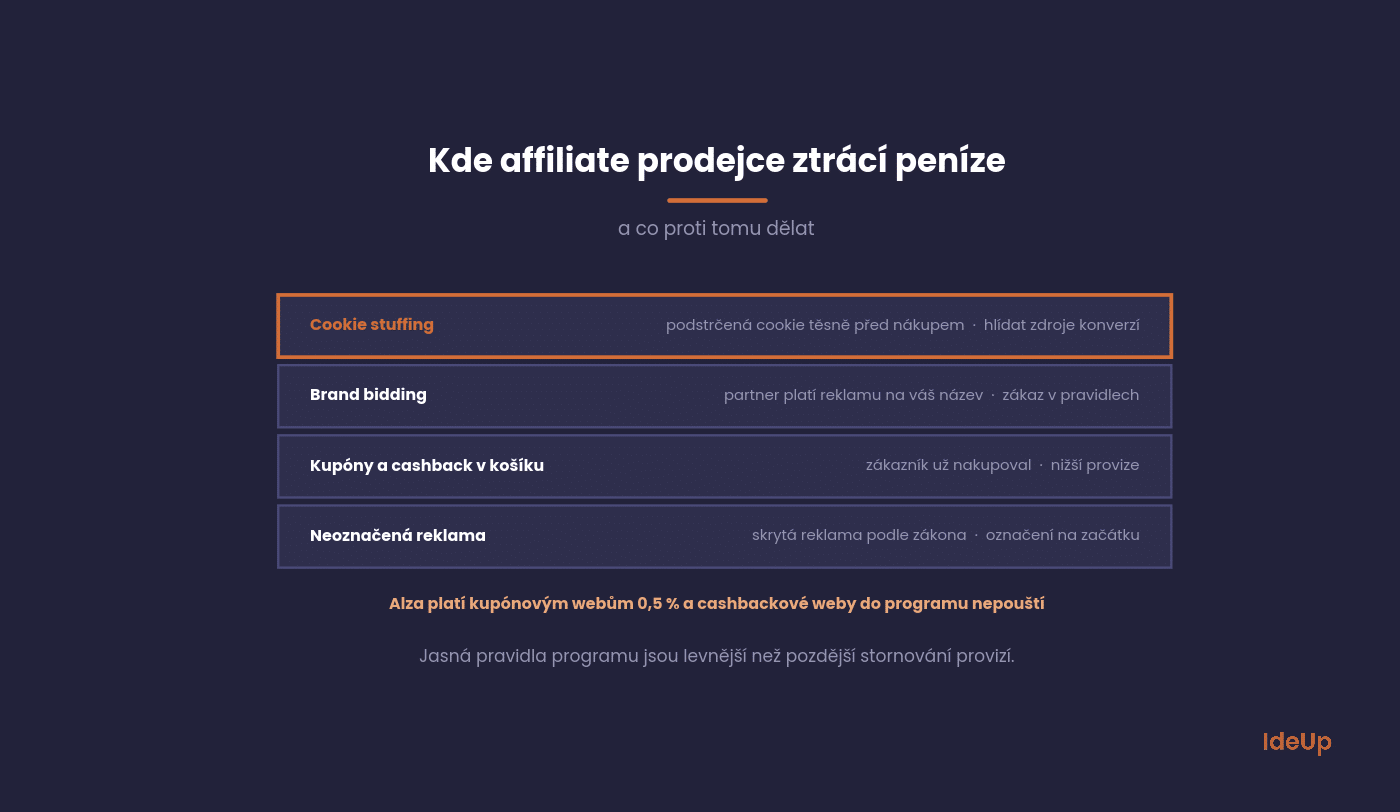
Another common violation is brand bidding. A partner buys a Google Ads advert for the online shop’s name and then earns commission on people who were already searching for the merchant themselves. Programmes usually prohibit this explicitly, and Alza even prohibits it for misspellings of its name.
What the law says about disclosure and consent
An affiliate link is paid promotion. If a partner places it in a review or post in such a way that readers cannot tell they are being paid for the recommendation, it may be covert advertising. The Consumer Protection Act (zákon o ochraně spotřebitele, Act No. 634/1992 Coll.) classifies this as a misleading commercial practice, and it is supervised by the Czech Trade Inspection Authority (Česká obchodní inspekce).
The solution is simple. At the beginning of the article or post, state clearly that it contains partner links and that you earn a commission on purchases. On social media, affiliate partnerships are labelled with words such as advertisement, paid partnership or sponsored content. You can find more details in our article on influencer marketing.
Anyone who sends affiliate links by email generally needs the recipients’ consent and must clearly label the message as a commercial communication. This is set out in the Act on Certain Information Society Services (zákon o některých službách informační společnosti, Act No. 480/2004 Coll.).
What affiliate is called in Czech and other questions
The English word affiliate translates into Czech as přidružený or partnerský (associated or partner). Czechs therefore talk about a partnerský program (partner programme), provizní systém (commission system) or provizní program (commission programme). For online shops, the term affiliate systém (affiliate system) often refers to the software on which their own programme runs.
In practice, however, the English term has caught on and is used by networks, online shops and partners alike. The quickest way to find a particular shop’s programme is therefore to search for the shop name plus affiliate, for example alza affiliate or heureka affiliate.
Do I need a trade licence for commission income
Commissions are taxable income. If you do affiliate marketing on a regular basis and for profit, it counts as a business, and you need a trade licence (živnostenské oprávnění) for it.
You can also see this in programme terms. Some pay out only against an invoice. Alza, for example, only transfers commissions once it receives a tax document. Check with an accountant how to tax the income correctly before your first payout arrives.
Where to start in your case
An online shop should start with a margin calculation, a website owner with content. Signing up for ten programmes at once without any content will not earn you anything.
For an online shop, the next steps are choosing a network or software, setting the programme rules and spending the first few months monitoring where commissions come from. For a website, what matters is whether your comparisons and reviews reach readers, and we can help with that as part of search engine optimisation. And if you are planning an affiliate programme for your own online shop, get in touch and we will work out with you what commission you can afford.
Frequently asked questions about affiliate marketing
What is affiliate marketing and how does it work?
Affiliate marketing is a partnership in which a seller pays a partner a commission for sales or leads that come through the partner’s tracked link. The partner recommends a product, the reader clicks, and the system records the partner’s ID. If the reader buys within the agreed period, the partner earns the commission.
What is the meaning of affiliate marketing?
The word affiliate means associated or connected. In marketing, it describes a partner who is connected to a seller and promotes its products in exchange for a share of the resulting sales. The partner is not an employee and is paid only for results.
Is affiliate marketing good for beginners?
It is easy to join, because most programmes are free and you do not need your own products. The hard part is attracting enough readers who trust your recommendations, which usually takes months. Start with a topic you know well and treat it as a long-term project rather than quick income.
How do you start affiliate marketing?
First choose a topic and create useful content around it, such as reviews or comparisons. Then join a network or a seller’s programme that fits your readers and place tracked links in your content. Label the links clearly and review your results after a few months to see what works.
USD amounts are approximate, converted at the Czech National Bank rate of 21.75 CZK per USD on 9 October 2026.

Leave A Reply