Advertising on Facebook and Instagram has the lowest barrier to entry of any paid channel. You can set up an account in ten minutes and launch a campaign in another five.
That is exactly why it is so easy to spend money on it with nothing to show for it. The system will happily take your money and deliver impressions, whoever you target.
This article explains how to set up campaigns so they do not burn through your budget, what decides the results today and when it is better to put your money elsewhere.
How it differs from search
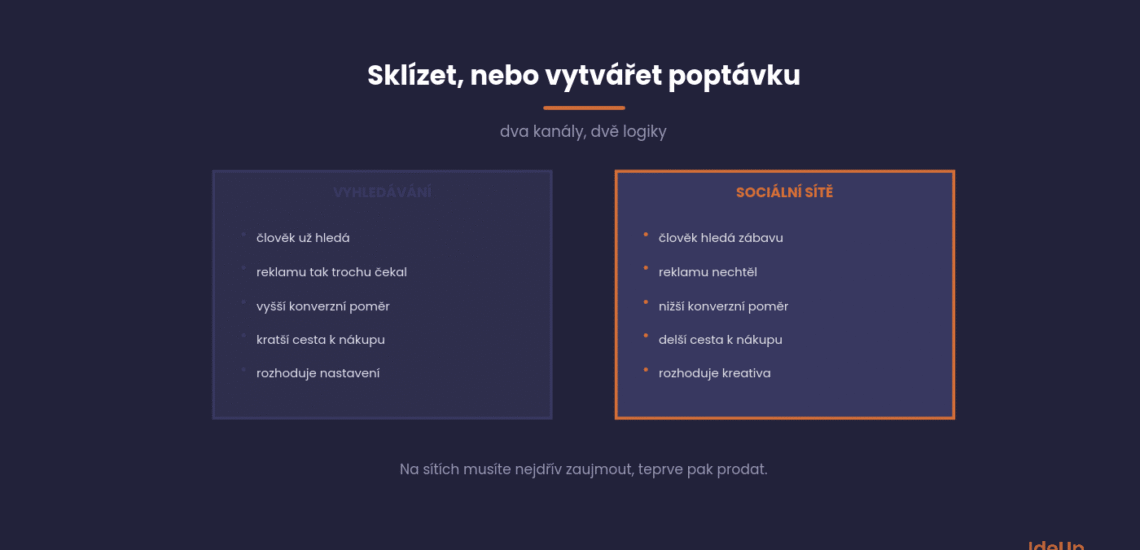
In search, you reach people who are looking for something. On social media, you reach people who are looking for entertainment and did not want your ad.
This leads to a completely different campaign logic.
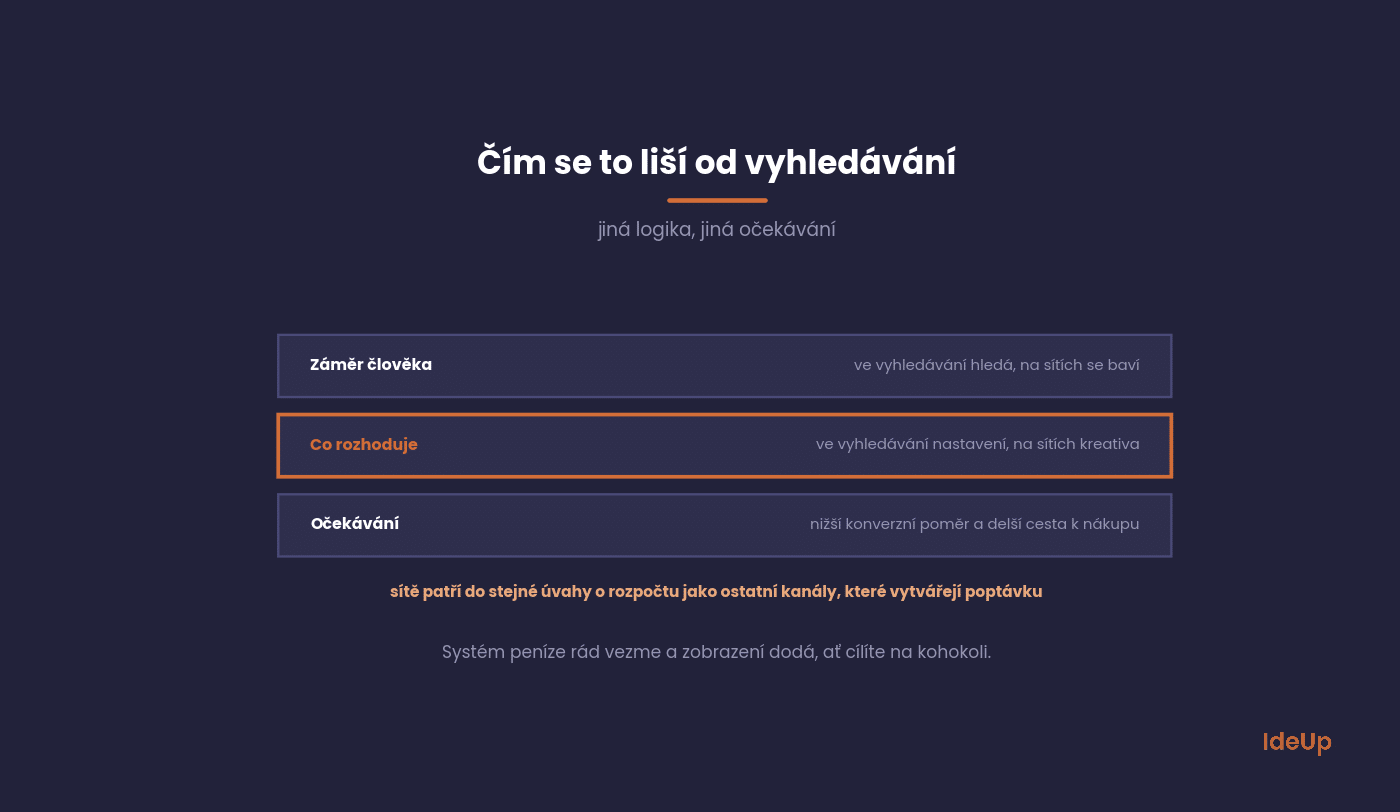
A social media ad first has to catch attention and only then sell. This means the creative matters more than the settings.
The second difference is in expectations. The conversion rate tends to be lower than in search and the path to purchase longer, because the person did not know about you a moment ago.
We discuss how to split your budget between channels that harvest demand and channels that create it in SEO or PPC. Social media belongs in the same consideration.
What decides the results today
Years ago, the competition was about targeting precision. Today the system handles most targeting by itself, and something else decides the outcome.
Three things, in this order.
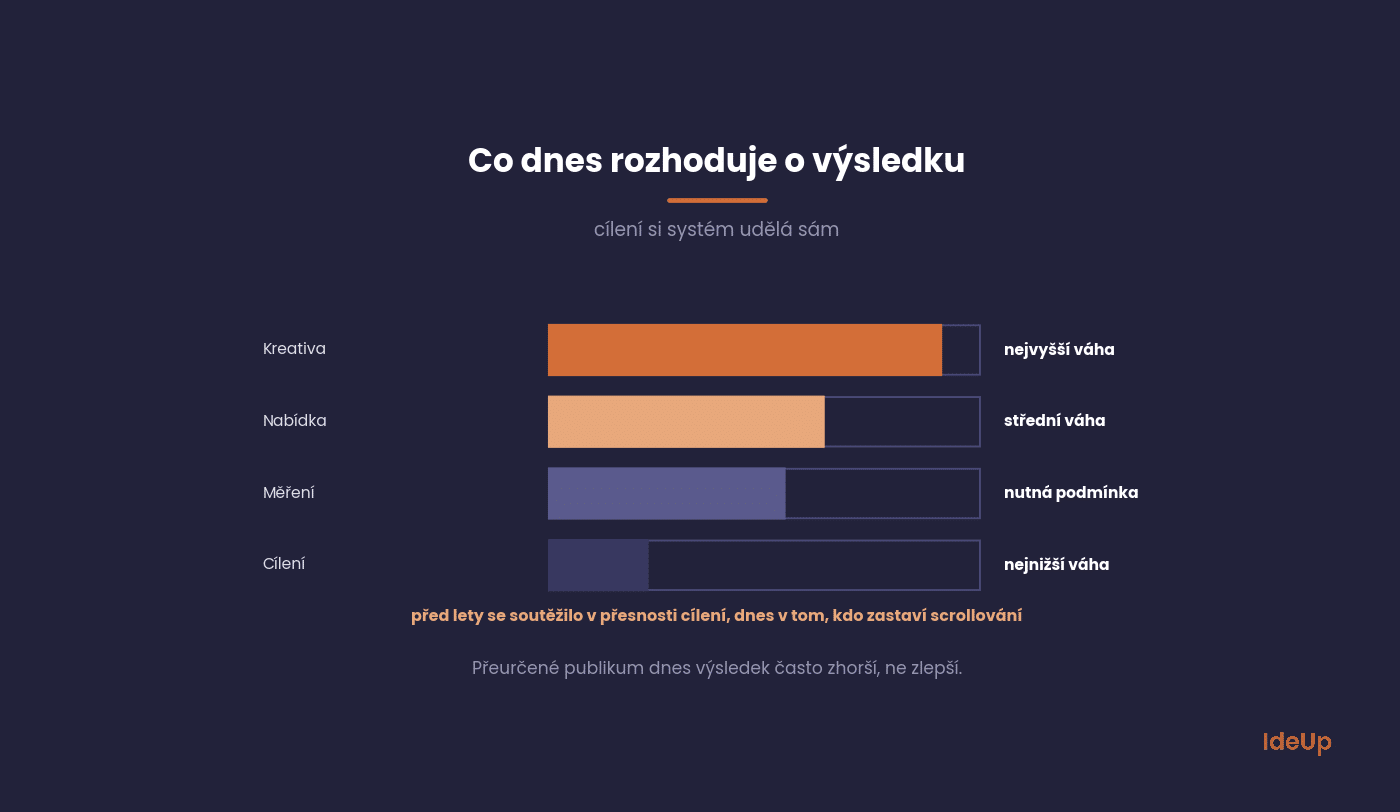
Creative. The image or video and the first few words. This is where it is decided whether someone stops scrolling. Prepare several variants and let them compete.
Offer. What exactly you are promising. A discount, a solution to a problem, something new. A weak offer cannot be saved by a good creative.
Tracking. Without properly implemented tracking, the system does not know whom to look for and optimises blindly. This is the most common technical mistake.
Today it is enough to set targeting broadly and let the system find people based on conversions. An over-defined audience often makes results worse.
Facebook video ads and lead ads
Two formats are worth a closer look because they behave differently from a standard image ad.
Facebook video ads
Video catches attention more easily in the feed, but only if the first seconds work. Many people scroll with the sound off, so add captions and make the message clear without audio. Shoot vertically if you want to appear in Stories and Reels, where a horizontal video wastes most of the screen.
Video does not have to be expensive. A short clip filmed on a phone that shows the product in use often performs as well as a polished production, and you can test more variants.
Facebook lead ads
Lead ads open a form directly inside Facebook or Instagram. The form is prefilled with details from the person’s profile, so they can send an enquiry in a couple of taps without visiting your website.
- Advantages. Very little friction, and the form works well on mobile even if your website does not.
- Disadvantages. Because sending the form is so easy, lead quality tends to be lower, and some people do not remember filling it in.
To keep quality up, add one or two qualifying questions and contact new leads within hours, not days. Connect the form to your CRM or email tool so enquiries do not sit unread in the platform.
How to structure campaigns
The most common mistake in smaller accounts is too many campaigns with small budgets. The system then has nothing to learn from.
A simpler structure works better.
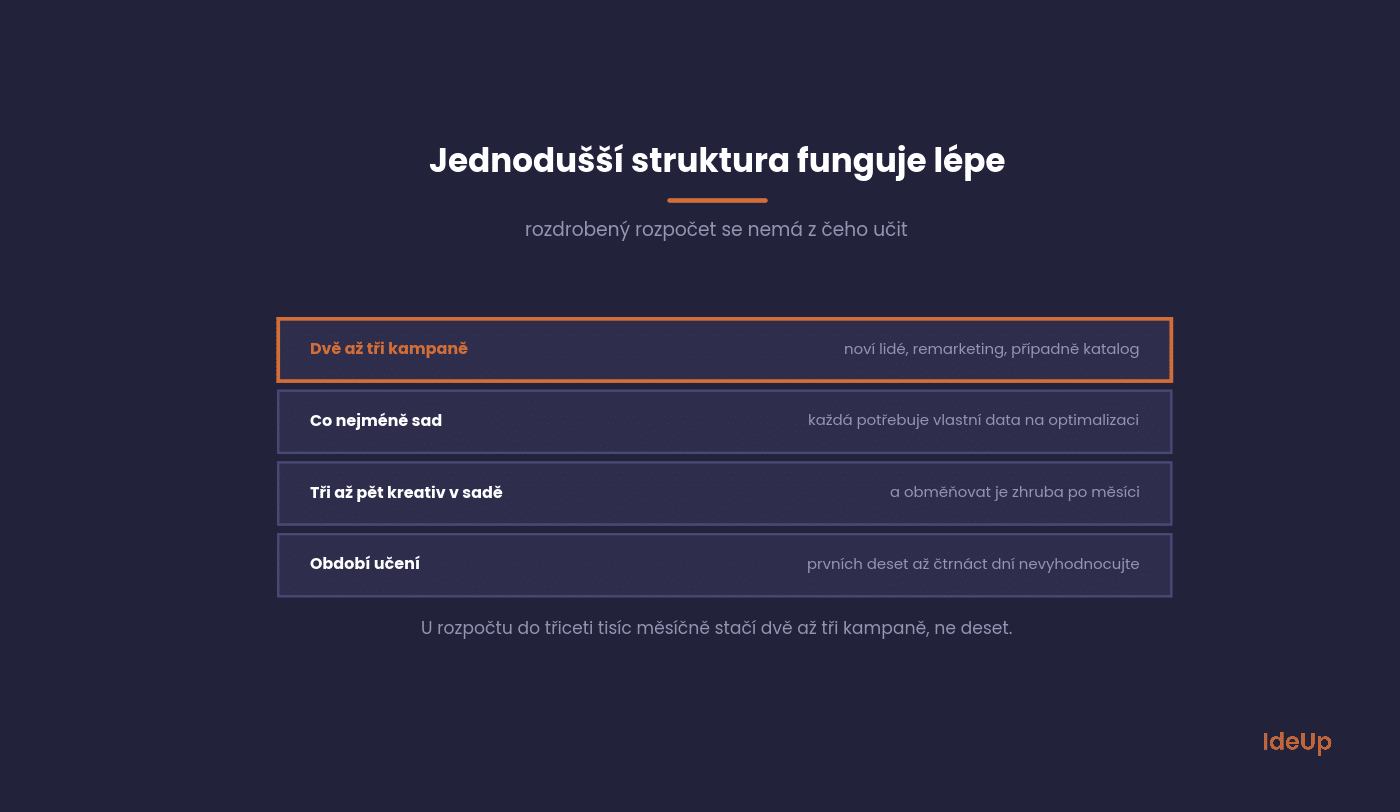
With a budget of up to roughly 30,000 CZK (about 1,400 USD) a month, two or three campaigns are enough. One to reach new people, one for remarketing and possibly one for catalogue sales.
Keep as few ad sets within a campaign as possible. Each ad set needs its own data for optimisation to get going, and with a fragmented budget it will never collect enough.
Put three to five creatives in each ad set and rotate them. The same ad stops working after a month because the audience has already seen it.
The same applies to remarketing on social media as anywhere else. We discuss when it helps and when you are just buying your own customers in remarketing.
How to do Facebook ads step by step
If you are launching your first campaign, go through these steps in this order.
- Set up the accounts. Create a business account in Meta Business Suite, an ad account and a payment method.
- Install tracking. Add the Meta Pixel to your website and check that it records the events that matter to you, such as purchases or enquiries.
- Choose the objective. In Ads Manager, pick the objective that matches what you want, such as sales or leads. The objective tells the system whom to look for.
- Set the budget and audience. Set the budget at campaign level, keep the audience broad and define only location and language.
- Add creatives. Upload several images or videos and write the main text, headline and call to action.
- Launch and wait. Leave the campaign alone during the learning period.
A common mistake is choosing the traffic or engagement objective when you actually want sales. The system then finds people who click or like, not people who buy.
Tracking and consent
Without tracking, the whole campaign is guesswork. At the same time, tracking on social media is much less accurate today than it used to be.
You need three things set up.
Tracking code on your website. Without it, the system cannot see what happened after the click and cannot optimise for purchases.
Server-side tracking. It fills in data lost to browser blocking. For online shops, it significantly improves accuracy.
Consent. Without properly configured consent, you lose some of your data and also risk problems with personal data protection.
Expect the figures in the ad platform and in Analytics never to match. Each measures differently, and a difference of tens of percent is common.
What budget makes sense
There is a lower limit below which a campaign has no way to learn. The system needs a certain number of conversions per week for optimisation to work.
For smaller online shops, this in practice means at least a few thousand CZK a month for a single campaign, not split across five.
Work out how much you can spend in total from your margin, not from a benchmark. We describe the process in performance marketing for online shops.
And allow for a learning period. The first ten to fourteen days after launch or after a major change are not representative.
How much do Facebook ads cost
There is no price list. Ads are sold in an auction, and each time there is space for an ad, the system compares the advertisers competing for the same person. Most campaigns are charged for impressions, even when you optimise for clicks or purchases.
You decide how much you spend in total by setting a daily or lifetime budget. What changes is how much you get for that money. The price of impressions and clicks depends on:
- competition in your industry and region,
- the season, as prices rise before Christmas when more advertisers compete,
- how relevant and engaging your ad is,
- the objective, because reaching likely buyers costs more than reaching anyone.
Rather than asking what an impression costs, ask what a customer may cost. If your margin on an order is 40 USD, a cost per purchase above that loses money on the first order, unless customers come back.
When to put your money elsewhere
Social media is not a universal solution. In three situations, it is better to invest elsewhere.
You can spot them in advance.
Your website does not convert. Traffic from social media is colder than from search. If your website does not work even with warm traffic, it will be worse here. This relates to the conversion rate and to how the website itself is built.
You sell to a narrow B2B market. The audience is too small for the system to have anything to learn from.
You have no creative. Without images and videos that catch attention, your social media budget is wasted. Content first, then ads.
Common questions
The five questions we are asked most often by online shops and smaller companies.
The answers apply in general; the figures vary by industry.
How many creatives to prepare
Three to five per ad set, rotated roughly every month. Fewer means the system has nothing to learn from.
The easiest way to have enough is to film short videos continuously, not campaign by campaign.
Should you target narrowly or broadly
Today, rather broadly, letting the system find people based on conversions. A narrow audience used to be an advantage; now it more often holds you back.
The exception is remarketing, where you do need precision.
Why my figures do not match Analytics
Because each system measures and attributes conversions differently. The ad platform also credits itself with views without a click.
Follow the trend within one system rather than comparing absolute figures between them.
Is it worth boosting posts
As a supplement, yes, especially for posts that already perform well organically. As a main strategy, no, because it lacks structure and tracking.
We discuss which networks to bother with at all in social media for businesses.
How long to wait for results
The first ten to fourteen days are the learning period. Evaluating earlier makes no sense, and changing settings during that period does harm.
Do a proper evaluation after a month, or after two for smaller volumes.
Where to start
Check whether your website has working tracking code and whether the system can see purchases. Without that, any campaign setup is pointless.
Then look at how many different creatives you have used in the last quarter. If it is fewer than five, you have your first task, and it costs nothing but time.
Want to connect your campaigns with the rest of your marketing so they do not cannibalise each other? Take a look at our services or get in touch via our contact page.
Frequently asked questions about Facebook ads
How much do Facebook ads cost per month?
As much as you decide, because you set the budget yourself and can start with a few dollars a day. The realistic minimum is the amount at which your campaign gets enough conversions each week to learn. That depends on your prices and on how well your website converts.
What are Facebook lead ads used for?
They collect enquiries, registrations or demo requests without sending people to your website. They suit services, education and B2B offers where the next step is a conversation. Expect to filter these leads more carefully than enquiries that come through your website.
Are Facebook video ads better than image ads?
Not automatically. Video often holds attention longer, but a strong image with a clear offer can beat a weak video. Put both formats in the same ad set and let the results decide.
Can you do Facebook ads yourself without an agency?
Yes, Ads Manager is built for advertisers without specialist training. The hard parts are tracking, a steady supply of creatives and the patience not to change settings during the learning period. If you can handle those, you can run a small account in-house.
USD amounts are approximate, converted at the Czech National Bank rate of 21.75 CZK per USD on 9 October 2026.