A web search engine is a service that uses robots to crawl the web, stores page content in its own database called an index, and, for every query, selects and ranks the most suitable results from it in a fraction of a second. Two are mainly used in Czechia. According to StatCounter, in September 2026 Google had a share of 78.7% and Seznam (the Czech search engine) 15.1%.
The key word is index. When searching, a search engine does not go through the live internet but through its own memory. If its robot has not found something and saved it to the index, the search engine will not show it to you, however well it is written on the website. And even a page in the index is not guaranteed to appear for a specific query.
A search engine is often confused with a browser. A browser (Chrome, Edge, Safari) displays pages, while a search engine (Google, Seznam) searches through them. We explain what the internet itself is in the article what is the internet.
How a search engine works in four steps
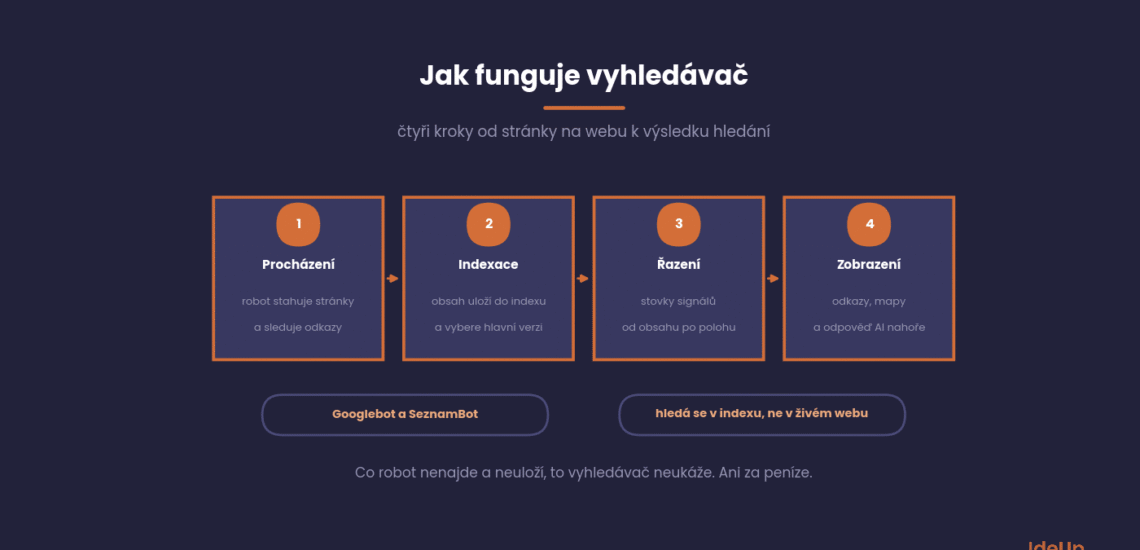
A web search engine works in four steps. A robot crawls pages, the search engine stores them in the index, ranks them for a query according to how well they match, and displays the results. In its documentation for website owners, Google describes the same stages as crawling, indexing and serving, and counts ranking as part of the last step.
An old picture from our blog still fits. The internet is a tangle of connected computers, and a search engine is another computer with a single task. It visits the others, reads what is on them and saves it.
- Crawling. The robot (Googlebot at Google, SeznamBot at Seznam) downloads pages and follows links to others. It decides by itself which websites it will crawl, how often and how many pages it will take from them. Google also renders the page and runs its JavaScript in the current version of the Chrome browser.
- Indexing. The search engine analyses the content, works out what the page is about and stores it in the index. When it finds several versions of the same page, it chooses one canonical version to show. According to Google, its index contains hundreds of billions of pages and over 100 million gigabytes.
- Ranking. For a query, the search engine selects candidates from the index and ranks them according to hundreds of signals, from content and links to the location, language and device of the person searching.
- Displaying results. The searcher gets a list of links with a title and a text snippet, often supplemented by a map, images or an AI answer at the top.
What is a search engine spider
A search engine spider is the program that handles the crawling step. It is also called a crawler, robot or bot. The name comes from the way it moves across the web. It goes from one page to the next along links, like a spider along the threads of its web.
A spider works roughly like this:
- It starts with a list of addresses it already knows, for example from previous visits or from sitemaps.
- Before visiting a website, it reads the robots.txt file to see which parts it should not crawl.
- It downloads each page and notes the links the page contains.
- It adds new addresses to its queue and plans when to return to the ones it already knows.
The spider does not decide where a page ranks. It only collects material. Indexing is the next step. The search engine processes what the spider brought back and decides what to store. A page can be crawled and still not be indexed, for example when it duplicates another page or offers little useful content.
A search engine searches its memory, not the live internet
With every query, a search engine searches its index, that is, the stored information about pages its robot has crawled, as they were at its last visit. The index never covers the whole web. That is why it will not show you a page its robot has not yet found, and sometimes it displays an old version, such as outdated opening hours. Crawling the entire internet again for every search is not possible.
A pub two streets away shows this well. You want its phone number, so you type its name into Seznam or Google, and the search engine offers you the pub’s website with a text snippet. But only if it has come across the website before. If not, you are out of luck, even though the website exists.
Website owners often forget this. According to its documentation, Google does not guarantee that it will crawl, index or show a page, even if the page meets all its rules. You cannot pay for more frequent crawling or a higher position.
You can help technically, with a sitemap, a sensible robots.txt file and a website that is easy for the robot to read. We describe everything worth checking in the article on technical SEO.
How a search engine ranks results
A search engine ranks results according to how well a page matches the query and the searcher’s intent, how high-quality and trustworthy it is, and the context in which the person is searching. Google states that relevance is determined by hundreds of factors, including location, language and device. People used to write about 200 factors; today Google publishes neither the exact number nor their weights.
At the beginning it was simple. There were few pages and the search engine counted words. A page with the word vacuum cleaner ten times beat a page with three occurrences. Once there were hundreds of equally “good” pages, a second signal was added: links. A page that thirty other websites link to carries more weight than a page with five links.
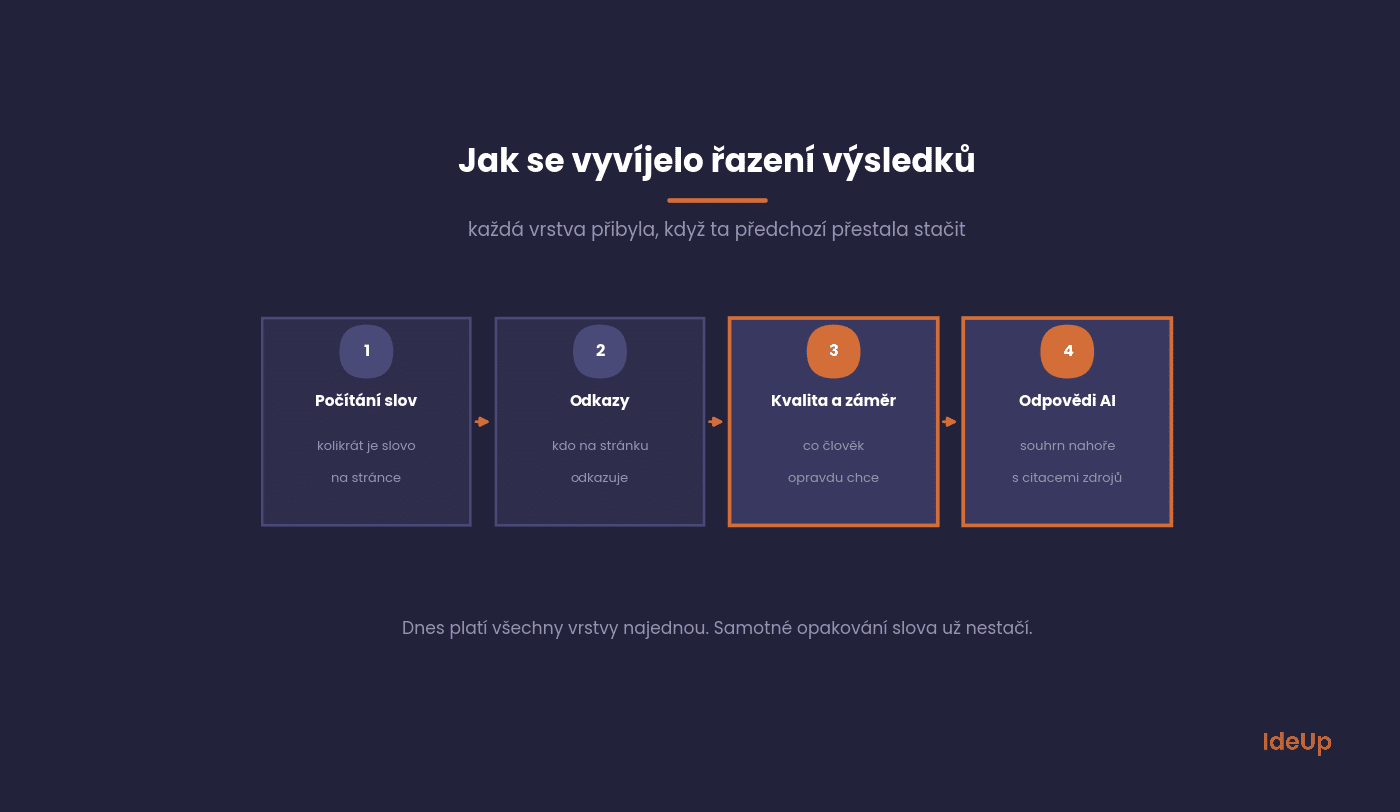
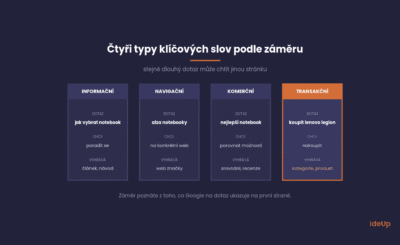
Today a search engine combines many more signals and, above all, looks at intent. In its overview of ranking systems, Google names, for example, BERT, which understands the meaning of words in a query, systems for content freshness and systems that favour the original source. Someone who types “vacuum cleaner” most likely wants to buy or compare, not read about the history of vacuuming. A page that misses the intent will not succeed even with perfect text.
| What the search engine evaluates | What it means | What you can do about it |
|---|---|---|
| Match with query and intent | the page answers what the person is looking for, in their words | write in the customer’s words, one page per topic |
| Content originality | the search engine favours the original over those who just copied it | do not copy manufacturers’ or competitors’ texts |
| Links and mentions | who links to you or names you | a link from a company in your field usually carries more weight than one from a directory where everyone is listed |
| Technical accessibility | the robot finds, reads and stores the page | sitemap, robots.txt, no unnecessary blocking |
| Searcher context | location, language and device | a local business needs an address on its website and a business profile |
Which search engines are used in Czechia
In Czechia, Google leads with a share of 78.7%, Seznam is second with 15.1% and Bing third with 4.7%. Yandex, DuckDuckGo and Yahoo together have about 1.4%. The figures are from StatCounter for September 2026 and cover all devices combined.
The device does matter, though. On desktop, Seznam has 16.6% and Bing 11.8%; Bing benefits there from being the default search engine of the Edge browser in Windows. On mobile, Bing barely exists (0.3%) and Google has 84.8%.
| Search engine | All devices | Desktop | Mobile |
|---|---|---|---|
| 78,7 % | 69,5 % | 84,8 % | |
| Seznam | 15,1 % | 16,6 % | 13,8 % |
| Bing | 4,7 % | 11,8 % | 0,3 % |
Seznam has grown stronger over the past year. According to StatCounter, it had 11.9% in September 2025 and around 15% a year later.
For a company selling in Czechia, Seznam’s 15% means roughly one in seven clicks from search that Google will not bring. Seznam has its own index, its own robot and its own tool for website owners, Seznam Webmaster.
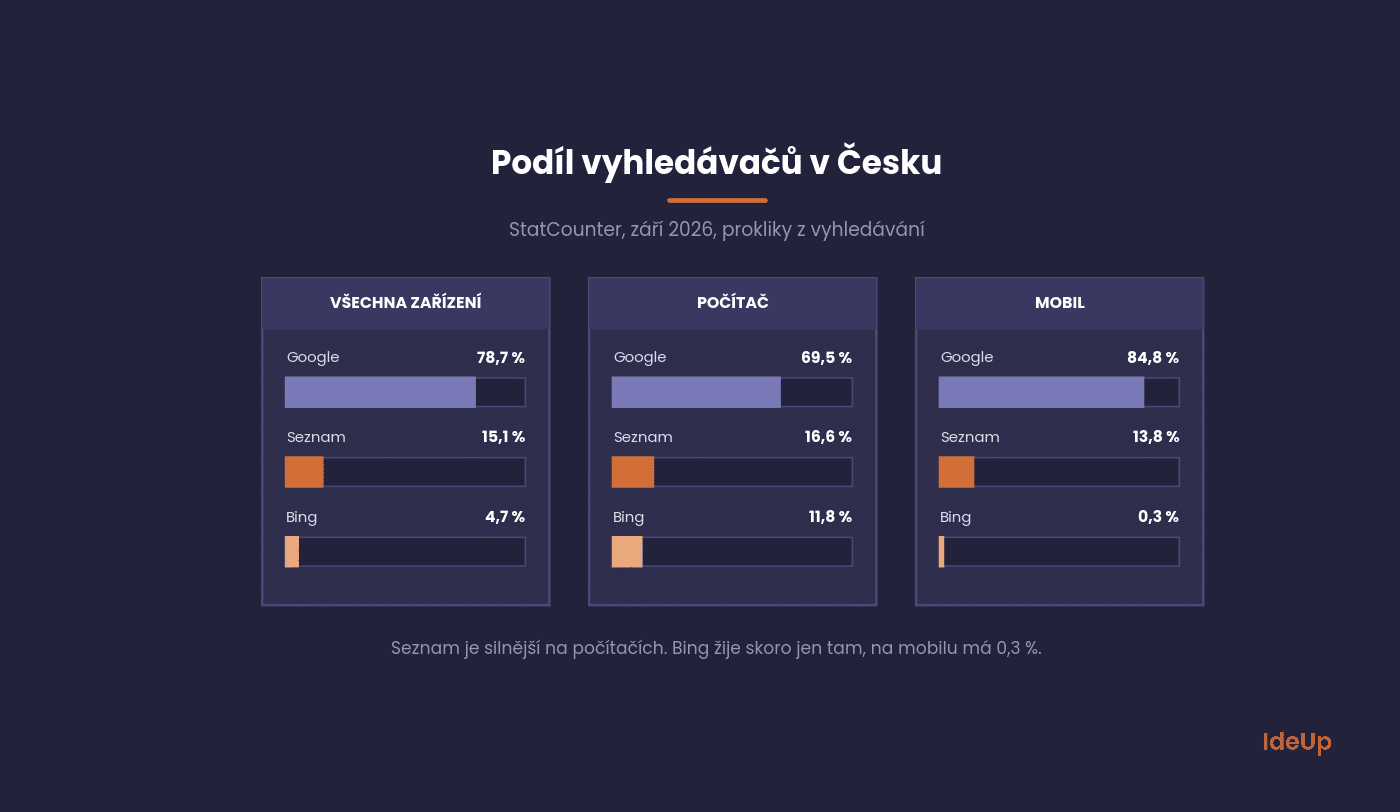
One caveat. StatCounter does not measure the number of searches but clicks from search engines to more than a million websites with its tracking code. Only your own analytics will show the real ratio on your website.
How AI answers are changing search
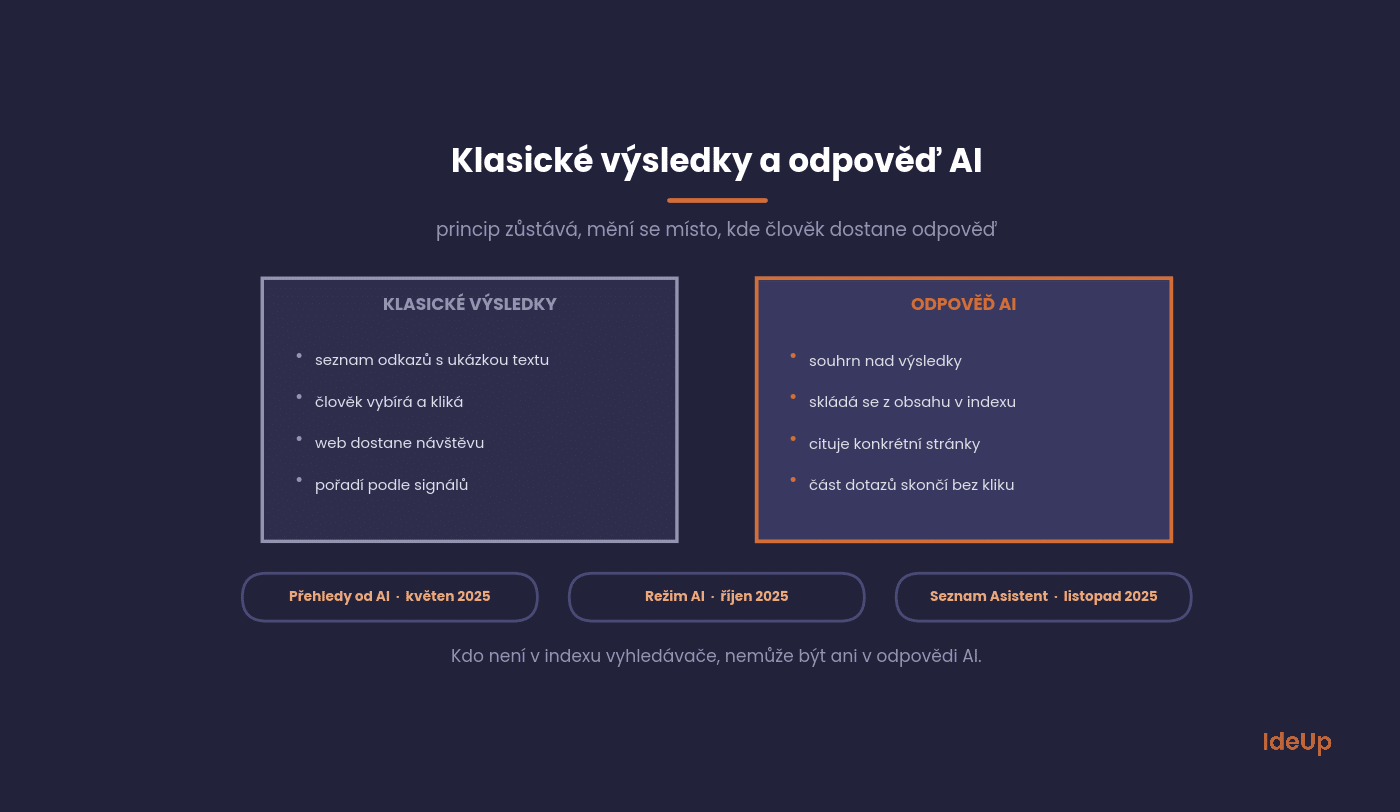
Search engines now add an answer generated by artificial intelligence above the classic links. Google launched AI Overviews in Czechia on 20 May 2025, initially only for some users, and AI Mode has also been available here since October 2025. In November 2025, Seznam launched Seznam Asistent, which answers with source citations and also appears in search results.
This does not change how a search engine works. Google states that only a page that is in the index and may be shown in results with a text snippet can be a link in AI Overviews and AI Mode. For a single question, it runs several related searches at once. If you are not in Google’s index, you cannot be in its AI answer either.
ChatGPT with search and other assistants work in a similar way. First they find pages on the web, then they compose an answer with links from them.
So what mainly changes is where the person gets the answer. Some queries are resolved directly in the results, and the person no longer visits the website. For a website, this means that being in the results is not enough. It must have an answer on the page that AI can take and link to.
Patrik Pilous, SEO consultant at IdeUp, sums it up by saying that SEO is not changing in its essence; the techniques and platforms are. Alongside positions in Google and Seznam, we therefore also track for clients whether AI answers mention and recommend their brand. We discuss how to get into them in the article on AI Overviews.
Where to start if you want to be visible in search engines
For website owners, this means a simple order. The search engine must first find and store the website, then understand it, and only then can it recommend it, in the list of results and in AI answers.
- Check that your website is in the index. For Google in Search Console, for Seznam in Seznam Webmaster. A page missing from the index will not appear in the results.
- Write in the customer’s words. If you sell vacuum cleaners, the words vacuum cleaner must be on the page. If you write “dust sucker”, you will show up for people searching for a dust sucker.
- Give each intent its own page. A category is for buying, an article is for a question.
- Earn links and mentions from your field, not from directories where everyone is listed.
- Also monitor AI answers to the queries that matter to you.
If you do not know where your biggest bottleneck is, we will look at your website as part of our SEO collaboration. We handle visibility in AI answers in a separate GEO service.
Frequently asked questions about search engines
What is the best search engine?
No single search engine is best for everyone. Google has a very large index and is the most widely used. Bing also supplies results to several other services, and DuckDuckGo focuses on privacy. Seznam is built around the Czech web, so the right choice depends on whether you value result quality, privacy or local coverage most.
What is the most popular search engine?
Google is the most popular search engine worldwide and also in Czechia. In Czechia, Seznam is a clear second, as the figures above show. In some countries local search engines play a bigger role, for example Baidu in China or Yandex in Russia.
What is the difference between a search engine and a browser?
A browser is a program on your device that opens and displays web pages. A search engine is a service you use inside the browser to find those pages. Browsers have a default search engine built into the address bar, which is why people confuse the two. You can usually change that default in the browser settings.