
Marketing archetypes are twelve character types, such as the Hero, the Sage or the Jester, that a brand uses to set its voice, story and visual style. The system is meant to help companies keep their communication consistent and stand out from competitors. The method was developed by Margaret Mark and Carol Pearson, who built on the psychological concepts of Carl Gustav Jung.
In practice, archetypes serve as a guide for creating content and building identity. They help define how a brand should speak to customers and what emotions it should evoke.
However, archetypes in marketing are not a horoscope or a scientifically measured personality. They are a strategic tool for directing creativity, and on their own they cannot replace a good product.
Where marketing archetypes came from
The term archetype comes from Greek, where arché means beginning and typos means imprint or pattern. It was introduced into psychology by the Swiss psychiatrist Carl Gustav Jung to describe innate patterns of experience in the collective unconscious. Jung believed these images are shared by all people, regardless of culture or era.
Jung himself never compiled a fixed list of twelve archetypes. The specific twelve were described later by Carol Pearson in her 1991 book Awakening the Heroes Within. Margaret Mark and Carol Pearson then applied the method to brands in their 2001 book The Hero and the Outlaw. That book is the source of the twelve archetypes listed in most overviews today.
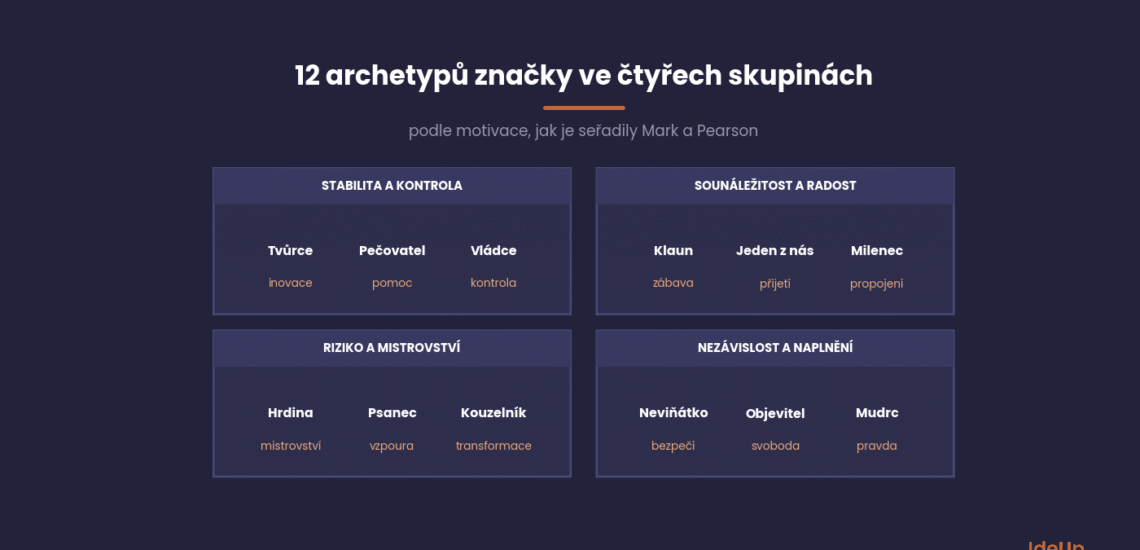
The authors divided the twelve characters into four groups based on the motivation that drives them. The first group seeks stability and control, and includes the Creator, the Caregiver and the Ruler. The second seeks belonging and enjoyment through the Jester, the Everyman and the Lover archetypes. The third group focuses on risk and mastery, represented by the Hero, the Outlaw and the Magician. The final three, the Innocent, the Explorer and the Sage, long for independence and fulfilment.
The twelve brand archetypes at a glance
Each archetype has its own core desire and a typical way of expressing itself. The table below shows how each character comes across in communication and which brands are most often associated with it in overviews. The examples reflect common interpretation, not statements by the companies themselves.
| Archetype | Core desire | Tone of voice | Example brand |
|---|---|---|---|
| Hero | Mastery | Bold | Nike |
| Magician | Transformation | Inspiring | Disney |
| Lover | Connection | Sensual | Victoria’s Secret |
| Sage | Truth | Factual | |
| Innocent | Safety | Optimistic | Coca-Cola |
| Explorer | Freedom | Independent | The North Face |
| Caregiver | Helping others | Kind | UNICEF |
| Outlaw | Rebellion | Rough | Harley-Davidson |
| Creator | Innovation | Original | LEGO |
| Ruler | Control | Confident | Rolex |
| Everyman | Belonging | Friendly | IKEA |
| Jester | Fun | Witty | Old Spice |
A brand does not have to stick to just one character; it can have a primary and a secondary archetype. We recommend no more than one secondary archetype. The main role should dominate and set the direction. The more characters alternate, the harder it is for customers to tell who is speaking to them and what to expect from the brand’s copywriting.
This is clearly visible with Coca-Cola and Pepsi, which sell essentially the same product. Coca-Cola is described as the Innocent, relying on nostalgia, family warmth and joy. Pepsi is classed as the Jester and focuses on humour and fun. Two competing brands with the same product are therefore built on completely different characters.
The Hero, Sage and Creator brand archetypes in more detail
These three archetypes come up often when companies define their identity. Each suits a different kind of promise, and each has its own trap.
The Hero brand archetype
The Hero promises that you can overcome a challenge and come out stronger. Its stories are about effort, discipline and winning. It fits sports brands and fitness services. It also fits B2B companies that help clients solve a difficult problem. In those stories, the customer is the hero and the brand is the coach or the equipment. The trap is arrogance. If the brand puts itself at the centre instead of the customer, the message turns into empty boasting.
The Sage brand archetype
The Sage wants to understand the world and share that understanding. It explains, uses facts and earns trust through expertise. Universities, consultancies, news media and analytics tools often lean on it. The Sage fears being misled or spreading wrong information, so its credibility depends on accuracy. The trap is dryness. A Sage that only lectures can feel distant and cold.
The Creator brand archetype
The Creator wants to make something original and lasting. It values imagination, craft and self-expression, and it often invites customers to create as well. Design studios, art supply makers, design software and toy brands fit here. The Creator fears mediocrity. The trap is perfectionism, where form starts to matter more than what the customer actually needs.
Same brand, different archetypes
When analysing the market, you will quickly find that assigning a brand to a particular archetype is not always clear-cut. Different overviews see the same company differently. Apple appears as the Magician because it changes the world through technology. At the same time, it is often labelled the Creator thanks to its emphasis on design and the creativity of its end users.
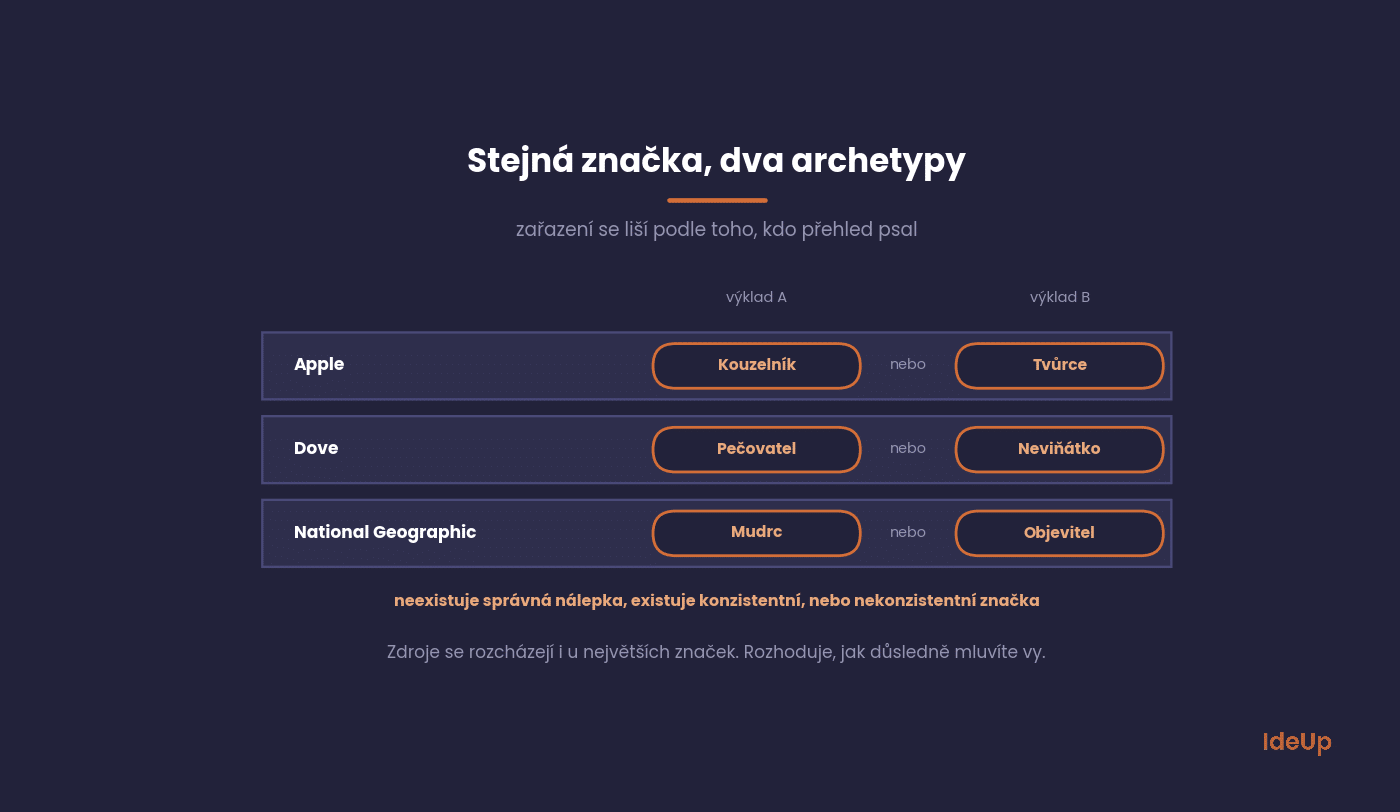
The same goes for Dove, which is often classed as the Caregiver for its long-standing focus on body care. Others see it as the Innocent because of its emphasis on natural beauty and purity. National Geographic also sits on the borderline. Sometimes it acts as the Sage, bringing facts about the world, and at other times as the Explorer, encouraging journeys into the unknown.
It follows that there is no single correct answer. An archetype is an interpretation of identity, not a mathematical formula. What matters most is not the label analysts give a brand, but whether its own communication is internally consistent. A brand that keeps switching personas gives customers no chance to associate it with anything.
How to choose an archetype for your own brand
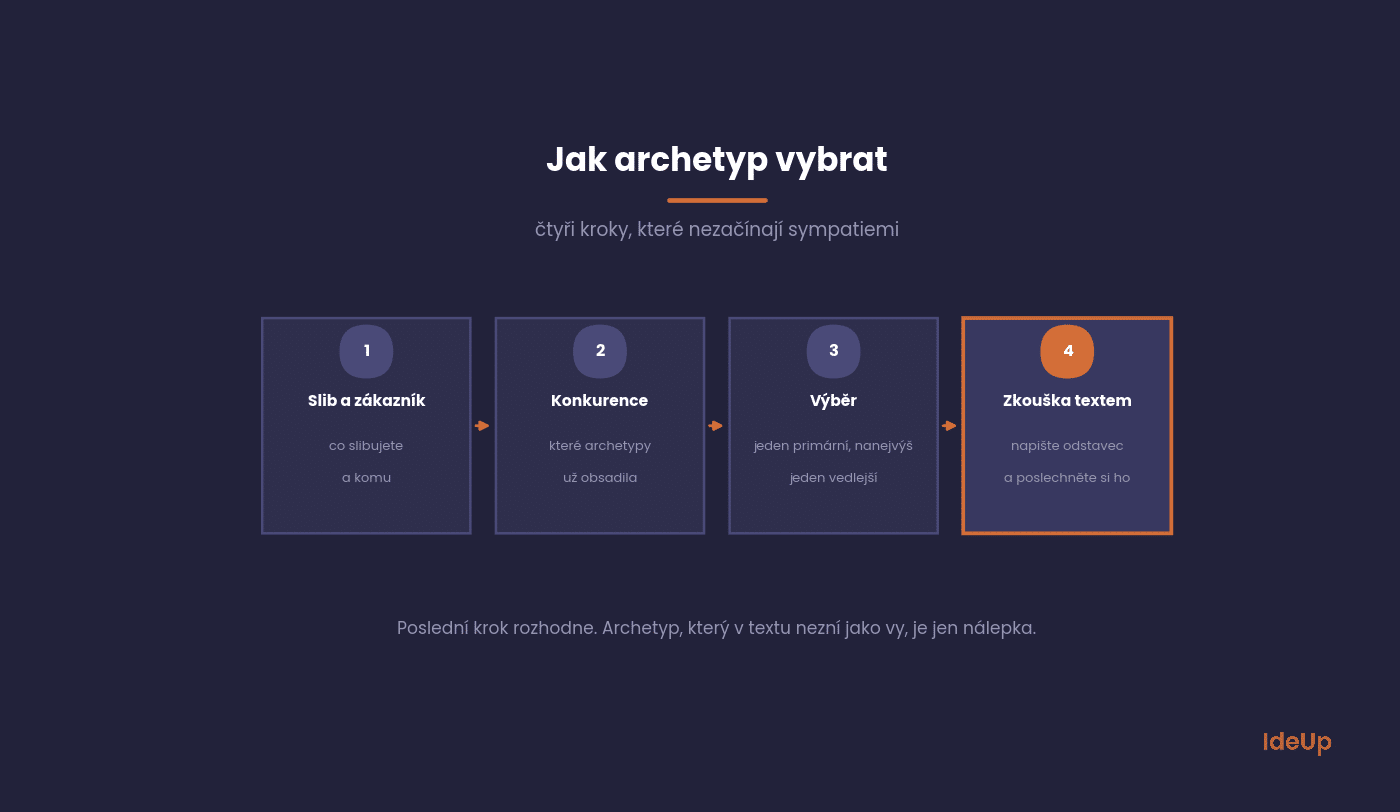
You do not choose an archetype based on which character you like. What matters is the brand promise, the customer and what competitors have already claimed. Four steps have worked well for us.
- Define exactly what you promise and to whom. Answer honestly who you are and what product you offer. You need to know your target audience and why you are addressing these particular people.
- Look at which archetypes your competitors have claimed. If everyone is trying to be a serious Sage, your opportunity may lie in the role of the Jester or the Hero. This is where archetypes meet positioning.
- Choose a primary archetype. It must match your values and what people buy from you.
- Test it on real copy. Try writing a few paragraphs for your website or a social media post and listen to whether it really sounds right.
It also helps to know what each archetype fears most. The Hero fears failure, the Ruler fears chaos. These fears show you which topics to avoid in your communication and what to emphasise in your story.
Common mistakes when working with brand archetypes
Choosing an archetype is the easier part. Most problems appear later, when the brand starts using it every day.
- Treating it as a design exercise. You change the logo and colours, but customer emails, packaging and support replies stay the same.
- Keeping it inside the marketing team. Sales, support and product staff speak to customers too. If they do not know the archetype, the brand sounds different at every touchpoint.
- Promising more than the product delivers. A budget brand posing as the Ruler, or a slow service posing as the Hero, quickly loses trust.
- Using a different character on each channel. Playful on social media, stiff on the website and cold in invoices is not a personality, it is confusion.
- Ignoring the shadow side. Every archetype has an exaggerated form. The Hero can become arrogant, the Sage condescending and the Creator self-absorbed.
How to turn an archetype into a brand voice
Once you have chosen an archetype, you need to translate it into writing rules. Take the message that you dispatch orders within twenty-four hours. The Sage writes it factually: “Your parcel will be dispatched within one day.” The Jester goes for exaggeration: “Before you can blink, your parcel is on its way.” The Caregiver reassures you: “We’ll take care of your order right away, and within 24 hours it will be on its way to you.”
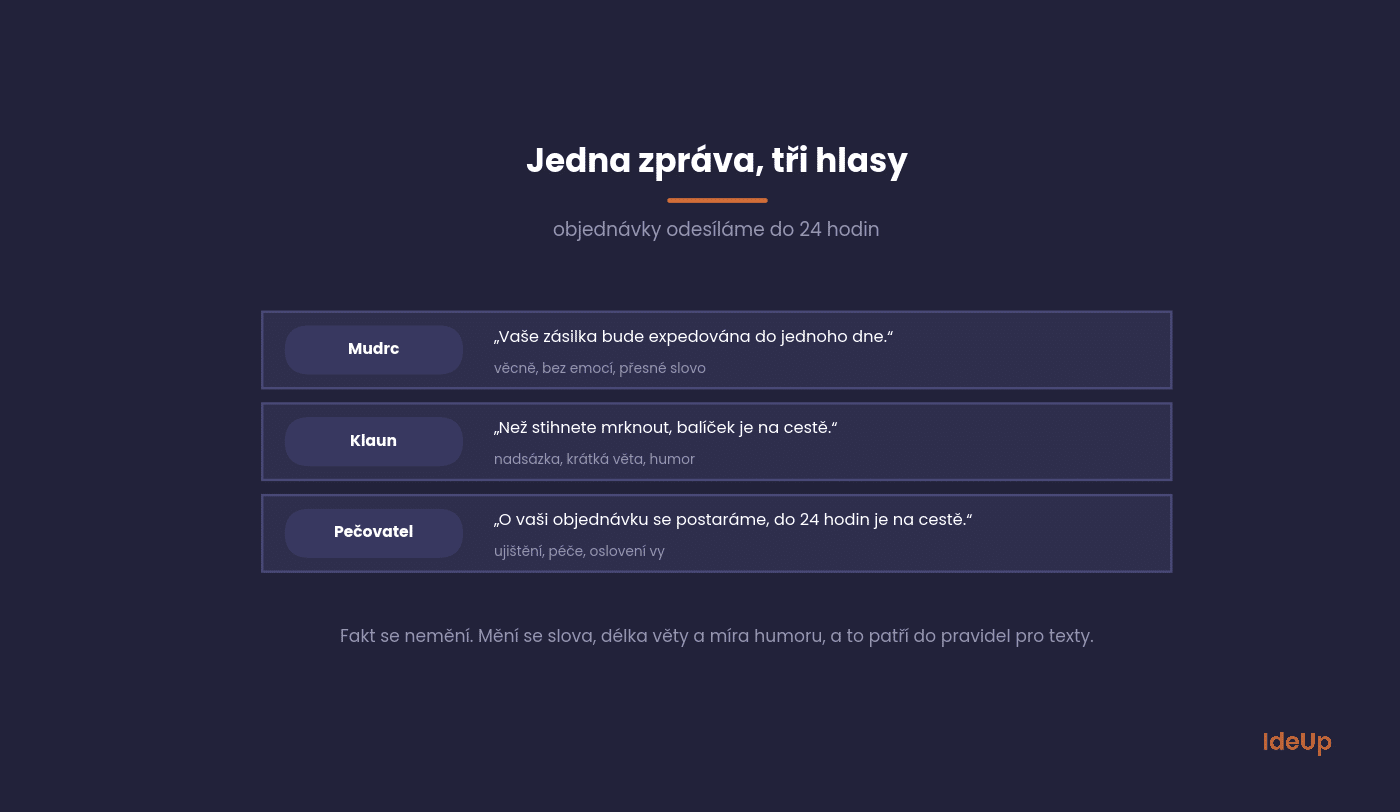
The archetype gives rise to rules for tone of voice. Decide which words you will use and make a list of banned expressions. Define sentence length. The Sage can afford more complex sentences, while the Everyman speaks briefly and directly. Decide whether there is room for humour in your communication and what kind of jokes are acceptable. Without these rules, the archetype remains just theory.
One example of a strong character is Alza and its green alien. Alzák first appeared in a radio advert back in 2005. Our interpretation is that Alza has long used the Jester archetype. In its Christmas 2024 campaign, the company gave Alzák a family representing its customers, and according to Alza, Alzák now focuses on the role of companion, guide, adviser and helper. Previously, he had appeared in various roles, including that of a customer.
This shows that even a very distinctive character needs a clearly defined role. When a mascot gives advice one time, goes shopping the next and cracks jokes the third, the archetype becomes diluted.
Where archetypes stop working
In their book, Mark and Pearson cite an analysis of data from the Young & Rubicam agency covering 50 well-known brands. According to this analysis, brands with a clear archetype increased their market value added over six years by 97% more than brands mixing several archetypes. It should be added, however, that this is a correlation drawn from agency data. There is no independent study with a public methodology confirming that this growth was caused by the chosen archetype.
As a measured model of brand personality, Jennifer Aaker’s 1997 scale is more commonly used. It was based on ratings of 37 brands by 631 respondents and defines five dimensions, including sincerity, excitement and competence. Archetypes, by contrast, are more of a storytelling method. If your product is weak or you lack well-thought-out positioning, no character will save you.
Another risk is sliding into caricature. In 2013, Alza won a poll by the Markething.cz website for the most annoying advert, yet it still keeps its Jester to this day. Among the top Google results in the USA for the query brand archetypes, there are also posts calling archetypes outdated and confusing. At IdeUp, we therefore use them as a point of reference, not as dogma.
Where to start
If you want to give your brand a clear voice, three steps are enough to get started. First, go through your last three social media posts and assess whether they speak in the same tone. Next, list five qualities your ideal spokesperson should have. Finally, choose the one archetype that best matches these qualities and write five copy rules for it.
An archetype is just one piece on which the whole of brand building rests. If you are unsure of your direction, we at IdeUp will help you set rules that will not just stay as theory in a drawer.
Frequently asked questions about brand archetypes
What is a brand archetype?
A brand archetype is a recognisable character type that a brand adopts to shape its voice, stories and visual style. It is based on universal patterns, such as the Hero or the Sage, that people understand intuitively. The aim is to make the brand consistent and easy to relate to.
Did Carl Jung create the brand archetypes?
No. Jung introduced archetypes into psychology, but he never applied them to brands or listed a fixed set of twelve. The twelve brand archetypes were developed later by Carol Pearson and Margaret Mark, who built on his ideas.
What are the types of brand archetypes?
The usual system has twelve types, from the Innocent and the Explorer to the Ruler and the Jester. They are grouped into four sets by core motivation, such as stability or belonging. Most brands use one primary archetype, sometimes supported by a secondary one.
What is the difference between brand personality and brand archetypes?
Brand personality is the set of human traits people associate with a brand, such as sincere or competent. An archetype is a ready-made character that bundles those traits into a story. You can think of the archetype as a tool for building and expressing a brand personality.
Leave A Reply