
SMS marketing means sending commercial and service messages to customers by SMS. It works even for people without a smartphone or internet access, and the message appears on the screen without the person having to open an app. That makes it suitable for messages with a short shelf life, such as a same-day offer, an appointment reminder or a parcel ready for collection.
That advantage comes at a price. A single SMS costs anything from a few tens of hellers to one crown depending on volume, while an extra email costs almost nothing. The rules are strict, and the line between a useful message and a nuisance is thinner than with email, because people carry their phones with them all the time.
Transactional and marketing SMS follow different rules
A transactional (sometimes called service) SMS informs the customer about something they triggered themselves: an order confirmation, a parcel at a pick-up point, a booking reminder or a verification code. It promotes nothing, so it does not fall under the definition of a commercial communication. People expect it and nobody unsubscribes from it.
A marketing SMS promotes goods, a service or a company: a discount, a promotion, a new product, an invitation. Marketing SMS is covered by the Act on Certain Information Society Services (zákon o některých službách informační společnosti, Act No. 480/2004 Coll.) with everything that comes with it, namely consent, labelling and the option to unsubscribe.
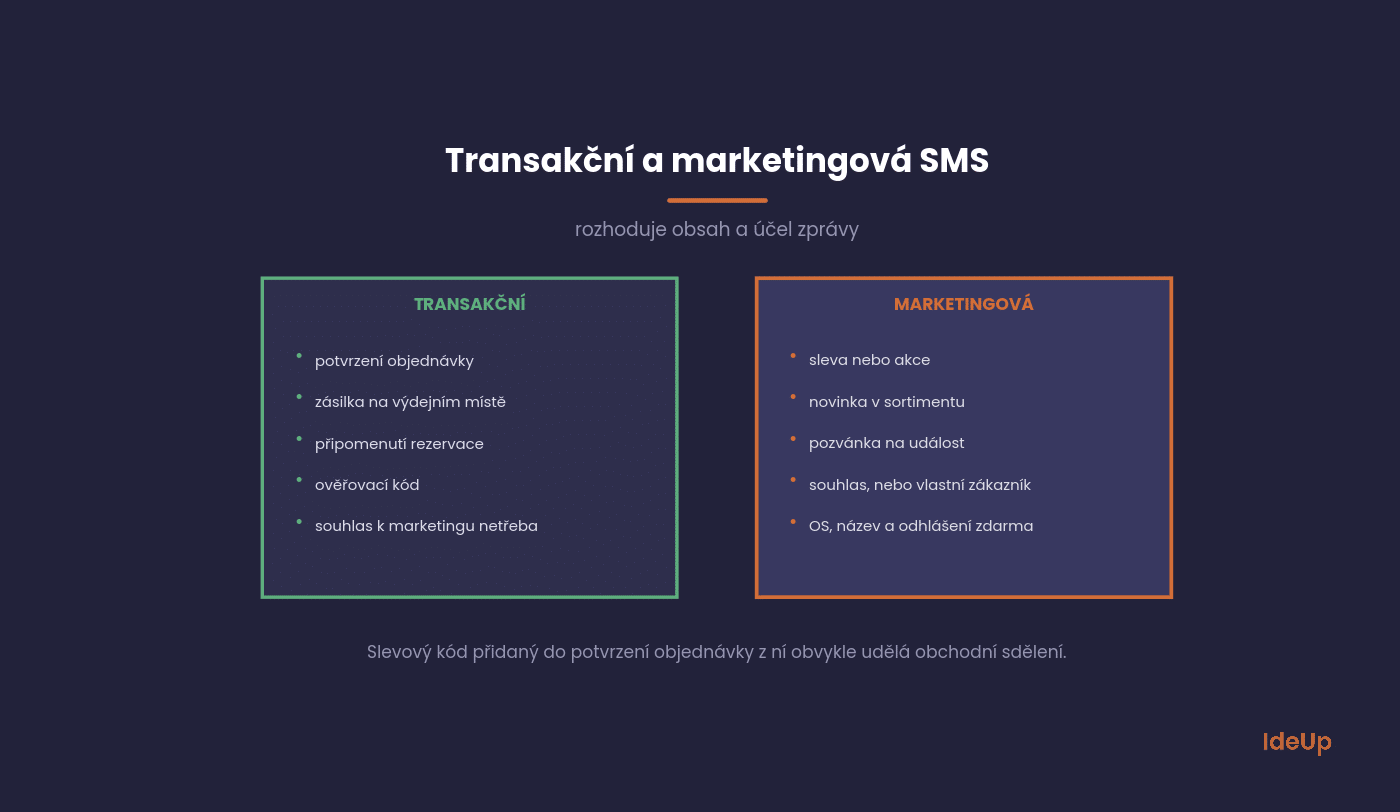
Watch out for hybrids. Whether a message is a commercial communication depends on its content and purpose. If you add a discount code for a future purchase to an order confirmation, you are promoting goods, and the service message usually becomes a commercial communication with all the obligations that entails.
When SMS makes sense for online shops and services
SMS makes sense where timing matters and the message is short. For services with bookings, such as hairdressers, car repair shops or medical practices, that means an appointment reminder the day before. It stops people forgetting, and it is a message they genuinely want to receive.
A restaurant can send regular guests the lunch menu in the morning, a hotel or guesthouse can fill free dates outside the season, and a financial adviser can send a reminder of a contract anniversary. An online shop will turn to marketing SMS for a time-limited promotion, for customers who regularly restock consumables, or when a product someone was watching is back in stock.
SMS becomes a nuisance when you send it to your whole database every week, or when it carries a message that an email would handle just as well. A newsletter with five tips does not belong in an SMS. Split your database by who bought and when, and send SMS only to the group for whom the message is genuinely relevant. The segmentation entry explains how.
SMS is therefore not a replacement for email but a complement for the few messages that cannot wait. Leave regular communication, stories and longer offers to email marketing, where each additional contact costs you next to nothing.
SMS and email marketing compared
If you use both channels, give each a clear job. Email suits content people read when they have time. SMS suits messages they need to see within a few hours.
- Length. An email has room for images, several products and a story. An SMS holds one offer and one link.
- Cost. With SMS you pay per message, so every extra recipient adds cost. With email the cost barely changes with the size of your list.
- Format. Email allows design and branding. SMS is plain text, so the wording has to do all the work.
- Tolerance. People accept several emails a week from a brand. The same frequency by SMS quickly leads to opt-outs.
A practical split for an online shop is to announce a sale by email and send a short SMS reminder on the last day, only to customers who clicked the email or have bought from you before.
What a marketing SMS must meet under the law
Under Act No. 480/2004 Coll., SMS counts as electronic mail, so the same rules apply as for commercial emails. Oversight lies with the Office for Personal Data Protection (Úřad pro ochranu osobních údajů, ÚOOÚ). A company that sends commercial communications in breach of the law faces a fine of up to 10 million CZK (about 460,000 USD).
You may send one in two cases. Either the recipient has given you prior consent, or they are your customer, you obtained their number through a sale, and you are offering them your own similar goods or services. According to the ÚOOÚ, a customer is only someone who has concluded a contract with you. A competition entrant or someone who has merely downloaded a catalogue is not a customer, and you need their consent.
The customer exception has one more condition. The person must be able to opt out at the moment they give you their number, for example with a box saying “I do not wish to receive commercial communications”, and then again in every message. Without this, the exception does not apply.
Every marketing SMS must then contain three things, whether you send it with consent or to a customer. The Office describes them quite specifically in its answers to frequently asked questions.
- A label stating that it is a commercial communication. For SMS, the abbreviation OS (obchodní sdělení) at the start of the message is enough.
- The name of the company on whose behalf you are sending the message. It can also appear in the alphanumeric sender ID. If someone else sends the message, such as an agency, both names must be included.
- A free way to unsubscribe. A phone number the person can call free of charge or send an opt-out message to. According to the ÚOOÚ, a link alone is not fully sufficient for SMS, because not everyone has a smartphone or internet access. If you send from an alphanumeric sender ID that cannot be replied to, include the number directly in the text. A free 800 number works for calls, but on Czech networks you usually cannot send an SMS to it. For opt-outs by message, use a number provided by your SMS gateway and check that it is free for the recipient.
In a dispute, it is you who must be able to prove consent, so keep a record of who gave it, when and where. For email, the ÚOOÚ recommends double opt-in, and in its view the same principle can be applied to phone numbers. It is not mandatory, but it is the simplest proof.
Three common shortcuts do not comply. A pre-ticked box is not consent, and neither is consent hidden in the terms and conditions, because the GDPR requires the request for consent to be clearly distinguishable from other matters. A purchased database of numbers will not pass either, as consent must be given to a specific sender, that is, to you.
After someone unsubscribes, no further commercial SMS may be sent to them. Connect the opt-out number directly to your database so the contact is removed immediately, not at the next manual check. In grey areas, for example when you take over another company’s database as part of an acquisition, a short consultation with a lawyer is worth it.
How much SMS marketing costs
You pay for every SMS sent. According to the public price lists of Czech SMS gateways, one message at volumes in the thousands costs roughly 0.80 to 0.90 CZK (about 0.037 to 0.041 USD) excluding VAT. SmsManager lists 0.89 CZK (about 0.041 USD) for 5,001 to 10,000 messages, and VIPTel 0.80 CZK (about 0.037 USD) per SMS to Czech networks regardless of volume. For large volumes the price falls, with GoSMS starting at 0.41 CZK (about 0.019 USD). We checked the price lists in October 2026.
On top of that comes the alphanumeric sender ID, that is, the company name instead of a number. It is registered with the mobile operators, has a maximum of 11 characters without diacritics, and SmsManager, for example, charges 500 CZK (about 23 USD) one-off and 500 CZK (about 23 USD) per month for it.
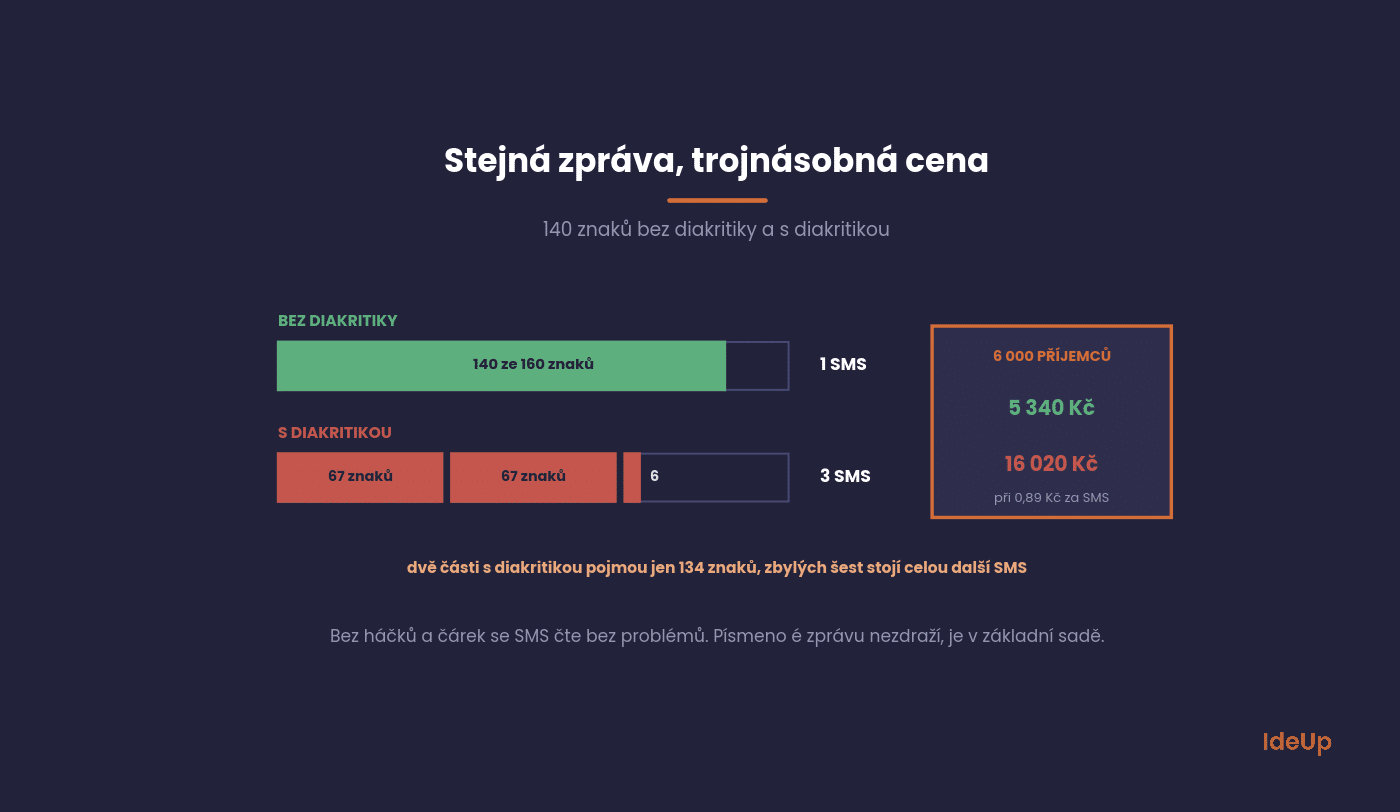
Often, though, diacritics eat up the most money. An SMS without Czech accents holds 160 characters. A single character outside the basic set, such as č or ř, is enough to switch the whole message to a different encoding with a 70-character limit. A longer message is split into parts of 153 characters, or just 67 with diacritics, and each part is charged as a separate SMS.
For a 140-character message, this makes a big difference. Without diacritics, it is one SMS. With diacritics, even two parts are not enough, because they only hold 134 characters, so three are sent. For simplicity, we use a single price of 0.89 CZK (about 0.041 USD), which would be slightly lower at higher volumes.
| Campaign to 6,000 recipients | Without diacritics | With diacritics |
|---|---|---|
| Message length | 140 characters | 140 characters |
| SMS per recipient | 1 | 3 |
| Total sent | 6,000 SMS | 18,000 SMS |
| Cost at 0.89 CZK (about 0.041 USD) per SMS | 5,340 CZK (about 250 USD) | 16,020 CZK (about 740 USD) |
Some characters behave differently than you might expect. The letter é is in the basic set, so the word “nové” (new) does not make the message more expensive, but the word “levnější” (cheaper) does. The € sign and square brackets take up two characters each, and an emoji switches the message to 70 characters just like a háček.
When planning, calculate the cost per order, not per SMS sent. We look at how to track cost per order across channels in performance marketing for online shops.
How to write an SMS that does not look like spam
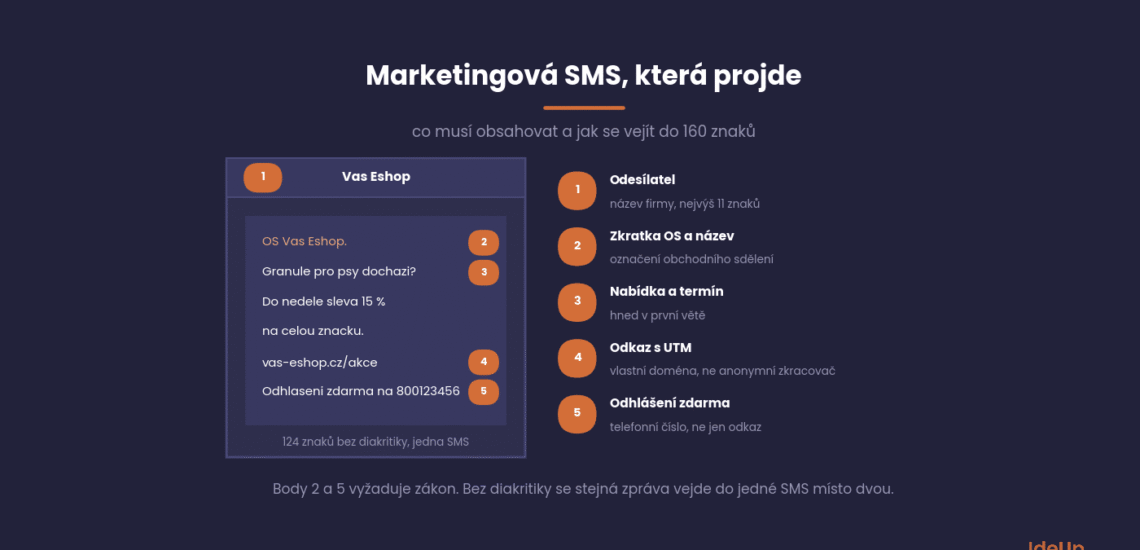
A good marketing SMS has five parts and fits into 160 characters. It contains a sender the person recognises, the abbreviation OS with a specific offer in the first sentence, a deadline or limitation, a link and an opt-out. This is how a message from a pet food online shop might look (the name, address and number are fictitious).
“OS Vas Eshop. Granule pro psy dochazi? Do nedele sleva 15 % na celou znacku. vas-eshop.cz/akce Odhlaseni zdarma na 800123456” (OS Your Eshop. Running out of dog food? 15% off the whole brand until Sunday. vas-eshop.cz/akce Unsubscribe free on 800123456)
The message has 124 characters and is sent as one SMS. With Czech accents, the same text would come to two. Do not write in capitals, do not put an exclamation mark after every sentence, and only address people by name if the names in your database are clean and correctly declined. The vocative case also often contains a háček (Jiří, Petře), which switches the message to the more expensive encoding.
Shorten the link, but use your own domain or the gateway’s shortener. An anonymous shortener looks just like the links in fraudulent SMS. Add UTM parameters to the link, otherwise you will not find the campaign in your analytics.
Choose the sending time based on when the person can respond. Send a lunchtime offer in the morning and a weekend discount on Thursday or Friday. In the evening and at night, an SMS feels like an interruption. Be more sparing with frequency than with email. We describe what keeps people engaged with regular messages in our guide how to write a newsletter.
How to measure an SMS campaign
Open rates cannot be measured for SMS. SMS has nothing like the tracking pixel in email, so the figures of 98% of messages read that circulate on providers’ websites have never been measured by anyone. Do not rely on them when planning. Five other things can be measured, and together they tell you more than any open rate.
| What to measure | Where | What it tells you |
|---|---|---|
| Delivery | delivery reports in the gateway interface | how many numbers are invalid |
| Clicks | UTM-tagged link in Google Analytics 4 | whether the offer caught attention |
| Orders and revenue | GA4 or the online shop, by UTM and discount code | how much revenue and margin the campaign brought |
| Opt-outs | number of opt-outs per thousand sent | whether you send too often or to the wrong people |
| Incremental benefit | comparison with a control group | how much people would have bought without the SMS |
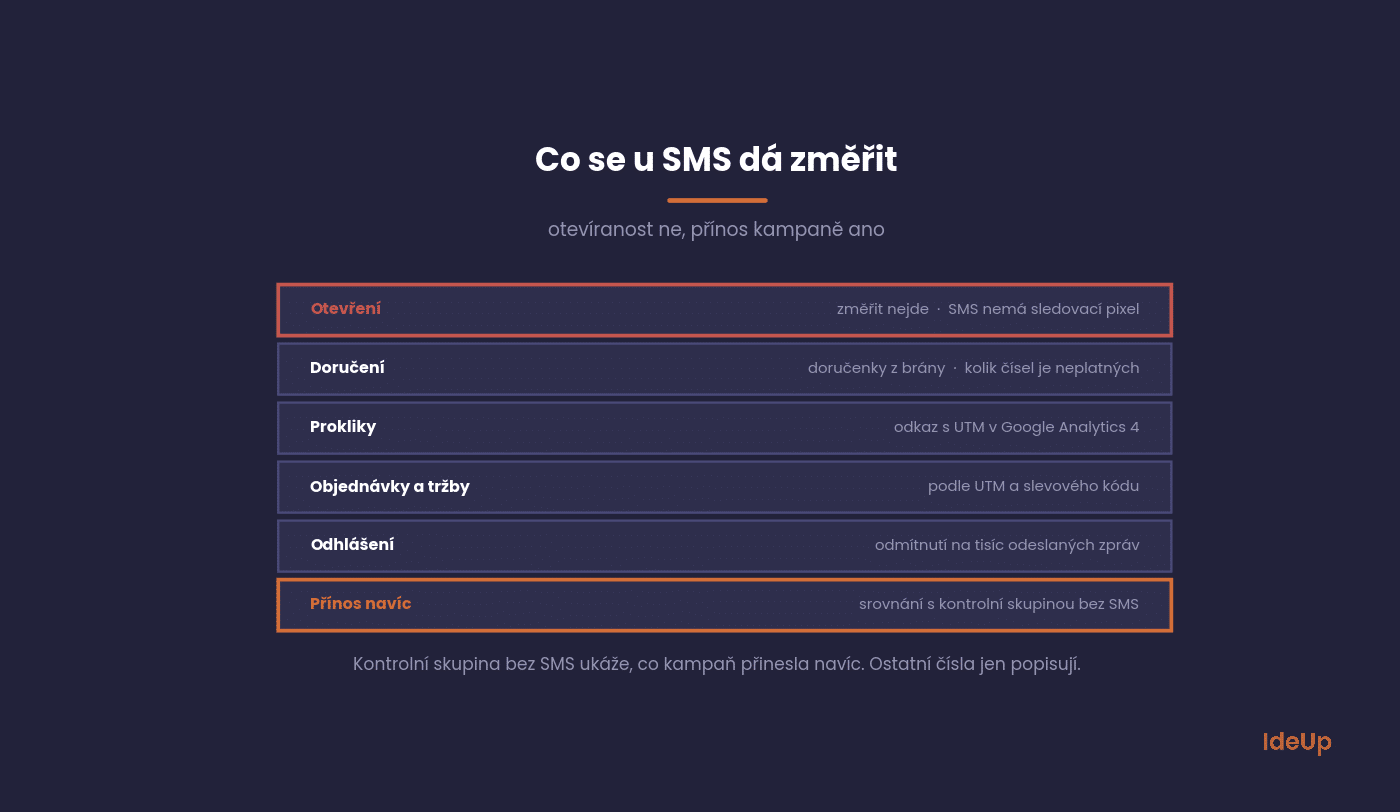
Of the five numbers, the control group is the most valuable, yet in practice it is often forgotten. Randomly select part of your target audience, for example a tenth, who will not receive the SMS, and after the campaign compare the share of people who made a purchase in each group. If both groups are chosen at random and are large enough, the difference between them is the best estimate of the additional value the SMS brought.
It all depends on measuring orders correctly. Without that, you will not even see the difference between the groups. You will find the steps in our article on setting up Google Analytics 4.
How to calculate the ROI of SMS marketing
ROI compares what a campaign earned with what it cost. Use the margin from additional orders, not total revenue, because revenue still includes the cost of the goods. The formula is additional margin minus campaign cost, divided by campaign cost.
An illustrative example. Your campaign costs 300 USD. Compared with the control group, it brings orders with an extra margin of 900 USD. ROI is 900 minus 300, divided by 300, which gives 2, or 200%. If the extra margin had been 250 USD, ROI would be negative and the campaign would have lost money, even though it produced some sales.
Can I send SMS messages to people who have already bought from me?
Yes, if you obtained the number during a sale, you are offering your own similar products or services and the customer was given the option to refuse. A pet food retailer can write about food and treats, but not about insurance from a partner.
Each message must still include the abbreviation OS (obchodní sdělení, commercial communication), the company name and a free opt-out. The exception does not apply to people who have never bought from you, even if they registered or entered a competition.
Can I buy a database of phone numbers?
In practice, no. Consent must be given to a specific sender, and whoever sells the database cannot pass it on to you. Both the sender and the company on whose behalf the messages are sent are responsible for the mailing.
Build your database from your own customers and from prospects who sign up themselves, for example when making a booking or setting up a stock alert. It will be smaller, but the people in it expect your messages.
Is Viber or WhatsApp worth using instead of SMS?
As a replacement for SMS, probably not. As a cheaper first attempt, yes. SmsManager’s price list states 0.39 CZK (about 0.018 USD) per message via Viber and 0.54 CZK (about 0.025 USD) via WhatsApp. However, messages are only delivered to people who use the app, and according to the same price list, around 15% of messages usually get through via Viber.
That is why gateways offer a combination where delivery is first attempted through the app and the remaining recipients receive the message as an SMS. Check their consent rules just as carefully as you would for SMS.
Before you send your first campaign
Go through your database and find out which numbers have documented consent and which belong to customers who were given the option to refuse. The rest do not belong in the campaign. Then set up a free opt-out number and connect it to your database.
Write a message without diacritics of up to 160 characters, add a link with UTM parameters and send it first to a smaller segment with a control group. Only when the margin from the additional orders exceeds the cost of the campaign should you extend it to more customers.
If you want to connect SMS with email and revenue tracking, write to us about the database you have and what you want to sell, and we will propose a first campaign, including a control group.
Frequently asked questions about SMS marketing
What is the best time to send SMS marketing?
There is no single best hour for every business. Send when the recipient can act on the offer, which usually means during the day and well before the deadline. If you are unsure, test two sending times on comparable segments and compare orders, not just clicks.
What do SMS marketing laws usually require?
Most countries that regulate marketing texts share the same core principles. You need a lawful basis to contact the person, usually their consent, you must identify yourself as the sender, and you must offer an easy way to opt out. The details differ from country to country, so check the local rules before you send messages to recipients abroad.
Is SMS marketing worth it for a small business?
It can be, especially if your business depends on bookings, repeat visits or time-limited offers. A small database of regular customers who asked for your messages often performs better than a large list of loosely related contacts. Start with a small campaign and calculate the return on margin before you scale up.
USD amounts are approximate, converted at the Czech National Bank rate of 21.75 CZK per USD on 9 October 2026.

Leave A Reply