For Czech e-shops, price comparison sites are one of the biggest sources of orders, and also the least thought-through. A feed goes live, a default cost per click is set, and from then on you just pay.
The result is often a channel that brings in plenty of orders and almost no profit. It looks good in revenue and bad in margin.
This article explains when price comparison sites pay off, how to manage them by margin rather than by position, and when it is better to switch off part of your product range.
How price comparison sites work economically
You pay per click and compete mainly on price. This means you enter the channel at a disadvantage if you are not the cheapest.
At the same time, these are people with the highest purchase intent you will find on the market. They have come to choose where to buy, not whether to buy.
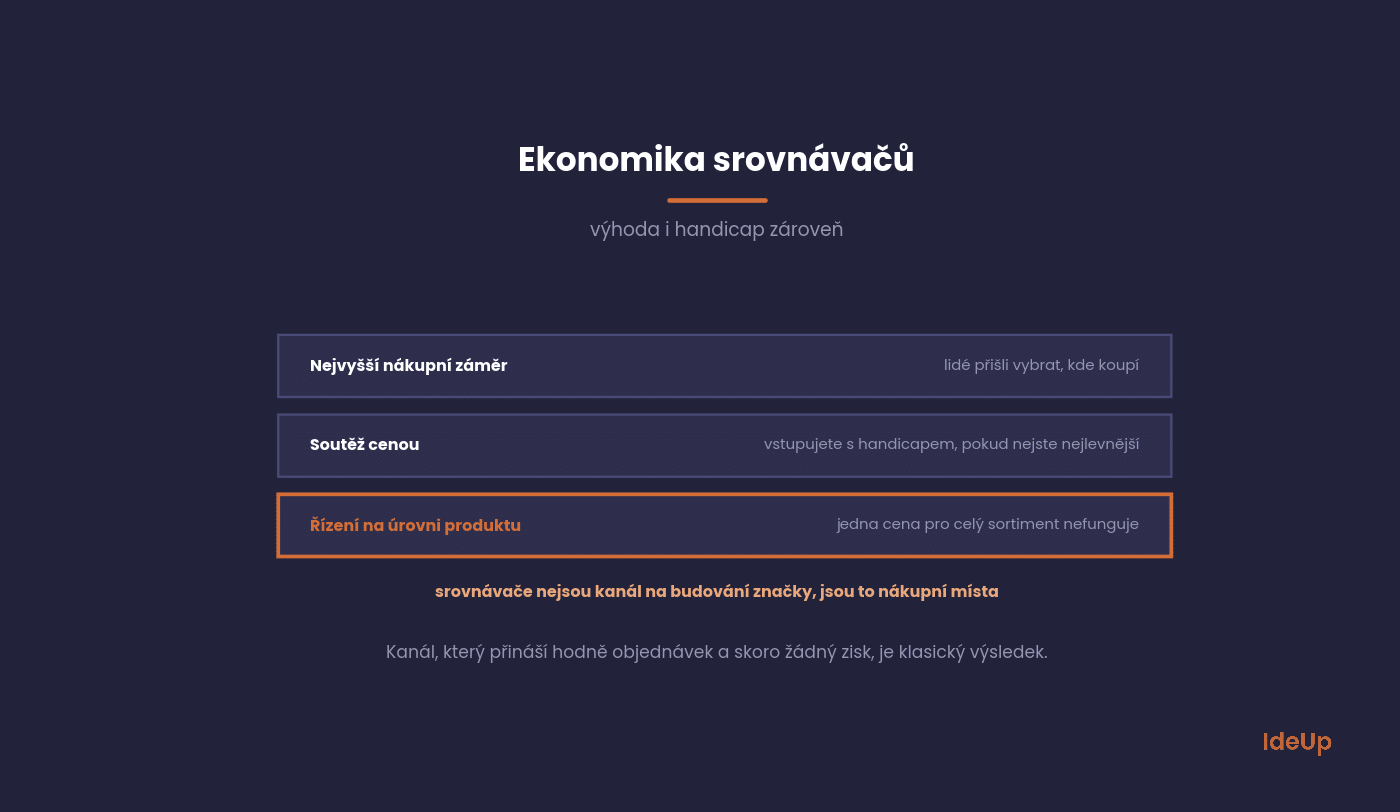
This leads to the first practical conclusion. Price comparison sites are not a channel for brand building. They are places to buy, and they behave accordingly.
The second conclusion is that they can only be managed at product level. Setting one cost per click for your whole range means losing money on low-margin items.
What comparison shopping engines are and how they work
Comparison shopping engines are price comparison sites in the international sense. They collect product offers from many online stores and show them side by side, so a shopper can compare price, delivery and store rating in one place. The shopper then clicks through to the store and buys there.
The process usually runs in four steps.
- You send a product feed. A file with titles, prices, availability, images and identifiers such as EAN codes, updated regularly.
- The engine matches your products. It pairs your items with the same products from other stores and places them in categories.
- Your offer is ranked. Price, cost per click, rating and delivery terms affect where you appear.
- You pay for the visit. The order itself happens on your website, not on the engine.
This is the main difference from a marketplace. On a marketplace the customer buys inside the platform and you usually pay a commission on the sale. On a comparison shopping engine you pay for traffic and keep the customer relationship, including their contact details.
When they pay off and when they do not
What matters is margin and whether your product is comparable. Where products can be compared item for item, price decides.
Four situations come up again and again.
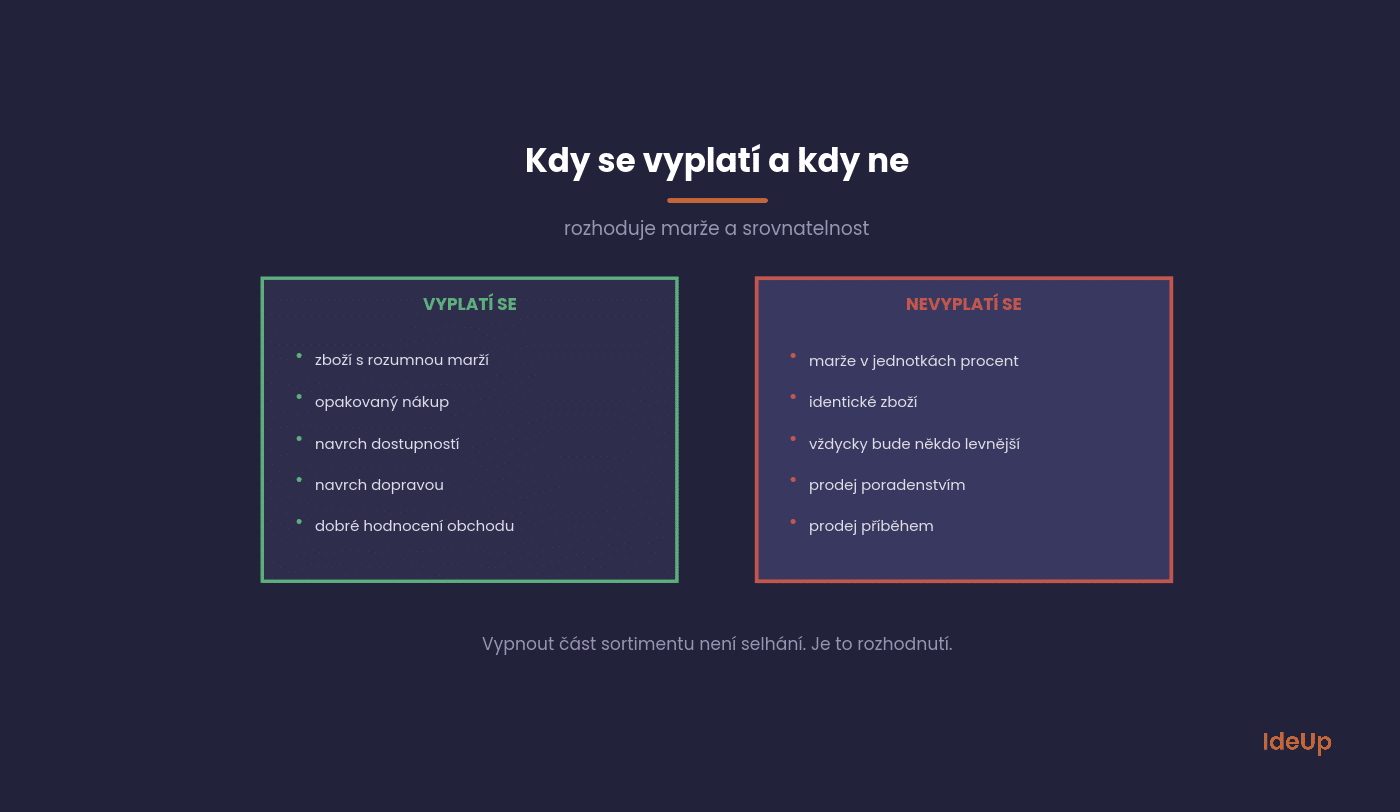
They pay off for goods with a reasonable margin, for products that are bought repeatedly, and where you have an edge in availability or delivery.
They do not pay off for identical goods with a single-digit percentage margin, where someone will always be cheaper, or for products sold through advice or a story.
Watch out for the repeat purchase trap. If customers buy from you repeatedly, you can afford to sell the first order below break-even. Without knowing customer lifetime value, though, this is a gamble, as we explain in performance marketing for e-shops.
How to set cost per click
This is where the profitability of the whole channel is decided. The process takes more work than the default settings, but it pays for itself within a month.
Three steps are enough.
Split your range by margin. Not by category, but by how much you earn per item. You will usually end up with three groups.
Work out the limit for each group. How much you can pay per order and how many clicks an order costs on average. This gives you the maximum cost per click.
Switch off what does not pay. For items where the cost per click would have to be below the site’s minimum, the channel simply does not work. Switching them off is a legitimate decision.
Most e-shops list their whole range on price comparison sites at the same cost per click. This means high-margin items subsidise the loss-making ones.
What matters besides price
Price is the strongest factor, but not the only one. Several things affect whether someone chooses you when prices are similar.
All of them can be improved without a discount.
Availability and delivery time. In stock for tomorrow beats goods that are 200 CZK (about 9.2 USD) cheaper but arrive in two weeks.
Store rating. It is shown directly in the listing. The difference between four and five stars is visible.
Feed quality. The title, image and attributes decide whether the product is matched to the right category at all. Google Shopping works in a similar way, as we explain in Google Merchant Center.
Free delivery from a lower order value. Price comparison sites count the total price including delivery. This is often the biggest hidden difference.
How to choose the best comparison shopping engines for your store
There is no single list of top comparison shopping engines that suits every store. The right choice depends on your market, your range and how you sell. Before you add a new engine, check a few things.
- Reach in your country. An engine that is strong in one market may have almost no shoppers in another.
- Fit with your categories. Some engines are strong in electronics, others in home goods or fashion.
- Pricing model. Find out whether you pay per click, per order or a flat fee, and what the minimum bid is.
- Feed requirements. Check which format and attributes are required and how often prices and stock are refreshed.
- Reporting. You need data at product level, otherwise you cannot manage the channel by margin.
Start with one or two engines and test them on a limited part of your range for a few weeks. Add more only when the first ones are profitable.
What to measure
The most common mistake is tracking return for the channel as a whole. The average hides the fact that half the range is losing money.
Measure at product level, or at least at group level.

Margin after click costs. The only number that tells you whether it pays off. Not revenue, not return.
Share of new customers. If a price comparison site mainly brings returning customers, you are paying for people you already have.
Return rate. In some categories it is significantly higher for orders from price comparison sites, which reduces real margin.
Customer lifetime value. It decides whether you can afford to sell the first order below break-even.
What to avoid
The following mistakes cost Czech e-shops the most money.
All of them are fixed through settings, not budget.
One cost per click for the whole range. The most expensive mistake of all.
Competing for first position at any cost. Position is not the goal. Profit is.
Outdated availability in the feed. You pay for clicks on goods you do not have.
Ignoring store ratings. A low rating makes every click more expensive, because people do not choose you.
Pros and cons of comparison shopping engines
Before you commit budget, weigh both sides.
Pros. Shoppers are ready to buy. You control your cost per click item by item. The customer orders on your website, so you can sell to them again without paying for the next visit.
Cons. Competition is mostly on price. Clicks cost money even when nobody buys. Feed errors can quietly waste budget, and the work of maintaining the feed never stops.
A simple illustrative example. If an item earns you 20 USD in margin and you need about 25 clicks for one order, every click above 0.80 USD turns that order into a loss.
Common questions about price comparison sites
The five questions e-shops ask us most often.
The answers apply in general; the numbers differ by category.
It depends on the category. For goods that people compare a lot, it is often a substantial share; for specialist ranges, it is minimal.
Decide based on margin after costs, not on share of revenue.
Are paid programmes and certifications worth it
Programmes such as verified store schemes increase trust and are often visible in the listing. For a new e-shop with no rating history, this helps a lot.
For an established store with good ratings, the benefit is smaller.
Should we list our whole range
No. List only what pays off and switch off the rest. Switching off half your range is not a failure, it is a decision.
At the same time, check whether switching items off has reduced the store’s overall visibility.
Not directly, but indirectly very much so. The quality of product data, meaning titles, attributes and availability, is the same for the feed and for your website.
Working on the feed usually means your product pages improve too. The same data powers both the feed and your website.
What to do if we are always the most expensive
Either find another advantage, such as availability, delivery or service, or leave the channel for that part of the range.
Trying to match prices on low-margin goods ends in selling at a loss.
Where to start
Export orders from price comparison sites for the last quarter and add the margin and click costs to them. Split them into three groups by result.
For the worst group, simply switch off the campaign for a month and compare total profit, not revenue. The answer is often surprising.
Want to go through it, including your feed and how it connects to your other channels? Get in touch via our contact page or browse our services.
Frequently asked questions about comparison shopping engines
What are comparison shopping engines?
They are websites that collect product offers from many online stores and display them side by side. Shoppers compare price, delivery and ratings, then click through to buy on the store’s own website. Stores usually pay for each click they receive.
Which are the top comparison shopping engines?
It depends on the country and the category. Google Shopping is used in many markets, while local engines often lead in individual countries. Choose based on reach in your market and on the profit each engine brings you, not on its overall size.
What is the difference between a comparison shopping engine and a marketplace?
On a comparison shopping engine you pay for a visit and the order is completed on your website. On a marketplace the customer buys on the platform and you usually pay a commission. With an engine you keep the customer relationship.
Are comparison shopping engines worth it for a small online store?
They can be, if you have products with a reasonable margin and a well-maintained feed. Start with a small part of your range and one engine. Expand only when margin after click costs is positive.
USD amounts are approximate, converted at the Czech National Bank rate of 21.75 CZK per USD on 9 October 2026.