In most companies, the description of the target audience takes one of two forms. Either “men and women aged 25 to 55 on a middle income”, or a five-page persona with a name, a photo and a favourite café.
You cannot decide anything based on the first. You cannot based on the second either, it just took longer.
This article explains how to describe your target audience so you can use it to choose a channel, write copy and decide on a budget.
Why demographics are not enough
Age and gender were useful when people bought TV advertising. Today you target behaviour and situations, not categories of people.
Two 40-year-old men on the same income can be completely different customers. One is just starting a business, the other has been running his for twenty years.
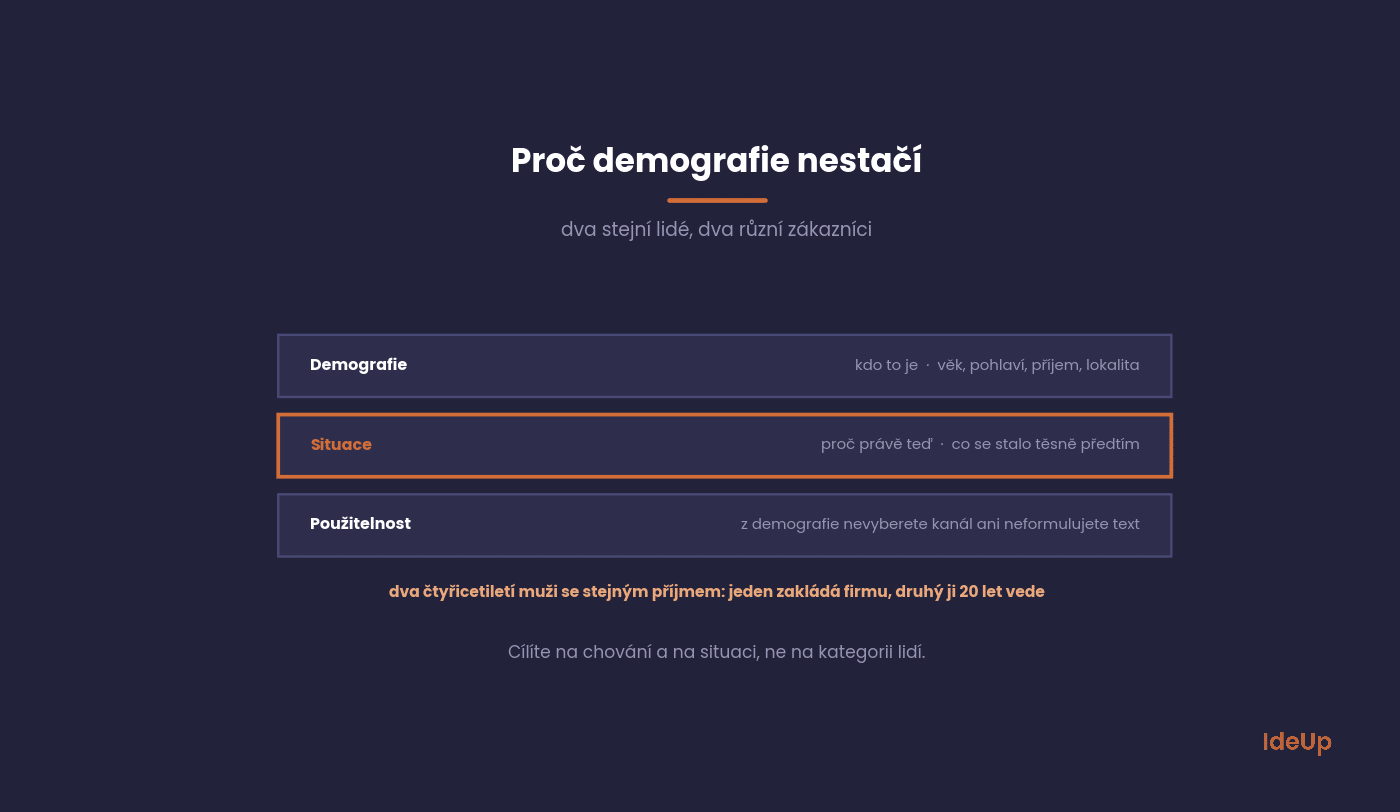
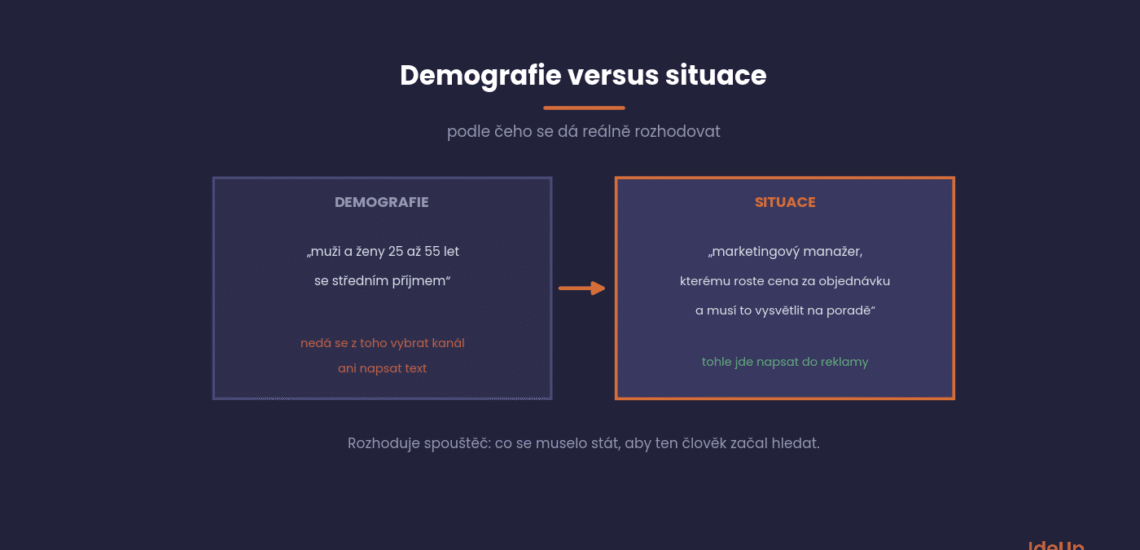
The trigger is what matters. What had to happen for that person to start looking for what you sell? The answer to this question is more useful than an entire demographic profile.
In practice: instead of “marketing managers at e-shops”, write “a marketing manager whose cost per order has been rising for a year and who has to explain it at a meeting”. You can put the second one into an ad.
What a target audience is in marketing
A target audience is the specific group of people you want to reach with a particular message, campaign or product. It is narrower than everyone who could possibly buy from you. It is the group you choose to address first because they are the most likely to respond and the most valuable to you.
Target market vs target audience
The target market is the whole group of buyers a company serves, for example small accounting firms in Central Europe. The target audience is the part of that market you address with a specific campaign, for example owners of those firms who have just lost a key employee.
One target market usually contains several target audiences. Each of them needs a different message, even when the product stays the same.
Six things you need to know about your target audience
A useful description fits on half a page and answers six questions. More information usually means you are collecting rather than deciding.
Phrase every answer in the customer’s words, not your own.
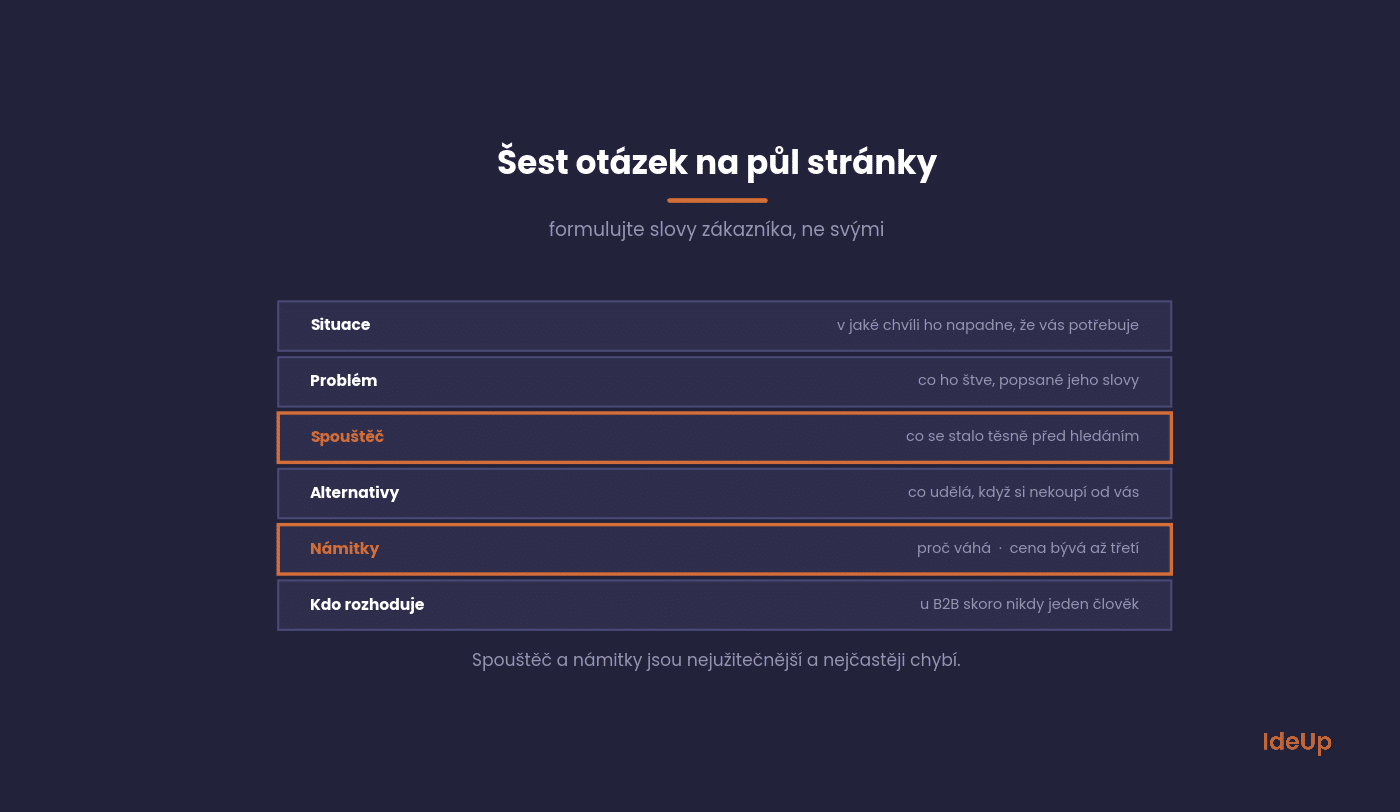
Situation. The moment a person realises they need something like you.
Problem. What specifically frustrates them, described in their words. Not in your product language.
Trigger. What happened just before they started looking. A contract ending, a drop in sales, a new boss.
Alternatives. What they will do if they do not buy from you. Often it is not a competitor but “let’s leave it” or “we’ll do it ourselves”.
Objections. Why they hesitate. Price tends to come third, even if they mention it first.
Who decides. In B2B, almost never one person. Who searches, who approves and who will use it.
Target audience types with examples
You can divide people in several ways. In practice you combine them, and the situation and trigger described above sit on top of the combination.
- Demographic. Age, gender, income, education, family status. Example: parents of children under five. Useful as a filter, not as a full description.
- Geographic. Country, region, city size. Example: small businesses in regional towns rather than capitals.
- Psychographic. Values, attitudes, lifestyle. Example: people who prefer to repair things rather than replace them.
- Behavioural. Purchase history, usage, loyalty. Example: customers who bought once and never came back.
- Firmographic. Used in B2B. Industry, company size, role. Example: operations managers at manufacturing firms with 50 to 200 employees.
An example of a target audience profile
A usable profile for an online invoicing tool might read: “The owner of a small service company who does her own invoicing in the evenings, has just paid a penalty for a late filing, would otherwise ask a friend who is an accountant, and hesitates because she is afraid of losing data when switching.” Every part of that sentence tells you something about the copy, the channel or the timing.
Where to get the information
The answers are not in analytics or market research. They are in the conversations your company has every day, it is just that nobody writes them down.
Four sources are enough, and you have all of them available for free.
Sales calls. Sit in on three meetings or listen to the recordings. The phrases customers use are gold for copywriting.
Customer support. Recurring questions tell you what people do not understand and what they are afraid of.
Search queries. The way people ask is their own language. We describe where to find them in our article on keyword research.
Interviews with existing customers. Five twenty-minute calls give you more than a questionnaire sent to two hundred people. Above all, ask what they were doing just before they bought.
HubSpot has a practical guide to persona research, including questions to use in interviews.
How to identify your target audience step by step
- Step 1. List your current customers and mark the ten that are the most profitable or the easiest to work with.
- Step 2. Look for what they have in common. Focus on situation, trigger and role, not only on age or location.
- Step 3. Write your hypothesis in one sentence. If you cannot, the group is still too broad.
- Step 4. Check the sentence against the sources above and rewrite it in the customers’ words.
- Step 5. Test it with a small campaign, for example USD 500, before you commit the whole budget.
Common mistakes
- Describing the customers you would like to have instead of the ones who actually buy.
- Copying a competitor’s audience without knowing whether it works for them.
- Treating the description as finished once it is written and never testing it.
How to turn the description into decisions
A description that leads to no change is just a document. The following four decisions should come straight out of it.
If they do not, the description is still too general.
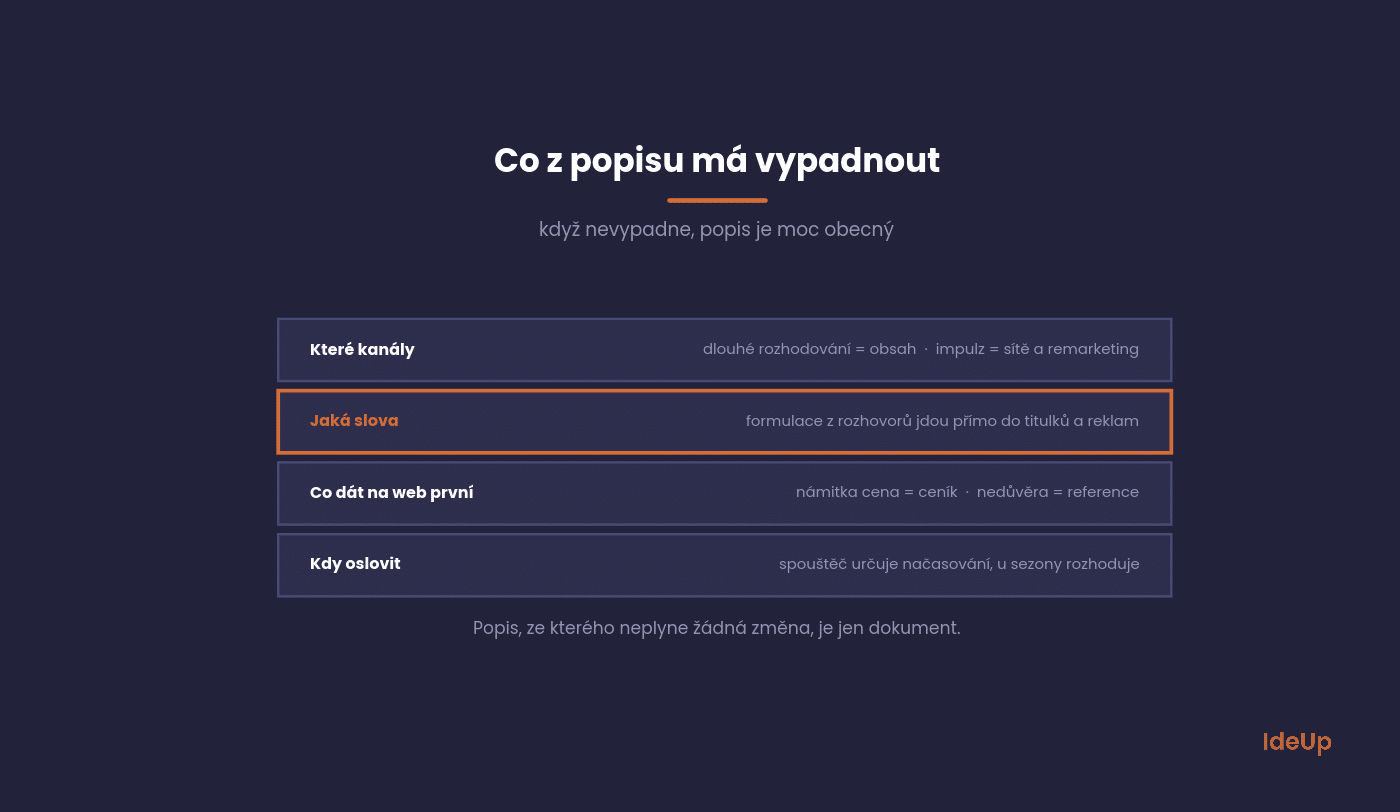
Which channels. A long decision process and a high order value mean content and search. An impulse purchase means social media and remarketing.
Which words. Phrases from interviews go straight into titles, ads and headings. Do not make them up on the customers’ behalf.
What to put on the website first. If the main objection is price, the service page needs a price list. If it is distrust, it needs case studies.
When to reach out. The trigger tells you the timing. In seasonal industries, that is the difference between a wasted budget and a profitable one.
How many target audiences should a company have
The answer is almost always: fewer than you think. Most small and medium-sized businesses can serve one properly and a second one halfway.
If you end up with four, rank them by their share of profit, not by the number of people.
A practical rule: write both your strategy and your website for the first one. You serve the other audiences by having a product that is just as good, even if you do not target them.
Trying to reach everyone at once ends in copy that speaks to no one. That is the most common reason why a company website does not convert.
When the description stops being valid
A target audience is not a document for eternity. It changes faster than companies expect, and you can tell from three signals.
A review once a year is enough, unless one of them appears sooner.
Your customer mix is changing. If your best customers differ from the ones you are targeting, the description is out of date.
Your copy stops working. Ads that worked for a year lose performance without any change in the competition. Often the situation in which people buy has changed.
A new alternative has appeared. A new tool or way of solving the problem changes the answer to the question “what will they do if they do not buy”.
Common questions about target audiences
The five questions we get most often in workshops.
The answers apply to small and medium-sized businesses. In corporations, the process is more formal.
Do we need personas with a name and a photo?
You do not. A photo and a name help the team remember who we are talking about, but on their own they do not decide anything.
If you are choosing where to spend your time, spend it on the trigger and the objections. Those are the parts that feed directly into your copy.
How do you describe a B2B target audience?
Describe the company and the roles separately. The company determines whom to approach, the role determines how to talk to them.
In B2B, it also matters who decides on the budget. That person is usually not the one who searches.
Can we derive our target audience from analytics?
Partly. Analytics tells you who visits the website, not why or what they are trying to solve.
Use it to verify hypotheses, not as a source. Interviews are the source.
What if we sell to the general public?
Even then, there is a group that buys from you more often and at a higher margin. Start with them.
A broad reach does not mean your communication should be generic. It means you have more audiences and need to choose the order.
How often should we interview customers?
Five calls once a year are enough for most companies. Sooner after a major change in your offer or in the market.
More useful than frequency is writing down phrases as you go. Sales hears them every week.
Where to start in your company
Call three customers you have won in the last six months and ask them one thing: what happened just before they started looking for you.
Write down their answers word for word. Within three calls, you will have both the trigger and the language they use to talk about the problem.
Want to turn this into content and channels? Have a look at our Services or get in touch via Contact.
Frequently asked questions about target audiences
What is a target audience in marketing?
It is the group of people you deliberately address with a specific message or campaign. It is chosen because those people are the most likely to respond and the most valuable to you. A good description includes their situation and what made them start looking for a solution.
What is the difference between a target market and a target audience?
The target market is everyone your company serves. The target audience is a narrower group within that market that you address with a particular campaign or message. One market usually contains several audiences.
Is a target audience persona the same as a target audience?
Not quite. A persona is a fictional representation of one typical member of an audience, written so the team can imagine a real person. The audience is the group itself, and the persona is only a tool for describing it.
Can you define a target audience by demographics alone?
You can, but the result rarely helps you decide anything. Demographics work as a filter, for example to exclude people outside your region. Behaviour, situation and triggers tell you much more about what to say and when.