The question “should we put our money into SEO or PPC?” comes up at almost every first meeting. Clients expect us to answer with one of the two names.
The answer they get is more boring: both, just in a different ratio and a different order. The two channels do not solve the same problem.
This article explains when to start with which, how to split the budget according to your company’s stage and where the two reinforce each other.
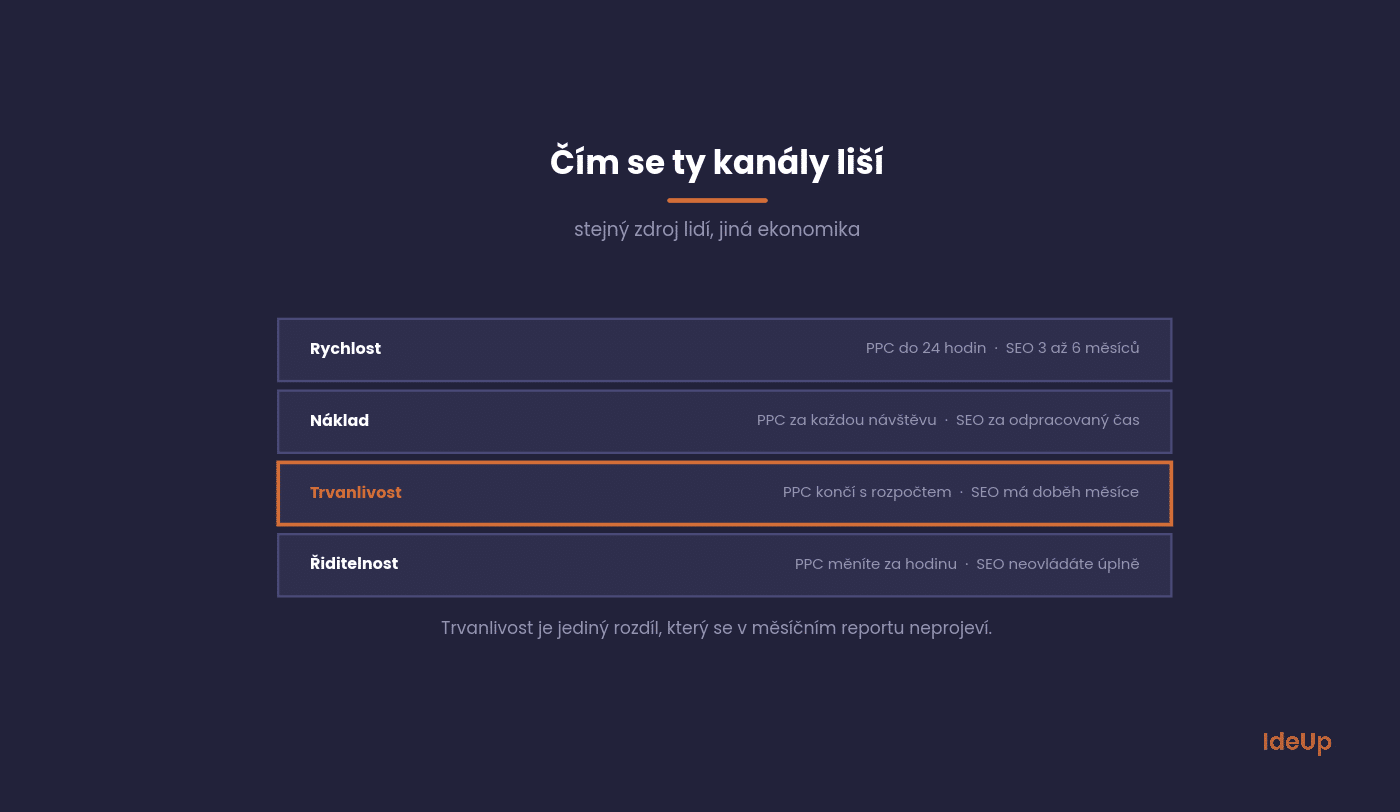
How the two channels differ
Both bring people from search, so they are easy to compare. Economically, however, they are two different things.
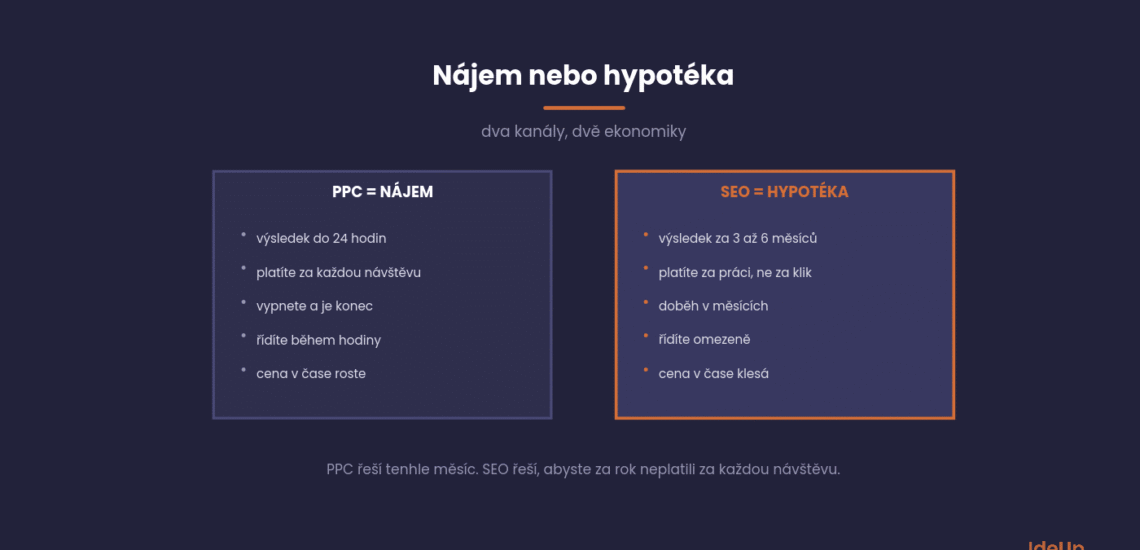
PPC is renting: you pay for each visit, and the moment you stop paying, the visits stop. SEO is a mortgage: you pay up front, and when the repayments stop, you keep the home.
This leads to the first practical rule. PPC answers the question “I need orders this month”. SEO answers the question “I don’t want to be paying for every visit a year from now”.
The second difference is in what you can control. In PPC you can change bids, targeting and budget within an hour. In organic search you wait for months and do not fully control the outcome.
SEO vs PPC, what each term means
SEO is the work that helps your pages earn unpaid places in Google and similar results. It covers content, the technical state of the website and links from other websites. You do not pay for each visit. You pay for the work that makes your pages visible.
PPC stands for pay per click. You choose the queries you want to appear for and set a bid. Your ad then shows next to the organic results, and you pay each time someone clicks on it. Google Ads and Microsoft Advertising are the best-known platforms.
SEO vs SEM vs PPC
SEM, or search engine marketing, is an umbrella term, and people use it in two ways. Some mean only paid ads, so for them SEM and PPC are almost the same thing. Others mean all visibility in the results, both paid and organic. In that wider sense, SEO is the organic part and PPC is the paid part. When a supplier offers you SEM, ask which of the two meanings they have in mind.
You may also come across the phrase organic SEO. It means the same as SEO. The word organic only stresses that the visits are not paid for per click.
When to start with which
The order is not a matter of preference but of circumstances. The following three scenarios cover most of the companies that come to us.
The guide is whether you need data, revenue or lower costs.
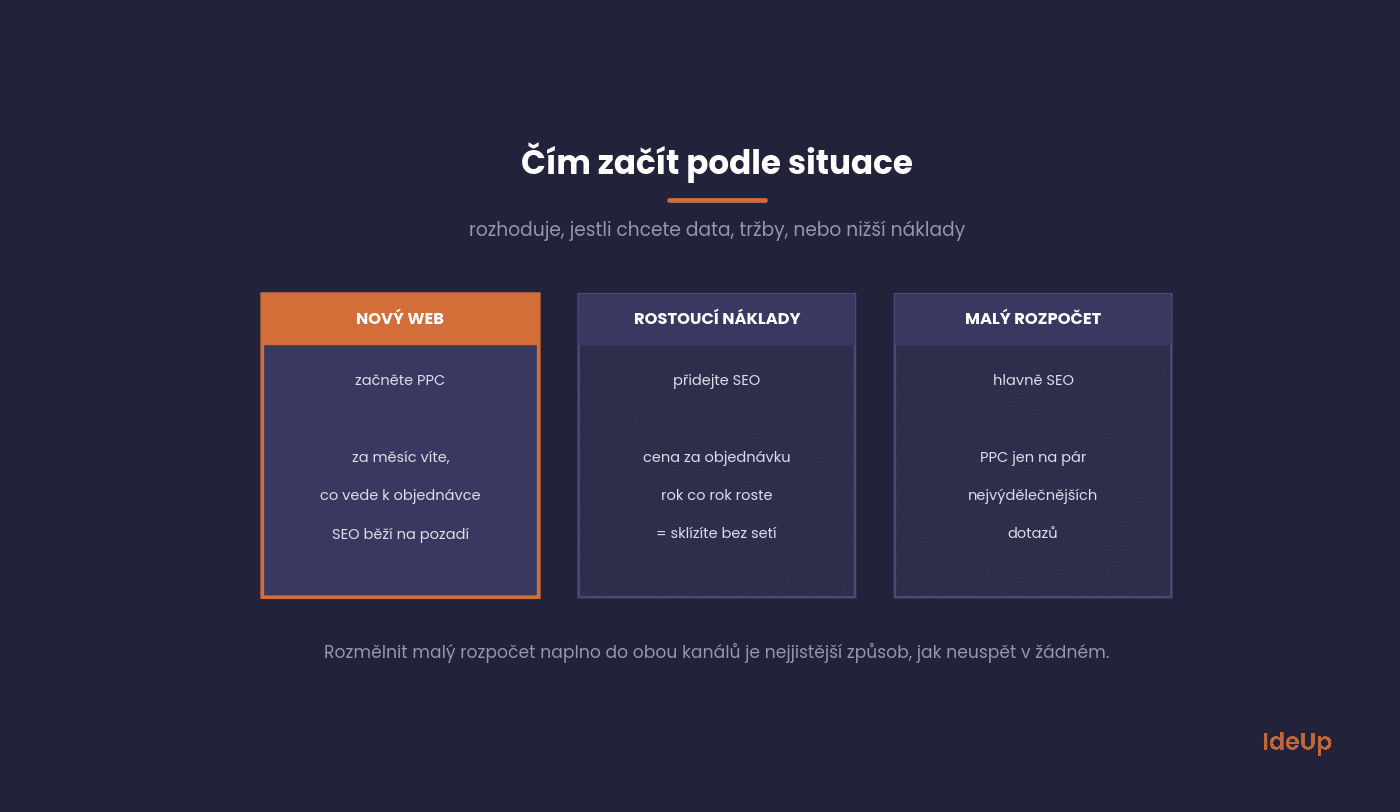
A new website or a new product. Start with PPC. Within a month you will know which queries lead to an order and at what cost. That is the cheapest way to find out what is worth building content around.
An established website with rising costs. Add SEO. If your cost per order in PPC rises year after year, you are paying ever more for demand that nobody is replenishing.
A small budget and a long horizon. Go for SEO and use PPC only for a few of the most profitable queries. Spreading a small budget fully across both channels is the surest way to fail in both.
How to split the budget by stage
The ratio changes over time, and that is the key point. A company that has the same split after three years as it did at the start is usually paying for its own name.
We use the following split as a starting point, not as dogma.
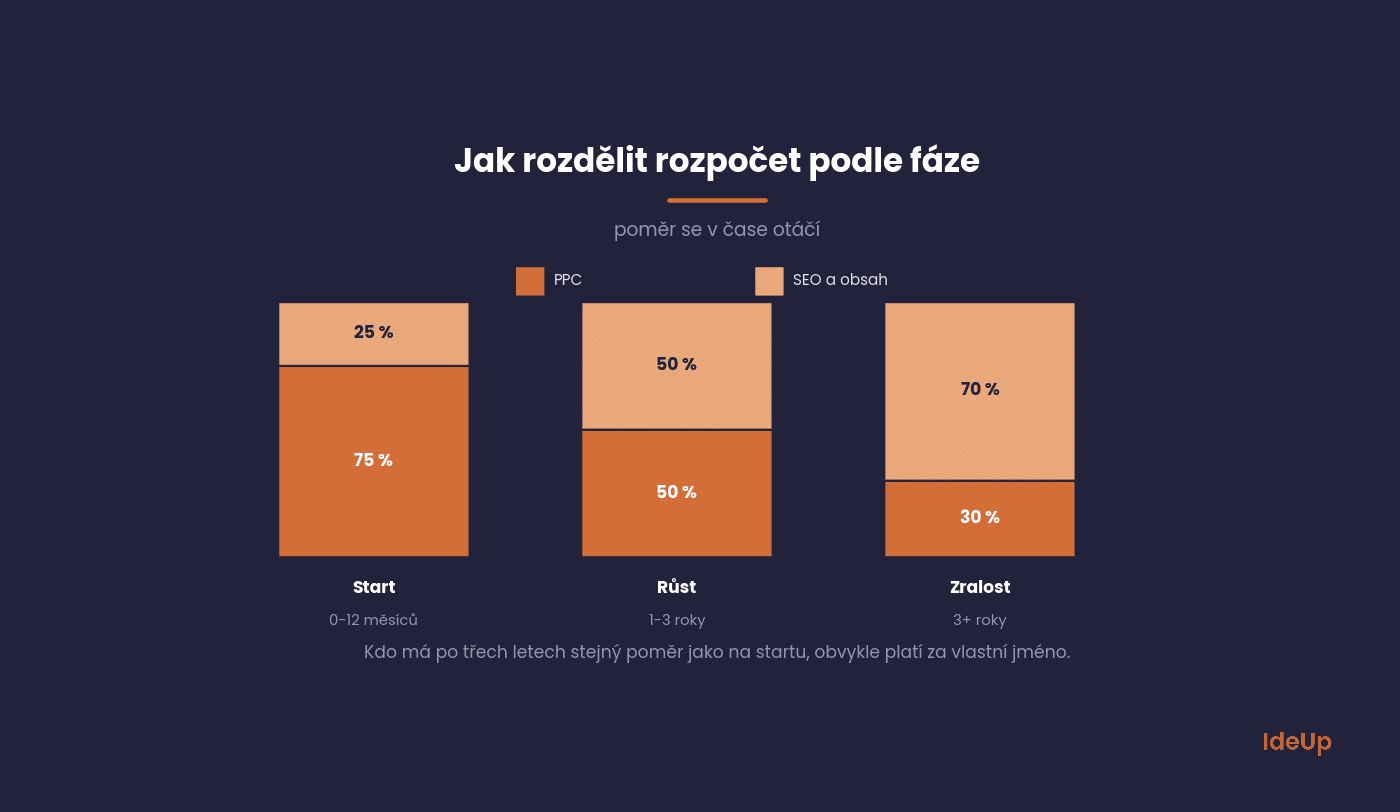
At the start, most of the budget goes into PPC because you need data and your first revenue. SEO runs in the background and you do not expect numbers from it.
In the growth stage, the ratio evens out. Organic search starts to deliver, and part of the budget can be moved from paid search into content.
At maturity, most enquiries come from organic search and the brand. PPC stays on the queries with the strongest purchase intent and on seasonal peaks.
Where the channels reinforce each other
The most common mistake is to manage them as two separate competitions. Yet they can help each other considerably when they are run by someone who sees both.
Four connections work almost every time.
PPC data as input for content. The queries that lead to conversions in ads are the best list of topics for keyword research. You do not have to guess, because you have measured it.
Testing titles. A headline that wins in an ad usually also works as a title in the search results. You can test it in a few days instead of a few months.
Covering the whole SERP. When you have both an ad and an organic result for the same query, you collect more clicks than either would bring on its own.
Covering gaps. Until a new category gains traction in organic search, PPC holds it. If something goes wrong in organic search, PPC prevents a drop in revenue.
How to compare them at all
Comparing them by cost per visit makes no sense, because with SEO the cost is spread over time. The cost per order calculated over a full year is more useful.
For PPC, take the annual spend and divide it by the number of orders from ads. For SEO, take the annual spend on the work and divide it by orders from organic search, excluding branded queries.
The second figure tends to be worse in the first year and much better from the second year onwards. That is exactly why SEO cannot be evaluated after three months.
Watch out for one more thing: always separate out branded queries. People searching for your name would have come anyway, and in the statistics they flatter both channels.
Pros and cons of SEO vs PPC
Neither channel is better in general. Each has strengths that match a different goal.
SEO
- Pro. Visits keep coming after the work is done, without a charge for each click.
- Pro. You can reach people early, while they are still learning about a problem.
- Con. Results take months, and you cannot speed them up with more money alone.
- Con. Changes in how Google ranks pages can move your positions without warning.
PPC
- Pro. Visits start as soon as the campaign is approved.
- Pro. You can target by location, device, time of day and audience.
- Con. Click prices rise when more competitors bid on the same queries.
- Con. Some people skip ads and click only on organic results.
When only one of them makes sense
There are situations where splitting the budget is a waste of time and you should go all in on one direction.
Both are rarer than companies expect, but they are worth knowing.
PPC only: a one-off campaign, a seasonal product, testing a new market, or a sector where the total search volume is so small that organic search has nothing to collect.
SEO only: sectors with advertising restrictions, extremely expensive clicks where PPC does not pay off, or companies without the capacity to manage ads on an ongoing basis.
Ahrefs has a detailed comparison of the two channels on this, including situations where only one makes sense. Its conclusion is the same as ours: in most cases the question is one of ratio, not choice.
Common mistakes when choosing between the two
Most failed budgets come from a few repeated errors, not from choosing the wrong channel.
- Trusting general statistics. Published figures on SEO vs PPC come from different sectors, countries and methods. Your own data from the last twelve months tells you more than any industry average.
- Sending ads to the homepage. A person who clicks on an ad for one product expects to land on that product. A generic page wastes the click you paid for.
- Switching off ads the day rankings appear. Lower the spend gradually and watch total orders. A first page position for one query does not cover all the queries your ads reached.
- Measuring only clicks. A cheap click that never turns into an order is more expensive than a costly one that does.
Questions that come up around this
Five questions we hear most often when planning budgets.
The answers are general. Specific figures depend on the sector and the margin.
Which is cheaper, SEO or PPC?
PPC in the first year, SEO from the second year. What matters is how long you plan to be in business.
Calculate it as the cost per order over the whole period, not per month. Otherwise PPC will always win.
Do ads compete with your own organic results?
For branded queries, partly yes, as you genuinely take some clicks from yourself. For non-branded queries, on the other hand, they complement each other.
It is easy to test: switch off the branded campaign for two weeks and compare total revenue, not just revenue from PPC.
How do I know it’s time to add more SEO?
When your cost per order in PPC rises year on year even though you are optimising the campaigns. That is a sign you are harvesting demand that nobody has sown.
The second sign is that you have exhausted the volume. Your ads have no room left to grow because there are no more relevant searches.
Does SEO make sense with low search volume?
In very niche sectors, the total search volume may be in the tens of queries per month. There, direct sales and B2B marketing are more effective.
The threshold is not a number of searches but the value of a deal. For contracts worth hundreds of thousands of CZK, even ten visits a month pay off.
Should one supplier handle both?
Ideally yes, because the connections between the channels are lost when they are run by two teams that do not talk to each other.
The condition is that the supplier does both properly. SEO bundled with PPC as an add-on is usually not done by anyone who understands it.
Where to start in your case
Calculate your PPC cost per order for the last twelve months and compare it with the same figure a year earlier. If it is rising, you know where to add.
The second step is to check in your ad account which non-branded queries lead to conversions. That is a ready-made list of topics for organic search.
Want to discuss it with real numbers? Get in touch to book SEO consulting, where we look at both channels together, not separately.
Frequently asked questions about SEO vs PPC
What is the difference between SEO and PPC?
With SEO you invest in content and the website so that your pages earn unpaid places in the results. With PPC you pay for each click on an ad. SEO builds results slowly but they last, while PPC works immediately and stops when the budget runs out.
SEO vs PPC, which is better?
Neither is better in every case. PPC suits you when you need orders or data quickly, and SEO suits you when you want to lower the cost of each order over the long term. Most companies get the best results by combining them in a ratio that changes over time.
What is the difference between SEO, SEM and PPC?
SEO is the organic part and PPC is the paid part. SEM is an umbrella term that some people use for paid ads only and others for both. Always check which meaning a supplier uses before you compare offers.
Are SEO vs PPC statistics useful for planning a budget?
Only as a rough orientation. Published figures mix different sectors, markets and ways of measuring. Your own cost per order from both channels over a full year is a far better basis for a decision.