

A brief is the set of instructions a client gives a supplier, typically an agency or a copywriter. A good brief fits on one page and answers three things: what should happen, who it is for and how success will be measured.
The word comes from English, where it means short, but also instructions or background material. The meeting at which the brief is handed over and clarified is called a briefing (in Czech also “brífink”).
Everything the supplier does rests on the brief. Whatever is missing from it, they fill in by guessing, and that guess then gets corrected in rounds of feedback that you pay for.
Why the brief matters so much
Clients and agencies see the quality of briefs very differently. A BetterBriefs study from 2021 found that 80% of marketers consider their briefs to be good. Only 10% of agencies agree.
The gap is even wider when it comes to strategy. According to the same study, 78% of marketers see a clear direction in their briefs, but only 5% of agencies do. The study’s authors estimate that up to a third of marketing budgets is wasted because of poor briefs.
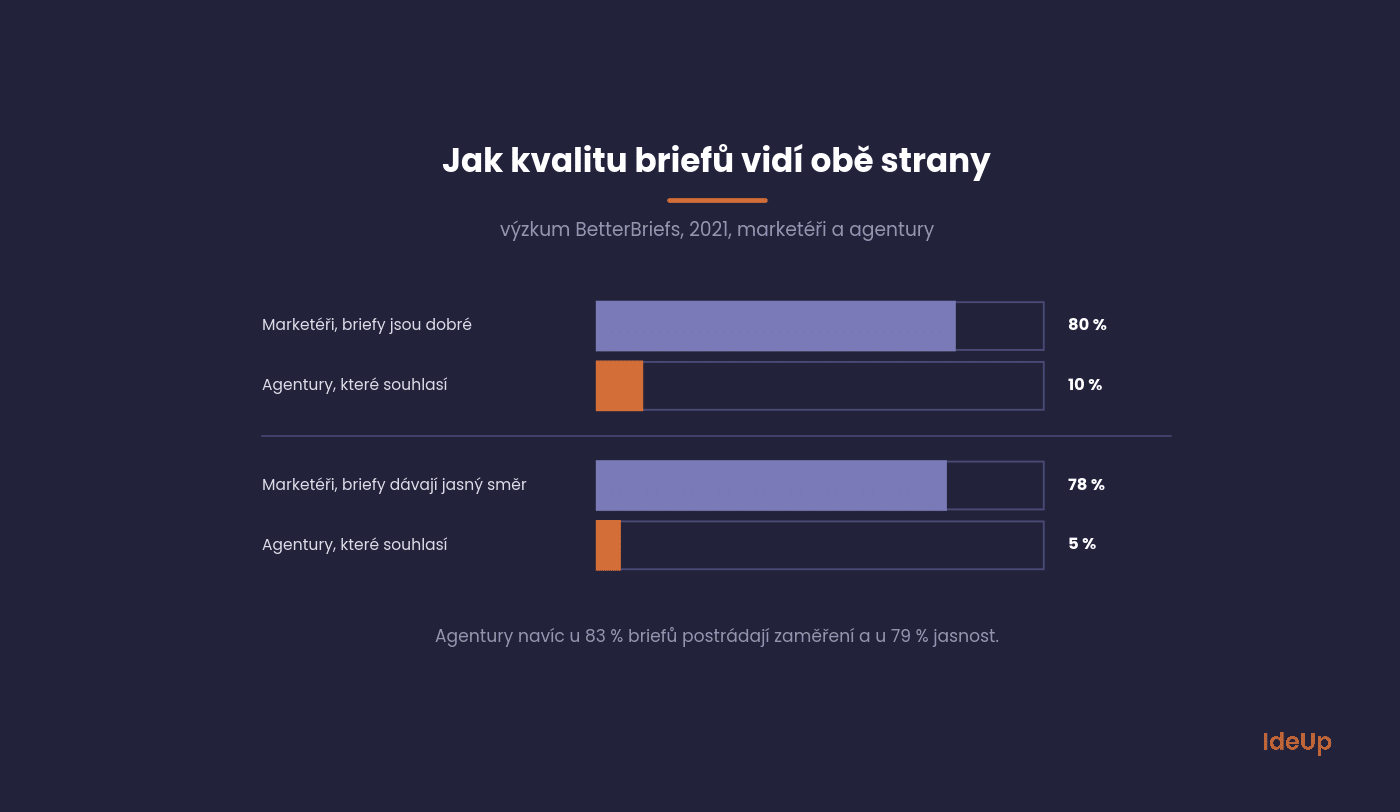
Agencies find most briefs lacking in focus (83%) and clarity (79%). The problem is rarely the form itself. More often, the client has not decided what they want.
Types of brief
In marketing, the word brief refers to several different documents. They differ mainly in who writes them and for whom.
Confusing them does not pay. A client who writes a creative brief instead of a client brief usually prescribes a solution before the problem is clear.
| Type of brief | Who writes it and for whom | What it adds |
|---|---|---|
| Client brief | the client, for the agency or supplier | business goal, budget, deadline, how success will be measured |
| Creative brief | the agency’s strategist or project manager, for the creative team | one main idea, customer insight, tone, mandatory elements |
| Copywriter brief | the client or agency, for the writer | topic, main query, reader, what they should do after reading, length, links |
| Media brief | the client or agency, for media planning | target audience, period, budget, channels, target metrics |
When you approach a marketing agency for the first time, you write a client brief. The agency should turn it into a creative brief and show it to you for approval.
A copywriter brief is essentially a client brief narrowed down to a single piece of text. It tends to be shorter and more specific because it deals with one output, not a whole campaign. You can find more about working with writers under copywriting.
What a creative brief is in advertising
A creative brief is the internal document that tells copywriters, designers and art directors what to make and why. It sits between the client brief and the first idea. The client brief speaks in business terms. The creative brief turns them into one thought the work should express.
In advertising, a strategist or account planner usually writes it after the briefing and the rebrief. It should be short enough for the creative team to keep in their heads while they work.
Elements of a creative brief
- Problem. What the communication has to solve, in one sentence.
- Audience. Who the people are and what they currently think or feel.
- Insight. A truth about the audience that the work can build on.
- Proposition. The one idea the work must get across, often called the single-minded proposition.
- Reason to believe. The proof that makes the proposition credible.
- Tone. How the work should sound and feel.
- Desired response. What people should think, feel or do afterwards.
- Mandatories. Logo, legal text, formats and anything else that cannot change.
What a brief should include
The outline varies between agencies, but the questions a brief should answer stay the same. The three main ones are in the introduction, and the others complement them.
The whole thing should fit on one or two pages. If a brief is longer, it usually means priorities have not been chosen.
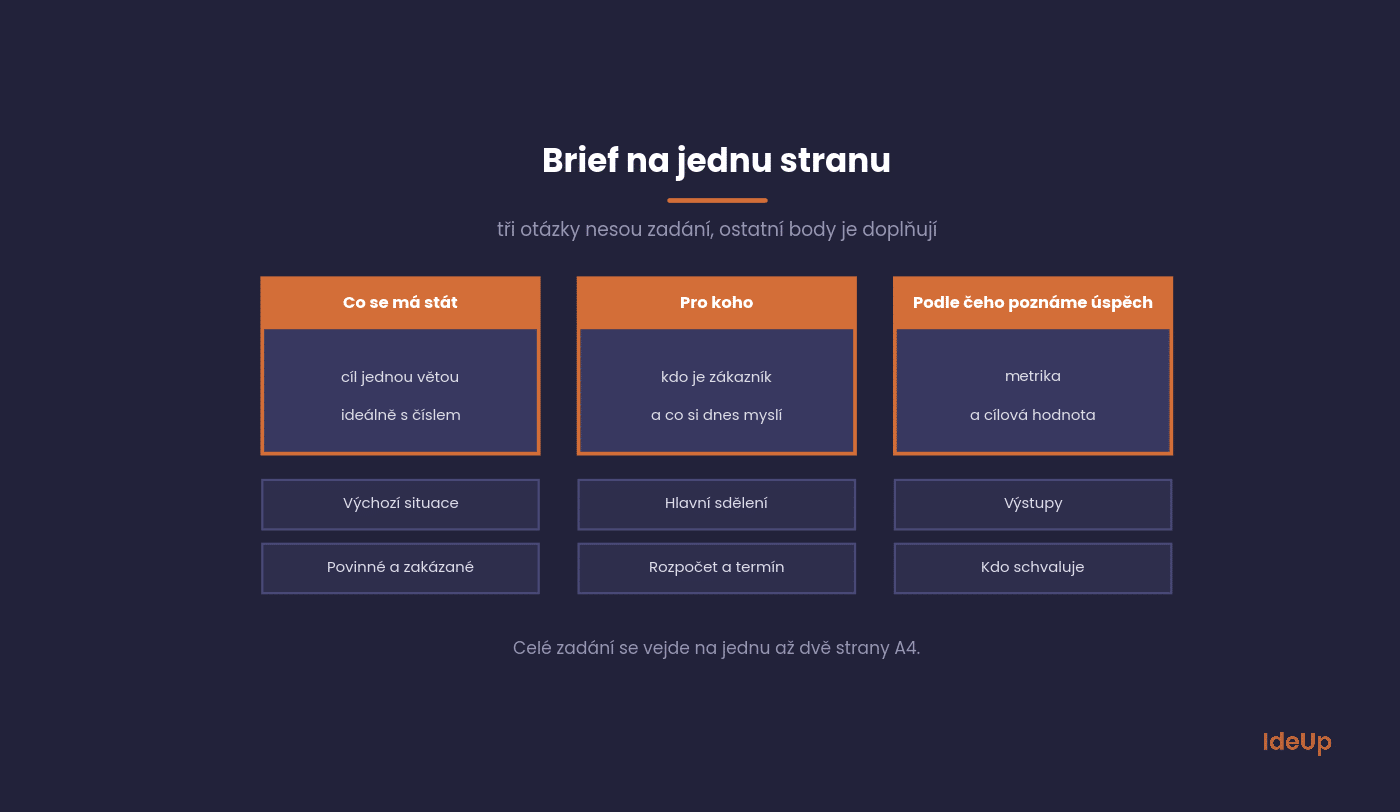
- Background. Why you are tackling this now and what has changed.
- What should happen. One sentence about the goal, ideally with a number. Not “raise awareness”, but “get 40 enquiries a month from the website”.
- Who it is for. Who the customer is, what they know about you today and what they think. Base this on what you actually know about your target audience, not on wishful thinking.
- Key message. The one thing people should remember. If there are four, they will remember none.
- Deliverables. Exactly what the supplier should deliver, in what format and to what extent.
- Must-haves and no-gos. Brand guidelines, legal restrictions, words you do not use.
- Budget and deadline. At least a range. Without a budget, the supplier will propose something that does not fit it.
- How success will be measured. A metric and a target value you will evaluate once the project ends.
- Who approves. The person who has the final say, and how many rounds of feedback you expect.
What a completed brief looks like
An outline stays abstract until you see it filled in. The following example is fictional, but its structure matches the good briefs we receive.
A garden furniture manufacturer has so far sold mainly to consumers through its online shop and wants to start selling to hotels and guesthouses. The brief is written by its sales department.
- Background. Hotels and guesthouses buy from competitors and do not know us.
- What should happen. Get 15 enquiries from accommodation providers by the end of March.
- Who it is for. Owners of smaller hotels and guesthouses who furnish their terrace once every few years and care mainly about durability.
- Key message. Furniture that lasts outdoors season after season without maintenance.
- Deliverables. A three-month campaign proposal, channels are up to you.
- Must-haves and no-gos. Logo as per the guidelines, no discounts in communication.
- Budget and deadline. 150,000 to 200,000 CZK (about 6,900 to 9,200 USD) including media, launch on 1 February.
- How success will be measured. Number of enquiries from the form, and a cost per enquiry below 8,000 CZK (about 370 USD).
- Who approves. The sales director, with two rounds of feedback planned.
Note that the brief does not prescribe channels or formats. It asks for enquiries and leaves the proposal for how to get them to the supplier.
A creative brief example built from the client brief
Here is how the agency might rewrite the garden furniture client brief for its creative team. The facts stay the same. What changes is the focus.
- Problem. Hotel owners do not consider us, because they know us only as a brand for homes.
- Audience. Owners of small hotels who see terrace furniture as a cost that comes back every few seasons.
- Insight. Guests notice worn furniture on a terrace before the owner does.
- Proposition. Furnish the terrace once and stop thinking about it.
- Reason to believe. Materials made for outdoor use that need no maintenance.
- Tone. Practical and calm, like advice from a supplier who understands hospitality.
- Desired response. Send an enquiry for a quote.
- Mandatories. Logo as per the guidelines, no discounts.
The client brief asked for enquiries. The creative brief gives the team one idea to work with.
Brief, briefing, rebrief and debrief
Four words are used around the brief and are often confused. Each refers to a different step in the collaboration.
A brief is a document. A briefing is the meeting at which the brief is handed over and the supplier asks questions. A rebrief, sometimes called a reverse brief, is the supplier’s response, in which they rewrite the brief in their own words and send it back for checking.
The briefing should be attended by the person who makes decisions about the project and the person who will do the work. The supplier does most of the talking, because they are asking the questions. The meeting ends with an agreement on when they will send the rebrief.
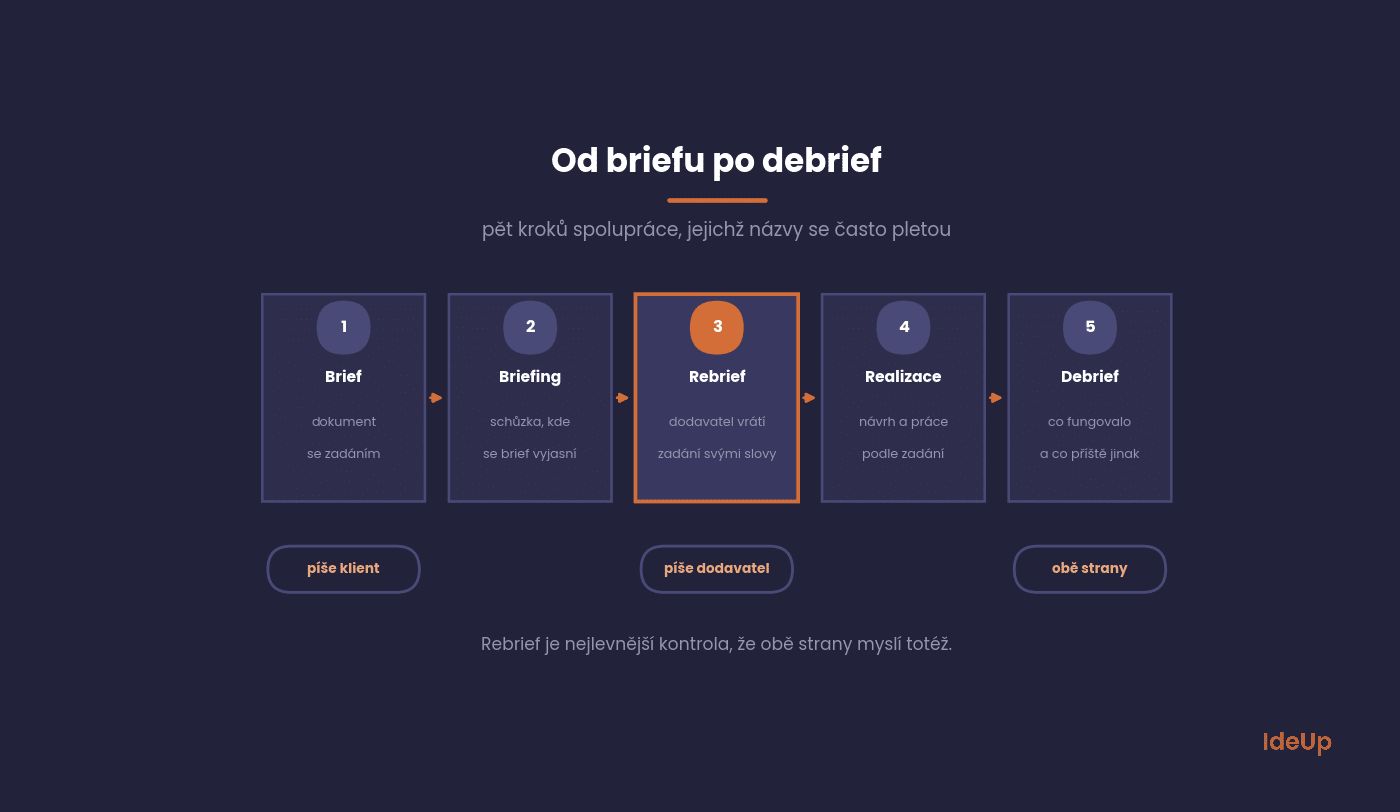
The debrief comes at the end. It is a post-project review of what worked and what to take into the next brief. In other fields, such as the military or psychology, the word debriefing has its own meaning.
We recommend always asking for a rebrief. If the agency sends back the brief with a different goal or a different target audience than you intended, you find out after an hour, not after the first proposal. At that point, fixing it means rewriting two lines of text, not throwing away a finished campaign.
The most common mistake in a brief
The client describes a solution instead of the problem.
“We want a TikTok video” is a solution. “We need people under thirty to know us” is a problem, which a video might solve, but so might something completely different. A brief with a ready-made solution deprives the supplier of what you are paying them for, namely a proposal for how to solve the problem.
Three other mistakes are less obvious but just as costly.
Everything is a priority. Five target audiences and four messages in one campaign. The supplier will choose for themselves, and may not choose what you would have.
No budget. The line “tell us how much it will cost” leads to proposals that are either too expensive or needlessly modest.
The brief replaces strategy. If it is not clear why the campaign exists and how it fits into the rest of your marketing, the brief will not fix that. The answer belongs in your marketing strategy, and the brief simply builds on it.
How to write a creative brief step by step
- Start from the approved client brief and rebrief. Do not start from a blank page.
- Write the problem in one sentence. If you need two, the problem is not clear yet.
- Describe the audience by what they believe now. Age and job title alone give the team nothing to work with.
- Look for the insight. Talk to sales, read customer reviews and listen to support calls.
- Reduce everything to one proposition. Check whether a stranger could repeat it after reading it once.
- Add proof, tone and mandatories. Keep each to two or three lines.
- Go through it with the creative team. Let them ask questions before any work starts.
To build a creative brief template, use the elements above as headings and leave short spaces for answers. A template with dozens of fields encourages people to fill in boxes instead of thinking.
How we write a content brief at IdeUp
For website copy, we write the brief ourselves, and only then does the writing begin. It is based on data, not impressions, and fits on one A4 page.
It includes the main query and two or three secondary ones with their search volumes, which pages currently rank at the top of search results for them and what type they are. It then covers what the website already has on the topic, so the new page does not compete with an old one, and ends with an outline of headings with internal links. The most important line, however, is what the text will offer beyond the competition.
If we cannot answer that, the text does not get written.
Common questions about briefs
We get these questions from companies that are just starting to work with an agency.
The answers apply to marketing campaigns as well as content projects.
Who should write the brief
The client writes the client brief, because they know their business and goals. The agency turns it into a creative or media brief for its own team.
If the client does not know how to write a brief, they can put it together with the agency at the briefing. At the end, however, they must explicitly approve it, otherwise there will be disputes about the brief once the work is done.
Should the brief be sent in advance, or is a meeting enough
Send it in writing a few days before the briefing. The supplier will have time to read it and will come to the meeting with questions, not first impressions.
A meeting without a written brief usually ends with everyone remembering something different. The difference then only shows up in the first proposal.
Do small projects need a brief too
Yes, just a shorter one. For a single article or banner, five lines are enough: goal, reader, key message, scope and deadline.
You can write five lines in ten minutes. A round of feedback caused by an unclear brief takes longer.
Where to start
Take the last brief you sent to an agency or supplier and try to find the answers to the three questions from the introduction in it: what should happen, who it is for and how you will measure success. Whatever is missing is your first task.
For your next project, ask for a rebrief. Still choosing a supplier? See how to choose an SEO agency, or send us your brief via our Contact page.
Frequently asked questions about creative briefs
What is a creative brief?
A creative brief is a short document that tells a creative team what to make, for whom and with what single idea. It is usually written by the agency’s strategist based on the client brief. Its job is to focus the work, not to describe the whole business.
What questions should a creative brief answer?
It should answer what problem the work solves, who the audience is and what they think now, and what one idea they should take away. It also covers why they should believe it, how the work should sound and what response you want. Mandatory elements such as logo or legal text complete it.
How long should a creative brief be?
One page is usually enough. If it runs longer, priorities have probably not been chosen. A short brief is also easier for the team to remember while they work.
What is the difference between a marketing creative brief and a client brief?
The client brief describes the business goal, budget, deadline and how success will be measured. The creative brief takes that and turns it into an insight and one proposition for the creative team. The first is written by the client, the second usually by the agency.
USD amounts are approximate, converted at the Czech National Bank rate of 21.75 CZK per USD on 9 October 2026.




Leave A Reply