Marketing strategy takes one of two forms in Czech companies. Either it does not exist, or it is a forty-slide presentation that nobody has opened since the agency handed it over.
Both lead to the same result. Decisions are made ad hoc, based on whatever a salesperson happens to offer or whatever the competition is doing.
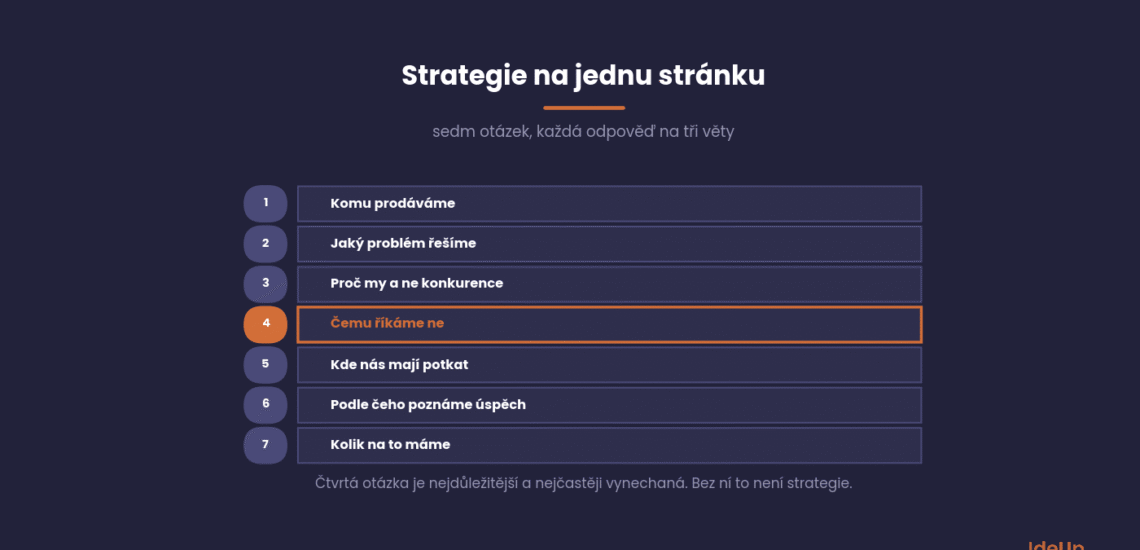
This article describes a strategy that fits on one page and that you can actually use to make decisions. Seven questions: once you know the answers, you know where to put your next crown.
Why long strategies go unused
The problem is not the quality of thinking but the format. A document that takes half an hour to read does not get opened when a decision has to be made.
Yet those are exactly the moments when strategy is used: when an offer to exhibit at a trade fair comes in, when someone proposes a new channel, when the budget has to be cut.
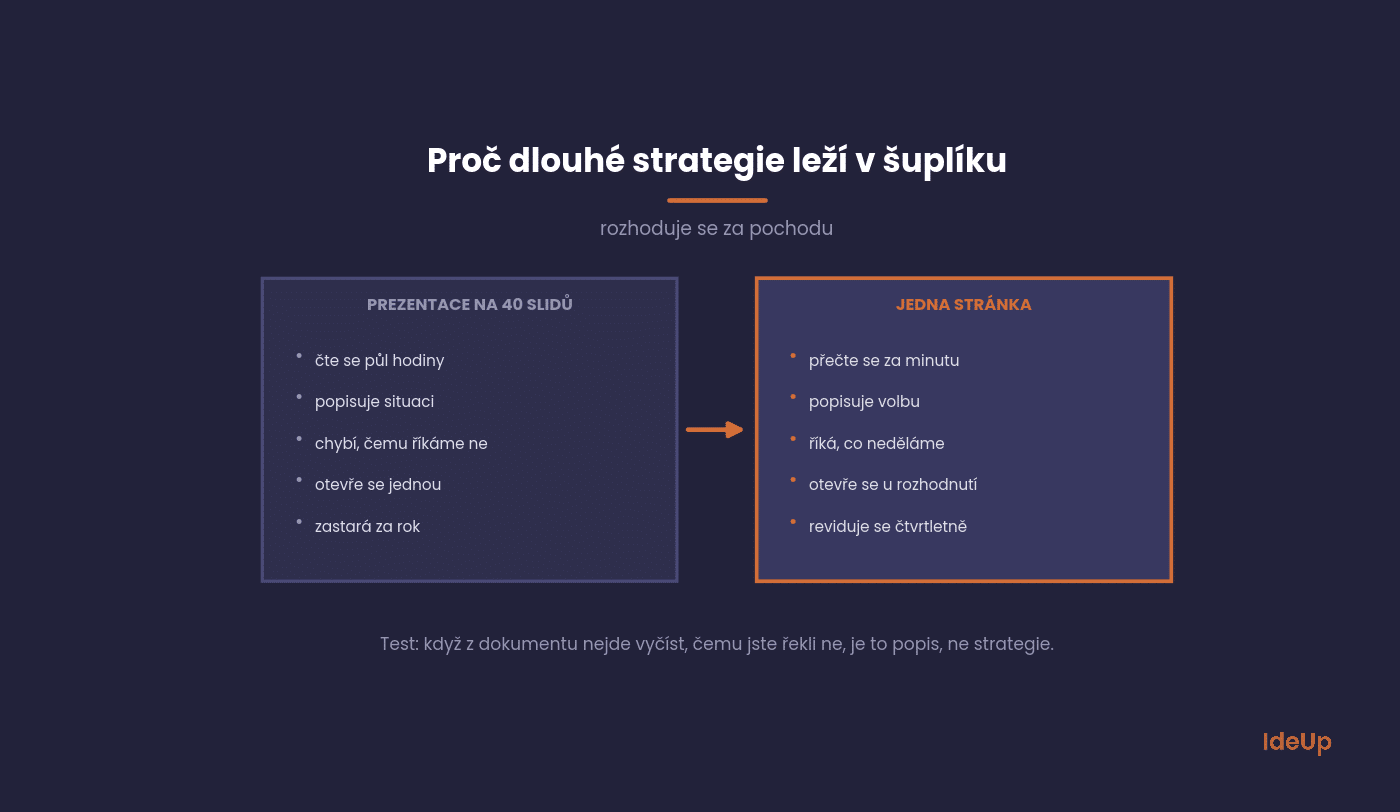
The second reason is that long strategies usually describe the situation, not a choice. Market analysis, competitor analysis and SWOT are background material. Strategy only begins where you say what you will not do.
A practical test: if the document does not show what you have said no to, it is not a strategy. It is a description.
What is marketing strategy and how it differs from a plan
A marketing strategy is a set of decisions about three things. It says which customers you want to win, why they should choose you, and where you will spend your limited money and time to reach them. It is a choice between options, not a list of activities.
Three terms are often confused. This confusion is one reason strategy documents grow so long.
- Strategy answers who, why and where. It stays stable for a year or more.
- Plan answers what will happen, when, and who is responsible. It changes every quarter.
- Tactics are the individual actions, such as a campaign, a newsletter or a trade fair stand. They change from week to week.
When a document mixes all three, the decisions get buried under the activities. If you keep them apart, the strategy can fit on one page.
The seven questions that make up the one page
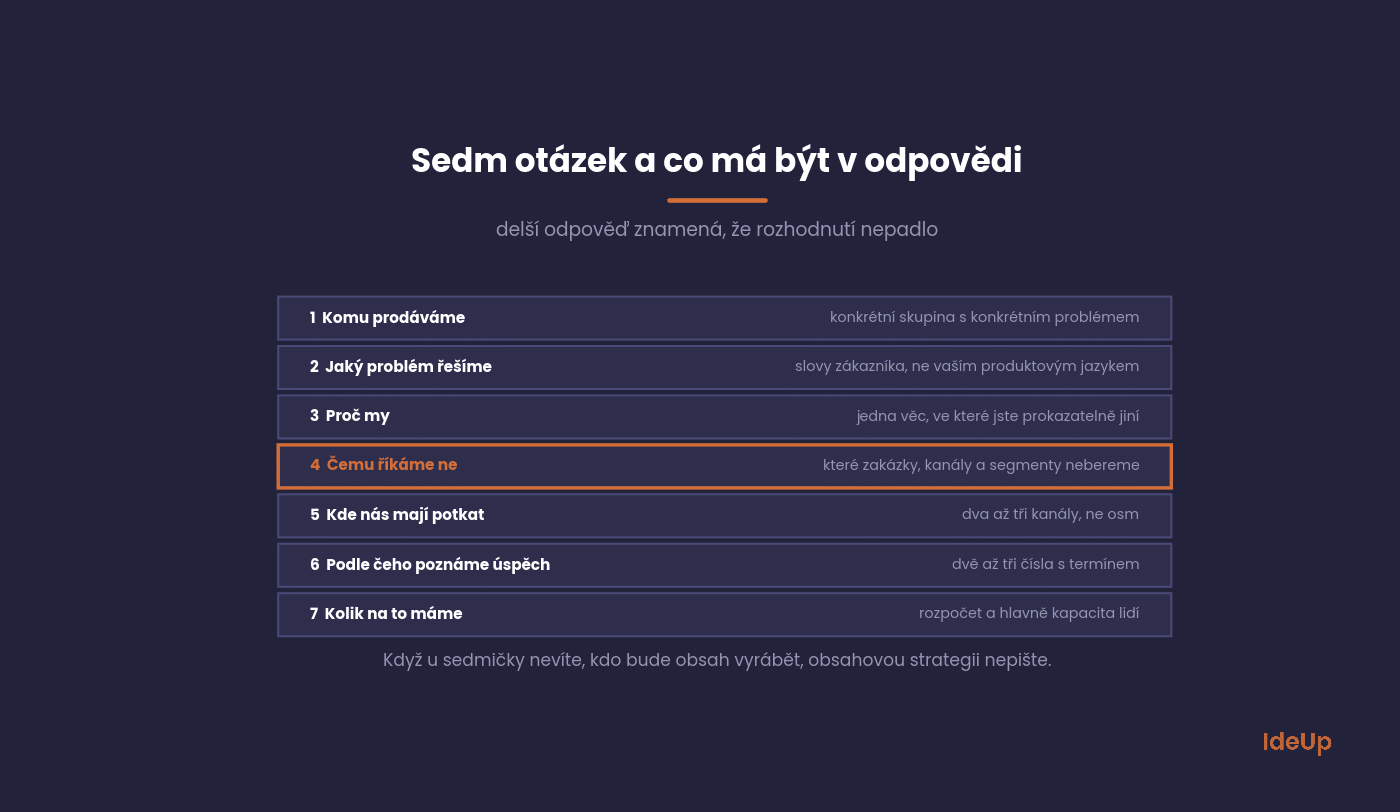
If you give specific answers to the following seven questions, you have a strategy. If not, you have a wish list.
Each answer should be one to three sentences. A longer answer usually means the decision has not yet been made.
Who we sell to
Not “companies”, but a specific group with a specific problem. The narrower the description, the better.
If you end up with three groups, rank them by their share of profit and write the strategy for the first one. The rest is a bonus. We explain how to create such a description in our article on the target audience.
What problem we solve
Described in the customer’s words, not yours. The difference between “we offer a cloud attendance solution” and “the managing director spends two hours a month retyping paperwork” is the difference between a sentence that does not sell and one that does.
These phrasings do not come from meetings but from conversations with sales and support.
Why us and not the competition
One thing in which you are demonstrably better or different. Not three, one.
If you come up with “quality” or “approach”, you do not have an answer. Your competitors will write those words too.
What we say no to
The most important question of all seven and the one most often skipped. Which jobs we do not take on, which channels we do not use, which segments we do not serve.
Without this answer, the budget gets spread thinly every year across everything that comes along.
Where they should come across us
Two or three channels, not eight. They are chosen based on where your target audience makes decisions, not where most people are.
For most companies, this means search plus one other channel. Which one depends on the length of the decision-making process and the value of the deal.
How we will recognise success
Two or three numbers with a deadline. Not “raise awareness”, but “fifty enquiries a month from organic search by the end of the year”.
If you cannot measure a number with the tools you have today, it is not a goal. It is a wish.
How much we have for it
Budget and staff capacity. Capacity is forgotten more often than money, and it is more often the reason a plan does not get completed.
A rule of thumb: if you have nobody to produce content, do not write a content strategy.
How to turn it into a quarterly plan
The strategy says where and why. The plan says what and when. Without the latter, the page remains a noticeboard.
The conversion is simple and takes an hour.
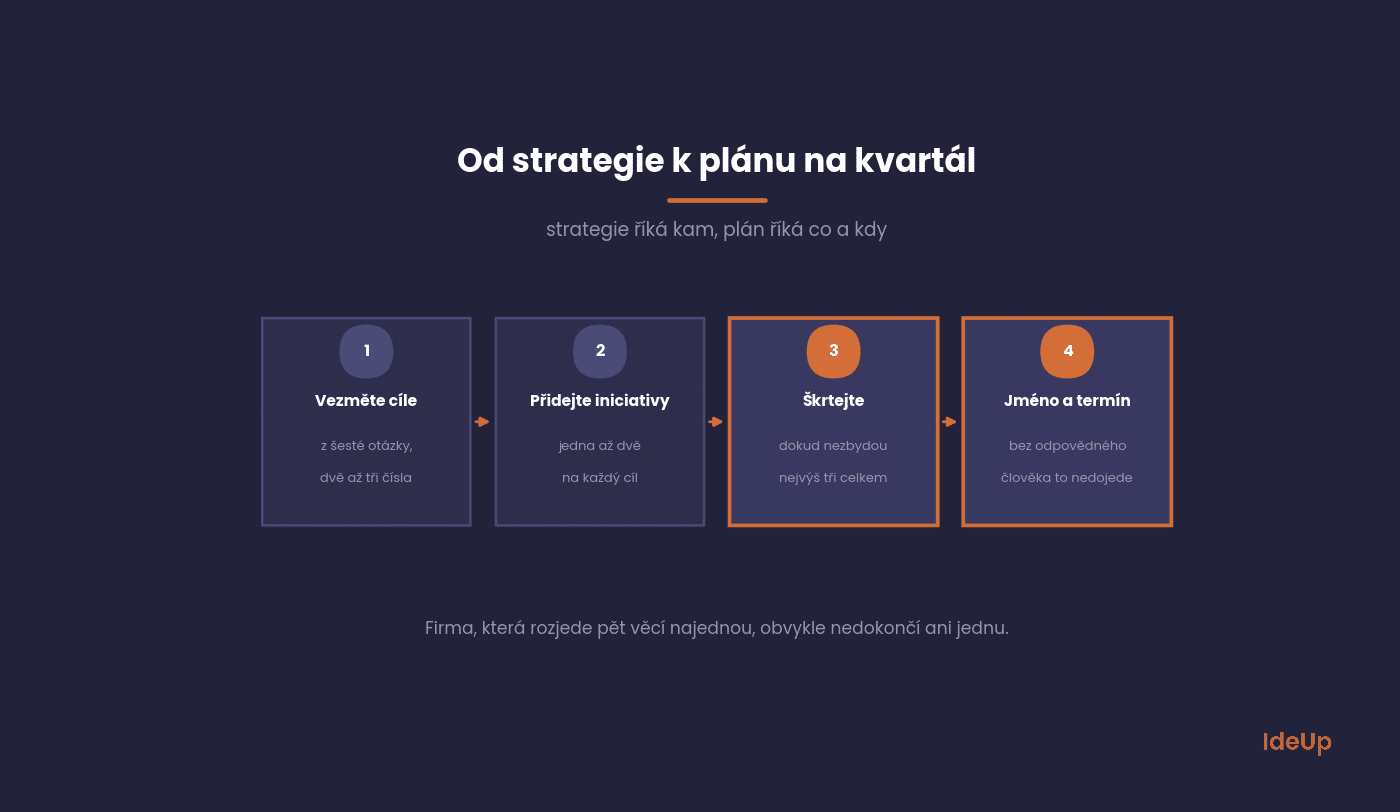
Take the goals from the sixth question and write one or two initiatives for the quarter for each. For each one, add the name of the person responsible and a deadline.
Then cut until no more than three initiatives remain in total. A company that launches five things at once usually finishes none of them.
Once a quarter, meet and review two things: what has happened to the numbers and whether the answers to the seven questions still hold. If an answer has changed, change the strategy. If not, carry on.
A one page marketing plan example
Here is a sample for a fictional company that sells scheduling software to small dental practices. It shows what the finished page can look like. The answers are made up, but you should aim for the same level of detail.
- Who we sell to. Dental practices with two to five chairs, where the owner also runs the reception.
- What problem we solve. Patients miss appointments, and the owner spends evenings rearranging the diary by phone.
- Why us. Setup takes one afternoon, and you do not need an IT person.
- What we say no to. Hospitals, chains with more than ten locations, and custom development.
- Where they come across us. Practical articles for practice owners on our website, and talks at regional dental association meetings.
- Success. 40 demo requests a month and 15 new paying practices a quarter by the end of the year.
- Budget. Around $3,000 a month, plus one person working two days a week on content.
The quarter goes underneath, with three initiatives. In this example they are eight articles on reducing missed appointments, two talks at association meetings, and a demo booking form added to every article. Each one has an owner and a deadline.
The whole thing fits on one side of A4. If yours spills onto a second page, look for an answer that hides a decision you have not made yet.
The most common mistakes
These are the issues we see most often in strategies, and all of them result in the document going unused.
You will recognise them at first glance.
Goals without numbers. “Strengthen the brand” cannot be evaluated, so it never is.
All channels at once. A budget split across eight channels never reaches the threshold at which it starts to work in any of them.
Strategy without sales. When marketing writes it alone, it usually targets different customers from the ones sales actually closes deals with.
Copying the competition. What the biggest player on the market does works because of its budget and recognition, not because of the idea.
How to set up your own template
You do not need a special tool. A free template in Word, Google Docs or a spreadsheet works as well as a paid one, as long as you keep the structure simple.
- Create a table with two columns and seven rows, one row for each question.
- Below it, add a second table for the quarter with three columns: initiative, owner and deadline.
- Limit each answer cell to three lines, so the format itself stops you from writing too much.
- Add the date of the last review at the top.
Save the final version as a PDF and put it where your team will see it, for example on the shared drive or on the first page of your project tool. Keep the editable file for the quarterly review.
Ready-made templates often add extra sections, such as SWOT tables or detailed persona sheets. Remove them unless you will actually use them to make a decision.
Questions that come up around strategy
Five questions we get from business owners and marketing managers alike.
The answers apply to companies of up to roughly two hundred people. For large corporations, it is different.
How often does the strategy change?
The answers to the seven questions should last one to two years. The plan changes every quarter.
If you change your strategy every quarter, it is not a strategy. It is a reaction to the last meeting.
Do we need a positioning statement and a mission?
They are useful, but only later. A company that cannot say who it sells to and what it says no to does not need a mission.
A mission helps mainly internally, with decision-making and recruitment. Customers are usually not interested in it.
Who should write it?
The owner or managing director together with sales and marketing. Not the agency on its own.
An outside perspective helps with the wording and makes sure the uncomfortable questions get asked. But the decisions must be made internally.
How much should it cost?
If you write it yourselves, two half-day workshops. With an external facilitator, usually tens of thousands of CZK.
More expensive options tend to cost more because of the volume of analysis, not because of the quality of the decisions.
What if we are not sure who we sell to?
Look at who buys from you repeatedly and where you have the highest margin. That is the answer, you just have not written it down.
If your best customers are completely different from the people your marketing targets, you have just found your main problem.
Where to start in your company
Set aside an hour and answer those seven questions. Where you do not know the answer, make a note of it, because that is more interesting than the answers you do have.
Then send the document to sales and ask whether they agree. Any mismatch between marketing and sales will become apparent within ten minutes.
Would you like to go through it with an outsider who will ask uncomfortable questions? Take a look at our Services or get in touch via our Contact page.
Frequently asked questions about marketing strategy
What is marketing strategy in simple terms?
It is your decision about who you want as customers, why they should choose you over the alternatives, and where you will reach them. Everything else, from campaigns to content, follows from those choices.
Is a one page marketing plan enough for a larger company?
If you have several product lines or very different customer groups, write one page for each of them rather than one long document. The principle stays the same. Each page must show clear choices, including what you will not do.
Where can I get a free one page marketing plan template in Word or PDF?
You can build one yourself in a few minutes. You need a table with seven rows for the strategy and a small table for the quarterly initiatives. If you download a ready-made template instead, check that it does not add sections you will never use.
Can a marketing plan exist without a marketing strategy?
It can, but then it is just a list of activities with no way to judge which ones matter. Without the strategy, every new idea looks equally valid, and the budget ends up spread across all of them.