
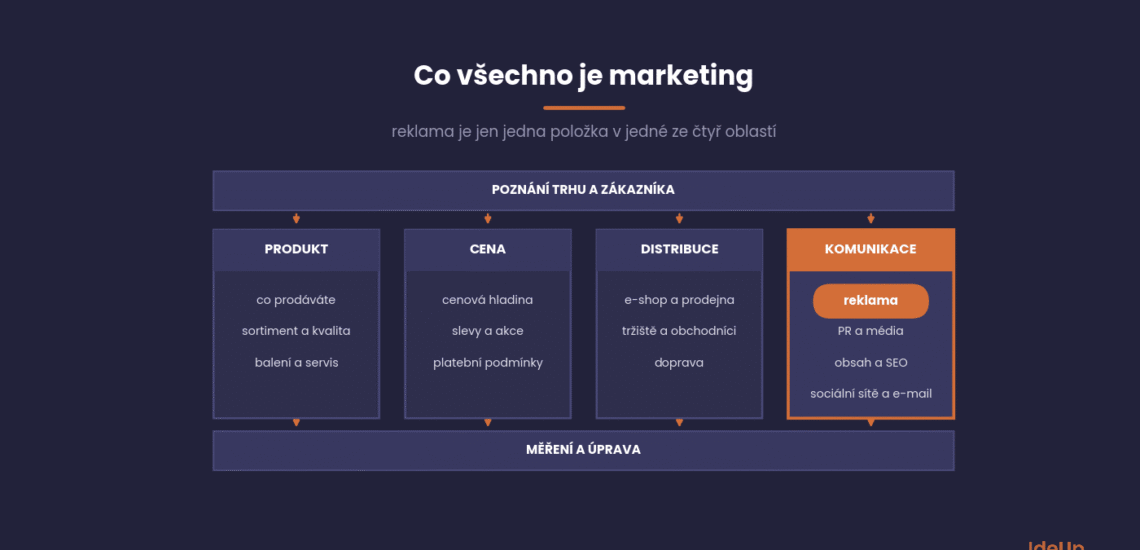
Marketing is the work of getting customers to choose you rather than your competitors. Put simply, it means finding out what customers need and then shaping both your offer and your communication so that the company makes money from it.
It also includes decisions about what you sell, at what price and where customers can buy it. Advertising is just the most visible part.
Definitions of marketing by the AMA, Kotler and Světlík
There are hundreds of definitions of marketing, and each one stresses something different. Czech textbooks and websites most often repeat two foreign definitions and one Czech one.
The American Marketing Association (AMA), which regularly revises its definition of marketing, describes it as the activity, set of institutions and processes for creating, communicating, delivering and exchanging offerings that have value for customers, clients, partners and society at large.
Philip Kotler, author of the textbook Marketing Management, sees marketing as a social and managerial process in which individuals and groups satisfy their needs and wants by creating and exchanging products and value. Czech economist Jaroslav Světlík stresses management. In his view, marketing leads to understanding, anticipating and influencing customer needs, and ultimately to satisfying them in a way that also lets the company meet its own goals.
What all three definitions have in common is that both sides must benefit from the exchange. If one of them loses out, the deal will not be repeated and you will have to find a new customer.
What is marketing as a business philosophy
Marketing is not only a set of activities. It is also a way of running a company, which textbooks call the marketing concept. It says that a company reaches its goals by understanding what its target customers need and by delivering that better than its competitors. Kotler compares it with other orientations a company can have.
- Production concept. Customers want cheap and available products, so the company focuses on producing efficiently.
- Product concept. Customers want the best quality, so the company keeps improving the product, sometimes beyond what anyone asked for.
- Selling concept. Customers will not buy enough unless pushed, so the company relies on hard selling and promotion.
- Marketing concept. The company starts with customer needs and builds the offer around them.
- Societal marketing concept. The company also considers the long-term interests of society, such as health or the environment.
The difference between the selling and marketing concepts lies in the starting point. Selling starts with what the company has made and asks how to move it. Marketing starts with the customer and asks what to make. A bakery that bakes the same range every day and then discounts the leftovers follows the selling concept. A bakery that notes what sells out by noon and adjusts its range follows the marketing concept.
Marketing is not the same as advertising or sales
In small companies, marketing often means advertising and social media. But advertising is just one communication tool, and communication itself is only one of the four areas that marketing decides on.
| Term | What it covers | Question it answers | How it is measured |
|---|---|---|---|
| Marketing | the whole offer, from product to communication | who to sell what to, at what price and where | margin and customer value |
| Advertising | paid space in the media and online | who to reach and where, for money | reach, cost per order or enquiry |
| Sales | closing a specific deal | how to turn an enquiry into an order | closed deals, revenue |
| PR | relations with the media and the public | what others say about you | mentions and their tone |
| Brand | the long-term image of the company | why customers should choose you | brand awareness, searches for the brand name |
The difference also shows in the money. According to an estimate in the Advertising Report (Zpráva o reklamě) by the Association of Communication Agencies (Asociace komunikačních agentur), 164.8 billion CZK (about 7.6 billion USD) went into marketing communication in the Czech Republic in 2025. Of this, 93.9 billion CZK (about 4.3 billion USD) went to the media. The remaining 70.9 billion CZK (about 3.3 billion USD), or 43%, went outside the media, to events, direct marketing, loyalty programmes and consumer competitions.
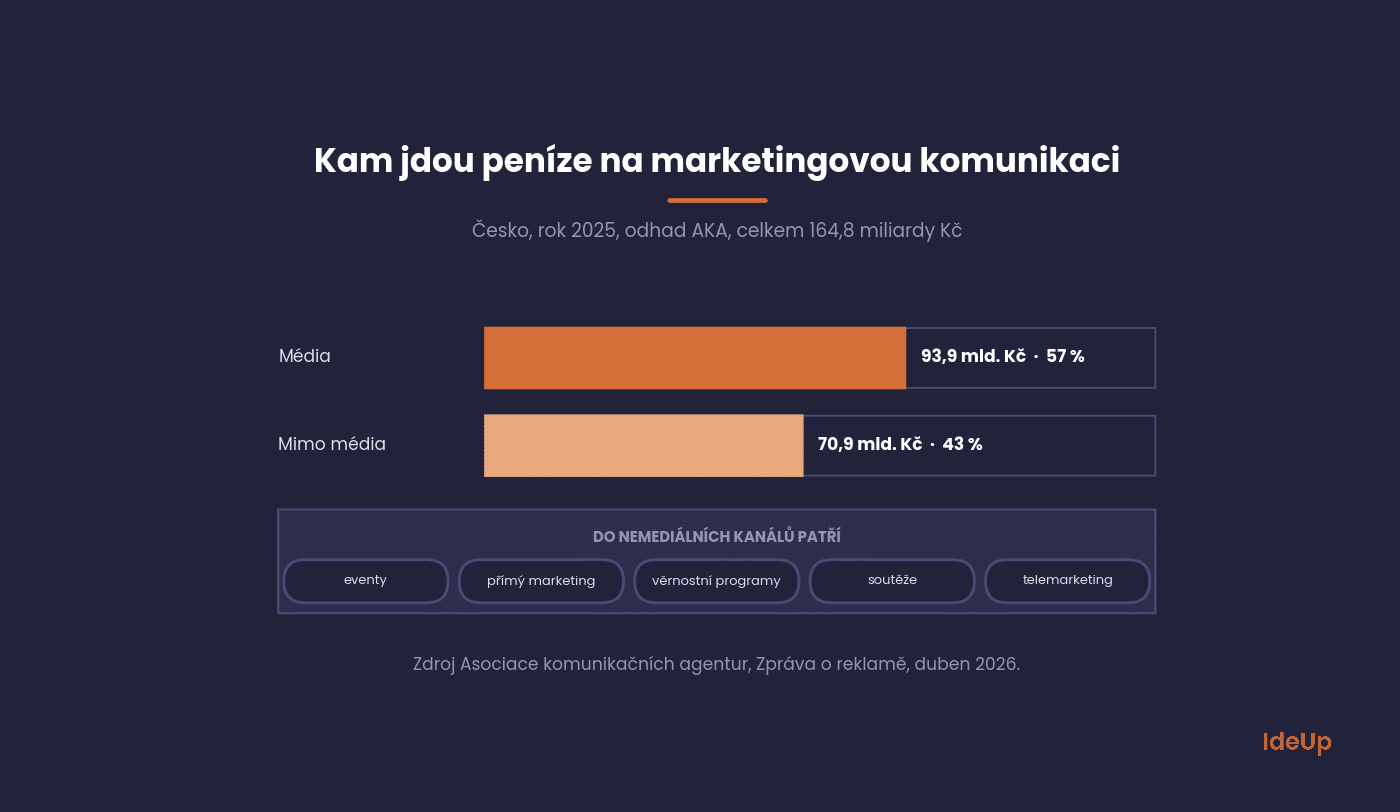
And that is only spending on communication. Decisions about product and price are not included in that figure, yet they often decide whether a customer buys long before any campaign does.
What marketing covers: 4P, 7P and 4C
The best-known map of marketing is the marketing mix. The original four Ps, product, price, place and promotion, were described by E. Jerome McCarthy in 1960. Promotion is often called communication. The later models in the table also build on the four Ps.
| Model | Author and year | Components | When to use it |
|---|---|---|---|
| 4P | McCarthy, 1960 | product, price, place, promotion | for goods and services, as a basic check |
| 7P | Booms and Bitner, 1981 | the 4Ps plus people, process, physical evidence | for services where people deliver the product |
| 4C | Lauterborn, 1990 | customer needs, cost to the customer, convenience, communication | when you want to review the mix through the customer’s eyes |
The 4C model looks at things from the customer’s side. Cost to the customer means not just the price but also the time and hassle of buying. The 5P and 8P models are not standardised, as each author adds a different letter.
At IdeUp, we work with the four Ps and add people and process for services. Further letters rarely change the decision. How to use the mix as a half-hour check when sales stall is covered in our article on the marketing mix in practice.
Types of marketing based on four decisions
Typical lists of marketing types mix strategic choices with individual tools. Guerrilla marketing, viral campaigns, remarketing and influencer partnerships are not types of marketing but tools that can be used in any of them.
It is more useful to divide marketing by four decisions that every company makes, even if it does not think about them explicitly.
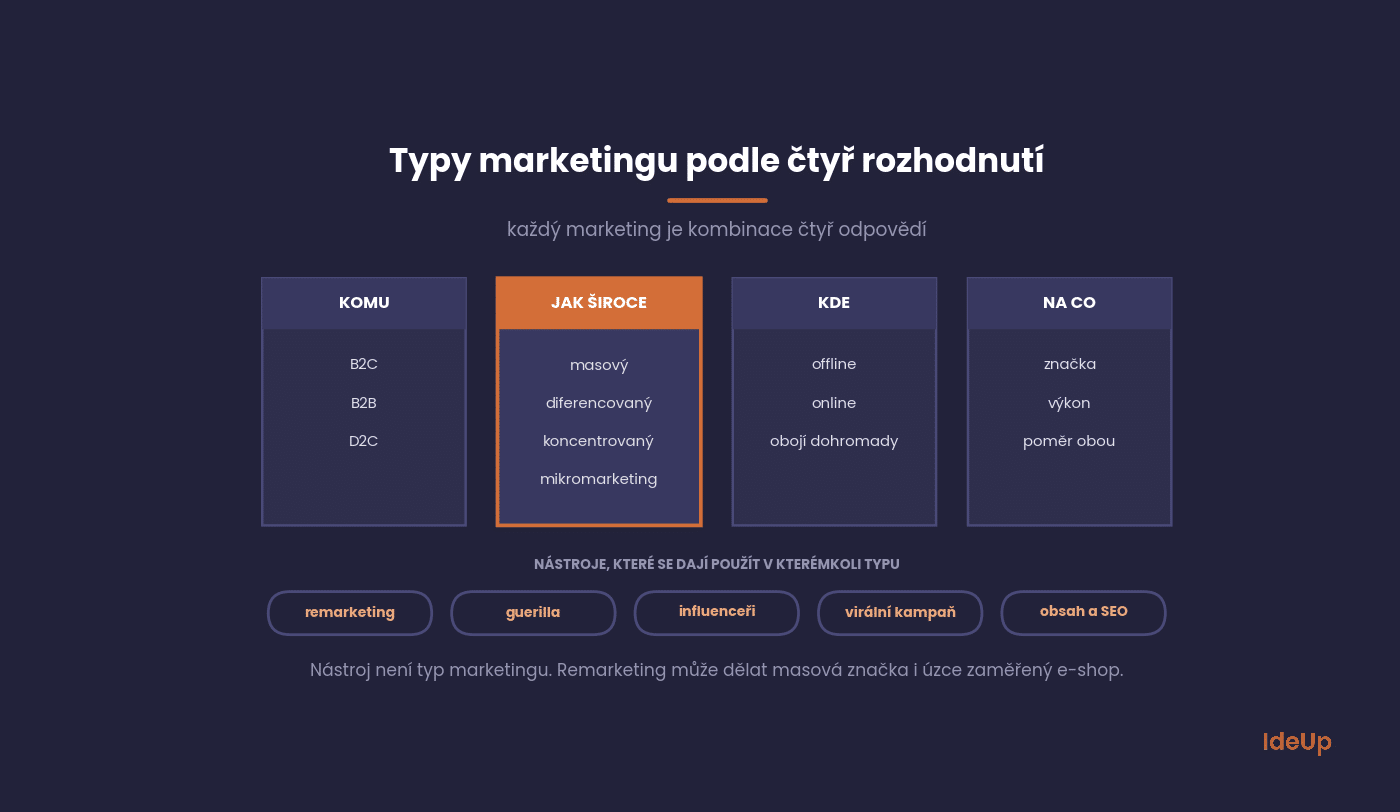
Who you sell to
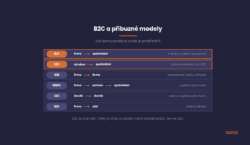
B2C means selling to end consumers, B2B means selling to businesses. D2C is when a manufacturer sells directly to end consumers, without retailers or large marketplaces.
In B2B, several people usually take part in the purchase decision and it takes longer. Marketing there therefore works closely with sales, because an enquiry from a campaign only becomes an order once someone follows it up.
How broadly you reach out
Here, marketing is divided by whether you treat the market as a whole or split it into groups. Undifferentiated, or mass, marketing offers everyone the same thing, while differentiated marketing has a different offer or message for each group.
Concentrated marketing, often called targeted marketing, focuses on one narrow group in which the company wants to be the best. The narrowest is micromarketing, meaning an offer for one place or one person. How to describe a group so that you can base decisions on it is shown in our article on the target audience.
Where you meet customers
Offline marketing uses television, print, billboards or a physical shop. Online marketing works mainly with websites and search engines, plus social media and email. It is often also called digital marketing.
The line between them is blurring. People who see a billboard often look up the brand on their phone, so the result of an offline campaign shows up in online data, for example in searches for the brand name. That is why it makes sense to plan both worlds together.
What marketing aims for
Brand marketing works on making people remember you and choose you when they are ready to buy. Performance marketing captures those who are buying now and is measured by orders and enquiries.
If you only do performance, you will hit a ceiling after a while, because the number of people buying right now is limited. Brand alone, on the other hand, lacks proof of what the campaigns earned. The balance between them depends on the industry and the company’s stage, but neither side lasts long without the other.
What is business marketing and how it differs
Business marketing, often called B2B marketing, is aimed at companies, public institutions and other organisations that buy products or services for their own operations or to resell them. A packaging manufacturer, an accounting firm or a supplier of warehouse software all do business marketing. Apart from the longer decision process, several other things set it apart.
- Fewer, larger customers. Losing one client can hurt badly, so keeping customers matters as much as winning new ones.
- Derived demand. Businesses buy because their own customers buy. When demand for cars falls, orders for car parts fall too.
- Choices must be justified. The buyer often has to explain the decision to a manager, so references, case studies, specifications and a clear calculation of return carry a lot of weight. Trust and fear of a wrong choice still play a role.
- Long relationships. A contract can run for years, so service after the sale is part of marketing.
If you sell an industrial cleaning machine for 20,000 USD, nobody will order it after seeing one advert. You need materials for the technician, the finance manager and the director, because each of them asks different questions.
Pros and cons of mass marketing
Mass marketing means offering one product with one message to the whole market. Typical examples are basic goods that almost everyone uses, such as salt, sugar or toilet paper, sold through national television and large retail chains.
The main advantages are these.
- Large production volumes lower the cost per unit.
- One offer and one campaign are simple to manage.
- Wide reach builds awareness quickly.
The disadvantages are just as clear.
- The total budget is high, even if the cost per person is low.
- A general message rarely speaks strongly to anyone.
- Competitors with offers for specific groups can take those groups away one by one.
- It is hard to tell which part of the effort brought results.
For a small company, pure mass marketing is rarely realistic. Even large brands now combine broad reach with separate offers for particular groups of customers.
Marketing goals are written in numbers
Textbooks following Kotler list four marketing goals from the point of view of society as a whole: maximum consumption, customer satisfaction, the widest possible choice and quality of life. They are useful for understanding the field but too general for running a company. In a company, a marketing goal has a number and a deadline. It usually falls into one of four directions: winning new customers, retaining existing ones, increasing purchase value or increasing brand awareness.
| Direction | Example annual target | How it is measured |
|---|---|---|
| Win new customers | 2,000 new customers at a cost of up to 400 CZK (about 18 USD) each | customer acquisition cost |
| Retain existing customers | share of repeat purchases from 25% to 32% | repeat purchase rate |
| Increase purchase value | average order from 1,500 CZK (about 69 USD) to 1,700 CZK (about 78 USD) | average order, margin |
| Increase brand awareness | a fifth more searches for the brand name | branded search, share of search |
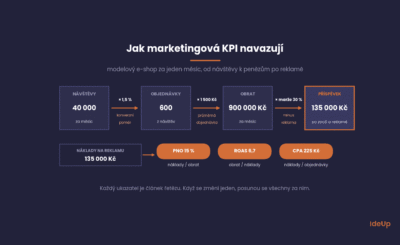
How to choose metrics for such goals and how to calculate them is shown in our entry on marketing KPIs, using one example online shop.
How marketing works in practice
Marketing runs in a cycle of six steps. In our experience, companies most often skip understanding the market and go straight to communication.
- Understanding the market and customers. What people are dealing with and who they compare you with. This also includes tracking changes around the company, from legislation to technology, which textbooks call environmental analysis. Research, customer interviews and search data all help.
- Choosing the target audience. Who you sell to as a priority and who you do not.
- Market position. Why customers should choose you rather than your competitors, in one sentence.
- Setting the mix. An offer that matches that position, from product to place of sale.
- Communication. Advertising, content, PR, social media, email.
- Measurement and adjustment. What brought in customers and what to change in the next round.
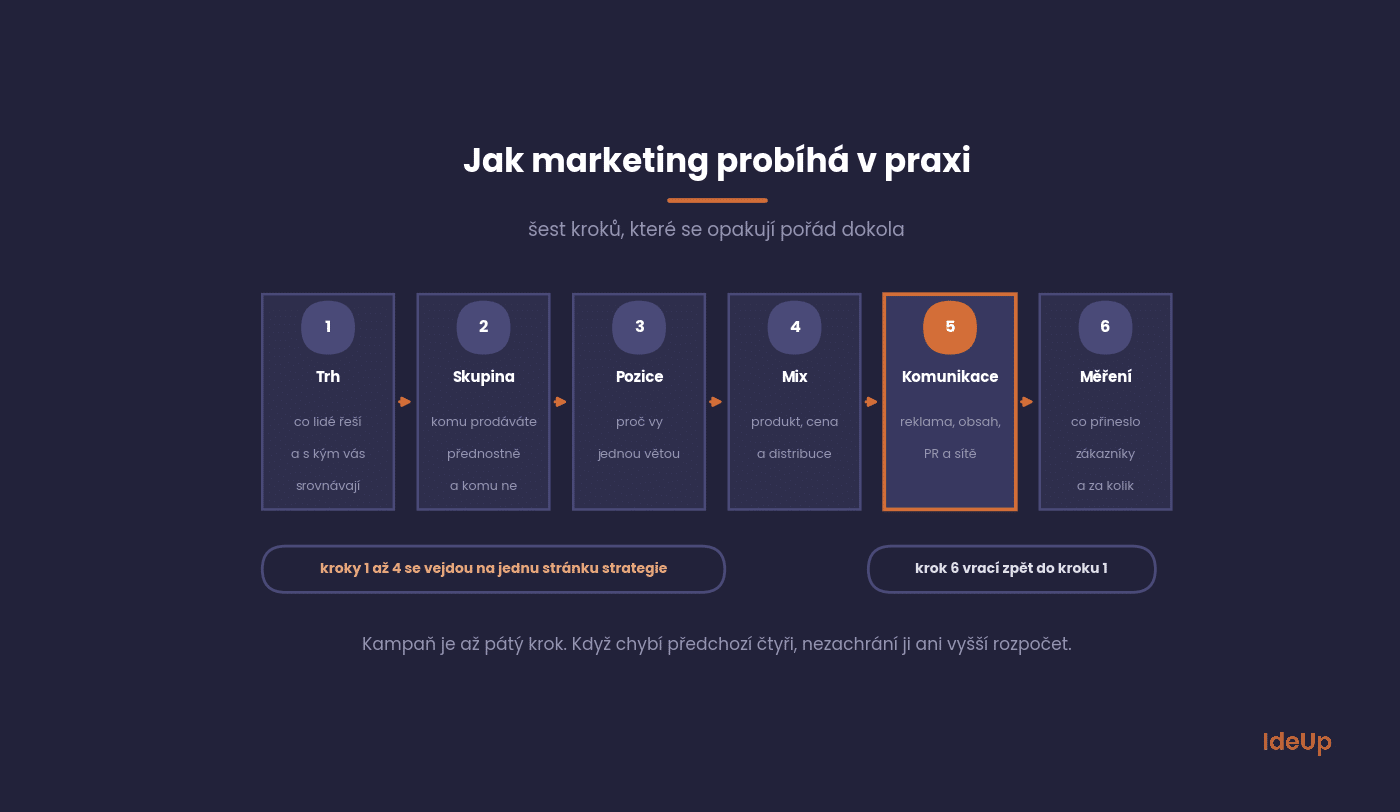
Together, the first four steps make up the marketing strategy. How to write it concisely and usefully is described in our guide to a one-page marketing strategy.
How to get started with marketing in a small company
A small company does not need a marketing department or a twenty-page annual plan. It needs to know who it sells to and why customers should choose it. After that, two or three channels that reach those people are enough.
How much it costs depends more on margin and goals than on the industry. For an online shop, advertising starts losing money when it eats up a larger share of turnover than your gross margin. Advertising as a share of turnover should therefore stay well below the margin. For services, what matters is how much you can afford to pay for one won order.
Start with a smaller amount, measure the cost per customer and only then increase spending. At IdeUp, we mainly help companies get found in search engines and in AI answers. You can see what we do for this in the overview of our Services.
Frequently asked questions about what marketing is
What is marketing in simple words?
Marketing is the work of finding out what customers need and shaping your offer and communication so that they choose you and the company makes money. It covers the product, the price, where it is sold and how you talk about it. Advertising is only one part of it.
What is the marketing mix?
The marketing mix is the set of decisions a company makes about its offer. The basic version has four parts, product, price, place and promotion. Services often add people, process and physical evidence.
What is B2B marketing?
B2B marketing is marketing aimed at other businesses and organisations rather than at individual consumers. Purchases tend to be larger, involve more people and lead to long-term relationships. That is why it works closely with sales and relies on references and clear arguments.
What is online marketing?
Online marketing reaches customers through the internet, for example through websites, social media, email and online adverts. It follows the same principles as any other marketing, only the channels differ. Its advantage is that you can usually see fairly precisely which activity brought in an order.
USD amounts are approximate, converted at the Czech National Bank rate of 21.75 CZK per USD on 9 October 2026.


Leave A Reply