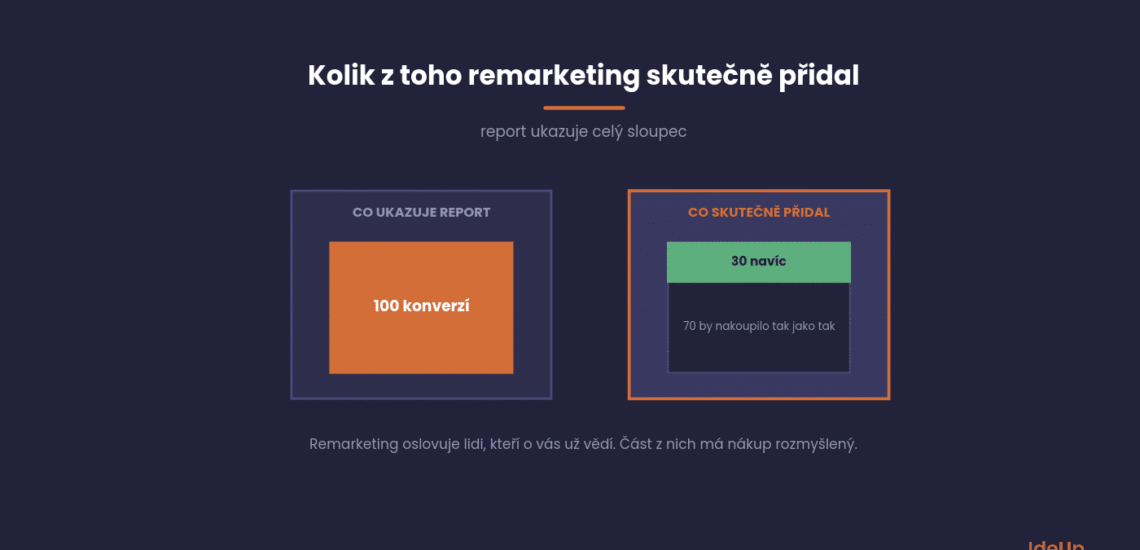
Remarketing looks great in reports. A low cost per order, a high conversion rate and a return that other campaigns cannot match.
That is exactly why it is the most dangerous channel in all of performance marketing. Those numbers largely describe people who would have bought anyway.
This article explains when remarketing really adds value, how to tell that you are just buying your own customers, and how to set it up so it is not annoying.
Why its numbers are misleading
Remarketing targets people who have already visited your website. That means they know about you, they have shown interest, and some of them have already made up their minds to buy.
When you show them an ad and they buy, the system takes the credit. The question the report does not answer is how many of them would have bought anyway.
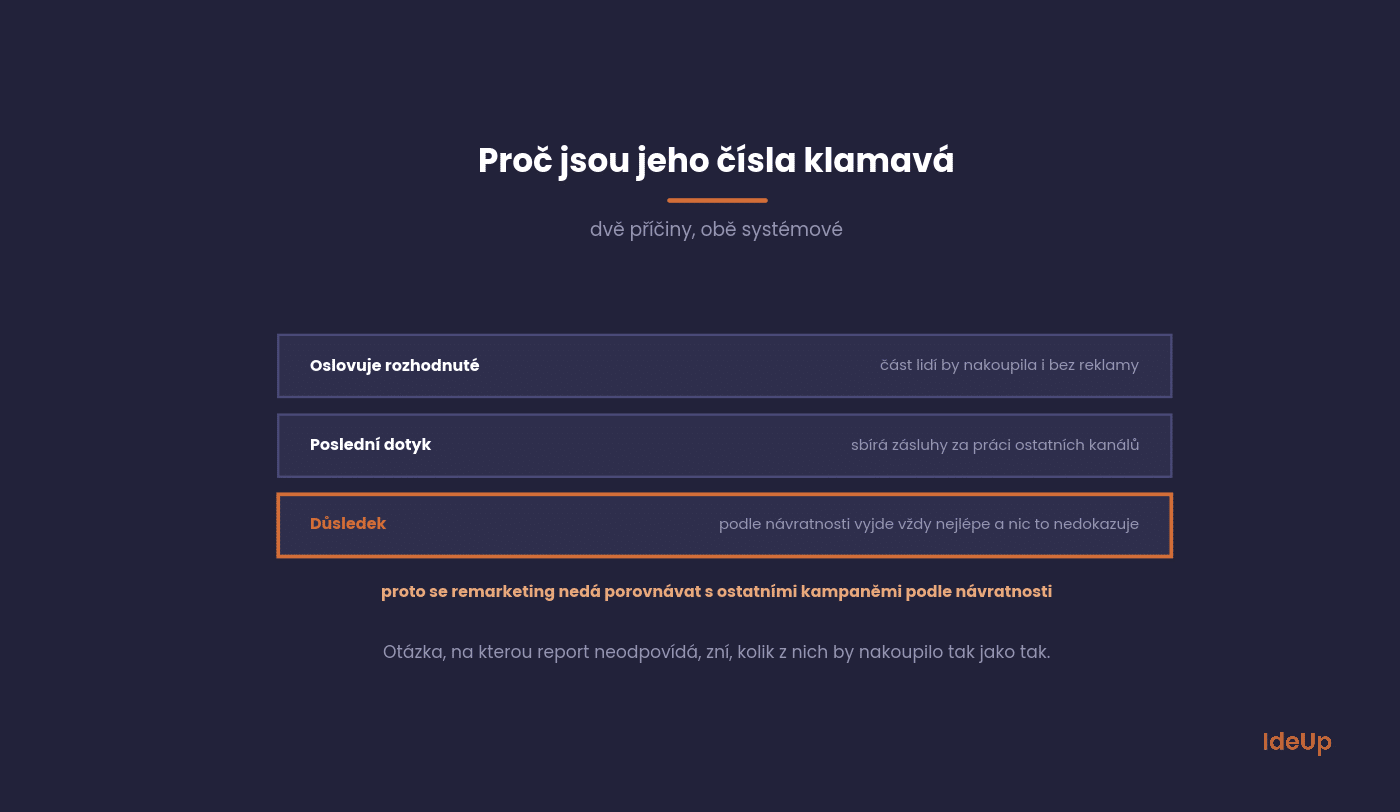
The second source of distortion is attribution. Remarketing is often the last touch before a purchase, so in a last-click model it collects credit for the work of other channels.
In practice, this means there is no point comparing remarketing with other campaigns by return. It will always come out best, and that proves nothing.
What remarketing is and how it works
Remarketing means showing ads or messages to people who have already interacted with you. Usually they have visited your website, used your app or given you their email address. You will also see the term retargeting used for the same thing.
On the technical side, it works through a tag or pixel placed on your website. When someone visits, the tag records the visit and adds that person to an audience list, for example everyone who viewed a product page. The ad platform then shows your ads to people on that list on other websites, in videos, on social networks or in paid search.
Each list has a membership duration. This is the window covered later in this article. When it runs out, the person drops off the list unless they come back to your website.
In the European Union and many other places, you need visitors’ consent before you can track them for advertising. If your consent banner is set up correctly, your lists will be smaller than your traffic. That is normal and does not mean the tag is broken.
When it really helps
This does not mean it is useless. There are situations where it adds real value, and they can be described.
What they have in common is that they involve people for whom a purchase is not a given.
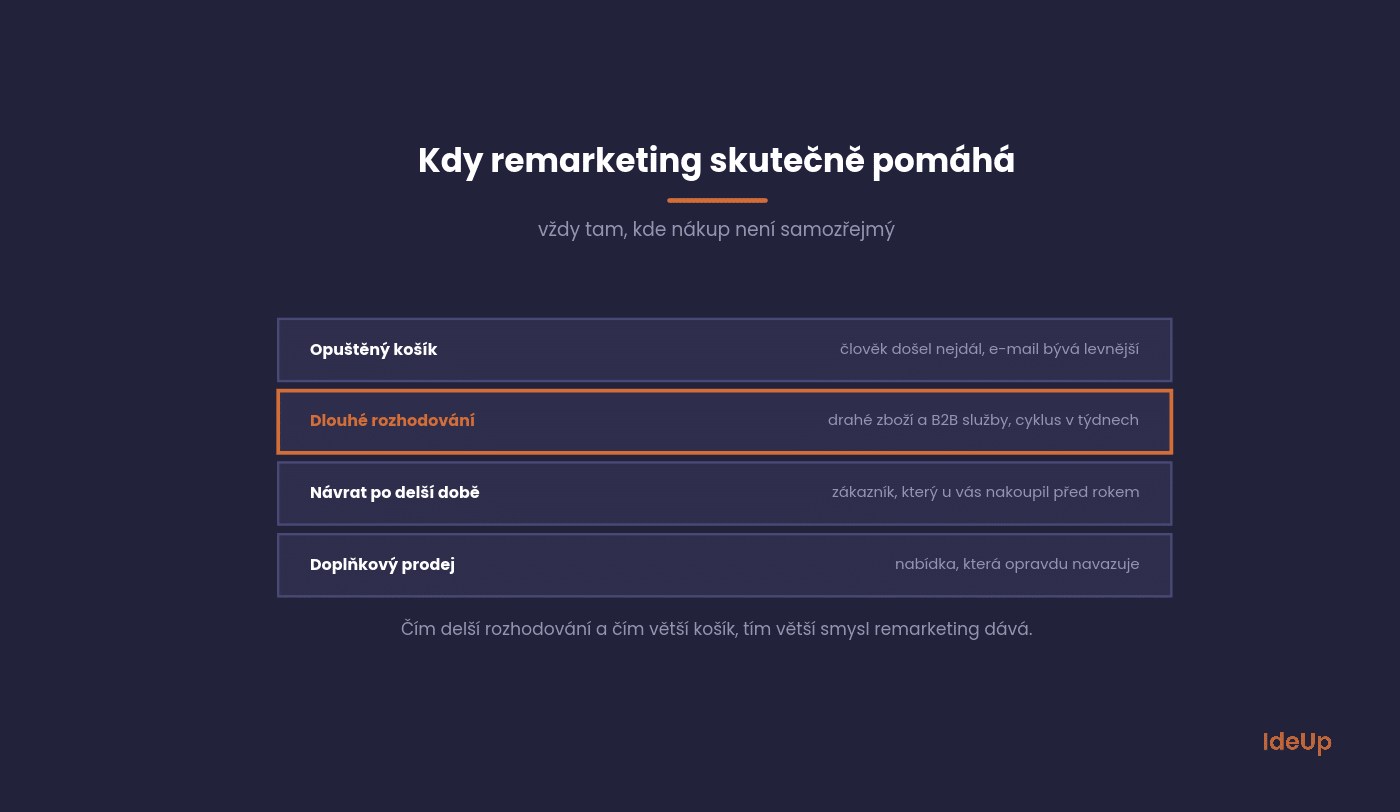
Abandoned basket. The person got furthest and did not finish. A reminder makes sense here, but be careful: email is usually cheaper and more effective than ads.
Long decision-making. For expensive goods and B2B services, the decision takes weeks. Reminding people in the meantime makes sense.
Returning after a long time. A customer who bought from you a year ago and nothing since. Here remarketing really renews the relationship.
Cross-selling. Offering things related to the product they bought. It works when the offer genuinely follows on.
When you are just buying your own customers
The opposite situation is just as common and can be recognised by a few signs.
If two or more apply, it is worth reviewing the campaign.
You target all visitors. An undifferentiated audience includes people who left after three seconds as well as those who had already decided to buy.
Short decision-making. With cheap goods bought on impulse, there is nothing to remind people of.
Long window. An ad that follows someone for a month after their purchase is not remarketing, it is harassment.
Large share of the budget. When remarketing swallows more than a fifth of your performance budget, you are usually reaping instead of sowing.
How to check what it really brings
There is a simple test anyone can do, and it costs nothing but two weeks of patience.
The process is the same as for brand campaigns in paid search.
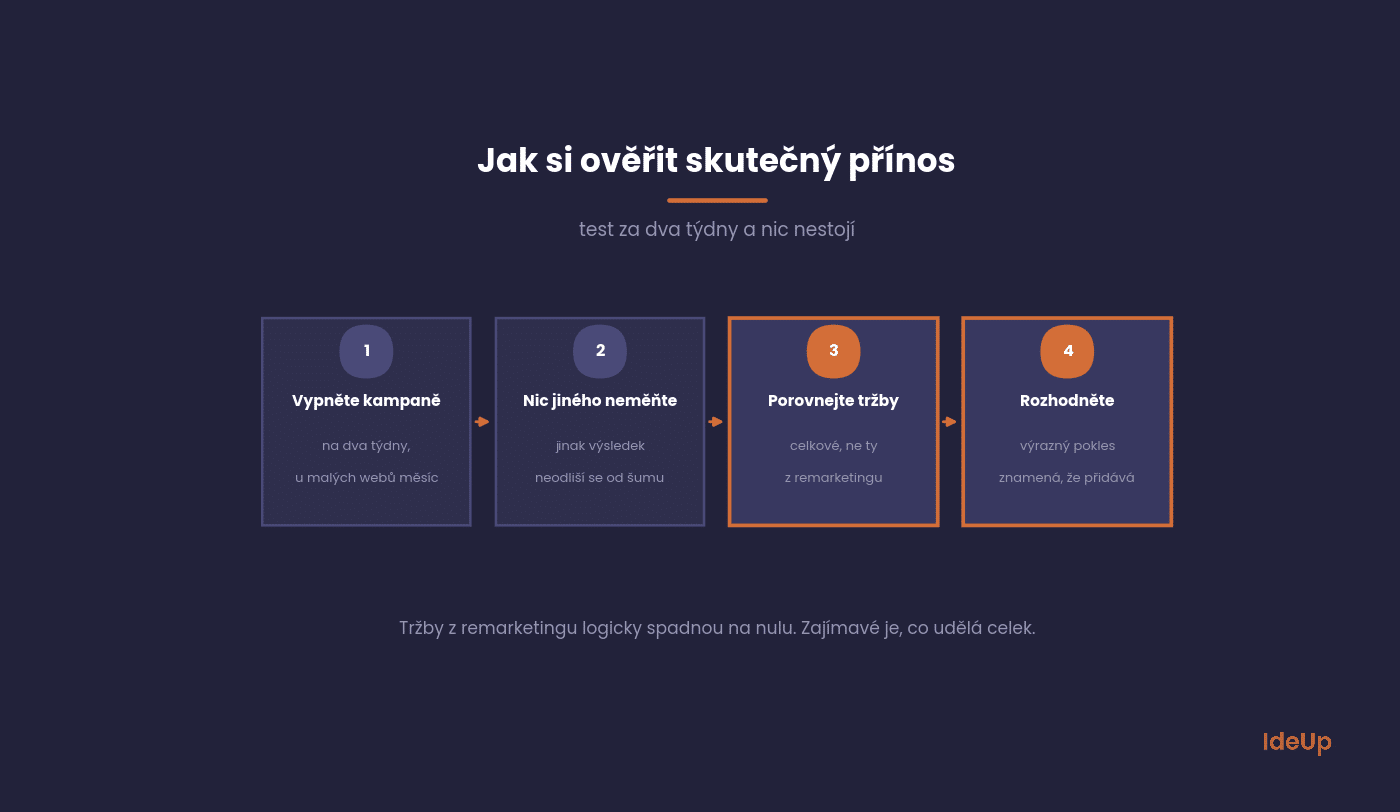
Switch off your remarketing campaigns for two weeks and compare total revenue with the same period before. Not remarketing revenue, which will of course drop to zero.
If total revenue falls significantly, the channel adds value. If it barely changes, the conversions simply moved elsewhere.
The test has two conditions. You need enough orders for the result to stand out from the noise, and you must not change anything else at the same time.
For smaller online shops with low volumes, extend the test to a month. A shorter period will prove nothing.
How to set it up sensibly
If it turns out to make sense, the next step is to set it up so it is not annoying and does not waste budget.
Four settings are enough, and all of them can be done in the interface.
Split audiences by behaviour. A category visitor, a product visitor and an abandoned basket are three different people with different likelihoods of buying.
Exclude those who have bought. The most basic setting and the most often overlooked. An ad for a product someone has just bought is wasted budget.
Set a sensible window. Three to seven days for quick purchases, thirty or more for long decisions. Not ninety days for everything.
Cap the frequency. Three to five impressions per person per week is the upper limit, beyond which you are only damaging your reputation.
Google has its own remarketing help for setting up audiences, which also describes the technical requirements, such as the minimum audience size.
Types of remarketing campaigns
Remarketing is not one campaign type. Which one you use decides where people see you and how much control you have.
Display and video remarketing
Banner and video ads that follow past visitors around other websites and platforms. This type has the widest reach and is also where frequency gets out of hand most easily.
Remarketing lists for search ads
In paid search, you can use your audience lists to change how you bid when a past visitor looks for something again. You might bid higher for people who abandoned a basket, or show ads on broader phrases only to people who already know you.
Because the person is actively looking for a solution, this is often the most useful form of remarketing in PPC. It is also the least intrusive, as nobody is followed around the internet.
Behavioural remarketing
The ad reflects what the person did on your website, such as which products they viewed or which pages they read. The most common example is dynamic ads that show the exact products someone looked at.
It suits online shops with a large catalogue. The risk is showing a product the person has already bought elsewhere, which you cannot know.
Email remarketing
Automated emails triggered by behaviour, such as a basket reminder or a message after someone browses a category. It only works for people who are in your database and have agreed to receive emails.
- Display and video give you reach, but need a strict frequency cap.
- Search ad lists give you precision with people who are already looking.
- Behavioural ads give you relevance, but need a good product feed.
- Email gives you low cost, but only for contacts you already have.
Remarketing versus email
For abandoned baskets and returning customers, both do the same job. The difference is in cost and in who you reach.
Email is cheaper because you already have the database. Ads also reach people who have not given you their email.
A sensible approach is to deploy email automations first and add remarketing for those who are not in your database. We cover this in more detail under email marketing.
When you do both at once for the same people, you pay twice for the same thing and the person gets the reminder twice.
What to avoid
We see the following mistakes again and again, and all of them cost either money or reputation.
They are fixed through settings, not creative.
An untargeted audience of all visitors. The fastest way to spend your budget on people who arrived by mistake.
Not excluding buyers. You pay to annoy your own customers.
Last-click evaluation. A model in which remarketing always wins because it sits at the end of the journey.
The same creative for months. People stop noticing it, and it starts to feel like stalking.
Questions people ask about remarketing
Five questions we get from online shops and service companies alike.
The answers apply in general; the numbers differ for specific industries.
How much budget for remarketing?
Usually a tenth to a fifth of the performance budget. If it is more, you are harvesting enquiries rather than creating them.
The exception is industries with very long decision-making, where the share can be higher.
Does remarketing work in B2B too?
It does, and often better than in e-commerce, because decisions take weeks. You can also target visitors to specific pages.
The key is a longer window and content that helps people decide, not a discount.
How long should the window be?
Roughly as long as a decision takes in your industry. Days for consumer goods, weeks for expensive services.
You can find this in Analytics in the conversion paths report, which shows the time to conversion.
Does remarketing affect the brand?
It does, in both directions. A sensible frequency reminds, an excessive one annoys, and people remember it.
With a brand you are still building, caution is warranted. This ties in with brand building.
What if I do not have enough traffic?
The audience must have a minimum size, otherwise the ads will not be shown. For small websites, it pays to invest in bringing people in first.
Until then, email automations are enough, as they have no size limit.
Where to start
Check in your ad account what share of your performance budget goes to remarketing. If it is over a fifth, you have your first question to look into.
Then check whether you have excluded people who have already bought. Half of the accounts we open do not have this set up.
Want to find out what the channel really brings you, including a switch-off test? Get in touch via the contact page or browse our services.
Frequently asked questions about remarketing campaigns
What is remarketing in PPC?
It is the use of audience lists in pay-per-click campaigns, so your ads reach or are bid differently for people who have already visited your website. You still pay per click, as with other PPC ads. The difference is that you are paying to reach people who already know you.
What are remarketing lists for search ads?
They let you use your audience lists in paid search campaigns. You can raise or lower bids for past visitors, or show certain ads only to them. This is useful because you reach people at the moment they are actively looking again.
What is behavioural remarketing?
It is remarketing based on what someone did on your website, such as the products they viewed or the pages they read. The ad then reflects that behaviour, often by showing the same products. It needs well-segmented audiences and an accurate product feed.
How is email remarketing different from ad remarketing?
Email remarketing sends automated messages to people already in your database, so you do not pay for each impression. Ad remarketing also reaches visitors who have never given you their email. Each person should get one reminder, not both.