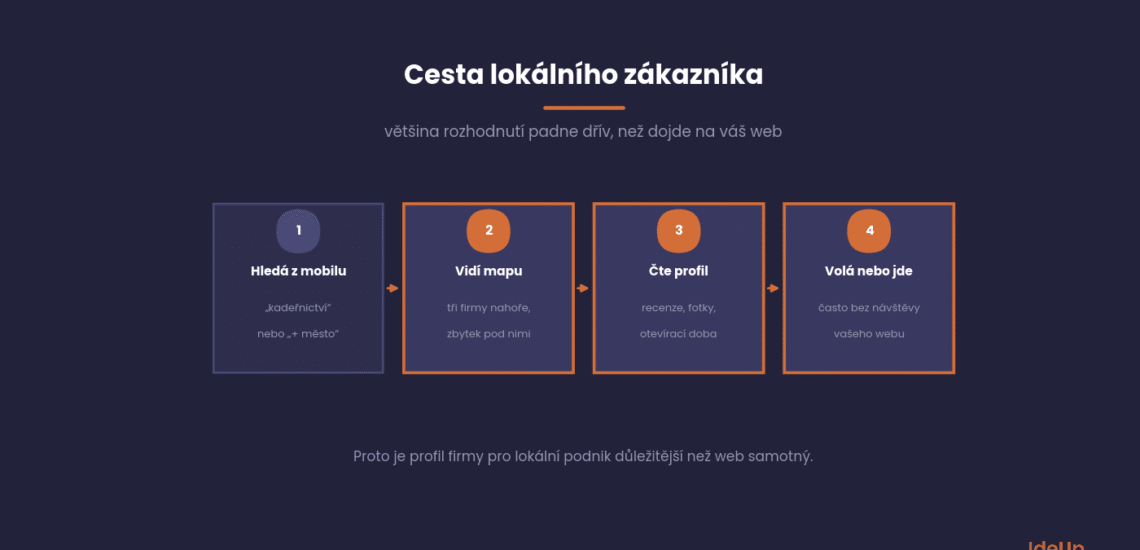
A hair salon, car repair shop, dentist, restaurant or tradesperson faces a different question from an online shop. They don’t need to be visible across the whole country. They need to be visible within a ten-kilometre radius.
This is called local SEO, and the competition is for a different spot than in regular search. What matters is the map block at the top, not the tenth blue link.
This article explains what affects that block, how to earn a place in it and which parts you can handle yourself in a single afternoon.
Why local search behaves differently
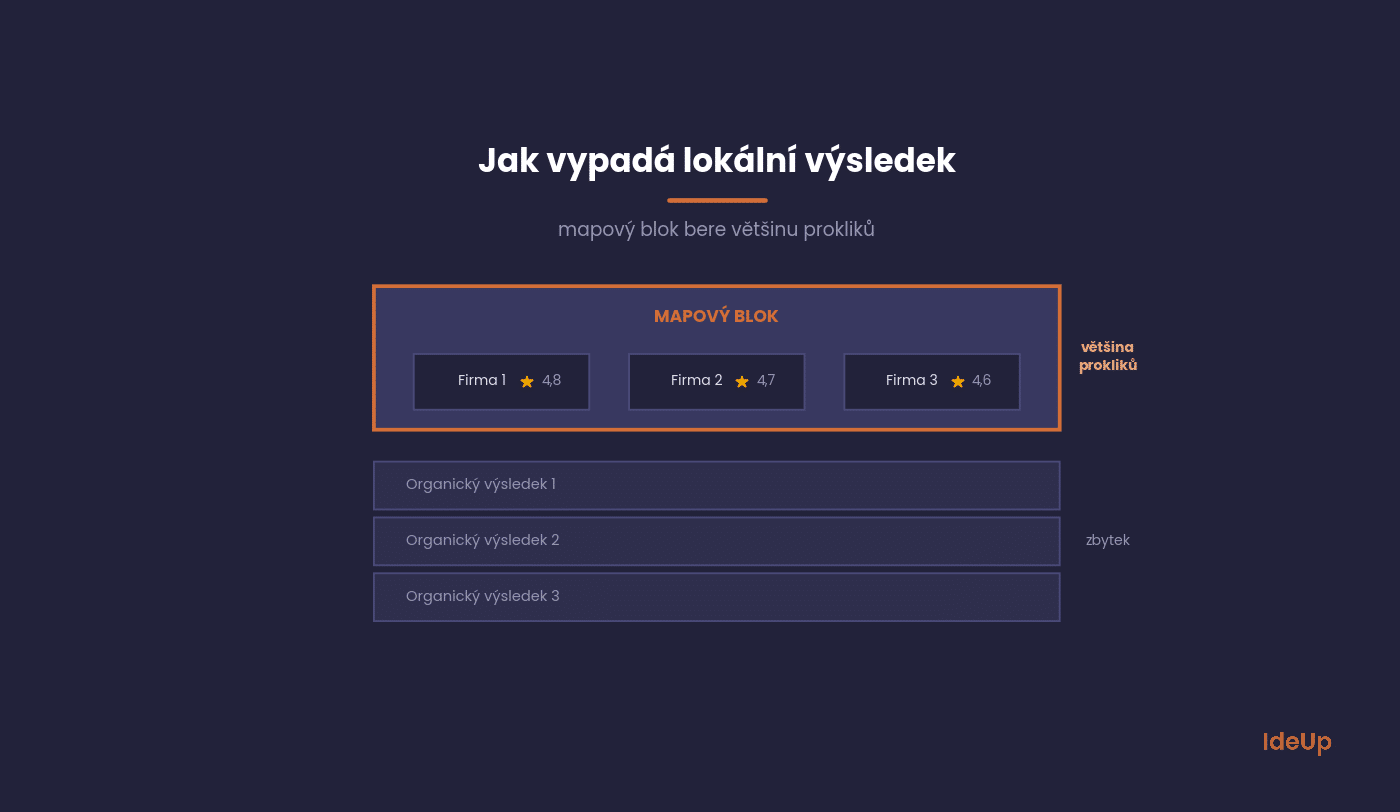
When someone searches for “hair salon Brno”, or just “hair salon” on their phone, Google doesn’t show the usual ten links. It puts a map and three businesses at the top.
This block takes most of the clicks. Anyone not in it competes for the leftovers below.
The second difference is in what Google evaluates. Besides the website content, distance from the searcher, completeness of the business profile and reviews all come into play.
The third difference is timing. A change to your business profile can show results within days, while regular SEO works in months. That makes local SEO the fastest-paying discipline a small business has.
What is local SEO and how it works
Local SEO is the work of making a business visible to people nearby at the moment they need it. It applies to businesses with physical premises and to those that serve a defined area. It covers your business profile, your website, your reviews and mentions of your business on other sites.
It works through the way Google matches a query with a place. When a query implies a location, either named by the person or taken from their device, Google draws on its business listings and not only on web pages. Your profile becomes the main thing it assesses. Your website and other sources confirm what the profile says.
The difference from regular SEO is scope. Regular SEO aims to rank pages for a topic wherever the reader is. Local SEO aims to rank a business for a service in a specific area. For that reason your address, opening hours and reputation count as much as your content.
Three things that decide your position on the map
Google itself states that it weighs three factors for local results. They are relevance, distance and prominence.
You can directly influence two of them. The third, distance, is fixed, and the only thing you can do about it is set your service area correctly.
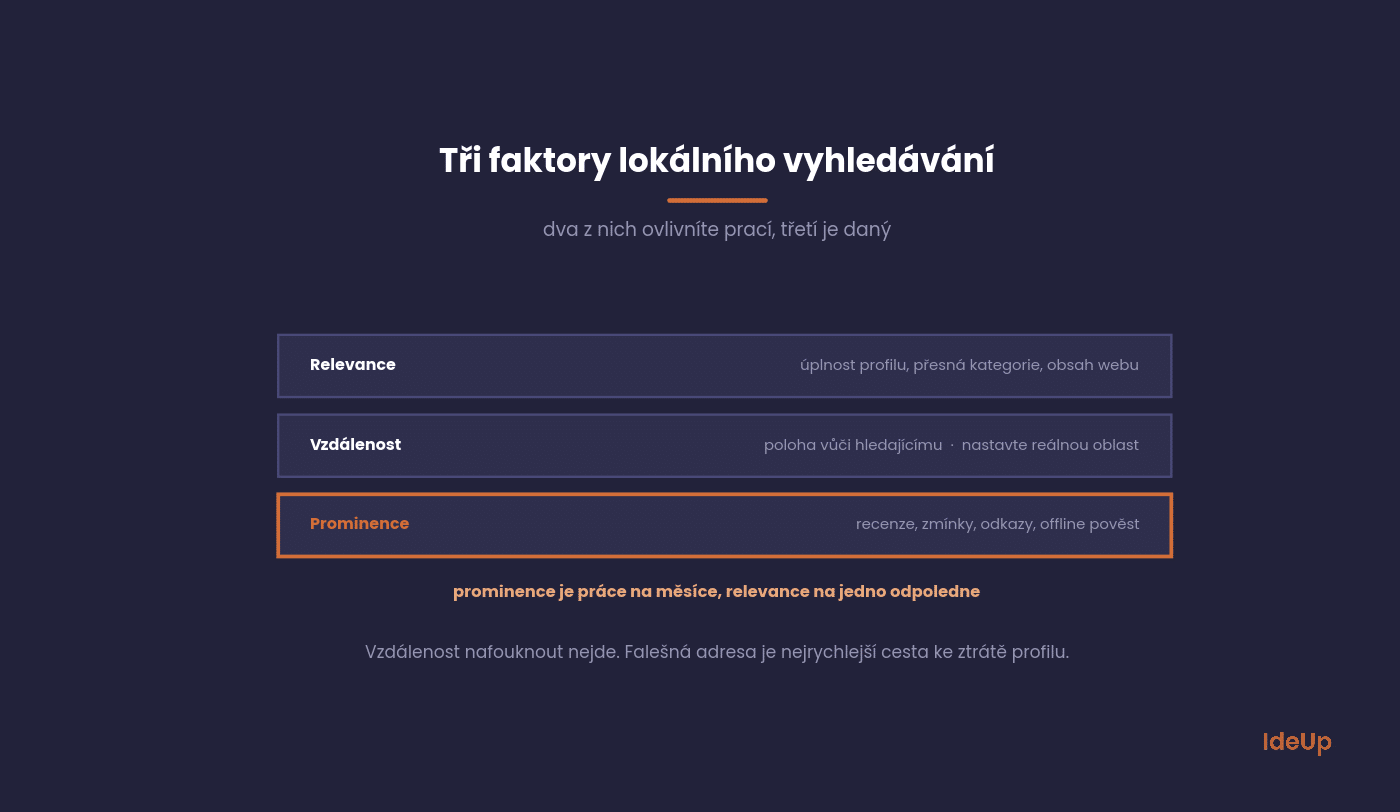
Relevance is how well your profile and website match what the person is searching for. You influence it through a complete profile, the right category and your website content.
Distance is your location relative to the searcher. Set the exact address or the area where you actually work, and don’t try to inflate it.
Prominence is how well known the business is. It is made up of reviews, mentions on other websites, links and offline reputation.
Google Business Profile, the foundation for everything
For a local business, the business profile matters more than the website. Most people make their decision right there, without ever reaching your website.
Yet it is often only half filled in and nobody ever goes back to it.
What to fill in now
The exact business category, opening hours including public holidays, phone number, address or service area, a link to your website and at least ten photos.
The category is the most important of these and the one most often rushed. Choose the most specific one, not the most general, and add secondary categories for services you actually provide.
What to keep up to date
Add photos regularly, not just once. Use posts and the services section, and answer the questions people ask in your profile.
Google has published its own guidelines on maintaining a profile and stresses the same point: a complete, up-to-date profile has an advantage over an empty one.
Reviews, the strongest lever you have
For local businesses, reviews are what links are for regular SEO. They decide your ranking and also whether someone chooses you.
Three things matter, and businesses usually deal with only one of them.
Number and freshness. Fifty reviews that are three years old carry less weight than twenty from the last six months. Collecting them has to be ongoing.
Replies. Reply to all of them, including the good ones. With a negative review, the reply matters more than the review itself, because other people read it.
Review content. When people mention a specific service in their reviews, it helps relevance. Don’t tell them what to write, but you can ask about their specific experience.
Never buy reviews. Google will notice, and the penalty will hit the profile you have spent years building.
What to do on your website
Your website plays a smaller role in local search than your profile, but without it, getting into the map block is harder. Four things are worth the effort.
All of them can be done without a developer if you have access to your content management system.
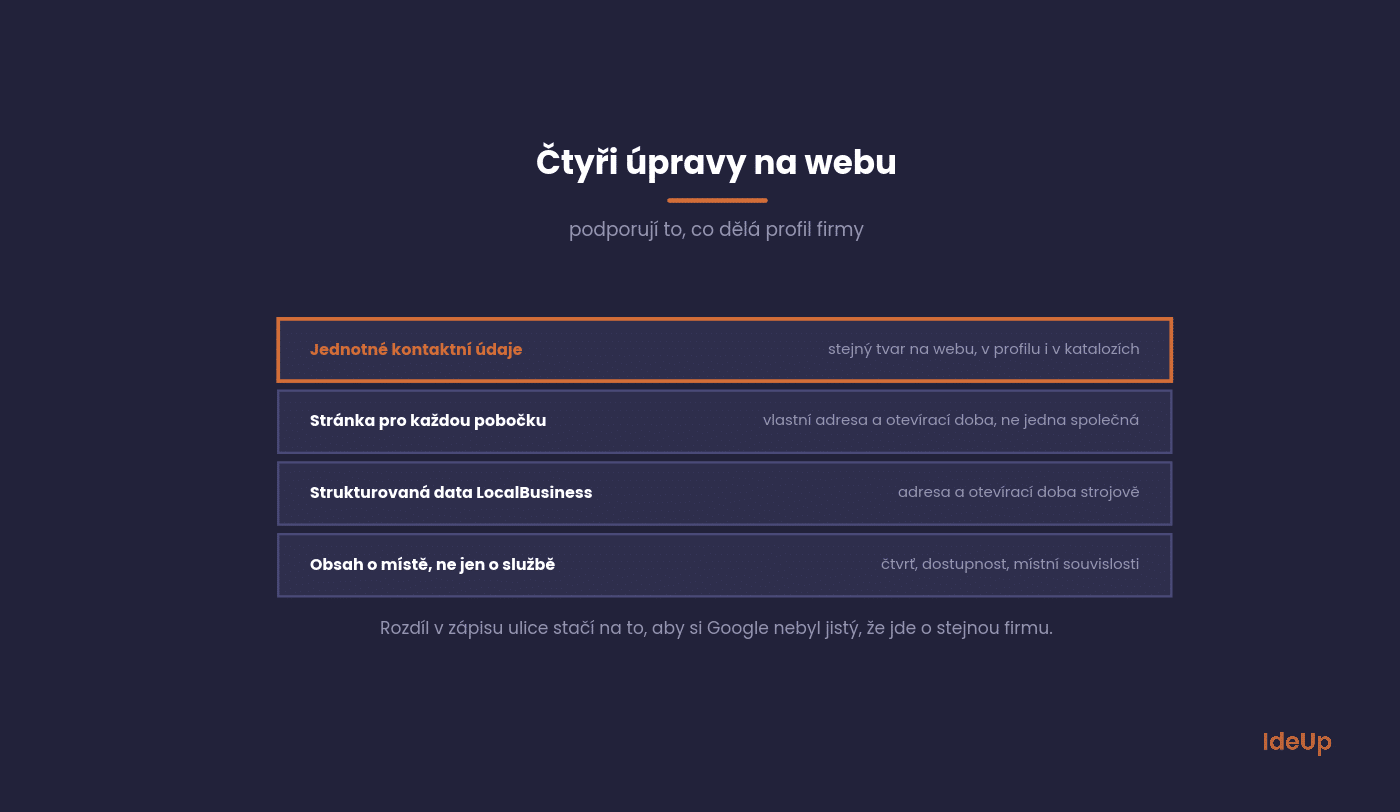
Contact details in a consistent format. Name, address and phone number must be identical everywhere: on your website, in your profile and in directories. A difference in how the street is written is enough to make Google unsure whether it is the same business.
A separate page for each branch. If you have three locations, they need three pages, each with its own address and opening hours, not one shared page.
LocalBusiness structured data. It describes your address and opening hours to Google in a machine-readable way. We explain how to do it in our article on structured data.
Content about the place, not just the service. A page that mentions the neighbourhood, transport links or local context has the edge for local queries over a generic service description.
Directories and mentions
Directory listings serve a different purpose in local SEO than in regular link building. It’s not primarily about the link but about confirming that the business exists and has consistent details.
This doesn’t apply to every directory, though. What matters is whether people actually use it.
In the Czech market, Firmy.cz, Mapy.cz and industry directories where your customers really search are worth it. Restaurants belong on booking portals, tradespeople on enquiry websites.
Skip directories set up to sell links. The same rule applies as with link building: traffic matters, not mere existence.
How local citations work
A citation is any mention of your business name, address and phone number on another website, with or without a link. Directories, industry portals, local news sites and chamber of commerce listings all count.
Their value lies in agreement. When many independent sources show the same details as your profile, Google has more confidence that the business is real and located where you say. Conflicting details, such as an old address on a forgotten listing, weaken that confidence.
- Make a list of every place where your business already appears.
- Correct outdated names, addresses, phone numbers and opening hours.
- Remove duplicate listings or ask the directory to merge them.
- Add new listings only where your customers actually look.
- Keep the login details in one place so the next update takes minutes.
A local SEO checklist for small businesses
Treat this list as a routine, not a one-off project. Once the groundwork is done, most items take only minutes.
Every month
- Check your profile for edits suggested by other users. Google can apply them without asking you.
- Add new photos and one post about a current offer or event.
- Reply to every new review.
- Ask recent customers for a review, in person or with a short message after the job.
Every quarter
- Compare your name, address and phone number across your website and your main listings.
- Update opening hours before public holidays and seasonal changes.
- Look at the businesses ranked above you and note what their profiles have that yours lacks.
Common mistakes in a local SEO strategy
- Adding a town or service to the business name. Google’s guidelines ask for your real-world name, and stuffing it can lead to suspension.
- Using a virtual office or a PO box as the address. Such addresses are not eligible for a profile.
- Creating several profiles for one location. Duplicates split your reviews and confuse customers.
- Changing the main category to test what works. Frequent changes make your profile less stable, not more visible.
- Leaving profile access with one person. If that person leaves, you can lose control of the profile. Add at least two owners or managers.
Questions about local visibility
Five questions we get from businesses with physical premises.
The answers apply in general; details vary by industry.
How long does it take to move up on the map?
Completing your profile can show results within days to weeks. For progress driven by reviews and mentions, expect months.
Adding the category and photos usually has the fastest effect. Those are the first two things people see.
Do I need physical premises?
No, but you must have a service area set. Businesses that travel to their customers have a dedicated mode in the profile without a public address.
In that case, you can keep your address hidden. Google then works with the area you specify.
How many reviews is enough?
It’s not about an absolute number but about how you compare with competitors in your area. Look at the three businesses above you and you’ll know what to aim for.
Watch the pace too. Ten reviews over a year look better than fifty in a single week.
Can I appear outside my own town?
In the map block, with difficulty, because distance is a strong factor. In the regular organic results, yes, through content targeted at that town.
A separate page for each area you actually serve, with real content about that area, will help.
Is local SEO worth it for an online shop?
If you have a pick-up point or a shop, definitely. Queries like “shop Prague” have strong purchase intent and little competition.
A pick-up point also brings the business onto maps, where people who would have missed it in search will see it.
Where to start
Open your Google Business Profile and check whether you have filled in the category, opening hours, description and at least ten photos. It’s an afternoon’s work with the fastest return in all of marketing.
The second step is to google your own business and check whether the name, address and phone number appear in the same format everywhere. Fix any inconsistencies.
If it turns out your website needs work too, get in touch via our Contact page. We handle local visibility as part of search engine optimisation.
Frequently asked questions about local SEO
What is local SEO in simple terms?
It is everything you do so that people near you find your business when they need your service. It mostly involves your Google Business Profile, your reviews, your website and consistent details across other sites. The aim is a place in the map block, not just a page in the regular results.
Is local SEO only about Google?
Google is the largest platform, but it is not the only one. Apple Maps, Bing Places and regional services such as Mapy.cz in the Czech Republic also show local businesses. The same basics apply everywhere: complete details, consistent contact information and genuine reviews.
How can I check my local SEO ranking?
Your position on the map changes with the location of the person looking, so one check from your office tells you little. Check from several points in your area, or ask people in different neighbourhoods to look for you. The performance report in your business profile also shows calls, direction requests and website clicks, which matter more than the position itself.
Can a small business do local SEO without an agency?
Yes, most of the work is within your reach. Filling in the profile, collecting reviews and fixing your listings needs time and consistency, not technical skills. Outside help makes sense mainly for website changes, structured data or businesses with many branches.