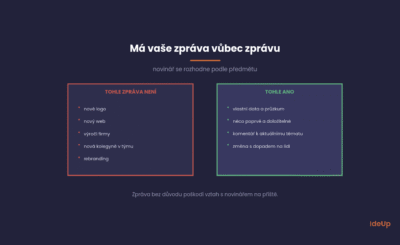
In Czech companies, content marketing meets the same fate as running shoes bought in January. It starts with enthusiasm, lasts three months, and then nobody touches the blog for a year.
The reason is not laziness. It is that people start writing instead of first deciding what the content is actually for.
This article explains how to turn a blog into a channel that brings in enquiries, how much time it really takes and why most company blogs do not work.
What content is really for
Content marketing is not writing articles. It is a way of being useful before anyone buys anything from you.
The difference from advertising is that advertising demands attention, while good content earns it. That is also why it works on people who do not yet know they need you.

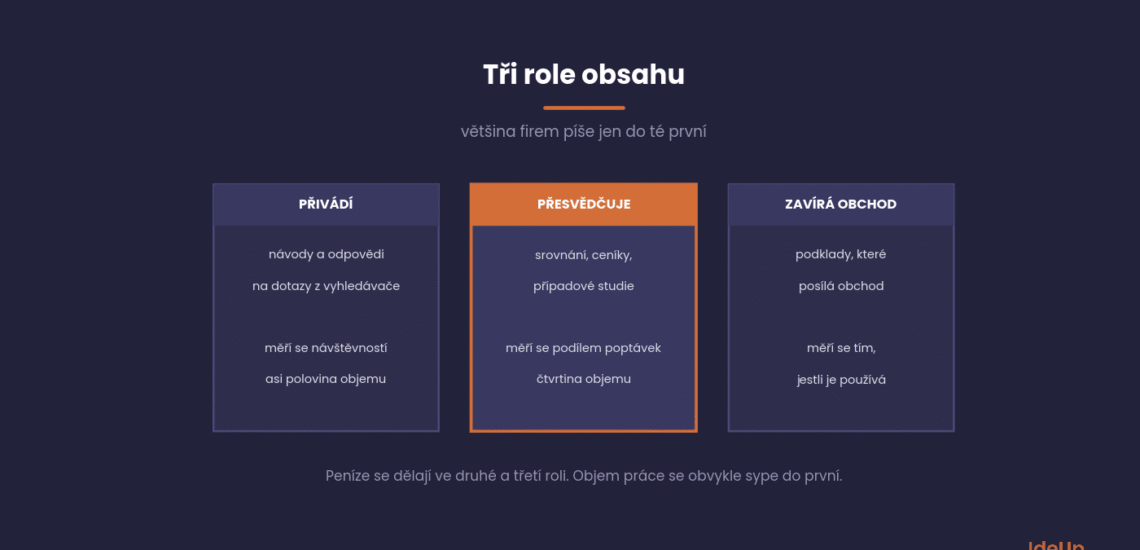
Content plays three different roles, and each looks different. It brings people in from search, persuades those who are already considering you, and helps sales close the deal.
The most common mistake is writing only for the first role. The blog brings in traffic, but that traffic has nowhere to go, because there is no content to help people make a decision.
What is a content marketing strategy
A content marketing strategy is a written plan. It says who your content is for, which problems it solves, which business goal it supports, and how you will produce and share it. A list of article titles is not a strategy. A list of titles is a calendar, and a strategy explains why each item is on it.
A usable strategy answers five questions.
- Audience. Who you write for and what they need to know before they decide.
- Goal. Whether content should bring new contacts, shorten negotiations or support existing customers.
- Topics. The problems you can explain better than others because of your own experience.
- Formats and channels. Articles, case studies, newsletters or sales materials, and where each one will be shared.
- People and measurement. Who writes, who supplies expertise, who publishes and how you will know it works.
Keep it short. Two pages that the whole team has read are worth more than a long document nobody opens.
Three types of content every company should have
The format, volume and way of evaluating it all differ by role. If you mix them, you will not be able to evaluate any of them.
The recommended ratio is roughly half, a quarter and a quarter.
Content that attracts
Guides and answers to questions people type into search engines. The goal is traffic and widening the circle of people who know you.
It is evaluated by organic traffic and the number of queries the website appears for. Keyword research provides the basis for choosing topics.
Content that persuades
Comparisons, case studies, price lists and answers to objections. These are read by people who already know what they want and are choosing between you and someone else.
It is evaluated by the share of visits that end in an enquiry. It is the smallest part of the blog in volume, but the most valuable.
Content that supports sales
Materials you send during negotiations: a decision paper for management, a comparison table, a sample deliverable.
It is evaluated by whether sales actually use it. If they do not, either it is poor or they do not know it exists.
Content marketing strategy examples
The same principles lead to very different plans depending on the business. These three simplified examples show how.
A B2B service company
Decisions take months and involve several people. The company writes practical guides for the specialists who look for a solution, case studies for the managers who compare suppliers, and a short decision paper for the person who approves the budget. Sales send links to these pieces at each stage of the negotiation.
A small local business
A kitchen fitter has a small audience and a limited number of topics. Around ten solid pages covering materials, timing, maintenance and typical mistakes are enough, along with finished projects that each have a short description. One new article a month keeps the plan realistic.
An online shop
Here content works before and after the purchase. Buying guides help people choose between product types, and care instructions and a newsletter bring customers back for their next order.
What it really costs
This is the figure that decides whether it makes sense to go ahead. Most companies underestimate the time and overestimate the money.
One proper article means roughly four to eight hours of work: choosing the topic and research, gathering your own data, writing, revision, publishing and images.
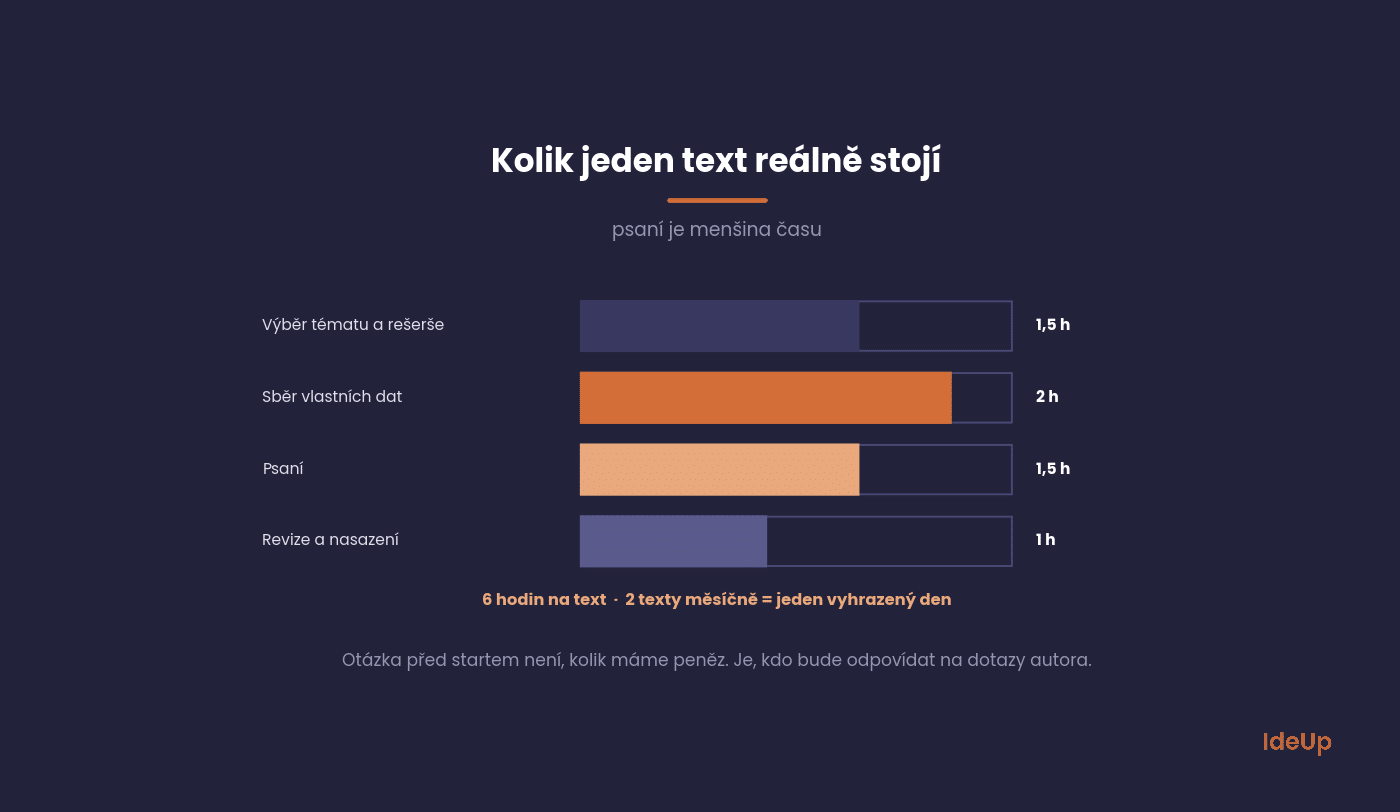
At two articles a month, that comes to roughly one dedicated day a month, or an external cost ranging from several thousand to low tens of thousands of CZK.
So the practical question before you start is not how much money you have for it. It is who in your company will answer the writer’s questions, because without internal input you get a generic text.
A sensible pace is two to four articles a month for a year. Ten articles at once followed by silence works neither for readers nor for search engines.
Where to find topics
The best topics are not in tools. They are in the emails you receive and in the calls your sales team makes.
Tools are for checking volume, not for coming up with ideas.
Customer questions. Anything you have answered twice in the past month is a topic. This is the most valuable source of all.
Sales objections. The reasons people do not buy are ready-made briefs for content that persuades.
Search Console data. Queries you already appear for but have no proper page for. We explain where to find them in our article on Search Console.
Gaps in the competition. Not copying, but looking for topics they cover superficially and where you have something extra to say.
Creating a content marketing strategy step by step
If you are starting from scratch, work through these steps in order. Each one depends on the step before it.
- Define one business goal. For example, more enquiries for one service, or shorter negotiations with larger clients. A single goal keeps every later decision simple.
- Describe the people who buy. Note their role, what worries them before buying and who else has a say. Ask your sales team rather than guessing.
- Sort your topics by role. Put each topic under attract, persuade or support sales, so that no role is left empty.
- Name the people involved. Decide who writes, who supplies the expertise and who publishes, and set a pace you can keep.
- Plan sharing before writing. For every piece, decide where it will be shared and which page it will lead the reader to next.
- Review every quarter. Drop topics that bring nothing, expand the ones that lead to enquiries and update older articles that still matter.
Why most company blogs do not work
The Content Marketing Institute has consistently found that companies with a documented strategy are significantly more successful than those without one. Its definition of content marketing rests on the same idea: consistent content for a clearly defined audience.
In practice it fails in four places, and all of them can be fixed with a decision, not a budget.
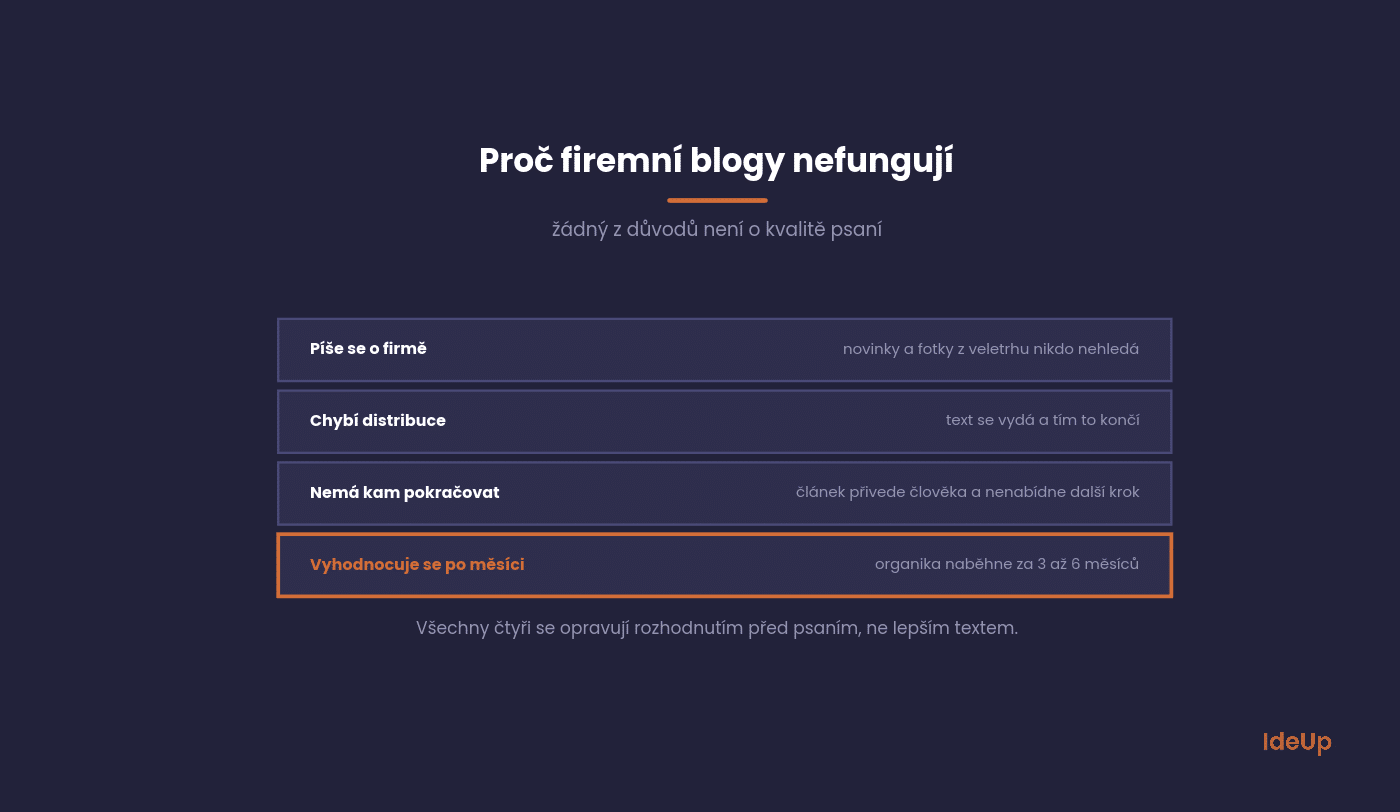
It is written about the company, not for the customer. Nobody searches for company news and trade fair photos.
There is no distribution. The article is published and that is the end of it. Without sharing, a newsletter and internal linking, nobody finds it.
There is nowhere to go next. The article brings a person in and then offers them no next step.
It is evaluated after a month. Content takes three to six months to gain traction in organic search. Anyone who cuts it after a quarter always cuts it.
What to measure and when
Measuring the number of articles is pointless. Four figures matter, and each is assessed over a different time frame.
Set them up right at the start, otherwise in a year you will have nothing to compare against.
After a month: whether content is being produced to plan at all. Nothing more can be measured after a month.
After a quarter: the number of queries the website appears for. It grows even when traffic does not yet.
After six months: organic traffic excluding branded queries, and the number of downloads or enquiries from content.
After a year: the share of enquiries where content played a part somewhere along the way. This figure decides whether to continue.
Common questions about content
The five questions we are asked most often when planning content.
The answers apply in general; details vary by industry.
How long does it take for content to pay off?
The first organic visits within three months, a measurable contribution to enquiries within six to twelve. Longer in competitive industries.
That is why a company with a budget for only one quarter should not take on content.
How many articles a month?
Two proper ones are better than eight quick ones. Sustainability is what matters, because the channel only works over a year.
Choose a pace you can manage even in your worst month, not the one you can manage in your best.
Can AI write it?
The first draft, yes; routine work, yes; the final text without review, no. We go into more detail in our article on SEO copywriting.
What matters is whether you add something to the text that the model has no way of knowing. Without that, you get a text that is everywhere.
Should we write for Google or for people?
That is a false choice today. Google assesses whether a text answers the query, which is exactly what the reader wants.
The only difference is structure: headings phrased as questions with the answer directly below. That helps both.
Is content worth it in a small industry?
If search volume is in the tens of queries a month, not as a traffic tool. As sales support, yes.
In that case, focus mainly on content that persuades and do not track traffic.
Where to start
Open your inbox and find five questions you have answered more than once in the past month. That is your first content plan.
Before you start writing, decide two things: who will answer the writer’s questions and who will publish the text. Without that, the launch will stall at the third article.
Want to set it up so that content ties in with both SEO and sales? Take a look at our copywriting service, or get in touch via our contact page.
Frequently asked questions about content marketing strategy
What is a content marketing strategy in simple terms?
It is a plan that connects what you publish with what your business needs. It defines your audience, your goal, your topics and the people responsible. Without it, content tends to be produced at random and is hard to evaluate.
How does a B2B content marketing strategy differ from a B2C one?
In B2B, several people usually take part in one purchase and the decision takes longer. Your content therefore has to speak to specialists, managers and whoever approves the budget, each with different concerns. In B2C, decisions are faster and content focuses more on choosing and using the product.
Does a small business need a content marketing strategy?
Yes, but a short one. A single page with your goal, the ten questions customers ask most often and a realistic publishing pace is enough. It stops you spending time on content that does not help anyone decide to buy from you.
What should a content marketing blog strategy include?
It should include the topics you will cover and the role each article plays. It should also say how often you publish, who writes and reviews the texts, and where each article leads the reader next. Add a plan for sharing and for updating older articles, otherwise the blog stops working after the first few months.