Most companies get the choice of SEO supplier wrong at the briefing stage. They ask which agency is the best instead of asking whether they need an agency at all.
Yet this decision has a bigger effect on the result than choosing between two specific names. The difference lies in how much of your money reaches the person who actually works on your website.
This article follows the money, the people and the questions you need to ask before you sign anything.
How much of your payment reaches the work
Let us start with a calculation that nobody says out loud in meetings. When you pay a large agency 1,700 CZK (about 78 USD) per hour, the person who works that hour often gets around 300 CZK (about 14 USD) of it.
The rest is margin, overheads, sales, account management and the cost of winning you as a client in the first place.
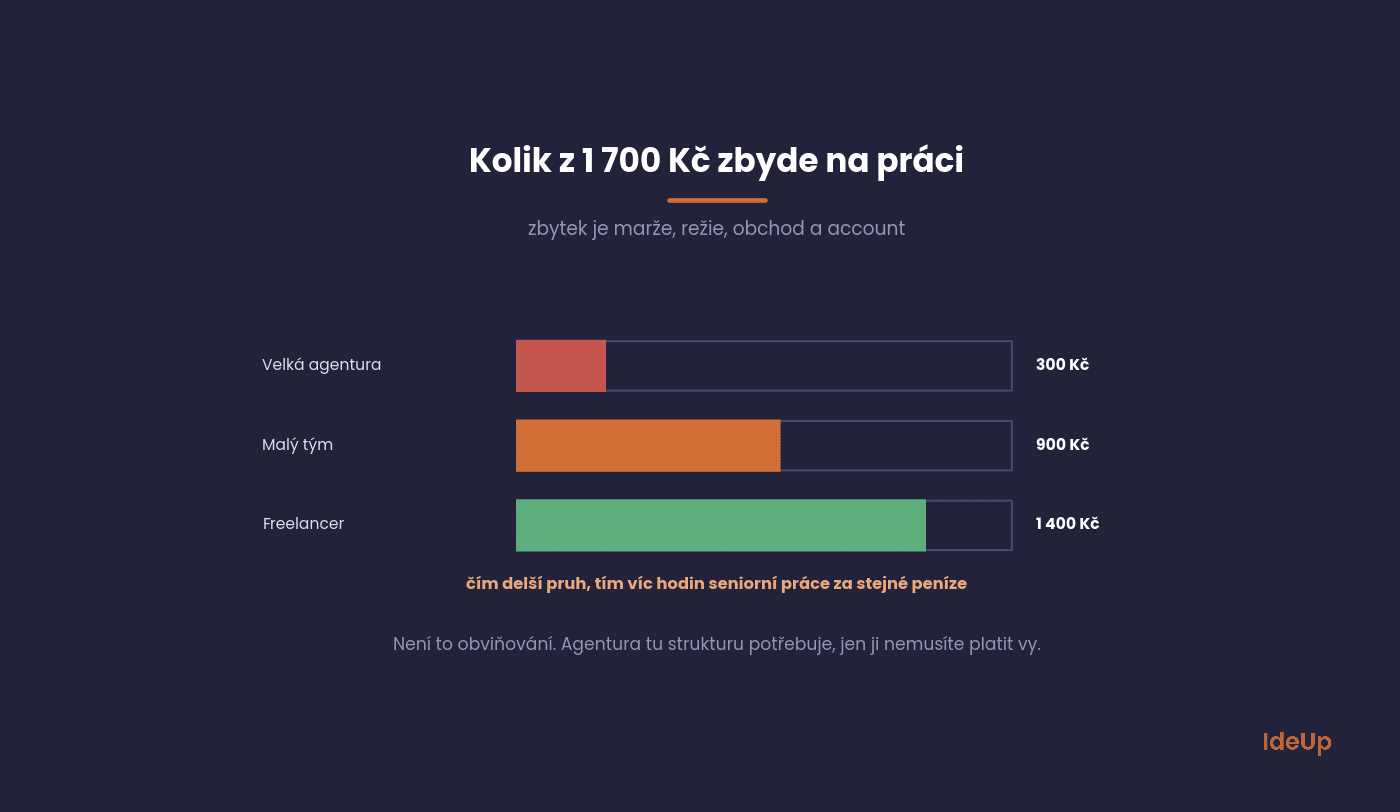
This is not an accusation. An agency needs that structure to operate, and on large projects it pays off. The problem arises when a small company buys a structure it will not use.
The practical consequence: for 20,000 CZK (about 920 USD) a month, a large agency gives you considerably fewer hours of senior work than an experienced freelancer billing the same amount. And in SEO, the number of hours worked has a direct effect.
When a freelancer or a small team makes sense
An experienced independent consultant or a group of freelancers who come together for a project is a better choice than a large agency for most Czech companies.
The reason is not the price but who does the work. With a freelancer, you talk to the person who does it, and they know everything about your website.
It pays off when your budget is up to roughly 40,000 CZK (about 1,800 USD) a month, you mainly need thinking and decision-making, and you have someone in-house who can implement the changes.
It does not pay off when you need high-volume content, PPC, social media management and development all at once. In that case, coordinating five suppliers costs more than one agency.
A group of freelancers combines both: each is senior in their field, overheads are a fraction and the client talks directly to the people doing the work. The weakness is that no single company stands behind it, so you need to make sure you know who is responsible for the project.
This is how we work too. On SEO projects we collaborate with consultant Patrik Pilous, so the client gets senior work without agency overheads.
Three models and the risks each one carries
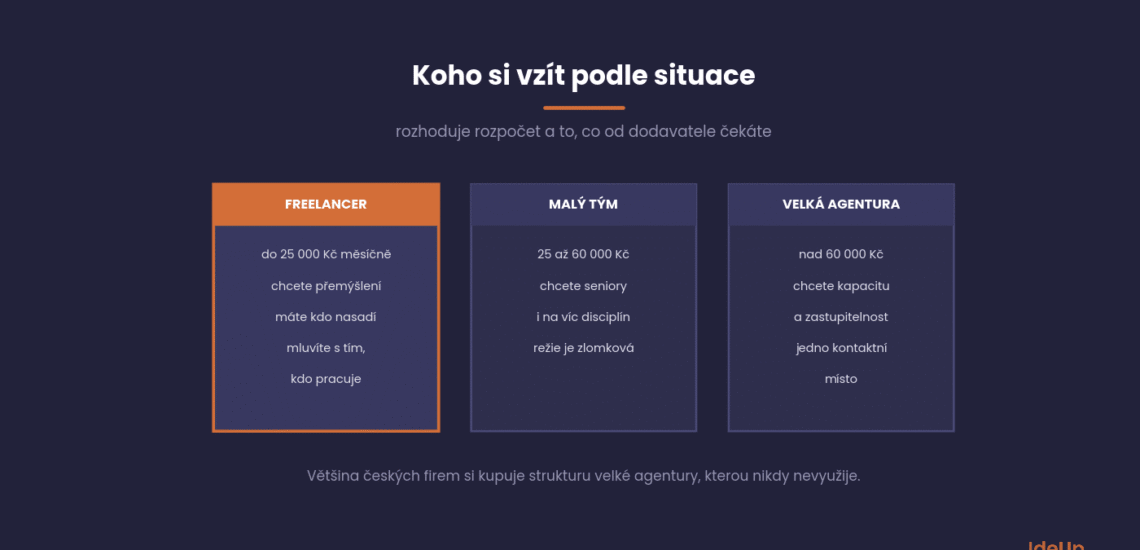
The decision is not between good and bad but between three sets of risks. You choose based on which risk you can live with.
We use the following overview when a client asks us whether they should hire someone other than us.
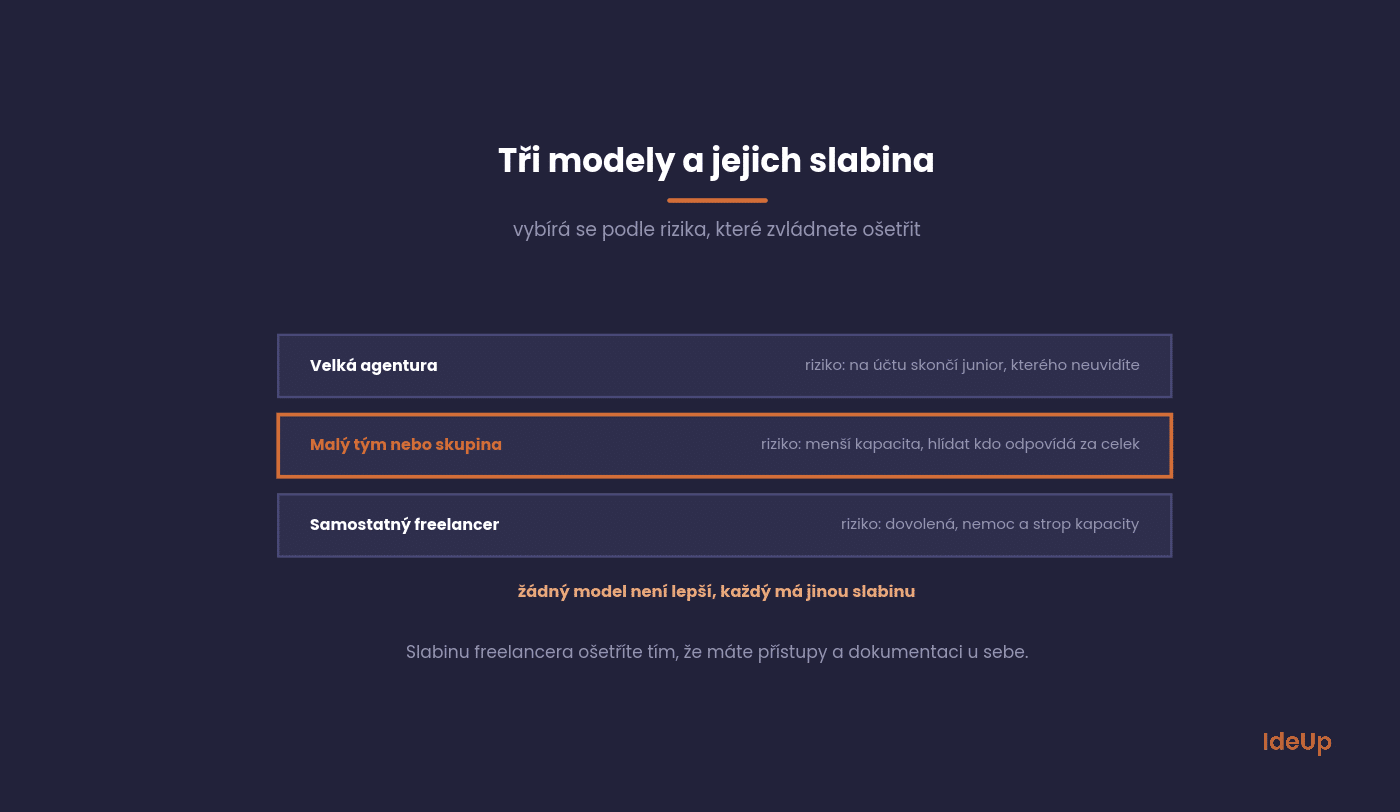
A large agency gives you capacity, cover and a single point of contact. Risk: your account goes to a junior you will only see in the timesheet six months later.
A small team or group of freelancers gives you senior people at a reasonable price. Risk: less capacity during peaks and the need to make sure someone is responsible for the whole.
An independent freelancer gives you the most expertise per crown and direct communication. Risk: holidays, illness and the capacity limit of a single person.
Eight questions for the first meeting
These questions separate a supplier who knows what they are doing from one who is good at selling. Write the answers down, as they will be useful when comparing offers.
If a supplier starts to squirm at any of them, it is not necessarily a red flag, but it is a point where you should dig deeper.
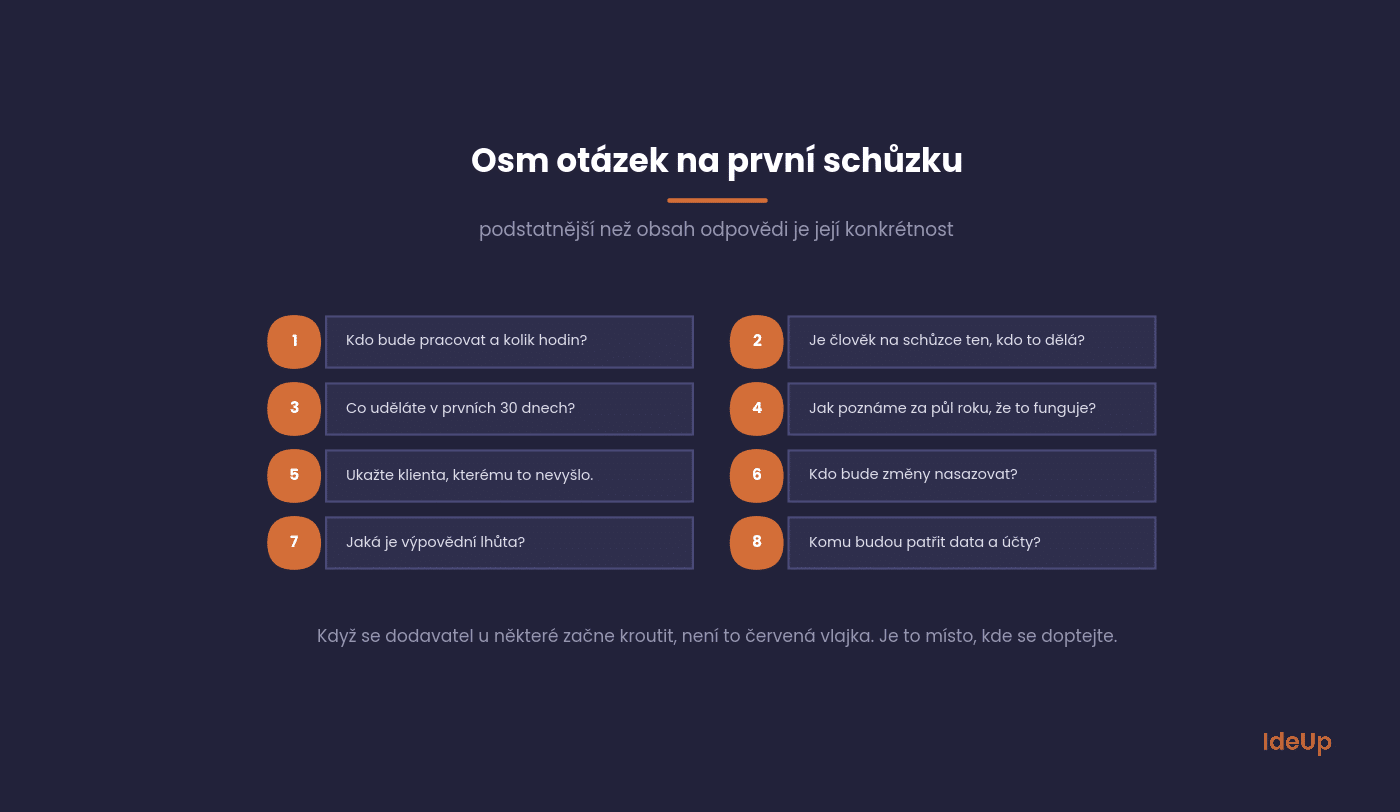
- Who exactly will work on the account and how many hours a month? You want a name and a number, not a job title.
- Is the person in the meeting the one who will do the work? At agencies the answer is usually no, which is fine, but you want to know in advance.
- What will you do in the first thirty days? A good answer is specific. A bad one sounds like “analysis and process set-up”.
- How will we know in six months that it is working? Ask about revenue from organic search, not rankings.
- Show us a client where it did not work out, and explain why. Anyone who claims it has never happened either does not have enough projects or is not telling the truth.
- Who will implement the changes? The most common reason SEO goes nowhere is that nobody implements the recommendations.
- What is the notice period? A one-year commitment with a new supplier is an unnecessary risk.
- Who will own the data and accounts? Search Console, Analytics and any tools should be yours.
Warning signs
Some things can be spotted before you sign. The following signs come up most often in problematic partnerships.
None of them automatically means a bad supplier, but two or more together deserve attention.
Guaranteed rankings. Nobody controls Google. You can guarantee the scope of work, not positions in the results.
Link packages in the price list. Anyone who sells links by the piece is doing purchasing, not link building.
An offer without looking at your website. The price can be estimated, the plan cannot. Anyone who sends a plan without opening your website is sending a template.
A report without decisions. Ask what the monthly report looks like. If it is thirty charts without commentary, you will get thirty charts every month.
Incidentally, Google has published its own guidance on choosing a supplier, and it warns about the same thing: be wary of anyone who guarantees rankings.
How to check references and past work
Case studies on an agency website are chosen to look good. They tell you what the supplier is proud of, not what working with them is like. References from real clients tell you much more, if you ask the right things.
- Ask for a current client, not a past one. A client who is still paying has no reason to be polite about a relationship that ended.
- Ask the reference what changed on their website. Concrete changes such as new pages, a fixed structure or rewritten content show that work was actually done.
- Ask how disagreements were handled. Every partnership has them. You want to know whether the supplier explained their reasoning or simply gave in.
- Ask for a sample of real output. An anonymised audit or a monthly report shows you the quality of thinking better than any presentation.
Check whether the case studies talk about business results such as enquiries or sales. Charts of traffic growth without context say little about whether the client earned more.
How to compare offers that are not comparable
You receive three offers and each has a different structure. Comparing them by total price is the fastest route to a bad decision.
So convert them to a common denominator: the number of hours of senior work per month.
For each offer, work out how many hours are included in the price and who will do them. If the offer does not say, ask. The answer is information in itself.
The second denominator is what you get as a firm commitment. Three articles a month and one technical fix is a commitment. “Ongoing website care” is not.
How to choose an SEO agency step by step
The choice is easier when you treat it as a short project with clear steps rather than a series of meetings.
- Set your goal and budget range. Decide what result would make the spending worthwhile and what you can afford each month for at least half a year.
- Choose the model first. Decide between a large agency, a small team and a freelancer before you look at names.
- Build a shortlist. Recommendations from people in your industry are usually more useful than rankings of agencies.
- Hold first meetings and take notes. Use the same questions with everyone so the answers can be compared.
- Check references. Speak to at least one client of each supplier you are seriously considering.
- Put the scope in writing. The contract should list what will be delivered, by whom and how you can end it.
Common mistakes when choosing a supplier
Deciding on the strength of the pitch. The best presenter is not always the best at the work. If the person in the meeting will not work on your account, their skill matters less than you think.
Leaving out the people who will implement changes. If your developer or content writer is not in the conversation, you may hire a supplier whose recommendations your team cannot carry out.
Starting during a website redesign. If a new website is coming in a few months, agree with the supplier how they will be involved in it. Otherwise much of the early work may be lost.
Expecting results too soon. Changes to a website take time to show in revenue. Judge the first months by the quality and pace of the work, not by sales.
What people ask us when choosing
Five questions we get when a company is choosing between us and someone else.
We answer them the same way, even if it sometimes costs us the work.
Is an agency always more expensive than a freelancer?
Not in total price, but almost always in price per hour of actual work. On large projects capacity makes up for it, on small ones it does not.
So compare the number of hours of senior work, not the total amount on the invoice. That is the only comparable figure.
What if the freelancer falls ill?
That is a real risk. You manage it by having access to all accounts and keeping the documentation on your side, not theirs.
The second safeguard is to agree on a stand-in in advance. Experienced consultants know each other and routinely cover for one another.
Should I give SEO to the same agency as PPC?
Only if it has an SEO team worth having. SEO is often bundled with PPC and done by someone who does not understand it.
The advantage of a single supplier is that they see both at once. But it is worth checking who exactly will do the SEO.
How long should the trial period be?
Three months with one month’s notice. In that time you will see how they work, even if you will not see results yet.
In three months you will see the quality of communication, the pace and whether anyone implements the recommendations. These are the three most common reasons for parting ways.
How many offers should I request?
Three is enough. With more, you get lost in comparisons, and your impression of the people decides anyway.
More important than the number is that everyone gets the same brief. Otherwise you are comparing three different things.
Before you call anyone
Write down what you expect from SEO in numbers, and who on your side will implement the changes. Without these two things, every supplier will send you a template.
And decide whether you are buying capacity or thinking. That is the real choice between an agency and a smaller supplier.
At IdeUp we work as a small team, so you talk to the person who works on your website. We can work out whether this is the right option for you during SEO consulting. We break down what you pay for what in our article on SEO pricing.
Frequently asked questions about how to choose an SEO agency
What should a contract with an SEO agency include?
It should state the scope of work, who will do it and how many hours a month are included. It should also cover the notice period, who owns the accounts and data, and what happens to the work if you part ways. Vague phrases such as ongoing care are worth replacing with specific deliverables.
Is it worth paying for an audit before signing a longer contract?
Often yes. A one-off audit, for example for a few thousand USD on a larger website, lets you see how the supplier thinks before you commit to monthly payments. If the audit is useful, you have a plan even if you later choose someone else.
Does the agency need to be based in my country?
Not necessarily, but it helps if the people working on your website understand your language and market. Content and research done without knowledge of local customers tend to miss what those customers actually look for. Ask who on the team speaks the language of your market.
USD amounts are approximate, converted at the Czech National Bank rate of 21.75 CZK per USD on 9 October 2026.