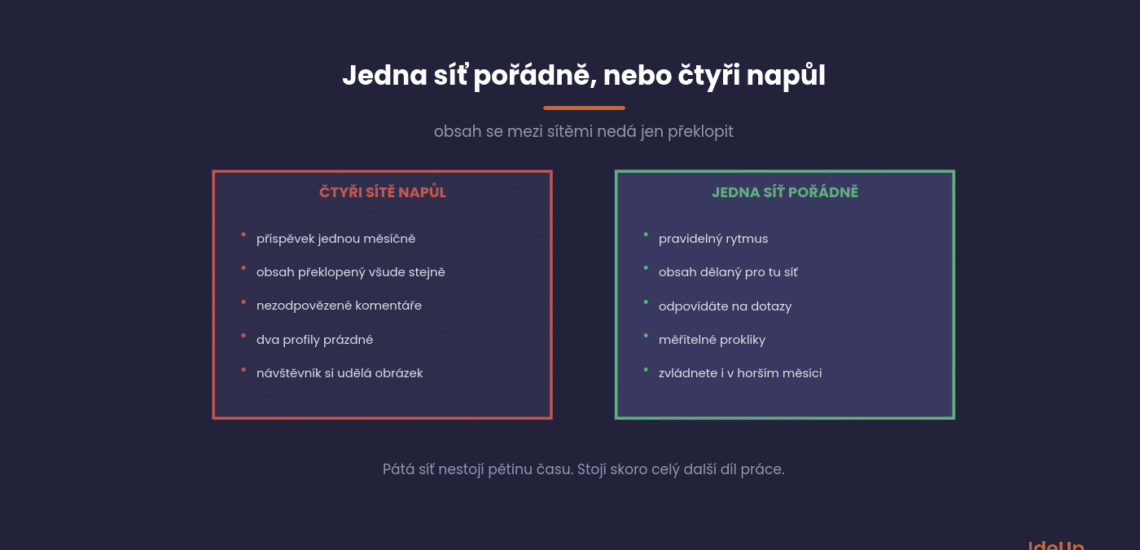
Almost every company we work with on marketing has profiles on four networks. They are active on one, occasionally on a second, and the other two have sat empty since the year someone set them up.
It is not carelessness. It happens because companies set up networks based on what is visible, not on where their customers are.
This article will help you decide which networks your company should actually focus on, how much time it takes, and how to tell when a network is giving you nothing.
Why there is no point being everywhere
Each network has its own format, its own rhythm and its own audience. Content that works on LinkedIn flops on Instagram, and vice versa.
This means that a fifth network does not cost a fifth of the time. It costs almost a whole extra share of the work, because content cannot simply be copied across.
The second reason is that an empty profile does harm. A visitor who comes across it reads the last post from two years ago and forms an opinion of how the company operates.
In practice, this leads to a simple rule. Choose one network, do it properly, and only add a second once you have the first under control.
When a network matches where your customers spend their time, it gives you something few other channels offer. You get a public, ongoing conversation with the people who buy from you.
- Trust before the first contact. A new customer can see how you work, what you know and how you treat people before they ever write to you.
- Direct contact. Questions, complaints and requests reach you without a form or a phone call.
- Quick feedback. You find out which topics, products or offers interest people, often within days.
- Word of mouth. Satisfied customers can share and recommend you with one click.
- Recruitment. Candidates check your profiles to see what it is like to work for you.
None of these benefits come from simply having a profile. They come from regular, useful activity in one place where your customers already are.
Which networks make sense for whom
The choice is not about how popular a network is, but about where your customers make decisions. In some sectors the answer is clear, in others it has to be tested.
The following overview is based on what we see with Czech clients across different sectors.
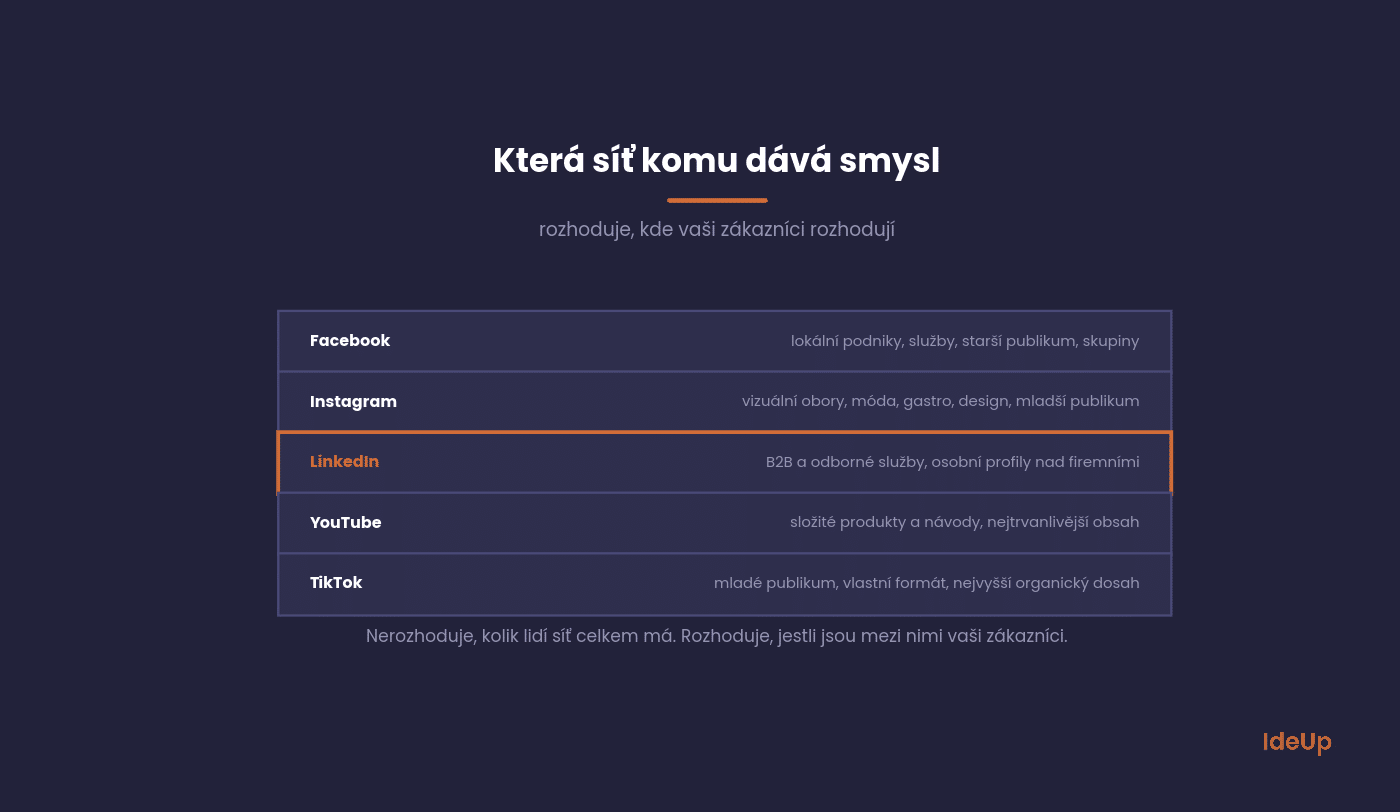
Still the strongest network for local businesses, services and older audiences. Groups work better than pages, because the organic reach of pages has been falling for a long time.
It makes sense for restaurants, tradespeople, shops with a physical store and anyone selling within a single region.
Visual sectors and younger audiences. Fashion, food and drink, design, fitness, travel, anything that can be shown.
If your product cannot be photographed in a way that interests anyone, Instagram will cost you more than it brings in.
The strongest network for B2B and professional services. Personal profiles work significantly better here than company pages.
In practice, this means that instead of a company profile, it pays for the owner and salespeople to post under their own names. This ties in with B2B marketing as a whole.
YouTube
The most demanding to produce and also the longest-lasting. A video from last year still brings people in, while a Facebook post lives for two days.
It is worth it for complex products, tutorials and anywhere decisions take a long time.
TikTok
The highest organic reach of all networks, but it requires its own format and pace. It does not work as a dumping ground for recycled ads.
It makes sense for brands with a young audience and companies that have someone who understands the format from the inside.
A plan does not need to be a long document. One page that answers a few questions is enough, as long as you follow it.
- Set one goal. For example more enquiries, more visits to your website or easier hiring. Each goal leads to different content.
- Describe your customer. Who they are, what problems they have and what they want to know before buying.
- Choose one network. Pick the one where that customer is active, using the overview above.
- Define three or four content themes. For example practical advice, examples of your work, answers to common questions and a look behind the scenes.
- Set a pace and an owner. Decide how often you publish and who is responsible, including a stand-in for holidays.
- Review once a month. Compare results with your goal and adjust themes, not only individual posts.
How much time it really takes
This is the number that decides how many networks you can manage. Most companies underestimate the time and overestimate their enthusiasm.
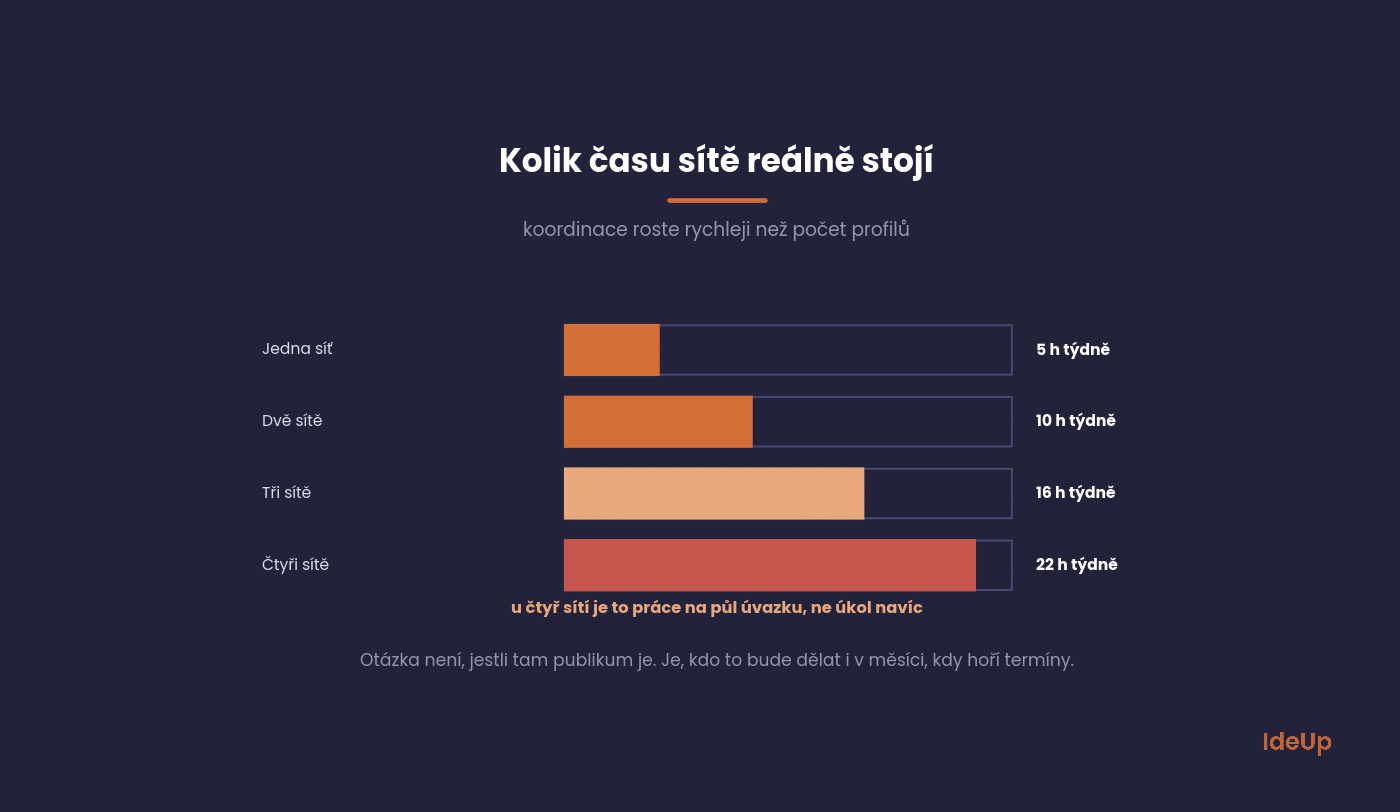
One network done properly means roughly four to six hours a week, including content preparation, publishing, replying to comments and evaluation.
With two networks it is not eight hours but closer to ten, because coordination is added. With four, it becomes a part-time job.
So the practical question before setting up another profile is not whether your audience is there. It is who will do it every week, including in the month when deadlines are piling up.
In a small company, social media usually lands on someone who already has a full job. A fixed routine keeps it from turning into a daily distraction.
A simple weekly routine
- Prepare all posts for the week in one block of time and schedule them in advance.
- Check comments and messages at two set times each day instead of all the time.
- Keep a shared list of ideas where colleagues can add questions they hear from customers.
- Spend a few minutes at the end of the week noting which post worked and why.
Practical tips for small teams
Turn one piece of work into several posts. A single customer project can become a photo, a short explanation and an answer to a common question.
Save replies to frequent questions so you can answer quickly without writing from scratch. And keep your profile basics up to date, such as opening hours, contact details and a link to your website, because people check them first.
What to measure
Follower count is a metric that looks good in a presentation and says nothing about sales. Bought and accumulated audiences behave completely differently.
Three things are worth tracking, all of which come after reach.
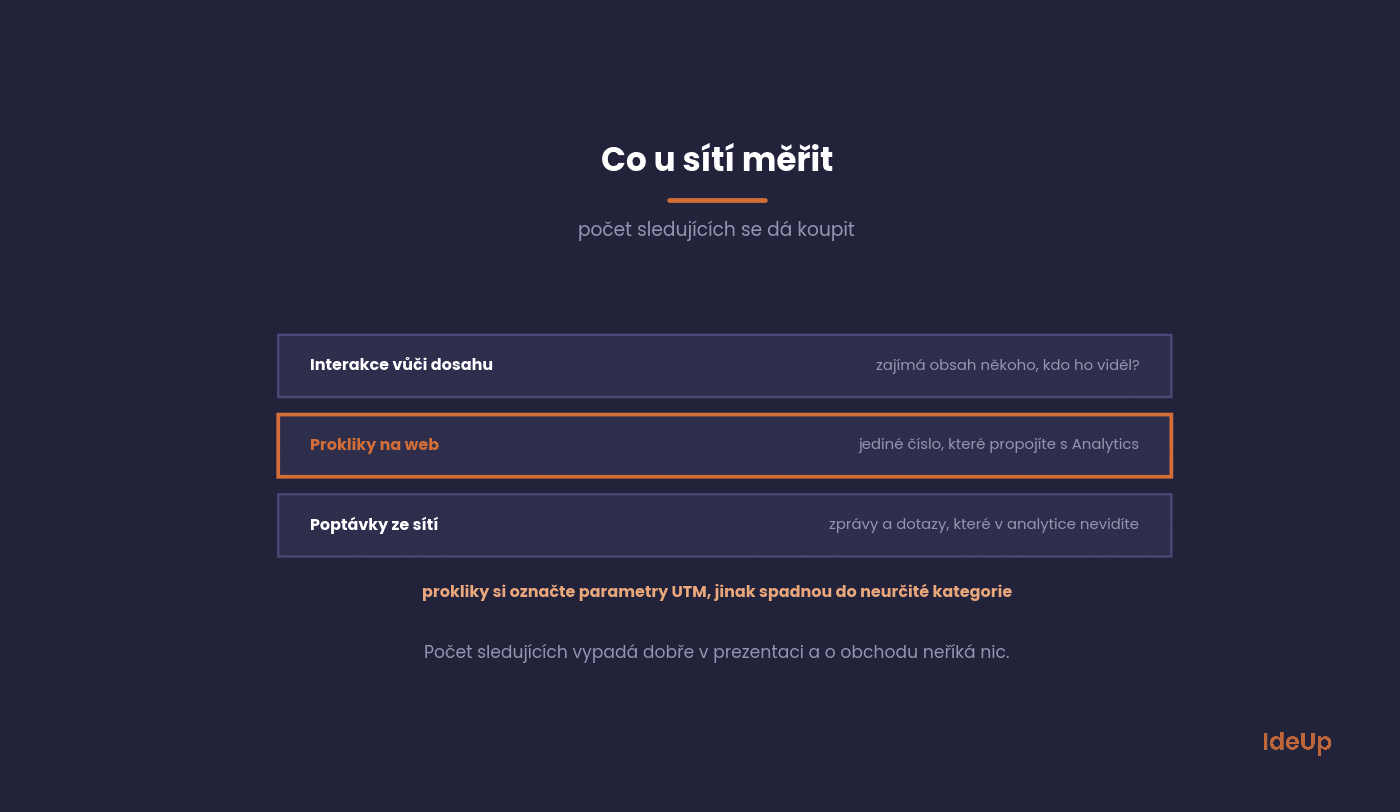
Engagement rate relative to reach. How many of the people who saw a post reacted to it in some way. It shows whether the content interests anyone.
Clicks to your website. The only number you can link to Analytics and to enquiries. Track it over time, not in absolute terms.
Enquiries from social media. Direct messages, comments with questions, forms with the source marked. For smaller companies this is often the main benefit, and it is not visible in analytics.
Tag your clicks with UTM parameters, otherwise they end up in an undefined category in Analytics and cannot be evaluated.
When to leave a network
Closing a profile is a legitimate decision that almost nobody makes. Yet it is better than letting it decay.
Three signals tell you that a network is not working for you.
Six months without movement. If neither reach nor clicks have increased after six months of honest work, your audience is not there.
Engagement without sales. Posts get likes, but not a single enquiry has come from them in a year. You are entertaining an audience that will not buy from you.
Nobody wants to do it. A network kept going only out of obligation shows in the content within a month.
If you decide to leave, do not delete the profile. Add a link to your website and a final post saying where people can find you.
Paid reach versus organic reach
The organic reach of pages on Facebook and Instagram has been falling for a long time. Without a budget, a post is seen by a fraction of your followers.
This does not mean organic is dead. It means it has moved elsewhere, mainly into groups, personal profiles and the formats the network is currently pushing.
For most companies, a combination is the sensible model. You publish organically on a regular basis and spend your budget on boosting posts that are already working organically.
However, do not manage paid advertising by network, manage it by results. We cover budgeting rules in our article on performance marketing.
What to avoid
We see the following mistakes again and again, and all of them cost time that could have gone elsewhere.
They are fixed by decisions, not by better content.
The same post everywhere. Everyone recognises automatic sharing to three networks at once, and it does not work fully anywhere.
Publishing without replying. An unanswered comment or message is worse than no post at all.
Content only about the company. News, anniversaries and party photos interest employees, not customers.
Tracking follower count. A number that can be bought is not a metric.
The five questions we get most often from smaller companies.
The answers apply in general, the details vary by sector.
No. Many companies live off search, referrals and direct sales, and social networks would only take up their time.
Consider it mainly if your product is visual or if people talk about it. Otherwise it is optional.
How often should we post?
Better once a week done well than five times in a rush. Algorithms reward reactions, not frequency.
Choose a pace you can keep up even in your worst month. Irregularity does more harm than lower frequency.
Should we hire someone external?
For production and planning, yes. For replying, probably not. An external manager will not know the answers to specialist questions.
A proven model is for someone external to prepare the content while a person from the company handles communication.
Not directly, as links from social networks usually do not pass on ranking value. Indirectly yes, because mentions and branded searches grow.
This relates to what we describe in our article on brand building. A stronger brand is reflected in search.
Is a LinkedIn company page worth it?
As a business card, yes. As a channel, usually not. The reach of company pages is a fraction of that of personal profiles.
It is more effective when people from the company post under their own names and the company page only supplements them.
Where to start
Check in Analytics how many visits came to you from social media over the past year and how many of them ended in an enquiry. That number tells you more than an impression based on follower count.
Then choose the one network where the numbers look best and focus only on it for the next three months. On the remaining profiles, add a link to your website and leave them be.
Want to connect it to the rest of your marketing so social media is not an island? Take a look at our Services or get in touch through our Contact page.
It lets customers get to know you before they contact you and gives them an easy way to ask questions. It also shows you quickly what interests people. The benefit only appears when you are active on a network your customers actually use.
There is no single best network. Facebook tends to suit local businesses, Instagram visual products, LinkedIn B2B and professional services, YouTube complex products and TikTok brands with a young audience. Choose by where your customers make decisions, not by the size of the network.
Focus on one network, prepare a week of posts in a single session and schedule them. Set fixed times for replying to comments and messages. A pace you can keep for months matters more than a busy first few weeks.