Video is the most expensive content format a company can produce. It is also the only one that can show a person, a product in motion and things that are hard to describe in text.
That is exactly why it so often misses the mark. A company shoots an expensive brand video, puts it on the homepage and then wonders why nobody watched it to the end.
This article explains when video pays off, which formats work without a big budget and how to tell whether it was worth it.
When video makes sense
What matters is whether the video solves something text cannot. If a paragraph can deliver the same information, video is just the more expensive option.
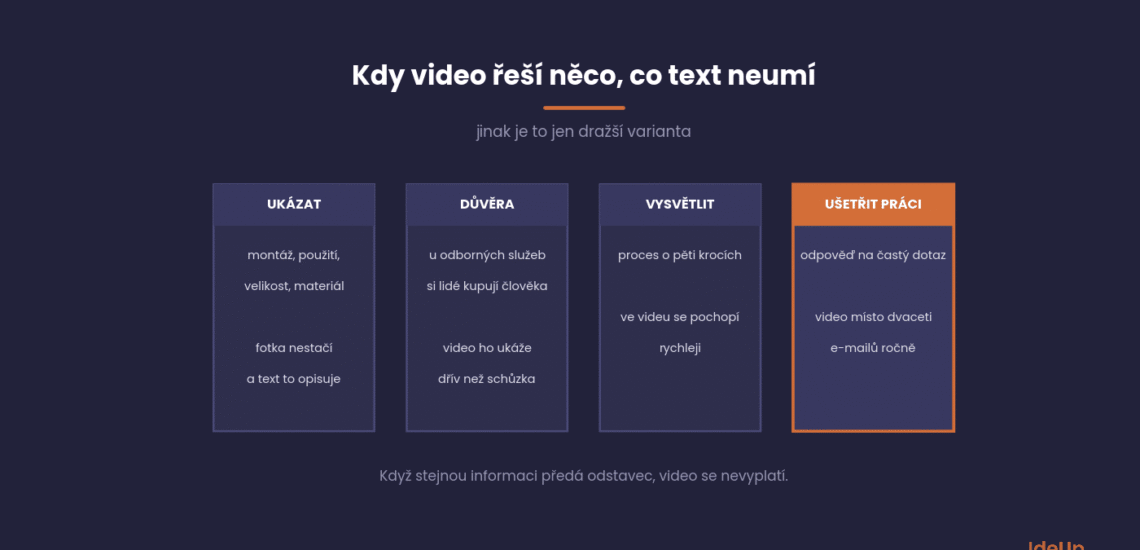
Four situations come up again and again across industries.

Something needs to be shown. Assembly, product use, size, material. Anything where a photo is not enough and text can only describe it.
Trust in a person is decisive. With professional services, people are buying a person. Video shows them before the first meeting.
You are explaining something complex. A five-step process is understood faster in a video.
You are answering recurring questions. A video that replaces twenty emails a year pays for itself.
When video does not make sense. When it is meant to be a brand video, when you want it because your competitors have one, and when you have nobody to keep producing it.
What video marketing is and why it matters
Video marketing means using video to help people understand, trust and choose what you offer. It covers everything from a thirty-second product clip to a recorded webinar. The goal is never the video itself but a step the viewer takes afterwards, such as an enquiry, an order or one less question for your team.
Why use video in marketing at all? Video carries tone of voice, facial expression and movement at the same time. In a few minutes a viewer gets a sense of who you are and how your product behaves, which would take pages of text.
Much of the importance of video marketing also comes from reuse. One recording can become a clip on your website, a short social cut, a quote in a newsletter and a written transcript. If you plan it well, a single shoot can supply several channels for months.
Formats that work without a budget
A 100,000 CZK (about 4,600 USD) production video is not a requirement. Most of what actually works today can be shot on a phone.
Five formats offer the best ratio of effort to benefit.
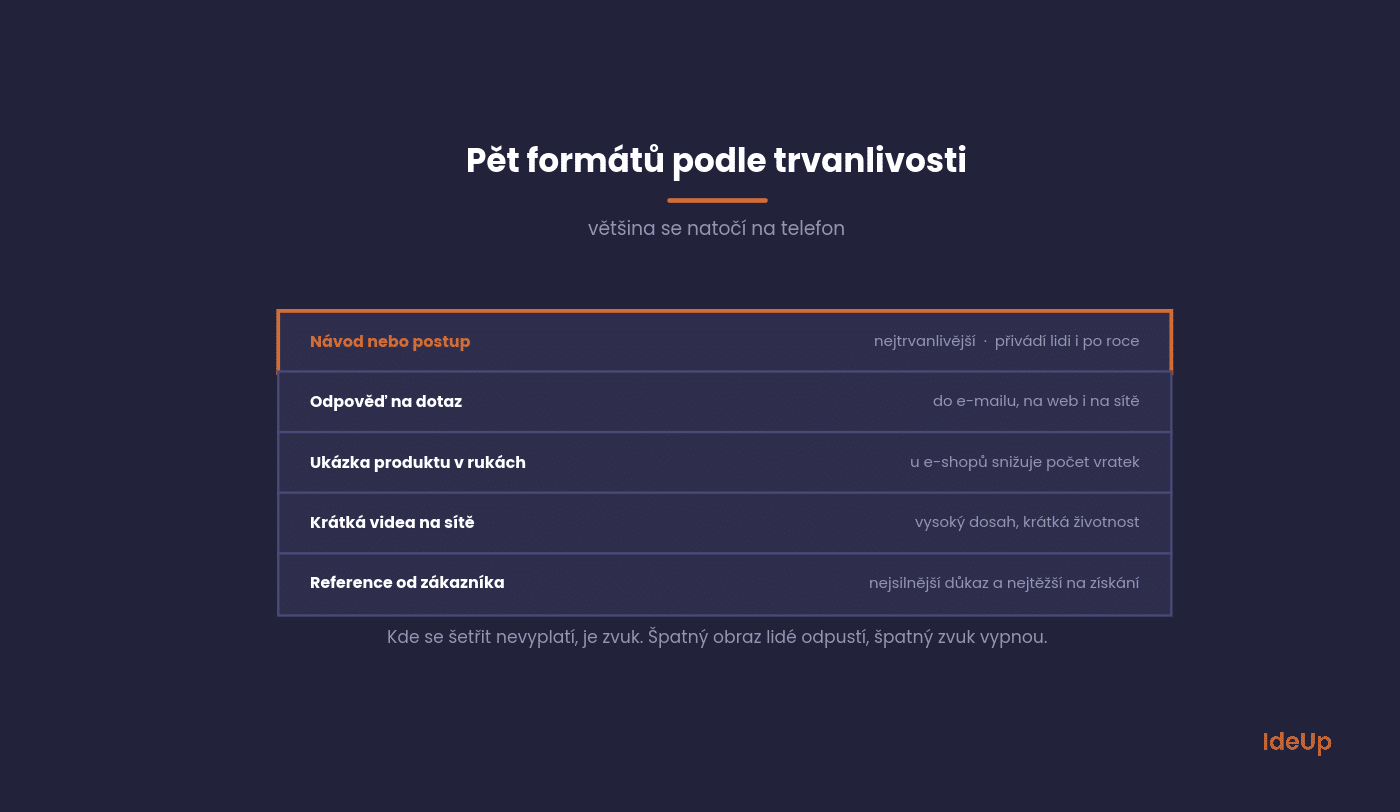
Tutorial or how-to. The most durable format. A video from last year still brings people in, while a social media post lives for two days.
Answer to a frequent question. A short video on a single question. It can be sent by email, embedded on the website and posted on social media.
Product shown in hand. For online shops, it reduces returns because people see the real size and finish.
Short social videos. High reach, short lifespan. They need their own format, not a cropped advert.
Customer testimonial. The strongest proof there is. Also the hardest to get.
Other types of marketing videos worth knowing
- Explainer video. A short overview of what you do and who it is for, often with simple animation.
- Product demo. A walk-through of the key features, useful in software and B2B sales.
- Case study. One project told from problem to result. It is more structured than a testimonial.
- Behind the scenes. Your team, your workshop and how you work. It builds familiarity.
- Webinar or talk recording. Longer content that you can cut into shorter clips.
- Onboarding video. Helps new customers get started and reduces the load on support.
Choose the type by the stage your viewer is at. Someone who has never heard of you needs a different video from someone who is comparing you with a competitor.
What it costs and where you can save
The range is huge. A video shot on a phone costs an hour of time, while a production video with a director and editing costs tens to hundreds of thousands of CZK.
What matters is what the video is for.
For tutorials and answers to questions, authenticity comes before production. A phone video with good sound works better than a polished spot.
Where saving does not pay off is sound. People will forgive a poor picture, but they will switch off poor sound within ten seconds. A microphone for a few hundred CZK is the best investment in all of video marketing.
The second thing is subtitles. Most videos on social media are played without sound, so without subtitles you lose most of your viewers.
Where to place video
The same video behaves differently depending on where it is. Uploading it to one place and linking to it is a wasted opportunity.
Three placements serve different purposes.
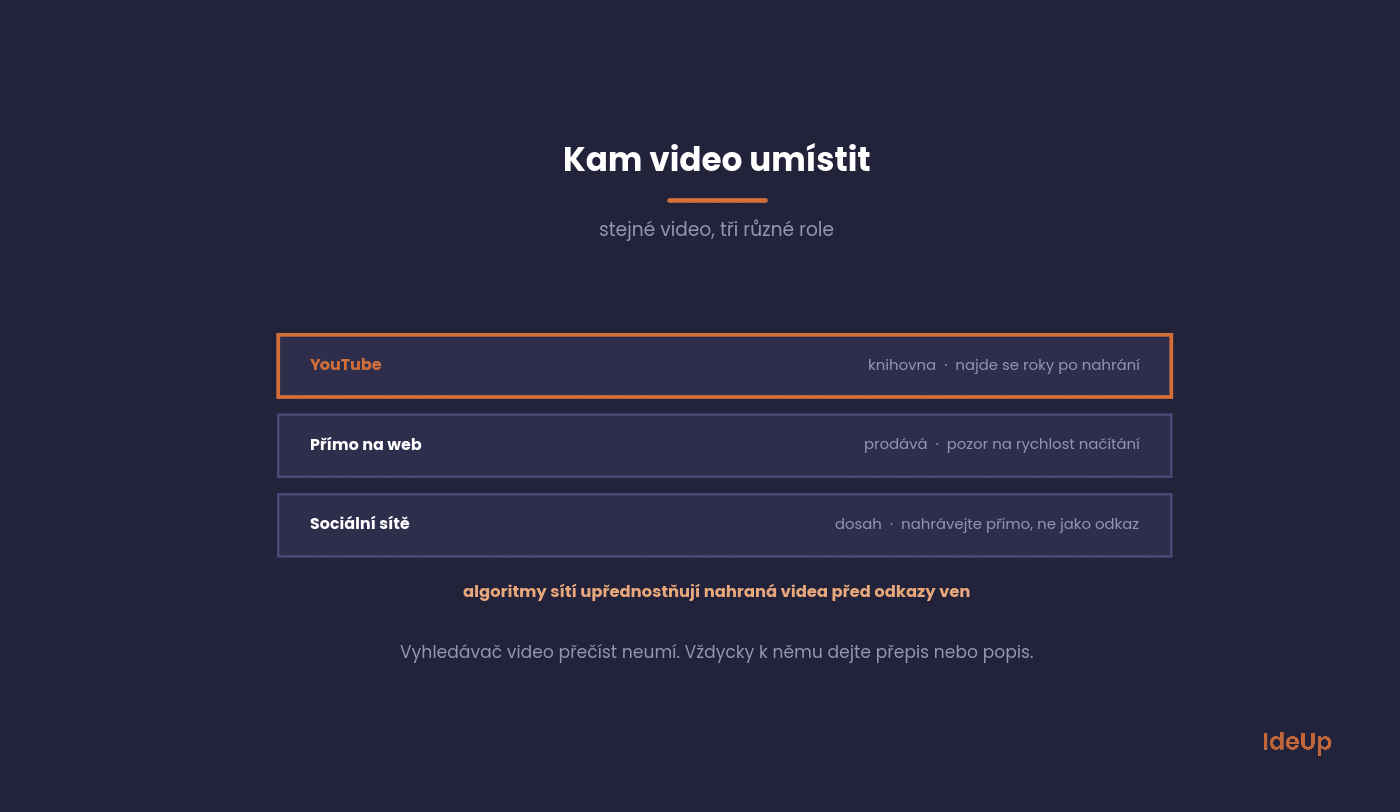
YouTube. The second largest search engine. Videos can be found years after upload, which no social network can do. This is the place for tutorials and longer content.
Directly on the website. For product and explainer videos. Watch the speed, as a badly embedded video slows the page down. This ties in with what we describe under website speed and what we deal with when building websites.
Social media. Upload directly to the network, not as a link. Algorithms favour native videos over outbound links. Which networks to focus on is covered under social media for businesses.
How to plan a video marketing campaign
A campaign is a set of videos with one goal, one audience and a fixed period. Without that frame, videos end up as isolated pieces that nobody connects.
- Set one goal. More enquiries, fewer returns or a product launch. One goal per campaign keeps the message clear.
- Pick the audience and their stage. Decide whether you are reaching new people or helping existing contacts decide.
- Choose formats and placement. Match each video to where it will live, as described above.
- Write a short script. An opening line with the point, one main message and one call to action.
- Shoot in batches. Record several videos in one session to save setup time.
- Publish, adapt and review. Cut a version for each platform, then compare the results after a few weeks with the goal you set.
Simple video marketing examples
An accounting firm records a short video on each deadline its clients ask about, sends it by email and posts a shorter version on social media. A furniture maker films every product being assembled and adds the clip to the product page. A software company runs a monthly live demo and turns the recording into five short clips, one per feature.
None of these needs a large budget. What they share is a repeatable format and a clear reason for each video to exist.
What to measure
View count is the least useful metric. Even three seconds before someone scrolls away counts as a view.
Three other things are worth looking at.
Watch time. What percentage of the video people watch. If most leave within the first ten seconds, the problem is the opening.
Actions after the video. Clicks to the website, enquiries, orders. For a video on a product page, compare the conversion rate with and without the video.
Work saved. For videos answering frequent questions, measure whether the number of those questions has dropped. That is a hard benefit you can calculate in hours.
What to avoid
These are the mistakes we see most often in company videos.
All of them can be fixed without extra budget.
A long intro. Logo, music and only then the content. The first five seconds decide whether anyone watches to the end.
Video without subtitles. Most social media viewers have the sound off.
One-off production. One video a year does not make a channel. Either a format you can repeat, or do not do it at all.
Video instead of text. A search engine cannot read a video. Always add a transcript or description.
Common questions about video
The five questions we get most often.
The answers apply in general; details vary by industry.
How long should a video be
Long enough to deliver one idea. On social media that means under a minute, for tutorials easily ten minutes.
Length is not the factor. What matters is that there is nothing extra in it.
Do we need a camera operator
For tutorials and answers to questions, no. For testimonials and product videos it helps, but mainly because of sound and lighting.
Invest in a microphone and lighting first, and only then in a camera.
Does video help with rankings
Indirectly. Video on a page increases the time people spend there and reduces bounces. It has no direct effect on rankings.
Videos also appear in search results as a separate block, which is extra space.
Does YouTube make sense for a small company
It does, but as a library, not as a channel for building subscribers. Do not try to win an audience; try to make your videos findable.
So write descriptions and titles as carefully as the titles on your website. It pays to start from keyword research so that the title matches what people actually search for.
Can we use AI to create videos
For editing, subtitles and transcription, definitely, it saves hours. For generating an entire video, be cautious for now, especially where trust is at stake.
For a video meant to show your people, generated content works against the purpose.
Where to start
List the three questions you get from customers most often and shoot a two-minute phone video for each. Sort out the sound with a microphone and leave everything else for now.
Then embed them on the relevant pages of your website and see whether the number of those questions drops. That is the quickest way to check whether it is worth continuing.
Want to connect video to a content strategy so it does not stay a one-off? Take a look at content marketing or get in touch via our contact page.
Frequently asked questions about video marketing
What is the importance of video marketing?
Video lets people see your product, your process and your team before they contact you. That shortens the time it takes to build trust. It also gives you material you can reuse on your website, in emails and on social media.
Why use video in marketing instead of text?
Use video when movement, a person or a process matters more than words. It shows size, use and tone in a way text cannot. If a paragraph explains the same thing equally well, text is cheaper and easier to update.
How do you make marketing videos with a small team?
Start with a phone, an external microphone and daylight from a window. Write a few bullet points rather than a full script and record several videos in one session. Add subtitles during editing, which simple low-cost apps handle well.
What types of marketing videos are there?
Common types include tutorials, explainers, product demos, customer testimonials, case studies, behind-the-scenes clips, webinar recordings and short social videos. Each suits a different stage, from first contact to the period after a purchase. Most companies get the best results from two or three types they can repeat.
USD amounts are approximate, converted at the Czech National Bank rate of 21.75 CZK per USD on 9 October 2026.