In B2B, marketing advice from e-commerce breaks down on one thing. Your entire target audience might be two hundred companies, with monthly search volume in the tens of queries.
There is no one to bring in ten thousand visits. On the other hand, a single contract can be worth hundreds of thousands, and five people will spend half a year deciding on it.
This article describes how to win enquiries when the market is small, which channels actually work there and how to measure it so it does not turn into counting likes.
How B2B is different
There are many differences, but three of them change the whole marketing set-up. Anyone who ignores them ends up doing e-commerce marketing in B2B and wonders why it does not work.
They lead to a different choice of channels and different metrics.
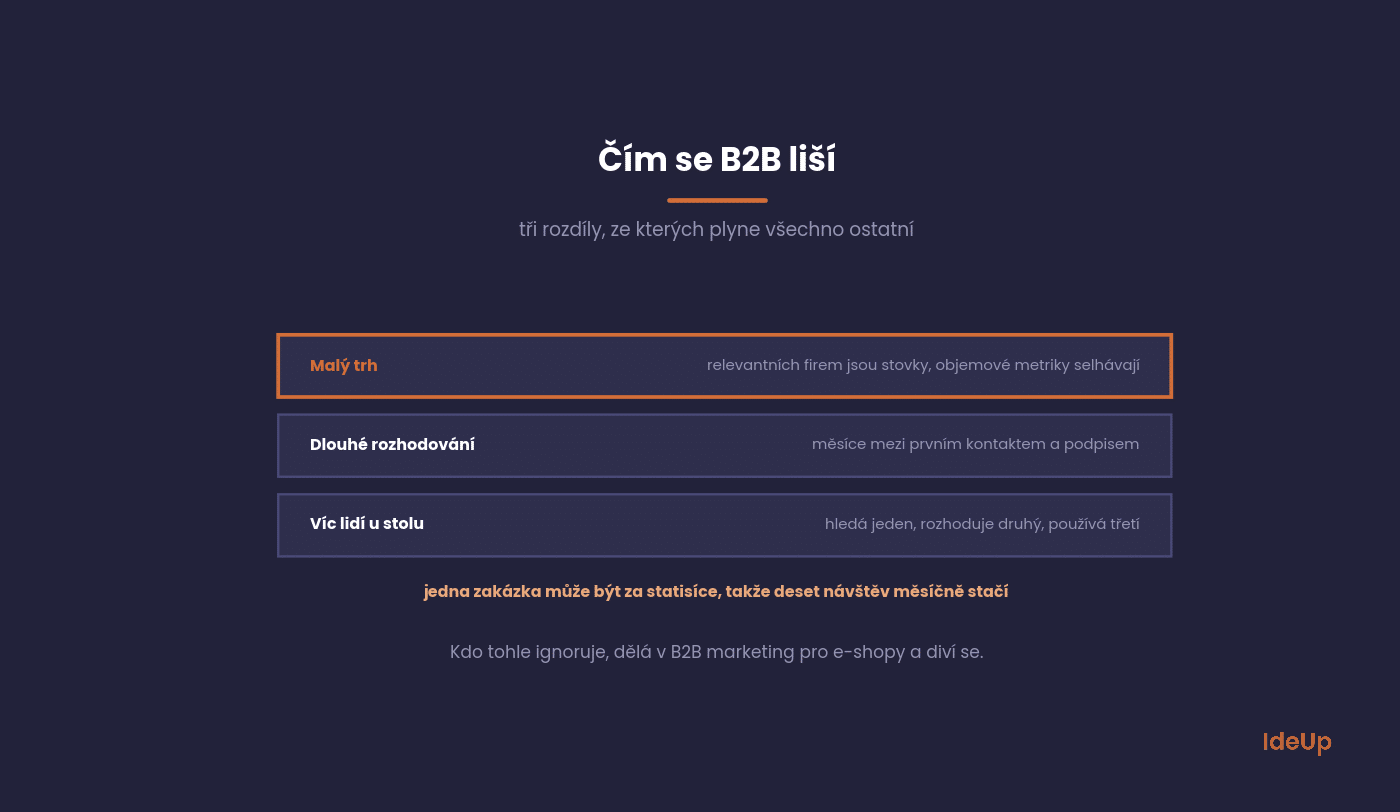
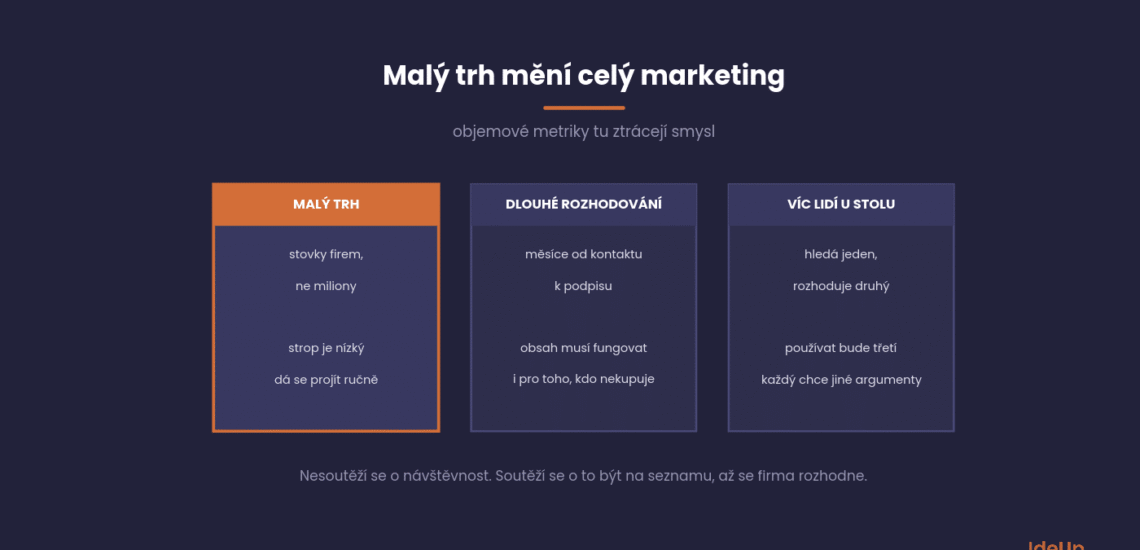
A small market. There are hundreds of relevant companies, not millions. Volume metrics lose their meaning because the ceiling is low.
Long decision-making. Months pass between first contact and signature. Content therefore has to work for someone who is not buying today.
More people at the table. One person searches, another decides and a third will use it. Each of them needs different arguments.
In practice, this means that B2B is not a competition for traffic. It is a competition to be on the list when a company starts making its decision.
What B2B lead generation actually means
B2B lead generation is the work of finding companies that could buy from you and turning them into named contacts who are willing to talk. A lead is not a visit or a follower. It is a specific person at a specific company who has shown interest or fits your target profile.
Leads are usually split into two groups. A marketing qualified lead has engaged with your content or got in touch. A sales qualified lead has been checked by sales and has a real need, a budget and someone who can decide. Keeping the two apart shows you whether the problem lies in attracting interest or in converting it.
Channels that work in a small market
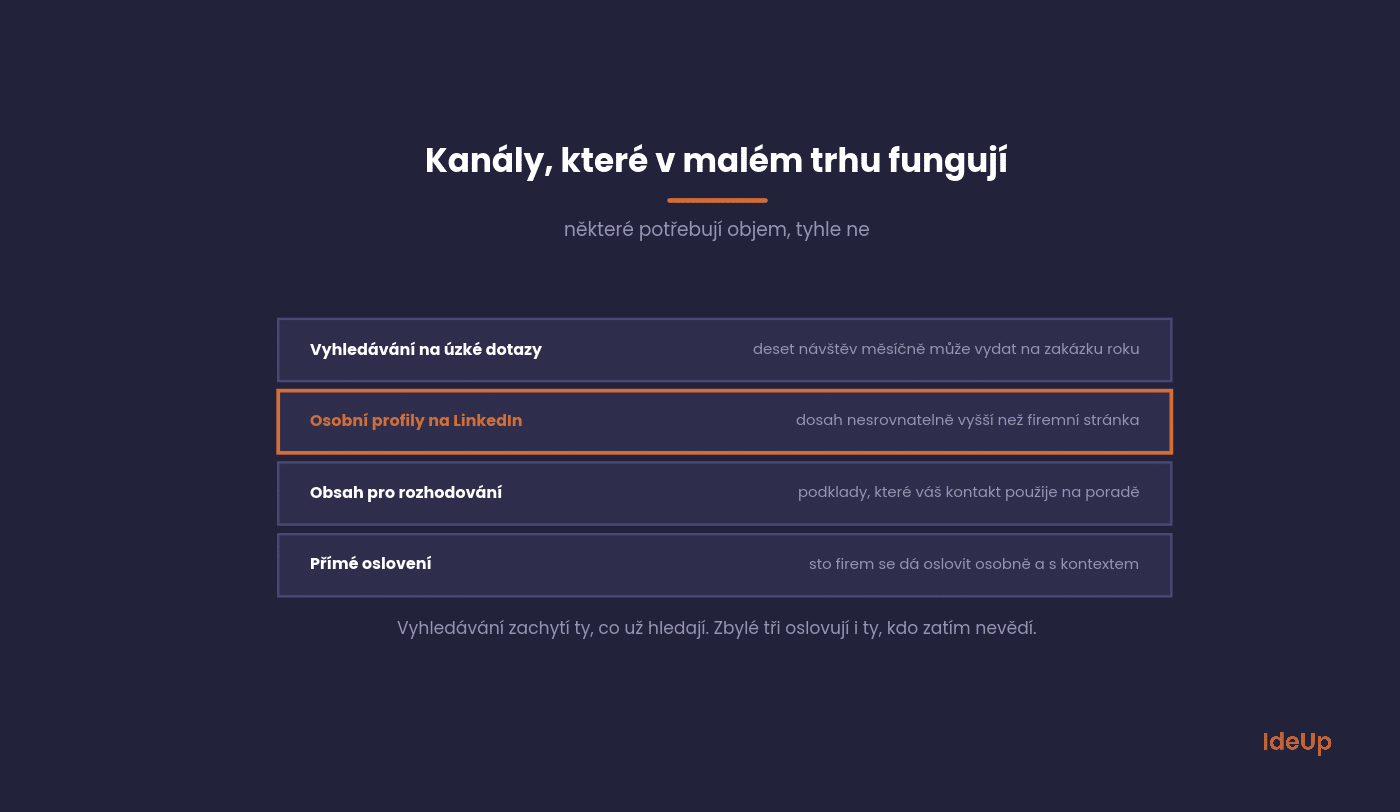
Not all channels scale down. Some need volume before they start working at all, while others work even with ten visits a month.
The following four have proven themselves across industries.
Search for niche queries
There are few queries, but they are extremely valuable. Ten visits a month on a query that only someone with a specific problem types in can lead to the contract of the year.
The key is not to target general terms, but the way people in the industry describe the problem. We explain the process in our article on keyword research.
Personal LinkedIn profiles
A company page has a fraction of the reach. Posts from the owner or salespeople under their own names work far better.
The aim is not to get an enquiry from a post. The aim is for people in the industry to know you before they start looking for a supplier.
Content that helps people decide
Comparisons, cost calculations, materials for meetings. Resources your contact will use to convince management.
This type of content cannot be measured by traffic. It is measured by whether sales use it in negotiations.
Direct outreach
When the market is small, you can go through all of it by hand. A hundred companies can be approached personally and with context, which is impossible with thousands.
The condition is that the outreach must not be mass outreach. The difference between a template and a message that responds to a company’s specific situation is enormous.
B2B lead generation tactics and examples for a small market
The channels above become more effective when you turn them into concrete tactics. These ideas suit markets with a limited number of companies.
- A small round table. Invite eight to ten people from target companies to discuss a shared problem. They get value from each other, and you get a room full of relevant contacts.
- A free short review. Offer a limited analysis of one specific area, such as a process, a document or a website. It shows your expertise on the client’s own material.
- Case studies the client has approved. One concrete story from a similar company convinces more than a list of services.
- Partnerships. Companies that serve the same customers with a different product can introduce you, and you can return the favour.
- Content created with a client. An interview or a joint guide reaches their network as well as yours.
Outbound versus inbound
Inbound brings contacts who come to you through content and recommendations. Outbound means you reach out first, by email, phone or a LinkedIn message. In a small market, outbound works best when it follows earlier activity, for example when you contact someone who has already seen your posts or met you at an event.
Cold outreach to people who have never heard of you tends to get fewer replies, and it uses up a first impression you cannot repeat. Combine both approaches rather than choosing one.
How to build a list of companies
In a small market, a list of target companies is more valuable than any tool. It can be built by hand and will last for years.
The sources are accessible and mostly free.
Start with industry associations and their member lists. Continue with exhibitors and attendees at trade fairs and conferences, as these are often published.
Add companies that appear in tenders and those that your existing customers mention as similar to themselves.
For each company, note who the likely contact is and whether you have ever spoken to them. This list then becomes the foundation for everything else.
The B2B lead generation process step by step
Once you have the list, the process repeats in the same order. Each step feeds the next one.
- Define your ideal customer. Industry, company size, region and the problem you solve best. Base it on your best existing clients.
- Prioritise companies and contacts. Mark the companies that fit the profile best and identify who is likely to look for a supplier, who decides and who will use the result.
- Make first contact. Through content, a personal message or an introduction from someone you both know.
- Qualify. Check whether there is a real need, a budget and a timeline before you invest sales time.
- Nurture. Stay in touch with those who are not ready yet.
- Hand over and review. Pass ready contacts to sales and regularly compare which sources led to closed deals.
The funnel in B2B is narrow from the start. You might begin with a hundred companies, talk to thirty, qualify ten and close two. In a small market, that shape is normal, not a sign of failure.
What to measure when the sample is small
Standard metrics fail in B2B. A conversion rate calculated from fifty visits a month is chance, not information.
It makes sense to track other things.
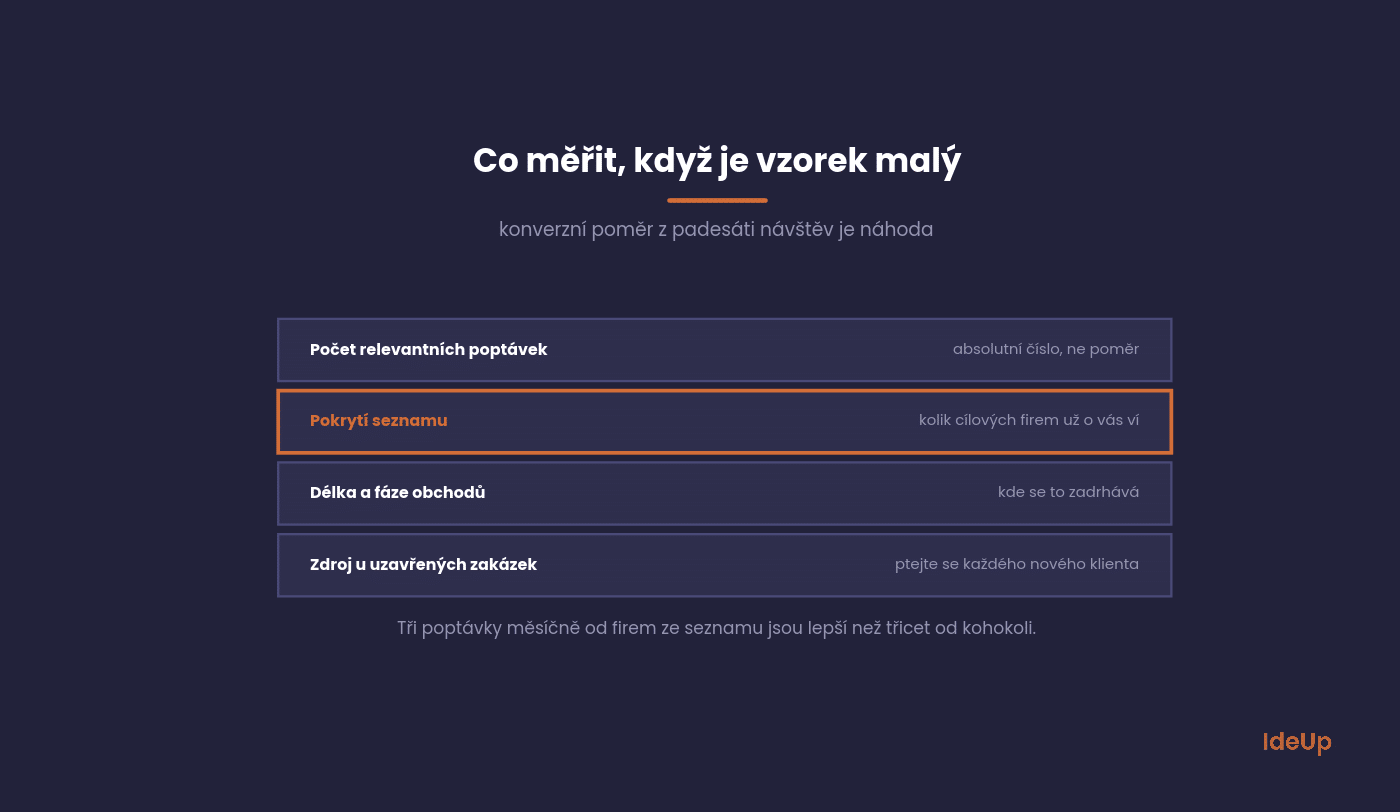
Number of relevant enquiries. An absolute number, not a ratio. Three enquiries a month from companies on your list is a better result than thirty from anyone.
List coverage. What percentage of your target companies already know about you. You can only find out by asking, but it is the most useful number you have in B2B.
Deal length and stages. How many opportunities are at which stage and how long they have been stuck there. This shows where things are getting held up.
Source of closed deals. Ask every new client how they heard about you. After a year, you will have data that no analytics tool can give you.
Where it most often breaks down
We repeatedly see the same three problems at B2B companies, and none of them is about the number of enquiries.
They all concern what happens to an enquiry afterwards.
Marketing and sales do not share information. Marketing targets different companies from the ones sales closes. One conversation would reveal this, and nobody has it.
There is no content for the middle stage. The website has a service page and a blog, but nothing for someone who is already considering and needs arguments for management.
Enquiries are not followed up. In B2B, a contact who got in touch and did not buy comes back a year later. If they are not on your list and you are not communicating with them, they will turn to a competitor.
How to deal with long decision-making
Half a year between first contact and signature is common in B2B. This means marketing has to be able to wait without forgetting the contact.
There are two solutions, and they complement each other.
The first is regular content sent to the contact. A newsletter with something useful once a month keeps your name in mind without being a nuisance. We explain how in our article on email marketing.
The second is a note on your list saying when to get in touch again. Not a sales call, but sending something relevant to that company.
Both cost little and pay off in a small market, because the number of companies you need to keep track of is manageable.
Common questions about B2B
The five questions we hear most often from companies with a small market.
The answers apply in general; details vary by industry.
Is SEO worth it when search volume is minimal?
What matters is contract value, not volume. For contracts worth hundreds of thousands, even ten visits a month are worth it.
The condition is to target queries with clear intent, not general industry terms.
Is a blog worthwhile when twenty people read it?
Yes, if they are the right people. In B2B, readership is a poor metric.
A more useful question is whether sales use those articles in negotiations.
Does LinkedIn work in the Czech Republic?
It does, but differently from the USA. Volumes are smaller, but the reach of personal posts tends to be high because there is little competition in content.
Company pages have minimal reach. Focus on personal profiles.
How much should a B2B company spend on marketing?
It depends on contract value and cycle length, not on a percentage of turnover. Work out how much you can afford to pay for one contract and work backwards from there.
We describe the logic of the calculation in our article on performance marketing. In B2B, just with a longer horizon.
Should we buy contact databases?
No. Apart from the legal risks, you get contacts who know nothing about you, and you waste your first impression on them.
In a small market, it is better to build your list by hand and approach contacts with context.
Where to start
Write down a list of companies that could realistically buy from you. If there are fewer than five hundred, you have a market where you can work by hand, and that is an advantage.
Then ask sales how your last three clients heard about you. The answer is often different from what marketing is aiming at.
Want to build it so that marketing and sales pull in the same direction? We specialise in B2B marketing, so get in touch via our contact page.
Frequently asked questions about B2B lead generation
What is a B2B lead generation funnel?
It is the path a company takes from first hearing about you to being ready for a sales conversation. It usually moves from awareness through interest and consideration to a decision. In B2B, the consideration stage is the longest, because several people compare options and need internal approval.
Does B2B outbound lead generation still work?
Yes, when it is targeted and personal. Messages that respond to a company’s specific situation get replies, while mass templates are mostly ignored. Check the rules on unsolicited business messages in each country you target, as they differ.
What are the most important B2B lead generation best practices?
Agree with sales on who your ideal customer is and write down what counts as a qualified lead. Keep one shared list of target companies and follow up every contact who does not buy straight away. Review where your closed deals came from every few months and adjust your effort accordingly.
Where can I find new lead generation ideas for B2B?
Ask your current clients what they read, which events they attend and whose advice they trust. Their answers show where your other target companies spend their time. Industry partners and the events your competitors attend are another useful source.