
Ambient marketing is advertising placed in people’s everyday surroundings so that the place or object itself carries part of the message. The medium might be the floor of an underground station or the handle of a shopping trolley. People come across the advert where they do not expect it, and they get the point precisely because of the place or object.
In English the term used is ambient advertising, while Czech uses ambient reklama or ambientní reklama. Ambient media are the media themselves, meaning surfaces and objects other than conventional billboards. The term appeared in the advertising industry in the United Kingdom in the late 1990s.
For a business, ambient is interesting because it is not bought from a rate card and a good installation spreads further on social media. Standard definitions, however, leave out what needs to be approved and how to tell whether the campaign worked. We cover both in detail below.
How ambient differs from OOH and guerrilla
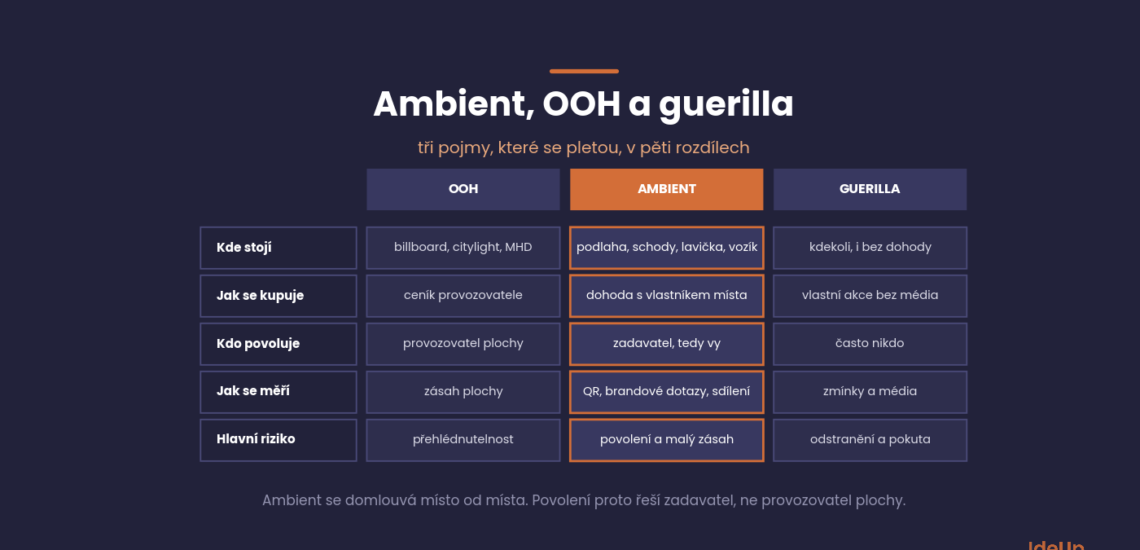
The three terms often get mixed up in practice, but for campaign planning what matters most is who approves the advertising and how it can be measured. Conventional outdoor advertising, or out of home, is bought on standard sites from their operator and planned as a medium. Ambient works with a surface or object that is not intended for advertising and is arranged case by case.
Guerrilla marketing is a broader approach to low-cost, unexpected communication, often without the agreement of the site owner. In the Czech Republic, ambient is commonly classed as part of it, but unlike street guerrilla it relies on a location the advertiser has arranged.
| Feature | OOH | Ambient | Guerrilla |
|---|---|---|---|
| Where it appears | billboard, citylight, public transport advertising | floor, stairs, bench, trolley, object in the space | anywhere, often without the owner’s agreement |
| How it is bought | site operator’s rate card | individual agreement with the site owner | own event, often without a medium |
| Who handles permits | site operator | the advertiser, meaning you | often no one, hence the risk |
| How it is measured | site reach according to the operator | QR codes, branded searches, shares | mentions, shares, media coverage |
| Main risk | the site is easily overlooked | permits and low on-site reach | removal of the installation and a fine |
The boundaries shift over time. Operators add some non-standard sites, such as floor graphics in shopping centres, to their offer, and ambient becomes a standard format. But if no one offers the surface for advertising and you arrange the location yourself, everything we say below about permits applies to you.
Four types of ambient by what they work with
Ambient has no fixed format. Ideas can be sorted by where the point comes from, and this classification helps both when briefing creatives and when estimating what will need approval.
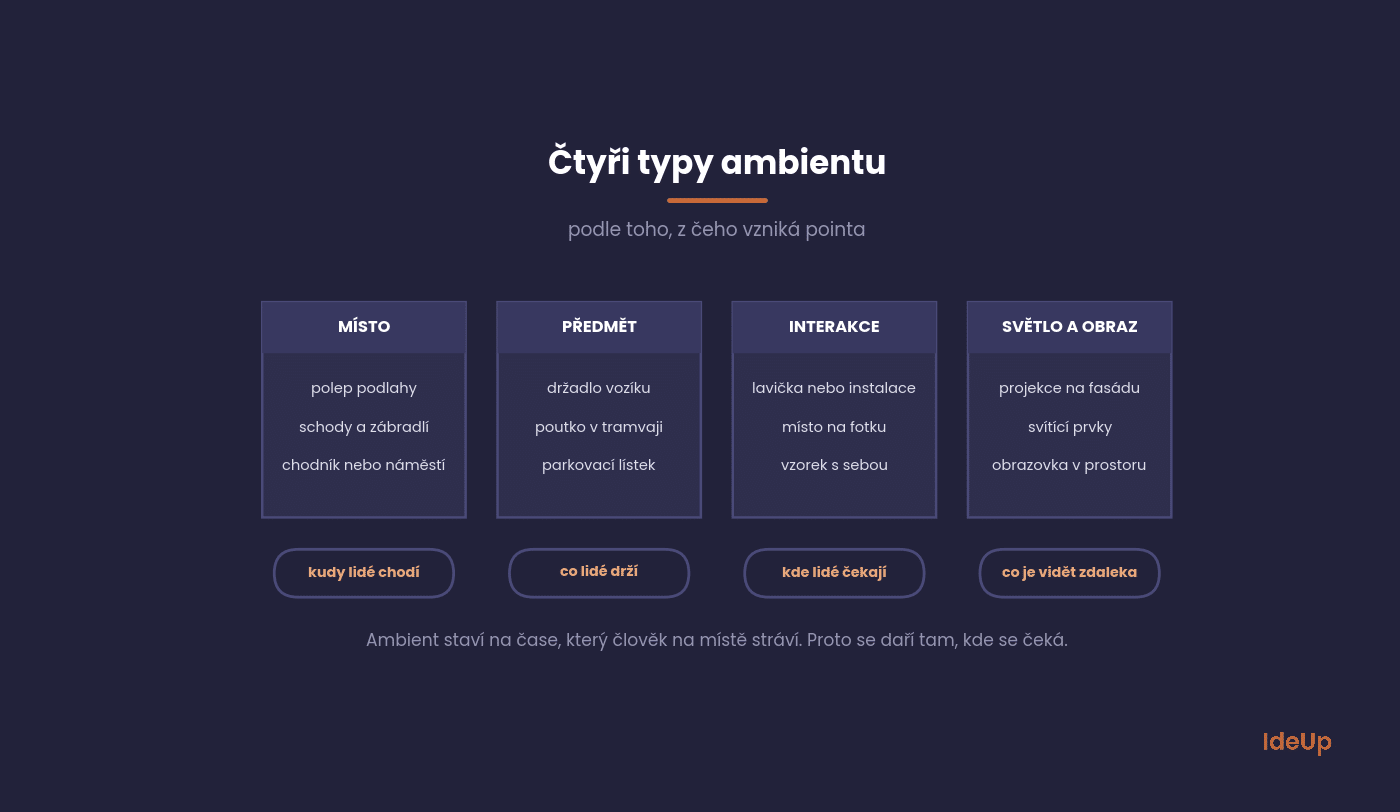
Working with the place is the simplest. A floor or stair graphic turns the space into part of the image, so the point comes from where people walk and where they look. The second group works with an object people hold in their hand, such as a trolley handle, a tram strap or the back of a parking ticket. The contact is brief but personal.
The third type is built on interaction, meaning an installation people sit on, take photos with or take something away from. It works well where people wait and have time, for example in cinemas or shopping centres. Ambient generally depends on the time a person spends at the location, but this is truest of interaction.
The fourth type works with light and image. Projections onto a façade or screens built into the surroundings are the most visible and the easiest to film. They are also the most likely to run into permit issues and the question of whether they disturb the surroundings or traffic.
Ambient marketing examples for each type
The ideas below are illustrative. They show how the point comes from the place or object, and you can adapt them to your own product.
- Place. A gym prints a step counter on station stairs, so each flight shows how many calories you have just burned compared with the escalator next to it.
- Object. A painkiller brand prints a short message on the back of parking tickets in a busy city centre car park, where drivers are likely to be stressed.
- Interaction. A furniture maker swaps the benches in a cinema foyer for its own sofas, with a small sign telling people they are sitting on the product.
- Light and image. A coffee brand projects a slowly filling cup onto a façade opposite a morning tram stop, timed to the hours when people wait.
Each idea works only in its location. Move the step counter to a lift or the sofas to a busy pavement and the point is lost. When you judge an idea, ask whether it would still make sense somewhere else. If it would, it is probably an ordinary advert rather than ambient.
When ambient pays off and when it does not
Ambient is a tool for being remembered and for a story people can retell. It is poorly suited to direct sales. It makes sense mainly when you meet most of these conditions.
- The place is logically connected to the product, so the point needs no explanation.
- The goal is awareness or a product launch, not orders this week.
- Your target audience gathers in specific places, such as a campus or a single shopping centre.
- You have a plan for getting the installation online, meaning photos and video that people will pass on.
- You have at least several weeks left for preparation and permits.
On the other hand, avoid ambient when you need measurable orders straight away, when the product has no visual point, or when you sell alcohol, medicines or other products for which the Advertising Regulation Act (zákon o regulaci reklamy) sets special rules. The same Act prohibits advertising elements that exploit fear. So do not use an idea based on startling passers-by, even if the site owner allows it.
The installation itself disappears within a few days. The brand stays in people’s memory only if further communication follows on from the installation. We explain why long-term brand work pays off even for companies that live on performance in our article on brand building.
Pros and cons of ambient marketing
Before you commit, weigh what ambient gives you against what it takes.
- Pro. People notice it because it breaks a familiar routine, so it is less likely to be ignored than a standard advert.
- Pro. A strong idea gives you material for weeks of content after the installation is gone.
- Pro. You can target a very specific group in a very specific place.
- Con. Results depend heavily on the quality of a single idea. A weak one simply goes unnoticed.
- Con. It is hard to repeat. The second time people see the same trick, the surprise is gone.
- Con. Preparation takes more of your own time than buying a standard site.
Who has to approve ambient and what you risk without a permit
With a billboard, the site operator handles the permit; with ambient, you do. And with every intrusion into normal operations, the number of parties who must give consent grows.
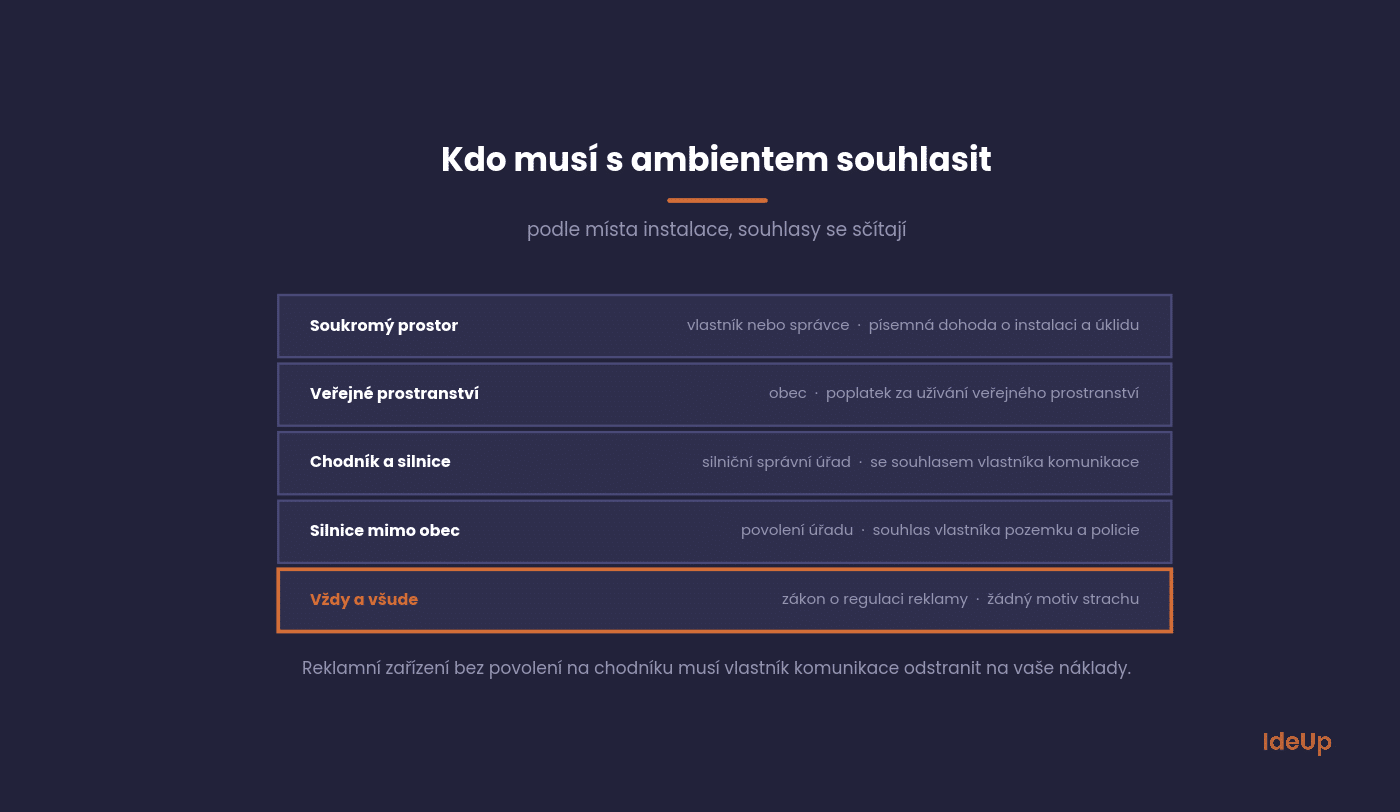
A private space, such as a shopping centre or cinema, requires the consent of the owner or manager. They usually also set the conditions for installation and clean-up. Without a written agreement, expect the installation to disappear before anyone manages to photograph it.
In a public space, such as a square or park, you need the municipality’s consent. Placing an advertising device or holding an advertising event there is also subject to the fee for the use of public space (poplatek za užívání veřejného prostranství). Each municipality sets the amount and conditions of the fee in its own bylaw.
Pavements and roads are classed as roads under the law. Under the Roads Act (zákon o pozemních komunikacích), both a graphic and a stand on the pavement count as special use. This is approved by the road administration authority with the prior consent of the road’s owner.
For local roads, the road administration authority is the municipal office. In large cities, responsibility is split between the city authority and the district offices, so ask the transport department first. The road’s owner must remove an unauthorised advertising device at the expense of whoever owns it, and the company faces a fine of up to 300,000 CZK (about 14,000 USD).
The rules are stricter for roads outside built-up areas. Advertising within a road protection zone that is visible from the road requires a permit from the road administration authority and the prior consent of both the landowner and the police. It must not be confused with road signs or dazzle drivers. On motorways and class I roads, only signage for a nearby business or a small surface, for example at a lay-by, can be approved.
What no permit can resolve is how people react. In January 2007, an agency in Boston placed light-up boards featuring cartoon characters around the city. The police treated them as possible bombs and closed part of a motorway and public transport, and the companies behind the campaign ended up paying two million dollars. An installation that could look like a suspicious object therefore does not belong near bridges, stations or government offices, however good the idea.
What the cost of ambient consists of and why it is not cheap
Ambient is said to be cheap. As far as media costs go, this is often true, because you are not buying a site from a rate card. But an installation in one place is seen only by those who pass by, which is a fraction of the reach of a nationwide campaign. The cost per on-site contact therefore tends to be high.
The budget is made up of six items, and the idea itself is only the first of them.
- Design and creative, including checking that the idea really works at the specific location.
- Production, including installation and removal, often the largest item for light installations.
- Approvals and fees depending on the location.
- On-site supervision, because unsupervised installations get damaged or disappear.
- Photos and video of the installation, from which the campaign spreads further.
- Online distribution, paid video promotion and media outreach.
Ambient has no standard price: a floor graphic and a light installation on a façade can differ in cost many times over. So ask suppliers for a budget broken down into exactly these six items, otherwise you will not be able to compare quotes.
The last two items determine the return. Only photos, video and their distribution turn a single installation into weeks of content and reach that cannot be bought on site. If there is nothing left for them in the budget, you will be paying for an event for random passers-by.
How to measure an ambient campaign
Ambient is harder to measure than performance campaigns, but it can be measured. The condition is that you set up measurement before the installation, because the QR code and discount code must be in place from day one.
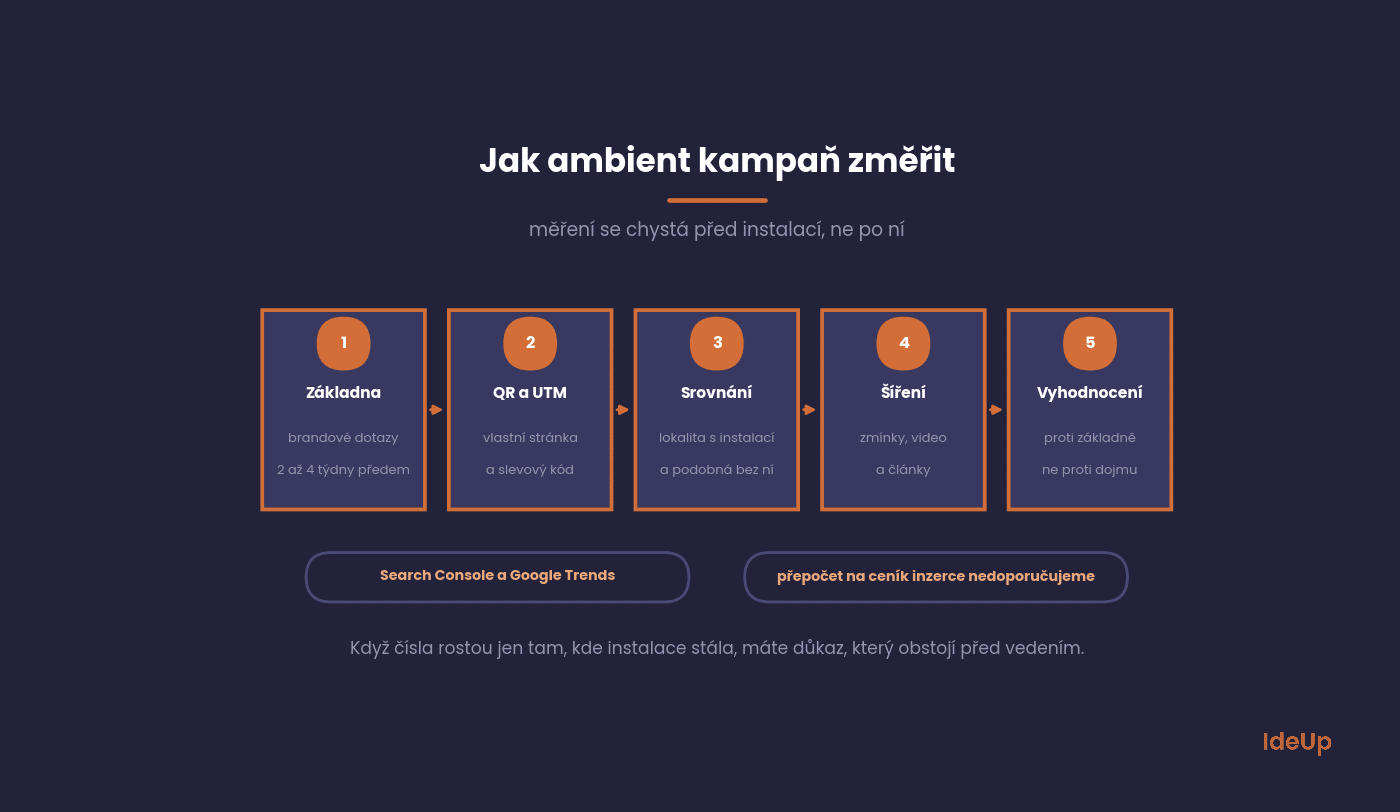
Start with a baseline. Two to four weeks before the campaign, record how often people search for your brand. You will find the data in Google Search Console under queries containing your brand name, and by region in Google Trends. After the campaign, compare against this figure, not against an impression.
Put a QR code or short URL on the installation that leads to a dedicated page with UTM parameters. These are tags in the link that let analytics identify where a visit came from. This way you will see visits from a specific location. If you sell online, add a discount code you do not use anywhere else.
Ambient is local, and you can use that to your advantage. Compare the town or region where the installation stood with a similar place without one. If branded searches and visits grew only where the installation was, you have proof that will stand up even in front of company management. Compare the same metrics from the same period, for example website visits from the given region in analytics and branded searches from Google Trends, otherwise seasonality or another campaign will distort the result.
Finally, track sharing on social media and who wrote about the installation. We do not recommend converting media coverage into the advertising cost that the same space in the media would have cost. It is a number that looks good in a presentation and does not survive the first question.
How to prepare your first ambient campaign
Before you start coming up with ideas, be clear about what the campaign should change and where. We recommend five steps in this order, because an idea without a location and without permits is expensive to rework later.
- One sentence that people should remember, and one number that tells you whether it worked.
- A place where your target audience spends time and where the punchline makes sense. Only then the idea.
- Consents and permits, with a buffer of several weeks.
- Measurement set up in advance. A baseline of branded searches, a QR code with UTM and a comparison location.
- A distribution plan. Who takes the photos, who films, where it gets sent and how much you put into paid promotion.
If you want to connect ambient with search and your website, book SEO consulting. Before the installation, we will set up a baseline of branded searches, UTM links and a comparison location with you, so that after the campaign it is clear what it delivered.
Common mistakes in ambient marketing
Most first campaigns fail for practical reasons rather than for lack of a good idea. These are the mistakes to watch for.
- The point needs explaining. If people have to read a paragraph to understand the joke, most will walk past. Test the idea on someone who knows nothing about the brief.
- The brand is missing. People remember the clever installation but not who was behind it. Make the brand visible without hiding the point.
- Only seen on a screen. A design that looks good in a presentation may be too small, too dark or blocked by people at the real location. Visit the place at the time of day the campaign will run.
- Weather and wear. Floor graphics get dirty and peel, outdoor installations get wet. Choose materials for the conditions and plan who will repair them.
- Safety. A slippery floor sticker or an object in a walkway can cause an accident. Check that the installation does not create a hazard, including for people with limited mobility or sight.
- No plan for removal. An installation left behind after the agreed date can damage your relationship with the site owner and your reputation.
Frequently asked questions about ambient marketing
What is ambient marketing?
Ambient marketing is advertising placed in everyday surroundings, where the place or object itself carries part of the message. Typical media include floors, stairs, benches or shopping trolleys. People notice it because they do not expect an advert there.
What are some ambient marketing examples?
Common examples include stair graphics, messages on trolley handles or tram straps, installations people can sit on or photograph, and projections onto façades. What they share is that the point only works in that particular location.
Is ambient marketing the same as guerrilla marketing?
Not quite. Guerrilla marketing is a broader approach that often works without the site owner’s agreement. Ambient relies on a location you have arranged and had approved, which makes it lower risk.
Is ambient marketing cheap?
Media costs are often low because you do not buy a site from a rate card. However, production, permits, supervision and online distribution add up, and on-site reach is limited. The cost per person who sees it on site tends to be high.
USD amounts are approximate, converted at the Czech National Bank rate of 21.75 CZK per USD on 9 October 2026.


Leave A Reply