
The internet is a worldwide network of interconnected computer networks that exchange data according to shared rules called the TCP/IP protocols. According to the International Telecommunication Union (ITU), around 6 billion people used it in 2025, which is 74% of the world’s population.
The definition sounds technical, but the internet is a physical thing. It is made up of cables, routers, servers and the devices we connect from.
Put simply, the internet is a huge tangle of computers. Some of them are the phones in our pockets, others are machines in the cooled halls of data centres. They are not each connected to every other one. Instead, they are linked through networks and routers, and they communicate using the same rules. That is why you can reach information from any corner of the planet.
The internet is a network of networks, not one big computer
A common misconception is that the internet is a single central brain or supercomputer that controls everything. The truth is simpler. The internet is made up of many smaller networks that work together. These are the networks of universities, companies, government institutions and households, linked to each other by cables under the ground and on the ocean floor.
Within this tangle of computers, there are two basic roles: clients and servers. A client is your laptop or phone, the device you use to ask for information. A server is a computer that stores information and sends it back to you on request.
As soon as you connect to the internet, whether through a home router or mobile data, your device becomes part of it too. In theory, you could turn it into a server and offer your content to others. In practice, most people do not do this and simply browse websites stored on other computers in the network.
The whole system works because every device on the network has its own IP address, much like every house has a postal address. Without addresses, data would get lost. Routers use them to pass the data on in the right direction until it reaches its destination.
What happens when you open a web page
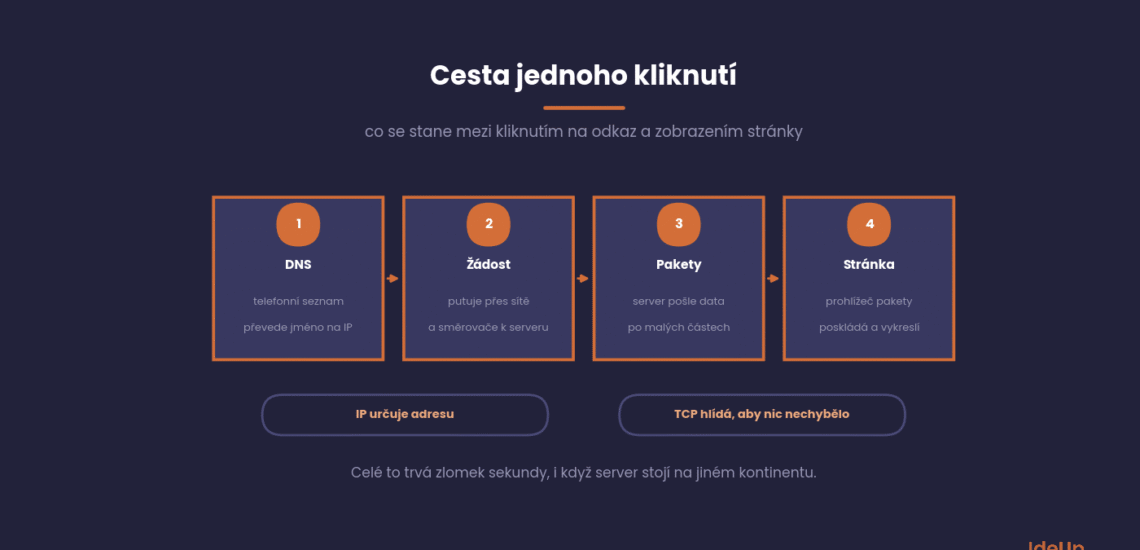
The whole process is like delivering a parcel that gets split into many small parts on the way. These parts are called packets. Each one carries the destination address, and the packets of a single page can travel to your computer by different routes through different routers.
A single click on a link happens in four steps.
- First, the browser needs to find out where the website is located. It sends a query to a system that works like the internet’s phone book. It is called DNS, and it converts a readable address, such as ideup.cz, into a numerical IP address.
- Once the computer knows the server’s numerical address, it establishes a connection and sends a request for a specific page. The request travels through operators’ networks and routers to the destination machine, which may well be on another continent.
- The server processes the request and sends the data back in packets. The IP protocol makes sure each packet knows where to go. The TCP protocol checks whether any were lost on the way and, if necessary, requests them again.
- The browser assembles the page code from the packets it has received and renders the text, images and buttons. It looks like a single smooth moment, but in reality two computers have had a conversation. One asked for the content, the other served it up in parts.
The internet, the web, Wi-Fi and search engines are not the same thing
People mix up these terms in everyday speech. The internet is the network that data travels across. The web is just one of many services that use this network, like email or video calls.
Web pages have their own address, the URL. To view them, you need a browser, which is a program on your computer or phone. A search engine, on the other hand, is a web service that helps you find the right page among a vast number of pages. We explain how it does this in our article how internet search engines work.
| Term | What it is | Most often confused with |
|---|---|---|
| Internet | A worldwide network of interconnected networks | the web or Wi-Fi |
| Web (WWW) | A service for viewing linked pages in a browser | the internet as a whole |
| Wi-Fi | A wireless local network that connects devices to the router at home | the internet itself |
| Browser | A program for displaying pages, such as Chrome or Safari | the Google search engine |
| Search engine | A web service that searches a stored list of pages | the browser it runs in |
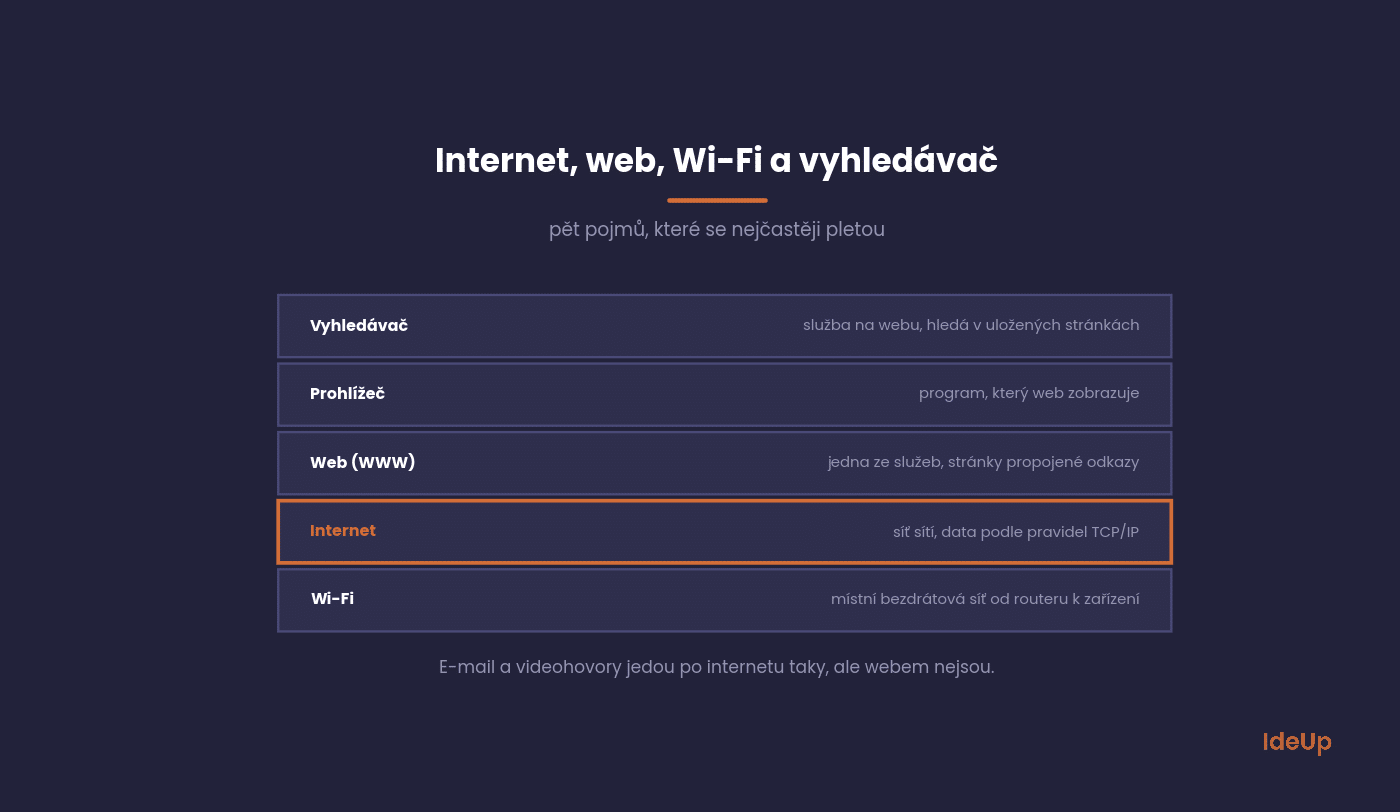
Wi-Fi is just a local way of getting the signal from the router to your phone without a cable. If the router stops working or the operator stops providing the connection, you will still see the Wi-Fi, but you will not get onto the internet. It is like having water pipes in your house with no water flowing in from the mains.
To launch your own website, you also need a domain and web hosting. The domain is your name on the network, and hosting is the space on a server where the website’s data is stored. We have written a detailed beginner’s guide on what a domain and web hosting are.
Who owns the internet and who runs it
No single person, company or country owns the internet as a whole. It is made up of many private and public networks, and those do have owners. Cables, networks and data centres belong to operators, universities, technology companies and states.
Ownership, however, is not the same as coordination. For networks to understand each other, there are international organisations that look after shared rules and addresses. ICANN is responsible for the domain name system and the allocation of IP addresses at the highest level. The IETF develops the technical standards that computers use to exchange data, including TCP/IP.
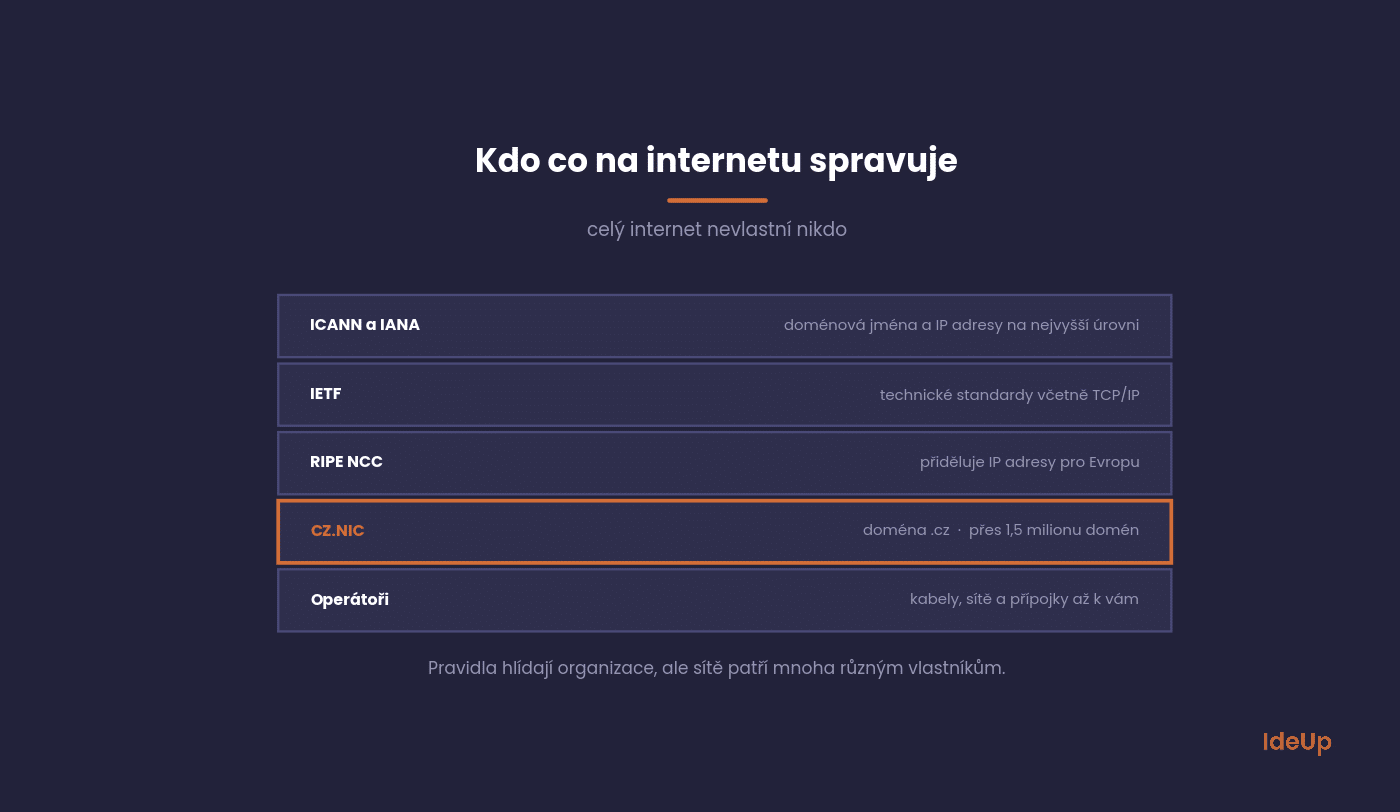
In Europe, IP addresses are allocated by RIPE NCC. For Czechia, the most important organisation is the CZ.NIC association, which has managed the national .cz domain since 1999. In March 2025, the number of registered .cz domains exceeded 1.5 million.
Anyone can publish on the internet, and nobody approves the content in advance. Alongside verified information, you will therefore also find mistakes, so it is worth checking your sources.
Advantages and drawbacks of a network nobody owns
Because the internet has no centre, it behaves differently from a system run by one company. This brings clear benefits and some real weaknesses.
- No single point of failure. If one route breaks, routers can send packets another way, so a local fault rarely takes the whole network down.
- Open access. Anyone with a connection can join, publish content or build a new service without asking for permission.
- Shared standards. Devices from different makers can work together because they follow the same public protocols.
- No quality control. Mistakes and false claims spread as easily as accurate information.
- Security is spread out. Each network, company and user is responsible for protecting their own part, and weak spots can be exploited.
- Large failures still happen. An outage at a big provider or a damaged undersea cable can affect a whole region.
How you connect to the internet
The route to the internet always goes through an internet service provider, the operator. In Czechia, the most common fixed connection is still a wireless one from local providers, colloquially known as “internet over wifi”. However, this is not the Wi-Fi from your router. It is a radio link to the provider’s antenna, which the router at home then distributes further.
Fibre-optic connections, which transmit data as light in glass fibres, are growing quickly. According to the Czech Telecommunication Office (Český telekomunikační úřad), there were just under 1.1 million of them at the end of 2025, more than older DSL connections over a phone line (957,000). People also connect via cable networks and mobile data over 4G and 5G.
Data from the Czech Statistical Office (Český statistický úřad) for 2025 show how commonplace the internet is. 81% of people aged over 16 used it every day, and 83% went online from a mobile phone. 8% of people in this age group had never used the internet. 32% of people already use artificial intelligence tools to create content, so the internet has long been more than just a place for reading.
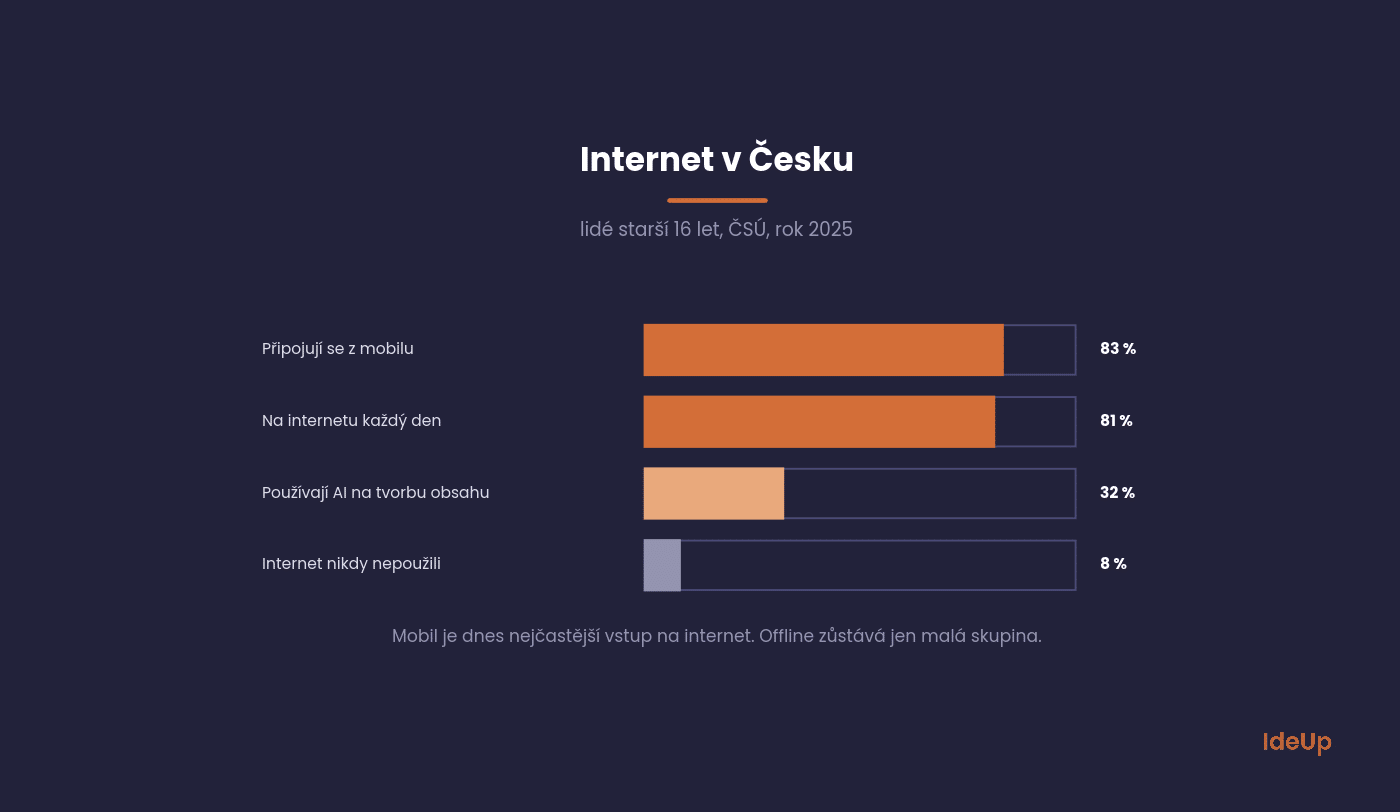
For anyone who builds websites, this leads to a simple conclusion. A page must work above all on a small screen, because mobile is now the main way most people get online.
What is the internet used for in everyday life
Once you are connected, you do not see the network itself. What you notice are the services that run on top of it. Most of what people do online falls into a few groups.
- Communication. Email, messaging apps, voice calls and video calls.
- Information and learning. Reading news, looking up facts, taking online courses and using reference sites.
- Work. Sharing files, editing documents stored in the cloud, joining remote meetings and using company systems from home.
- Shopping and banking. Buying goods, paying bills and managing accounts without visiting a shop or branch.
- Entertainment. Streaming music and video, playing online games and following social media.
- Connected devices. Smart thermostats, security cameras and other equipment that send data to servers and receive commands.
Each of these services uses its own software and rules, but all of them rely on the same addressing and packet delivery. That is why one home connection can carry a video call, a file download and a music stream at the same time.
Where the internet came from
The history of the internet goes back to the United States in the 1960s. In 1969, the ARPANET network was created, connecting several university computers. It was an experimental network that tested whether data could be sent remotely between different machines.
1 January 1983 is often cited as the birth of today’s internet. On that day, ARPANET switched to the TCP/IP protocol suite, which is still in use today. The web came later. Tim Berners-Lee proposed it in March 1989 at the CERN research centre, the first server and browser were running by the end of 1990, and on 30 April 1993 CERN released the web software into the public domain.
Czechoslovakia officially connected to the internet on 13 February 1992 from the Czech Technical University in Prague (ČVUT), via a 19.2 kb/s line to Linz in Austria. We were the 39th country in the world to join the global tangle of computers.
Who initially developed what is now known as the internet
No single inventor created the internet. It grew out of the work of many researchers. ARPANET was funded by ARPA, the research agency of the US Department of Defense, which later became DARPA.
The two names most closely linked to the internet are Vint Cerf and Bob Kahn. In the 1970s they designed TCP/IP, the rules that let separate networks exchange data as if they were one. This is why they are often called the fathers of the internet.
Their work built on earlier ideas. Packet switching, the method of splitting data into small parts, was developed independently by Paul Baran in the United States and Donald Davies in the United Kingdom.
Tim Berners-Lee is sometimes called the inventor of the internet, but that is a mix-up. He created the web, a service that runs on a network that already existed by then.
What this means if you have your own website
If you run your own website, you are not just a reader on the internet. Your website sits on one of the servers in the network, and people reach it through an address, a link or a search engine.
In practice, this means three things. Have a domain and hosting that you control. Check that search engines can see your website, because otherwise there is no route to you from search. And if you are still planning your website, at IdeUp we help with website creation, from structure to copy.
Frequently asked questions about what the internet is
What is the internet in simple terms?
The internet is a worldwide network that links billions of devices through cables, routers and servers. The devices exchange data using shared rules called TCP/IP. Any phone or computer that connects becomes part of the network.
What is the difference between the internet and the World Wide Web?
The internet is the network that carries data between devices. The web is one service that runs on it, made of linked pages you open in a browser. Email, messaging and video calls also use the internet, but they are not part of the web.
Who initially developed what is now known as the internet?
The internet started as ARPANET, a research network funded by the US Department of Defense. Vint Cerf and Bob Kahn designed the TCP/IP protocols that joined separate networks into one. Many other researchers contributed, so no single person can claim to have invented it.
What is the internet used for?
You use the internet to communicate, find information, work remotely, shop, bank and stream entertainment. It also connects smart devices such as thermostats and cameras. All of these services share the same underlying network.

Leave A Reply