SEO copywriting has a reputation for being writing for robots. Squeeze the keyword into the text five times, add a few synonyms and you are done.
That idea is ten years old and today it does active harm. Google and language models now judge whether a text answers the question, not whether it contains the right phrase.
This article is about how to write texts that people read to the end and search engines find. Above all, it covers two things that matter more than the writing itself: your own information database and how to use AI sensibly today.
What decides today whether a text works
The order of factors has reversed over the last few years. The keyword used to come first and usefulness somewhere at the back. Now it is the other way round.
Google describes this in its documentation on helpful content, and it is worth noting what is missing from it: no recommended keyword density, no minimum length.
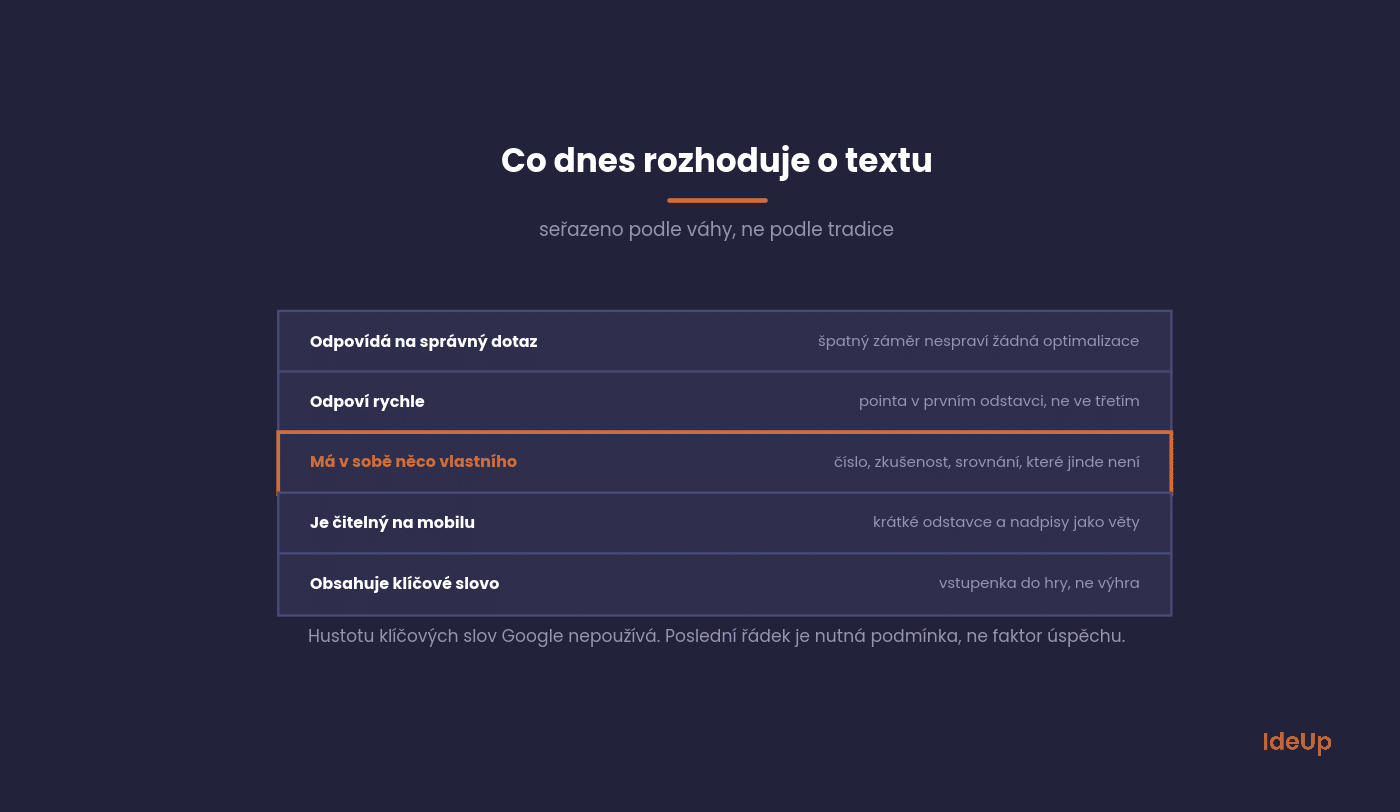
In practice, this means four things. The text must answer the right query, answer it quickly, contain something you cannot find elsewhere and be readable on mobile.
Putting the keyword in the title and the first paragraph is still part of the craft. It is just no longer the deciding factor.
What is SEO copywriting and how it differs from ordinary copywriting
SEO copywriting means writing texts that answer a specific question people have, in a form that both readers and automated systems can understand and quote. The aim is to persuade the right people and to be found by them in the first place.
Classic copywriting starts with the product and the message the company wants to get across. SEO copywriting starts with the reader’s question and the words they use to ask it. The craft of good writing is the same in both. Only the starting point changes.
- Starting point. Ordinary copy begins with a company brief. This kind of writing begins with what the reader wants to know.
- Lifespan. A campaign text works for a few weeks. A good article can keep bringing in readers for years.
- Measuring success. You judge it by whether the right people arrive and stay, not only by clicks during a campaign.
The two disciplines are not opposites. A text that is found but does not persuade wastes the visit, and a persuasive text nobody finds wastes the writing.
A structure that works for readers and search engines
The most common mistake in Czech corporate texts is that they only get to the point in the third paragraph. The author wants to lay the groundwork first.
Meanwhile, the reader has left and the robot has taken its answer from someone else.
The answer right under the heading
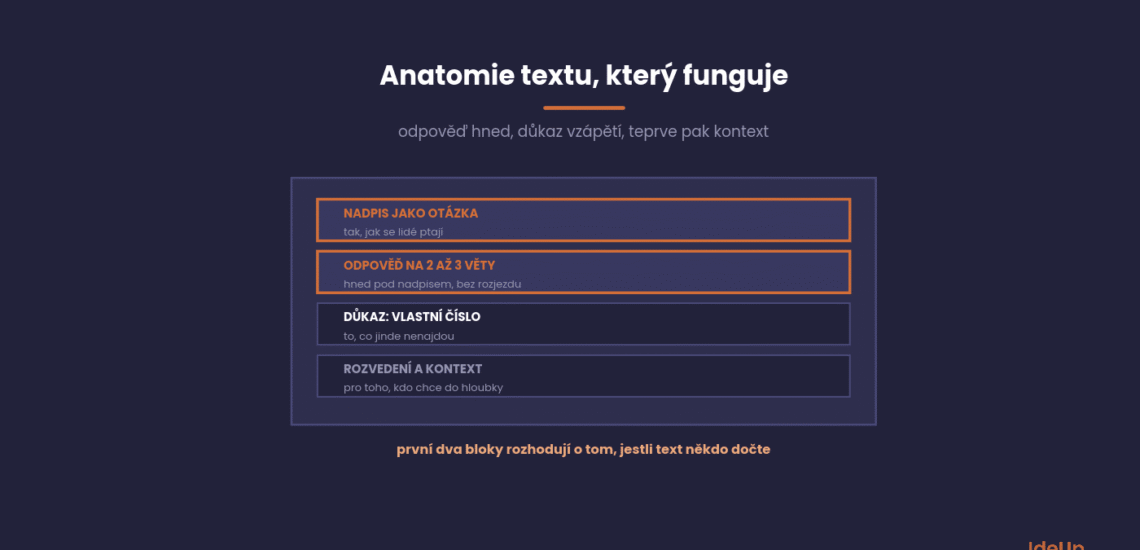
Under every heading phrased as a question, write a brief answer of two to three sentences. Only then expand on it.
This structure has two effects at once. The reader gets what they came for, and the model has something to quote when it puts together an answer.
Short paragraphs and clear headings
A paragraph of two to four lines gets read, a paragraph of eight gets skipped. On mobile, this applies twice over.
Write headings as sentences, not labels. “How much does an SEO audit cost” works better than “Price”, because that is exactly how people ask.
One text, one cluster of queries
Each text should serve one cluster of related queries. If you cram three different topics into it, it will not rank for any of them.
Splitting topics across pages is work that belongs in keyword research, not in the writing stage.
SEO copywriting examples, before and after
The principles are easier to see on real sentences. Here are three typical rewrites.
An opening paragraph
Before. “In today’s fast-paced world, companies face many challenges when choosing a supplier of industrial cleaning.”
After. “An industrial cleaning contract for a warehouse usually covers floors, racking and loading bays. Here is what to check before you sign one.”
A product description
Before. “Our high-quality office chairs offer maximum comfort.”
After. “The chair has adjustable lumbar support, height-adjustable armrests and a seat depth you can set for both shorter and taller users.”
A section heading
Before. “Our services”. After. “What an annual maintenance contract includes”.
In each case the rewrite is more specific, uses words a customer would use and gives the reader a reason to keep going.
Information database, what makes your texts impossible to copy
Here is something most companies underestimate. The most valuable part of content work is not the writing but collecting your own data.
A text that merely retells what is everywhere else has no chance today. Not with Google, and not with a model putting together an answer.
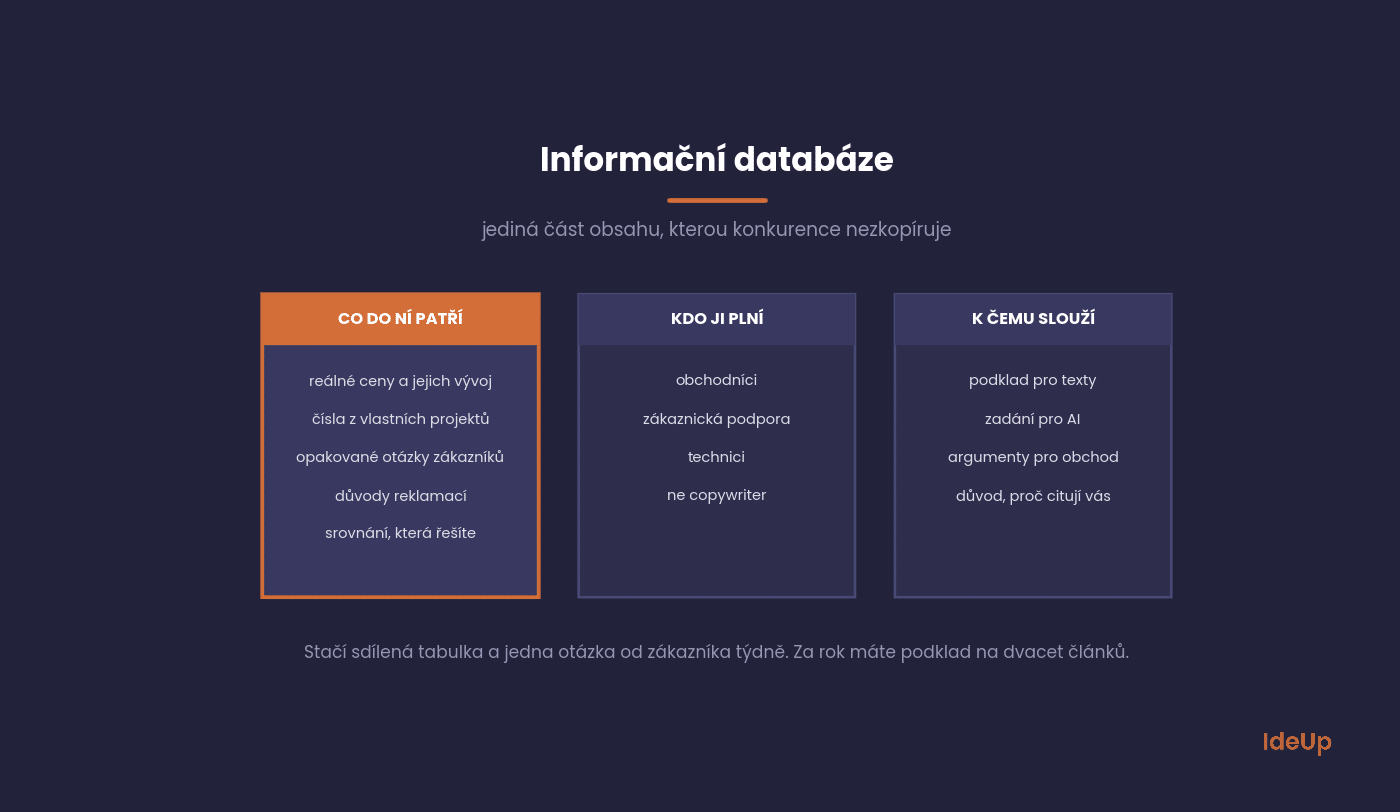
An information database is simply an organised collection of what only you know. It does not have to be a system costing millions; for most companies a shared spreadsheet is enough.
What belongs in it: real prices and how they change, figures from your own projects, questions customers ask you repeatedly, the reasons behind the most common complaints, and comparisons of products you discuss in meetings.
Who fills it: not the copywriter. Sales staff, support and technicians. The copywriter is just the one who builds texts from it.
A practical approach: create a document where anyone adds one customer question and its answer every week. After a year, you have material for twenty articles that nobody else can write.
How to use AI sensibly today
Language models have changed the economics of writing. Work that used to take a day now takes two hours. Ignoring this is as unwise as relying on it blindly.
The difference between useful and harmful use lies in what you give the model and what you check afterwards.
Where AI really helps
Clustering keywords into topics, proposing a text structure, rephrasing a paragraph that is not working, checking readability, and generating title variants for testing.
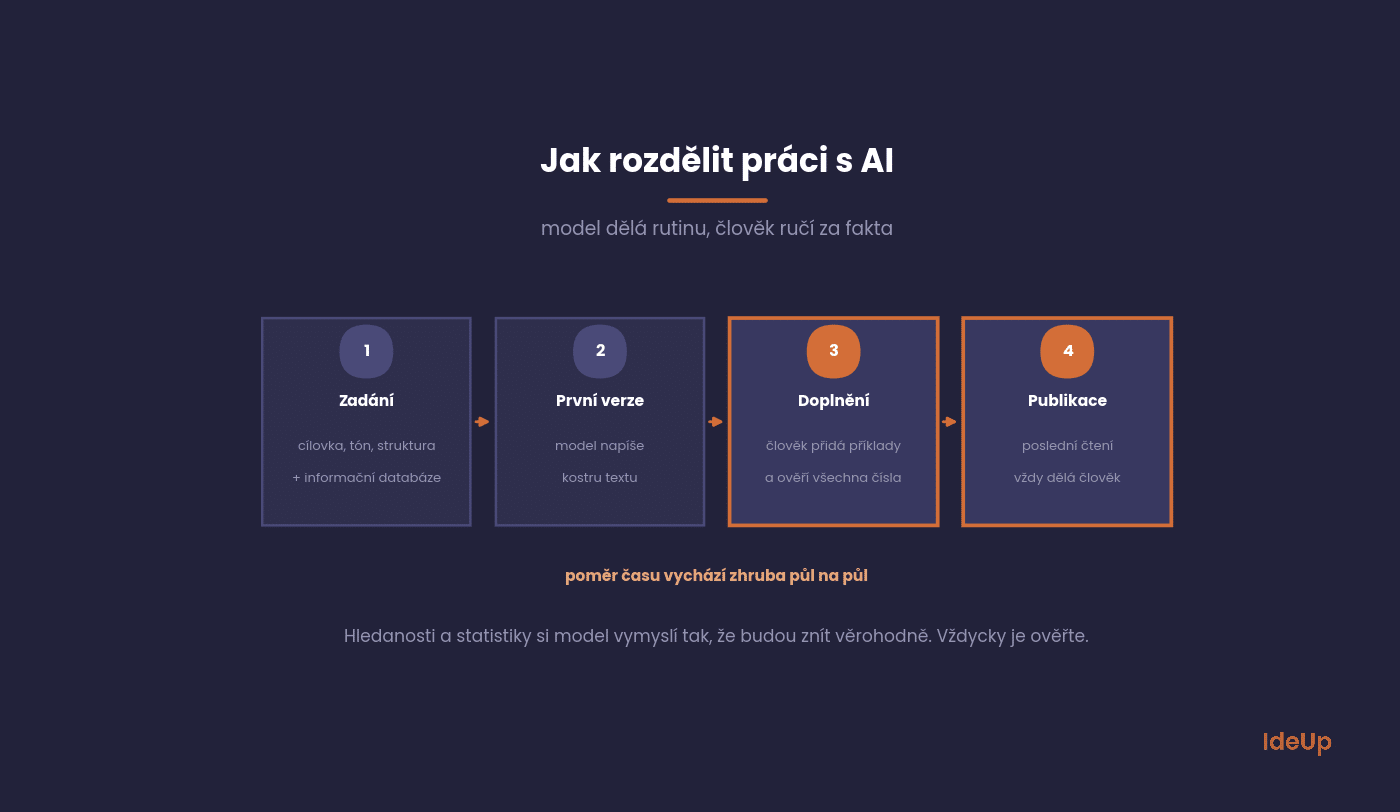
Its greatest strength, however, lies elsewhere: you give it your information database as source material and let it write a first draft from it. The output is then built on your data, not on what the model picked up on the internet.
Where you must not use AI
For figures the model has no way of knowing. Search volumes, prices, statistics. The model will happily generate them and they will sound plausible.
And for the final version without reading it. Every published text should have a human behind it who has verified the facts and added what the model cannot know.
The process we use
The brief for the model includes the target audience, tone, the structure from the research, three samples of your earlier texts and an extract from the information database on the topic.
The output then goes to a human who adds specific real-world examples, verifies all the figures and cuts generic passages. The time works out at roughly half and half.
Meta texts that are often forgotten
The title and description in search results decide whether someone clicks. Yet they are often written at the last minute without much thought.
And yet it is the quickest change with a measurable effect you can make on your website.
A title of up to around sixty characters, with the main query at the front and a reason to click. A description of up to around 155 characters, written as an invitation, not a summary.
Google often rewrites the description based on the query, which is fine. It does not mean you should not write one, only that you should not expect it to appear word for word.
What to avoid in your texts
These are the things we see most often in client texts, and they all have the same consequence: nobody reads the text to the end.
Yet they can all be fixed in a single revision.
A three-paragraph warm-up. The first sentence should be the most important one, not an introduction to the subject.
Repeating the keyword. When a phrase appears fifteen times in a text, it reads badly and does not help.
A text without a single number. General advice is everywhere. Specific figures are the reason people read you in particular.
Missing links. A text without internal links is a dead end for both readers and robots.
SEO copywriting checklist before you publish
SEO friendly copywriting is mostly a matter of discipline. Run through this list before every text goes live.
- The first two sentences answer the main question of the text.
- The title says plainly what the page is about.
- Every heading tells the reader what the section contains.
- At least one fact or example comes from your own experience.
- Every figure has a source you have checked yourself.
- Paragraphs read comfortably on a phone screen.
- Images have alt text that describes what they show.
- The title and description are written, not left to chance.
- Someone other than the author has read the text.
- The end gives the reader a clear next step.
If a text fails more than two points, it is better to hold it back for a day than to publish and fix it later.
Questions about writing for search engines
Five questions we get from clients and their in-house marketers.
The answers apply in general; the details vary for each specific website.
How long should an article be?
Long enough to answer the query and not a paragraph longer. Length is not a factor; it just often coincides with a longer text covering the topic more fully.
A practical guide: look at what ranks in the top ten for the query and ask what those texts are missing.
How many times should I use the keyword?
In the title, in the first paragraph and then naturally wherever it makes sense. Do not worry about density; it is not a metric Google uses.
It is more useful to cover the related terms and questions that belong to the topic. That shows Google you understand the subject.
Does Google penalise texts written by AI?
Not for how they were created, but for being unhelpful. The problem is that unhelpful generated content can be produced in far greater volumes and far faster.
What matters is the result, not the tool. A text with your own data will hold up, whoever wrote it.
Is it worth updating old articles?
Almost always more than writing new ones. A text that already has some history moves up faster once it is expanded than an article written from scratch.
Start with texts ranking in positions 5 to 15. That is where the ratio of effort to effect is best.
Who should write the texts, an in-house person or a copywriter?
Ideally both. The in-house person has the knowledge and data, the copywriter knows structure and language. The worst option is an external writer with no access to your information.
A model that works is an interview: the copywriter asks, the in-house expert answers, and the text is built from that.
Where to start
Create a document for your information database and add ten questions customers have asked you in the past month. That is the brief for your first three texts.
When you write, put a two-sentence answer under each heading and only then explain. You will see for yourself how much shorter the text becomes.
Do you need someone who can do both, that is, write and work with data? Take a look at our copywriting or get in touch via our contact page.
Frequently asked questions about SEO copywriting
What are the best SEO copywriting tips for beginners?
Start with one important page rather than a whole website. Write the answer first and the explanation second, then read the text aloud to catch long or unclear sentences. Add at least one example from your own work, because that is what makes the text worth reading.
Can AI do SEO copywriting on its own?
It can produce a usable draft, but not a finished text. A model does not know your prices, your customers or your results, and it may state invented facts with confidence. Treat its output as raw material that a person with real knowledge of the topic must check and complete.
What makes copywriting SEO friendly?
A clear topic, a quick answer, headings that describe their sections and wording that matches how readers ask. Add a clean structure that works on mobile and information the reader cannot get elsewhere. Clever phrasing matters far less than clarity.
Are SEO copywriting best practices the same in every language?
The principles are the same everywhere. What changes is how people phrase their questions and the grammar of the language. In Czech, for example, words change their endings depending on grammatical case, so a phrase has to appear in a form that reads naturally rather than in one fixed shape.