Asking “how much does SEO cost” follows the same logic as asking “how much does a car cost”. The answer is anywhere from twenty thousand to several million, and both are true.
The difference is that with a car, you know what you get for the money. With SEO, most companies have no idea, so they decide based on a single number in the proposal.
This article gives concrete figures from the Czech market, explains four pricing models and, above all, describes situations where SEO is not worth it at all. No agency will tell you that last part on its website.
Four models for billing SEO
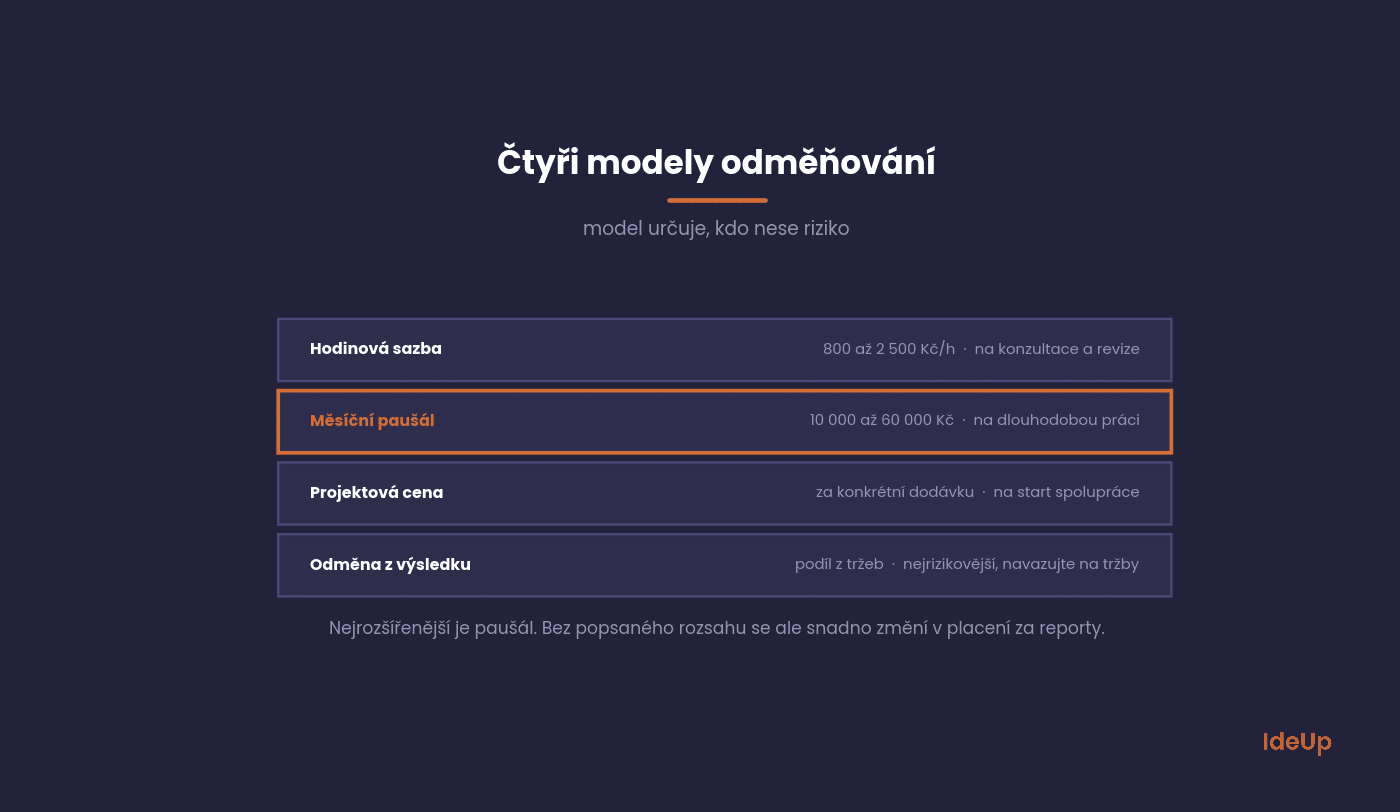
The model is not a detail in the contract. It determines who carries the risk, how the work will be done and what happens when results do not come.
On the Czech market you will come across four in practice, and each suits a different situation.
Hourly rate
You pay for time worked. Consultant rates on the Czech market range from roughly 800 to 2,500 CZK (about 37 to 110 USD) per hour, depending on experience and on whether you hire a freelancer or an agency.
It suits one-off tasks: a consultation, a review of someone else’s proposal, training an in-house person. For long-term work it is impractical, because you end up arguing about timesheets instead of results.
Monthly retainer
The most common model. You agree on a scope and a fixed amount, usually 10,000 to 60,000 CZK (about 460 to 2,800 USD) a month, depending on the size of the website and your ambitions.
The advantage is predictability for both sides. The disadvantage is that without a clearly defined scope, a retainer can easily turn into paying for reports.
Project price
You pay for a specific deliverable: keyword research, an audit, a website migration, a content strategy. Prices range from a few thousand to around a hundred thousand, depending on scope.
Good for starting a partnership, because both sides can test how well they work together before committing for a year.
Performance-based fee
It sounds the fairest and in practice it is the riskiest model. Whoever is paid for rankings has an incentive to push up queries that are easy to win and bring nothing.
If you go for it, tie the fee to organic revenue, not to rankings. And expect the supplier to want a bigger share, because they carry the risk for you.
How SEO agency pricing works for audits and consulting
Audits and consulting are usually priced separately from ongoing work. An SEO audit is typically charged as a project. The price depends on the size of the website, how deep the technical review goes and whether you get a prioritised list of fixes or only a list of problems.
SEO consulting is mostly billed by the hour or as a prepaid block of hours. It works best when you have someone in-house who will carry out the recommendations, because you pay for advice, not for implementation.
Many agencies also present their services as tiered plans. Before you pick one, check what actually changes between the tiers. Often it is only the number of hours or reports, not the type of work.
Specific price bands and what you get in them
The following figures are based on what we actually see in enquiries and proposals on the Czech market. Treat them as a guide, not as a price list.
The key column is the one on the right. It determines how many hours of work can realistically be delivered for the money.

Up to 5,000 CZK (about 230 USD) a month gets you roughly two to four hours. That is enough for monitoring and minor tweaks, not for real progress. It makes sense for a small website that is already in good shape.
In the 10,000 to 25,000 CZK (about 460 to 1,100 USD) band, ongoing work is possible: content, on-page changes, technical fixes, monthly reviews. This is where SEO starts to make sense for most small and medium-sized companies.
From 30,000 CZK (about 1,400 USD) upwards, you add link building, higher-volume content production and work on the website architecture. This band makes sense for e-shops and for companies where organic search already accounts for a substantial share of revenue.
Why proposals differ so much
Two agencies send you proposals for the same website at 12,000 and 45,000 CZK (about 2,100 USD). The difference is almost never that the more expensive one can do three times as much.
It lies in how many hours are included in the price and who will work them. That is a question everyone should ask, and few do.
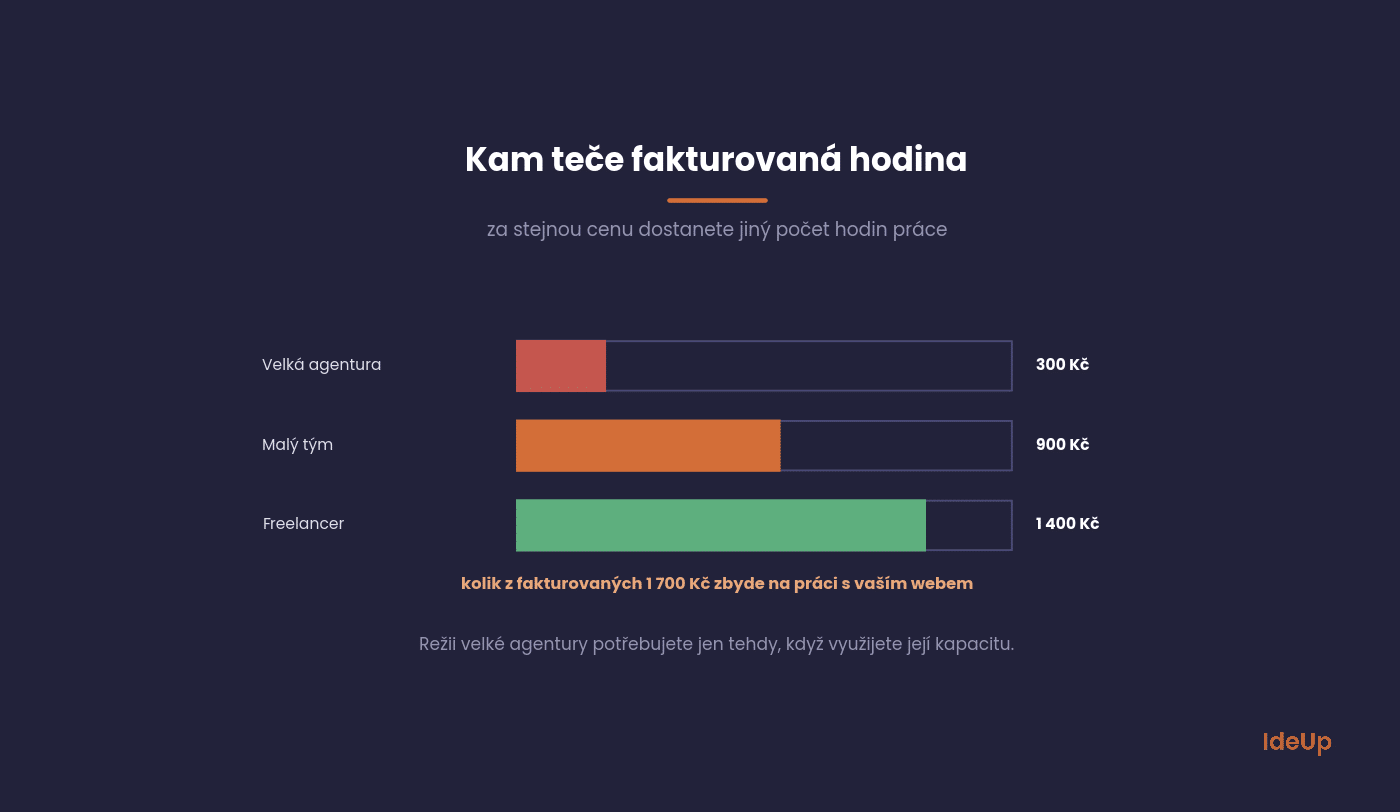
With a large agency, besides the work itself, you also pay for a salesperson, an account manager, offices and the agency’s own marketing. So less of each billed hour reaches your website than you would expect.
That does not mean an agency is a bad choice. It means that for the same money you get a different structure of work, and it is good to know which one. We cover the differences between suppliers in detail in our article on how to choose an SEO agency.
When SEO is not worth it
This is the most useful part of the whole article, and also the one you will not find in proposals. There are situations where investing in SEO is the wrong decision.
There is nothing exotic about them; we come across them regularly.
You have nothing to build on. Optimisation will not fix a website that has nothing to offer. First the product and pages that convert, then the traffic.
You need revenue within three months. Organic search picks up within three to six months and reaches its full effect after a year. If you need money now, the budget belongs in PPC.
Nobody searches for your market. In very narrow B2B fields, total monthly search volume may be in the tens of queries. There, direct sales and B2B marketing make more sense than fighting for rankings.
You have a budget for three months. SEO for a quarter is a wasted budget. Either you have enough for a year, or do not go for it.
What a proposal should include
A proposal that does not tell you what will be done is not a proposal but a price list. Before you sign, ask for four things in it.
Without them you have no way to compare two suppliers, because each one means something different by “SEO”.
- Scope in hours or in specific deliverables. “Ongoing optimisation” is not a scope.
- Who will work on it. A name, not a job title. And whether it is the same person who presented the proposal to you.
- What happens in the first three months. A concrete plan, not phases like “analysis, implementation, evaluation”.
- How success will be measured. Ideally organic revenue, at the very least traffic from non-branded queries.
Common mistakes when comparing SEO pricing
- Comparing the monthly total instead of what is delivered for it.
- Overlooking the minimum contract length and the notice period.
- Assuming the price includes implementation when it only covers recommendations. Ask who will make the changes on the website.
- Choosing the biggest package in the hope of faster results. More hours help only if your website can absorb the work.
- Forgetting extra costs such as copywriting, development time or tools, which may be billed separately.
How much to budget by website type
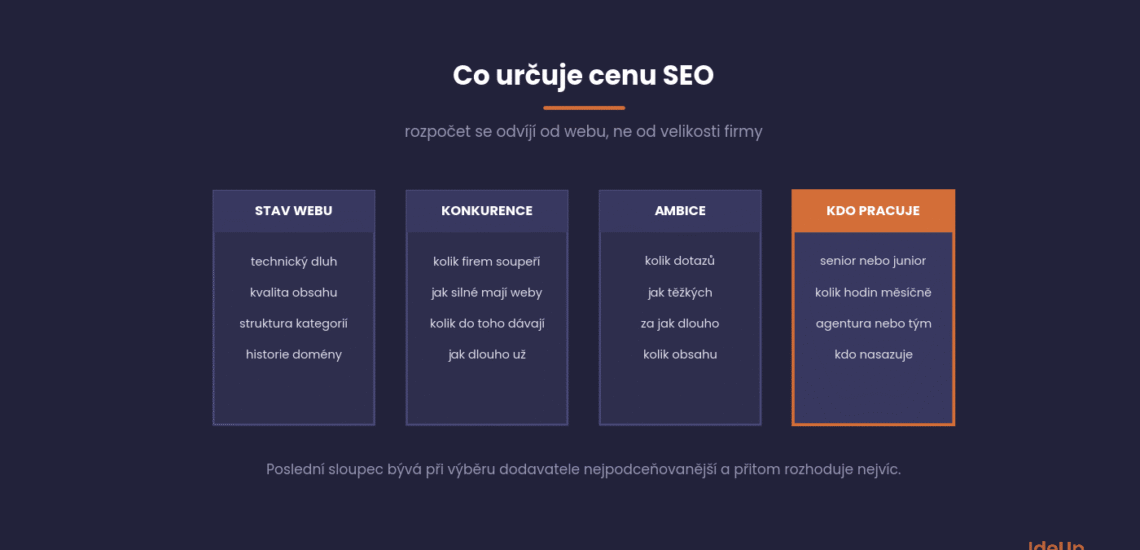
The budget is not derived from the size of the company, but from how much work the website needs and how strong the competition is in its field.
Treat the following ranges as a starting point for a conversation, not as an offer.
Company website or sole trader: 8,000 to 15,000 CZK (about 370 to 690 USD) a month, or a one-off project for 30,000 to 60,000 CZK (about 1,400 to 2,800 USD) followed by maintenance only.
Smaller e-shop with up to a thousand products: 15,000 to 35,000 CZK (about 690 to 1,600 USD) a month. Most of the work goes into categories, filters and technical health.
Large e-shop or competitive field: 40,000 CZK (about 1,800 USD) and up, with a substantial part going to content and link building.
In its analysis of SEO pricing, Ahrefs follows similar logic for English-speaking markets. The figures there are higher, but the ratio between price bands and scope of work holds true here as well.
Common questions about pricing
We have picked the five we hear most often at a first meeting.
The answers are general; for a specific website the figures may differ.
Why is SEO not a one-off payment?
Because your competitors are working too. One-off optimisation gives you a head start that disappears within a year if nobody keeps working on it.
There is an exception: a website in good shape in a field with no competition can make do with one-off work and an annual review.
When will I see the first results?
Minor title tweaks show up within weeks. New content and structural changes within three to six months. Links are the slowest; expect a year there.
Pages that already have some history move fastest. New content starts from zero and takes longer.
Is cheap SEO better than none?
Usually not. For a few thousand a month you can buy either a little work or bad work. The latter will cost you more than doing nothing.
Badly bought links or mass-generated content then take months to remove. In that situation, doing nothing is cheaper.
Can I do SEO myself?
The basics, yes, especially for a small website. You will find the process in our article on how to do an SEO analysis of a website. What usually holds you back is time, not knowledge.
For a company website with ten pages, it is manageable. For an e-shop with thousands of URLs, you run into the volume of work, not its complexity.
How much of the budget should go to content?
For most projects, roughly half. The rest goes to technical work and links. The ratio changes depending on the state the website is in.
For a technically broken website, the ratio is reversed for the first quarter. There is no point writing for a website that Google cannot crawl properly.
How to work out what makes sense for you
Take the annual revenue you currently get from organic search. If you do not know it, that is your first task, even before deciding on a budget.
Then ask yourself by what percentage it would have to grow for the annual cost of SEO to pay for itself. If the number sounds realistic, you have your answer.
Do not want to calculate it blindly? We will go through it with you during SEO consulting and tell you straight away whether search engine optimisation makes sense for you now, or whether it is better to put the money elsewhere.
Frequently asked questions about SEO agency pricing
How much does an SEO audit cost?
It depends mainly on the size of the website and the depth of the review. A small company website needs far less time than an e-shop with thousands of URLs. Ask whether the price includes a prioritised action plan, because a list of problems without priorities is hard to act on.
Is pay for performance SEO pricing suitable for a small business?
Rarely. The supplier carries the risk, so the fee per result tends to be higher, and small websites often do not have enough organic revenue to measure results reliably. A modest retainer or a one-off project is usually easier to control.
Which SEO pricing model is the best?
There is no single best model. Hourly rates suit one-off advice, projects suit clearly defined tasks and retainers suit ongoing work. Choose the one that matches how long you need help and how clearly you can define the scope.
USD amounts are approximate, converted at the Czech National Bank rate of 21.75 CZK per USD on 9 October 2026.