

Public relations, or PR for short, is the work of managing relationships between a company and the public. In practice, it means getting into the media and in front of people without buying the space.
In Czech it is called vztahy s veřejností, but the abbreviation is what stuck. PR is often confused with advertising, and the difference between them determines what you can expect from it.
This article explains how PR differs from advertising, what it can and cannot do, and why it belongs in an SEO plan even though it is not directly linked to rankings.
PR and advertising are not the same
The difference lies in who controls the content. With advertising it is you, with PR it is the newsroom. This has consequences both ways.
Advertising is predictable. You pay, it runs, and you say exactly what you want. At the same time, people know it is paid for and treat it accordingly.
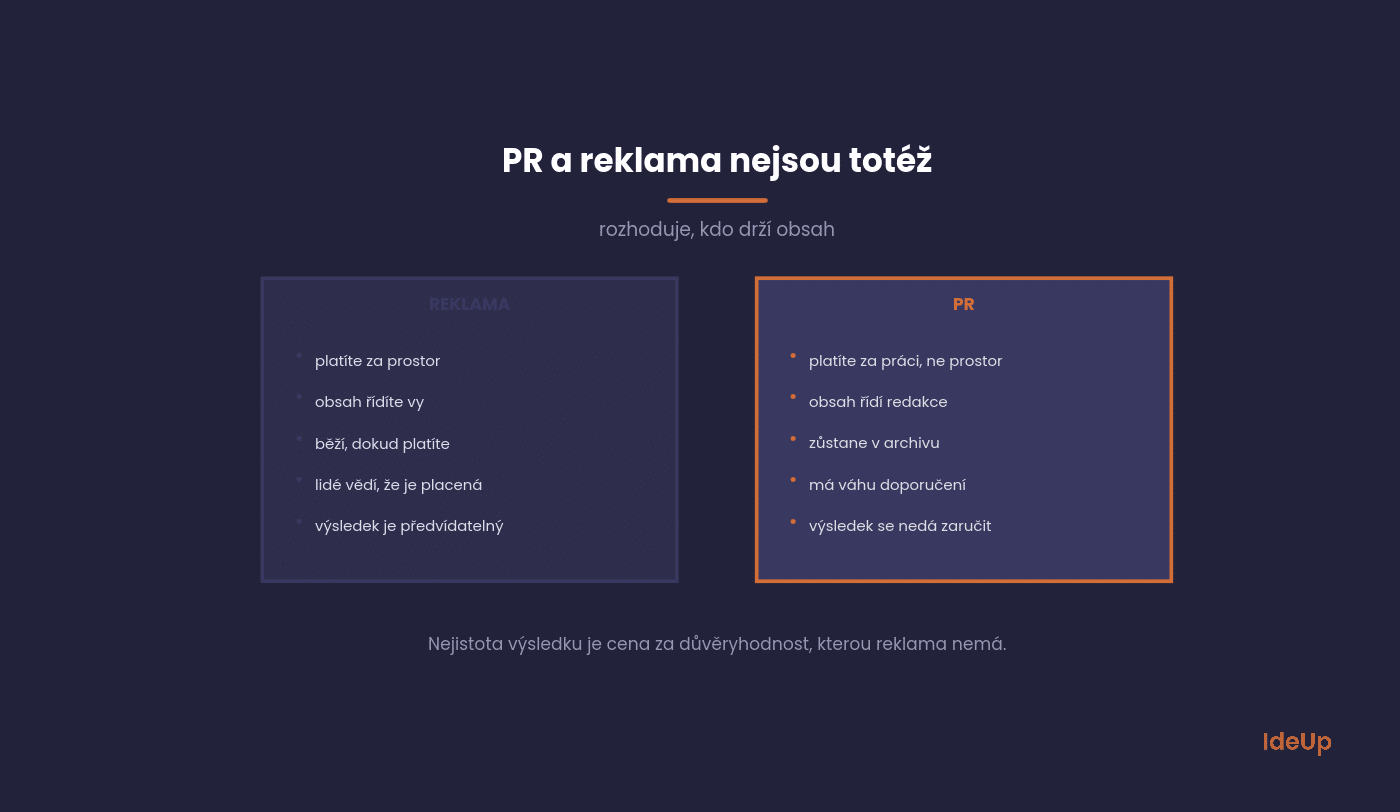
With PR you pay for the work, not for the space. Nobody can guarantee that the article will be published, or that it will say what you wanted.
But when it is published, it carries the weight of a recommendation. The newsroom took it because they found it interesting, and that is how the reader sees it.
The second difference is how long it lasts. Advertising stops as soon as you stop paying. An article stays in the archive and people link to it for years.
What is public relations within marketing
Marketing is the broad discipline of getting a product to the people who need it. It covers the product itself, pricing, distribution and promotion. Advertising and PR both belong to promotion, but they work towards different goals.
Marketing usually aims at sales and is judged by them. PR aims at reputation, meaning what people think of you before they ever need you. Customers, journalists, future employees and investors all form an opinion of a company, and PR works with all of them.
- Main question. Marketing asks how to sell more. PR asks how the company is seen and whether people trust it.
- Audience. Marketing speaks mostly to customers. PR also speaks to the media, employees, the local community and investors.
- Control. Marketing content is mostly your own. PR depends on other people choosing to retell your story.
In smaller companies, one person often does both. That works well as long as you know which goal a given task is serving.
What PR can and cannot do
Dissatisfaction with PR almost always comes from the wrong expectations. Companies expect it to do what advertising is meant to do.
It is worth saying this out loud before the work even starts.
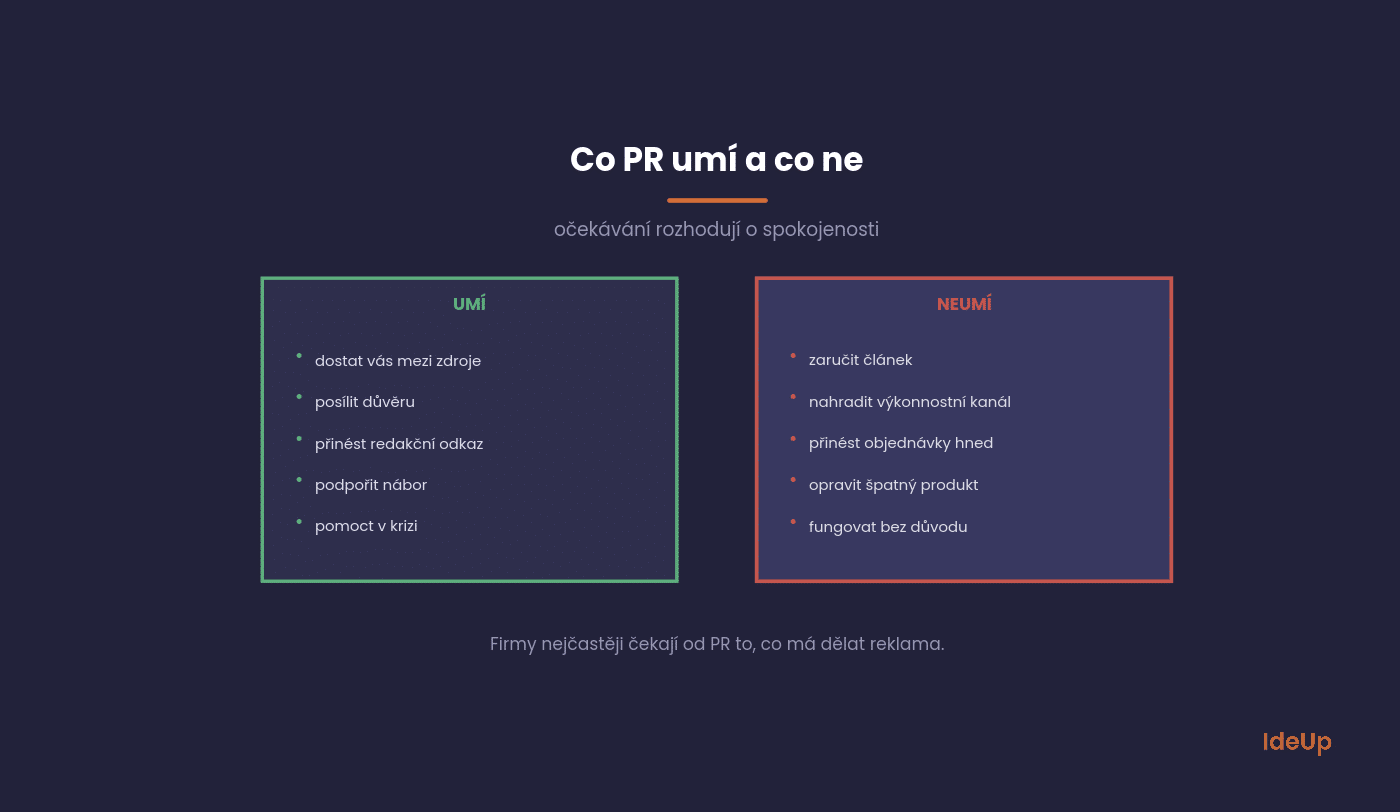
PR can get you among the sources that others link to. It can build trust with people who are unsure about you. It can bring an editorial link that cannot be bought.
It can also help with recruitment, because people want to work for companies they have heard of. And it can limit the damage when something goes wrong.
It cannot guarantee an article, because the newsroom decides that. It cannot bring orders straight away. Above all, it cannot work without a reason, meaning without something actually happening in the company.
What public relations people actually do
The purpose of PR is to earn and keep the trust of the people a company depends on. Day to day, that turns into fairly practical work.
- Looking for stories inside the company, such as new data, a change, a milestone or an expert opinion.
- Writing statements, releases and answers to journalists’ questions.
- Preparing spokespeople so they can talk to the media clearly.
- Watching what is being said about the company and responding when needed.
- Keeping employees informed so that news does not reach them from outside first.
A large part of the job is saying no. A good PR person tells management when a topic is not news, which saves the company’s credibility with reporters.
Who is on the other side
PR is work with people, not with a contact database. Each of them wants something different, and your story has to get past all of them.
Most stories stop at the first one.
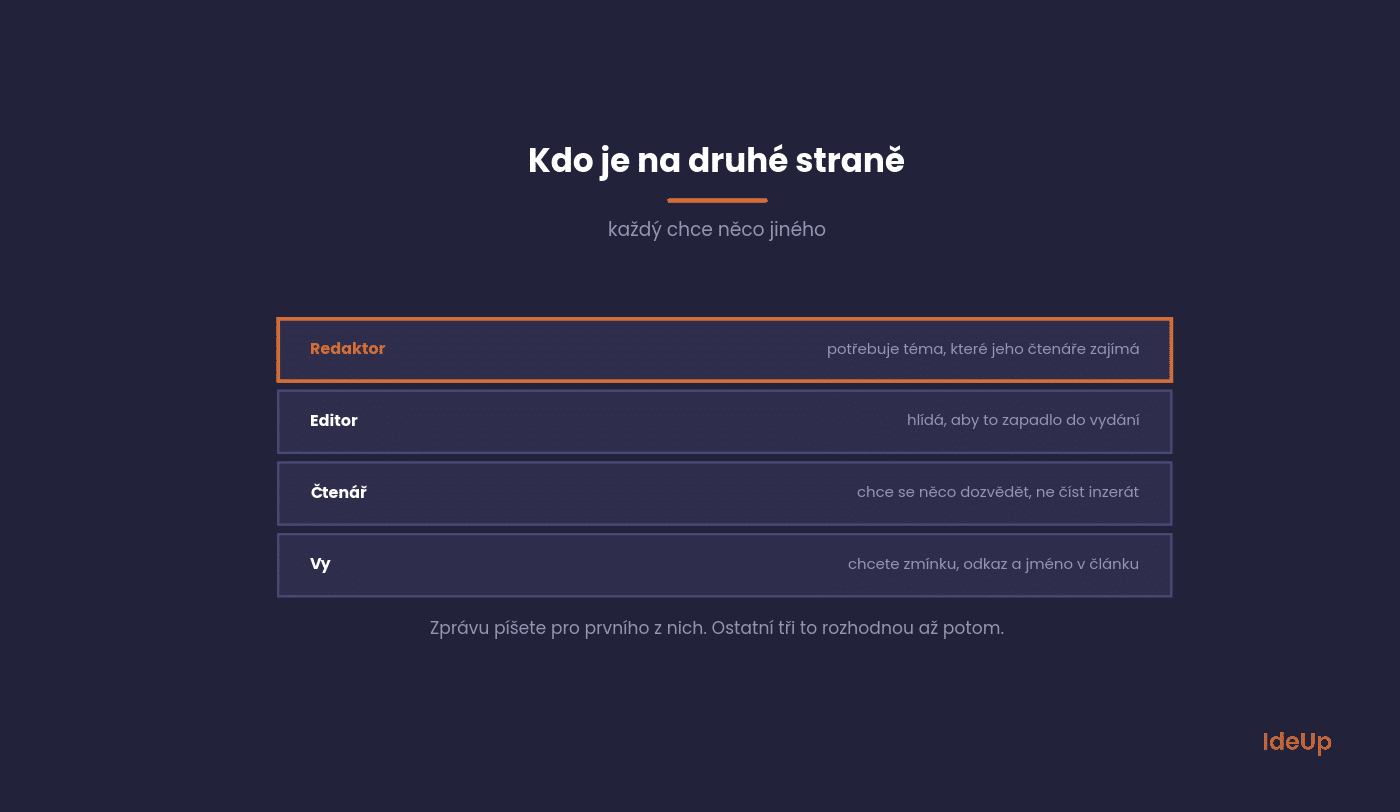
The reporter needs a topic that will interest their readers. Not you, not your company, their readers. That is the whole of PR in one sentence.
The editor makes sure it fits the issue and does not overlap with anything else. The reader wants to learn something, not read an advert.
You want a mention, a link and your name in the article. That is legitimate, but it comes last, not first.
Tools used in PR
PR is not just the press release, although that is the best-known part. In practice, five things are used.
Most of them cost nothing but time.
Press release. The most common format. We cover when it makes sense to write one and how to structure it in our article on the press release.
Your own data. A survey or statistics from your systems. The strongest tool of all, because nobody else has that data.
Expert commentary. When the media cover a topic from your field, you offer your view. It requires speed, not preparation.
Press kit. Photos, logos and basic facts about the company in one place. Journalists find what they need themselves and you save hours.
Relationships. The least visible and most valuable part. A list of five reporters who will pick up the phone to you lasts for years.
What is a public relations campaign
A campaign is a planned series of PR activities built around one message, aimed at one goal and run over a set period. A single press release is an action. A campaign combines several tools so that they support each other.
- Set one goal. For example, becoming known as the expert on a specific topic in your field.
- Choose the audience. Decide who should change their view of you, and which media they read.
- Find the reason. The campaign needs something real at its centre, such as your own data or a new service.
- Plan the order. Decide what goes out first, who gets it and what follows a week later.
- Review the result. Compare it with the goal you set at the start, not with how busy you were.
A simple example is a company that surveys its customers, releases the main findings to trade media, offers regional figures to local titles and then has its expert comment whenever the topic comes up again.
How to build a media list
The quality of the list matters more to the result than the quality of the story. A mass mail-out to two hundred addresses is the quickest route to the bin.
Building a good list takes one afternoon and lasts for years.
Start with topics, not media. Look up who has written about your field in the last six months. The same names will start to repeat.
Read their articles. You will find out what interests them and how they present it. Without this, you cannot write a single sentence on why you are writing to them in particular.
Split them into three groups. Trade media, general news media and regional media. Each group needs a different angle on the same story.
Keep a note of who replied. After a year you will have a list of people worth writing to, and that is the greatest value of all PR.
Regional media are the most underrated. For a company with physical premises, they tend to be more accessible and bring a more specific audience than a national title.
Why PR belongs in an SEO plan
This is why PR shows up even where nobody would expect it. A link from an editorial article is a type of link that cannot be bought.
It is also an honest method, because the link comes from giving the media a reason to write about you.
Expectations need to stay realistic, though. Many media do not give links at all, or add an attribute that does not pass on ranking value.
Even so, a mention has value, because it strengthens the brand, and today brands are read by language models too. We describe how PR fits into a wider plan in our article on link building.
Crisis communication
The most visible part of PR comes when something goes wrong. A data leak, a product recall, a badly judged post, a dispute with a customer.
The difference between companies is not whether a crisis comes, but how quickly they respond and with what.
Get in touch before they ask. Silence is read as an admission. The first few hours decide who will tell the story.
Say what you know and what you do not. Admitting that you are still looking into something is better than claiming something you will retract a day later.
Speak with one voice. One person, one statement. Three different versions from the same company are worse than the problem itself.
Say what you will do. An apology without action is just words. A concrete step is what people appreciate.
Most crises can be handled on the day they start. Yet companies often leave them for two days and then deal with something ten times bigger.
Internal PR
The part that hardly anyone talks about, yet it decides whether a consistent image gets out of the company.
Employees are the largest media channel a company has, whether it manages it or not.
If people inside the company learn news from the media, something is wrong. Employees should know before the public, even at the cost of a one-day delay.
The second practical point is recruitment. People research a company just like customers do, they simply look in different places, such as employer reviews and LinkedIn.
The third is simple. When a company has clearly written down what it does and why, employees talk about it in a similar way to the outside world. Without that, everyone interprets it in their own way.
How PR is evaluated
Evaluation is the weak spot of PR and is often the reason it is the first thing cut from the budget. Four numbers are enough.
None of them requires a paid tool.
Number and quality of coverage. Not how much, but where. One article in a trade publication is usually worth more than ten on content farms.
Links gained. How many pieces of coverage include a link, and what kind. We cover this in our article on backlinks.
Brand searches. Compare the week before the coverage and the week after. With bigger coverage, the difference is visible straight away.
Direct traffic. People who find the website themselves after reading the article.
What to avoid is converting coverage into the equivalent advertising cost. It is a habit from the 1990s and says nothing about whether the PR worked.
Common questions about PR
These are the four questions we get most often from smaller companies.
The answers apply in general.
Does a small company need a PR agency
An agency mainly helps with contacts and wording. But the reason to write about you has to come from inside the company.
An agency that invents reasons will harm your standing with newsrooms in the long run.
How much PR costs
With external support, you pay for time, not for coverage. A smaller company can usually fit within a few tens of thousands of CZK a month if it supplies the topics itself.
The most expensive option is paying an agency to come up with topics. That is how you get stories nobody publishes.
Are paid distribution services worth it
For reach, yes. For quality links, usually not. Sending a release to dozens of portals ends up in sections nobody reads.
Ten personally approached reporters bring better results than mass distribution.
How often to get in touch
Only when you have something to say. For a smaller company, that realistically means two to four times a year.
A fixed schedule leads to inventing reasons, and that is the beginning of the end of your relationship with the newsroom.
Where to start in your company
Check whether your systems hold data that nobody else has. Orders, seasonality, customer behaviour. That is the quickest route to a topic someone will write about.
Then find five reporters who have written about your field in the last six months and read their articles. This list will last you for years and it is free.
Want to connect PR with link building so it brings links too? We work on link building, get in touch through our contact page.
Frequently asked questions about public relations
What is the definition of public relations?
Public relations is the planned work of building and protecting the relationship between an organisation and the people around it. That includes customers, the media, employees, investors and the local community. Unlike advertising, it relies on earned attention rather than paid space.
What is the purpose of public relations?
The purpose is to make people understand and trust the organisation. A good reputation makes sales, hiring and partnerships easier, and it gives the company some goodwill to draw on when something goes wrong.
In public relations terms, what is a crisis?
A crisis is any event that can seriously damage how the public sees an organisation if it is handled badly. Typical examples are a data leak, a faulty product, an accident or a public dispute. What makes it a crisis is the risk to trust, not only the size of the problem itself.
What is the difference between advertising and public relations?
With advertising you pay for space and decide exactly what it says. With PR you earn coverage by giving the media a story worth telling, and the newsroom decides how it is presented. Advertising offers control, while PR offers credibility.


Leave A Reply