
A keyword is a word or phrase that people type into a search engine when they are looking for something. In SEO and PPC, the term refers to the queries for which a page or an ad should appear. A single keyword also covers its variants, such as inflected forms, typos and synonyms with the same meaning.
Beware of confusion. Universities use the same term for the words listed below the abstract of an academic paper, and programmers use it for the reserved words of a programming language. That is why, if you type klíčová slova (keywords) into Google, you will see guides to writing a bachelor’s thesis alongside advice for websites. Here we only mean the term as it applies to websites and search engines.
A keyword and a search query are not the same thing
A search query is exactly what one person typed. A keyword is a generalisation that marketers work with. One keyword covers dozens of queries that differ in form but want the same answer. This article shows it well. From April to September 2026, Google showed it for all of these queries, and for us they are a single topic, because the people searching want to know the same thing.
| Query in Search Console | Impressions over six months |
|---|---|
| keyword | 91 |
| keyword definition | 65 |
| the term keyword | 20 |
| what is a keyword | 13 |
| keyword in text | 7 |
| keyword meaning | 5 |
This leads to the first rule. Each page should cover one intent, otherwise your pages start competing with each other and you get keyword cannibalisation.
In PPC advertising, the difference between a keyword and a query is even clearer. The keyword entered in a campaign is matched to queries according to its match type, which is broad, phrase or exact. Negative keywords, in turn, stop the ad from showing for unwanted queries. An online shop selling new goods might exclude a word such as bazar (second-hand), so that it does not pay for people looking for used items.
What is a keyword made of
Most keywords consist of a core term and one or more modifiers. The core term names the subject, such as running shoes. The modifiers narrow it down and tell you more about what the person needs.
- Attribute, such as waterproof running shoes.
- Audience, such as running shoes for beginners.
- Price, such as running shoes under 100 USD.
- Location, such as running shoes Prague.
- Problem, such as running shoes for knee pain.
Each modifier you add makes the phrase more specific and usually less common. A phrase with two or three modifiers is typically what people mean by a long tail keyword. When you plan a page, write down the core term first and then list the modifiers your offer genuinely matches. That gives you the secondary phrases for your subheadings without guessing.
How keywords used to be used
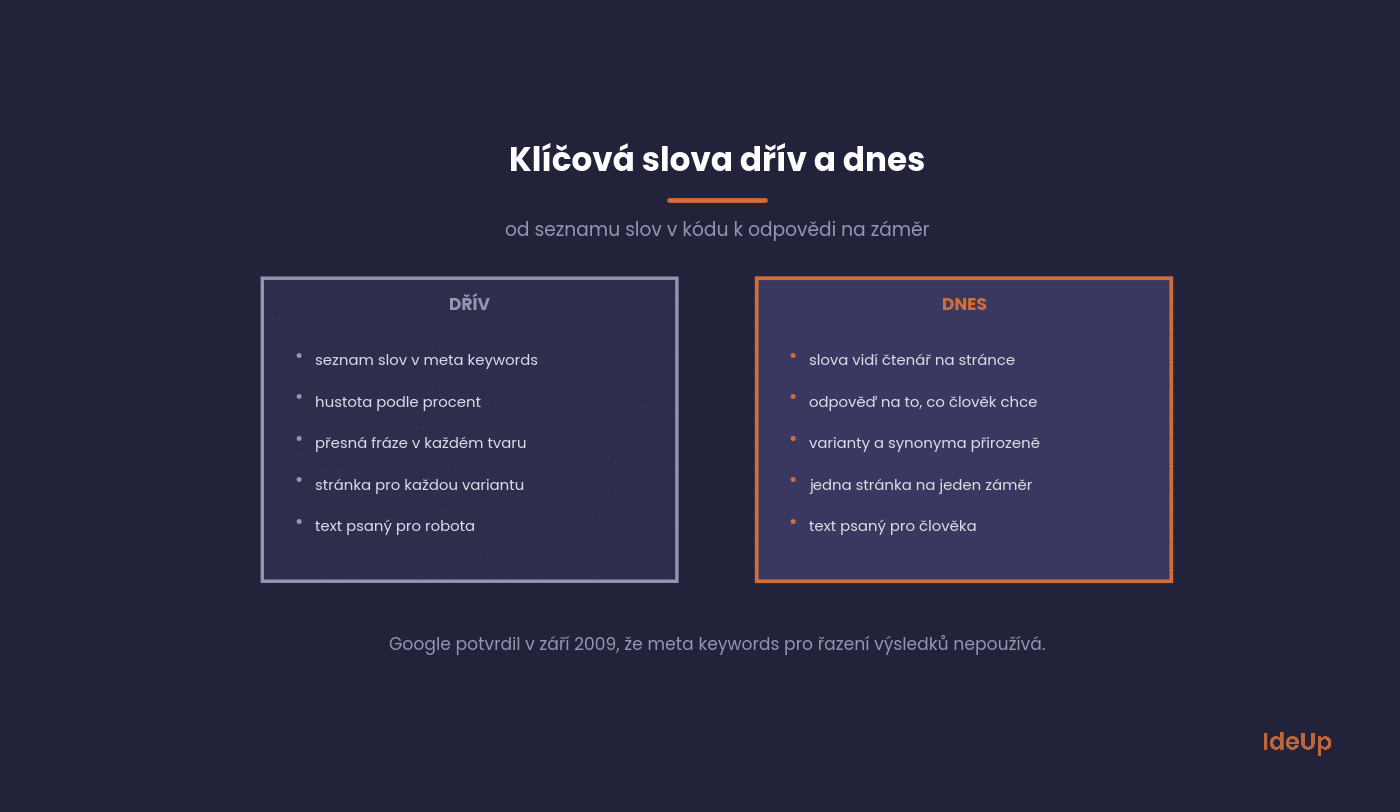
In the early days of the internet, a keyword meant something else. The website author added a list of words describing the page to its source code, in the so-called keywords meta tag. Visitors could not see them; only the search engine read them, and used them to work out what the page was about and which queries it should appear for.
This worked until website owners started adding words that had nothing to do with the content. Search engines therefore stopped taking meta keywords seriously. In September 2009, Google officially confirmed that it does not use them for ranking results, and that has not changed since.
Another misconception from that time lasted longer: keyword density, meaning the percentage of the text made up by the target phrase. You can still find advice claiming that 3% is ideal. Google has never given any ideal percentage, and text written to hit a percentage is hard to read.
Types of keywords by length
By length and search volume, keywords fall into three groups. Short, general words such as laptop have huge search volume and unclear intent. Mid-length queries such as gaming laptop already narrow the choice. And long phrases such as gaming laptop under 25,000 CZK (about 1,100 USD) belong to the so-called long tail.
In English they are called long tail keywords; in Czech, longtailová klíčová slova or dlouhý ocas (literally “long tail”). No, it is nothing rude. The name describes the shape of the curve when you sort queries by search volume. A few queries are searched by many people, and behind them stretches a long end of thousands of queries that only a handful of people search for.
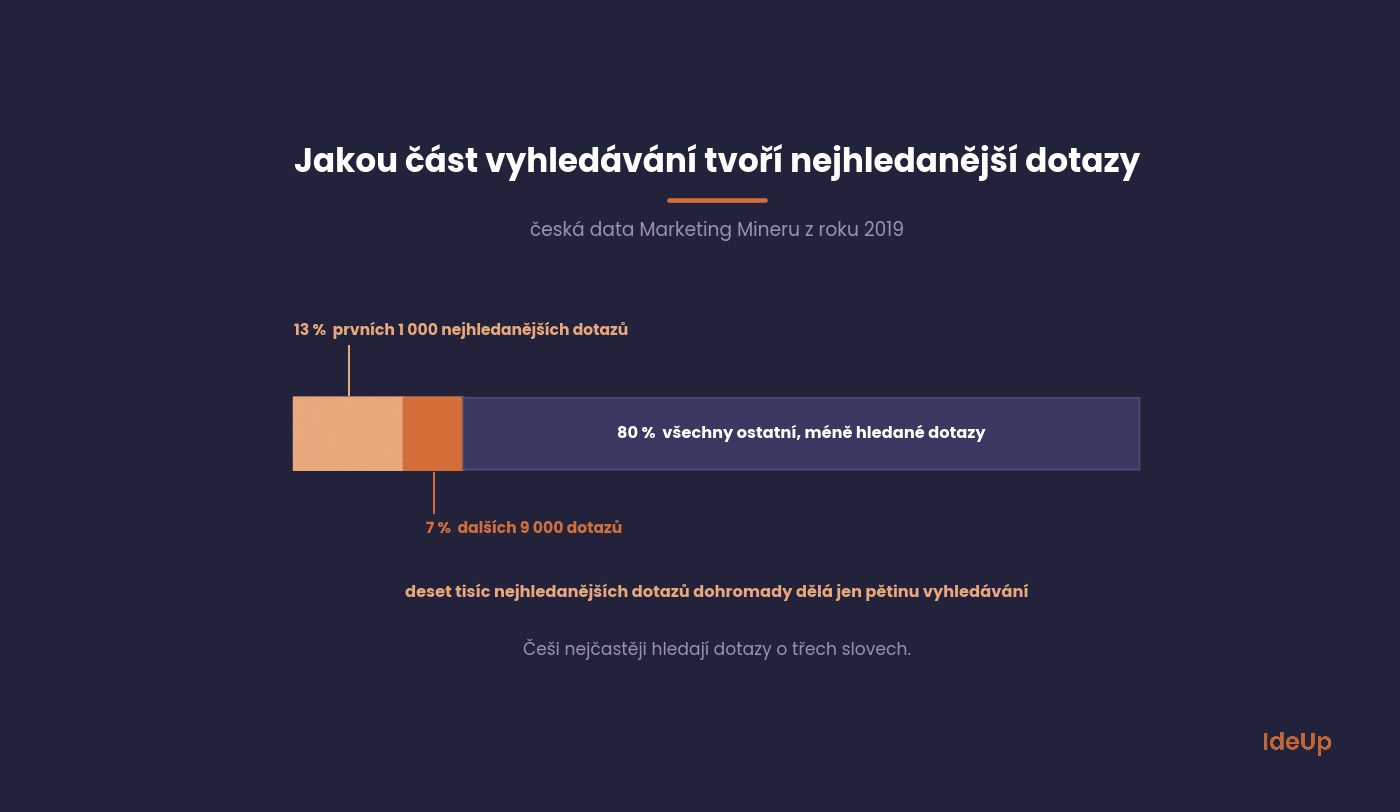
That long end is in fact the majority of searches. According to an analysis by Marketing Miner of Czech data from 2019, the top 1,000 most searched queries make up only 13% of total volume, and the top 10,000 only 20%. Czechs most often search using three-word queries.
The long tail is defined not by the number of words but by search volume. Even a two-word query belongs to it if only a few people search for it each month.
For a smaller website, the long tail is the most achievable route. Large websites compete for general terms, but for a specific query, a page that answers it precisely is enough. We explain more about turning long queries into traffic in our long tail glossary entry.
Types of keywords by intent
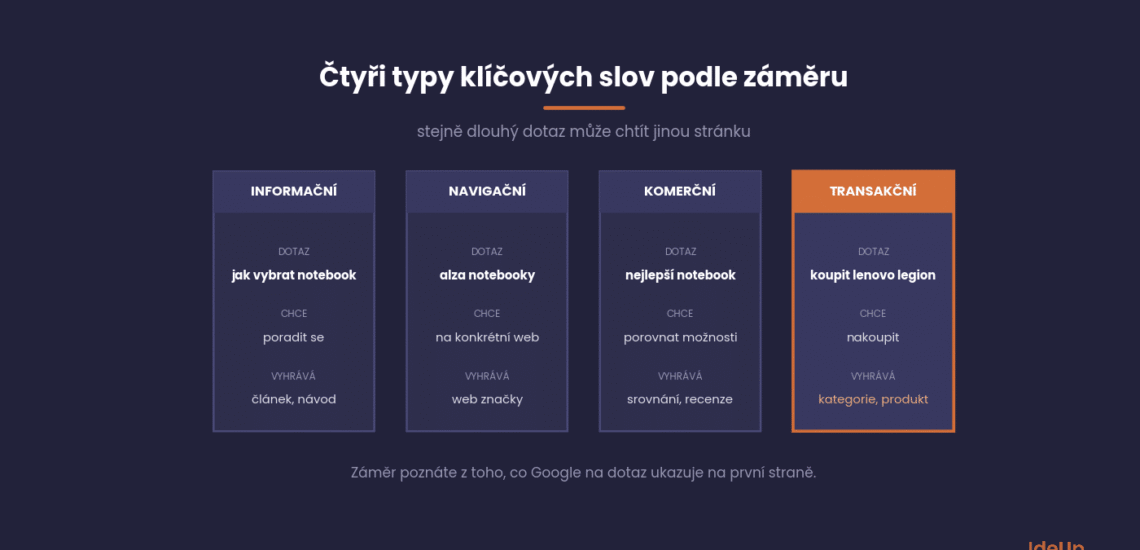
Length tells you how specific a query is. Intent tells you what the person wants to do. Intent matters more when choosing the right page, because two queries of the same length can call for completely different answers. Here is an example using keywords around laptops.
| Intent | Example query | What the person wants | Which page wins |
|---|---|---|---|
| Informational | how to choose a laptop | to understand, to learn | article, guide |
| Navigational | alza laptops | to reach a specific website | brand or shop page |
| Commercial | best laptop under 20,000 CZK (about 920 USD) | to compare options | comparison, review, category |
| Transactional | buy lenovo legion | to make a purchase | category, product |
Informational keywords bring people who are not buying yet but are looking for advice. For an online shop, they are a way to reach customers before the competition does. Transactional keywords bring fewer people, but they are ready to pay. The quickest way to identify intent is to type the query into Google and see what it shows. If the first page is full of online shops, an article will not break through, and vice versa. The four types of intent, with more examples, are covered in our article on search intent.
Where the keyword appears in the text
The target phrase belongs in the places that tell both readers and search engines what the page is about. You do not need to cram it into every paragraph.
- The page title, which appears in search results.
- The main H1 heading and the first paragraph, which answers the query straight away.
- Subheadings, which include variants and related questions.
- The URL, short and without diacritics.
- Image descriptions (alt text), when the image genuinely shows what it describes.
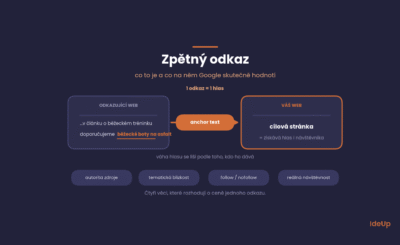
- The anchor text of links pointing to the page from elsewhere on the website.
- The meta description, which does not affect ranking but does affect whether people click.
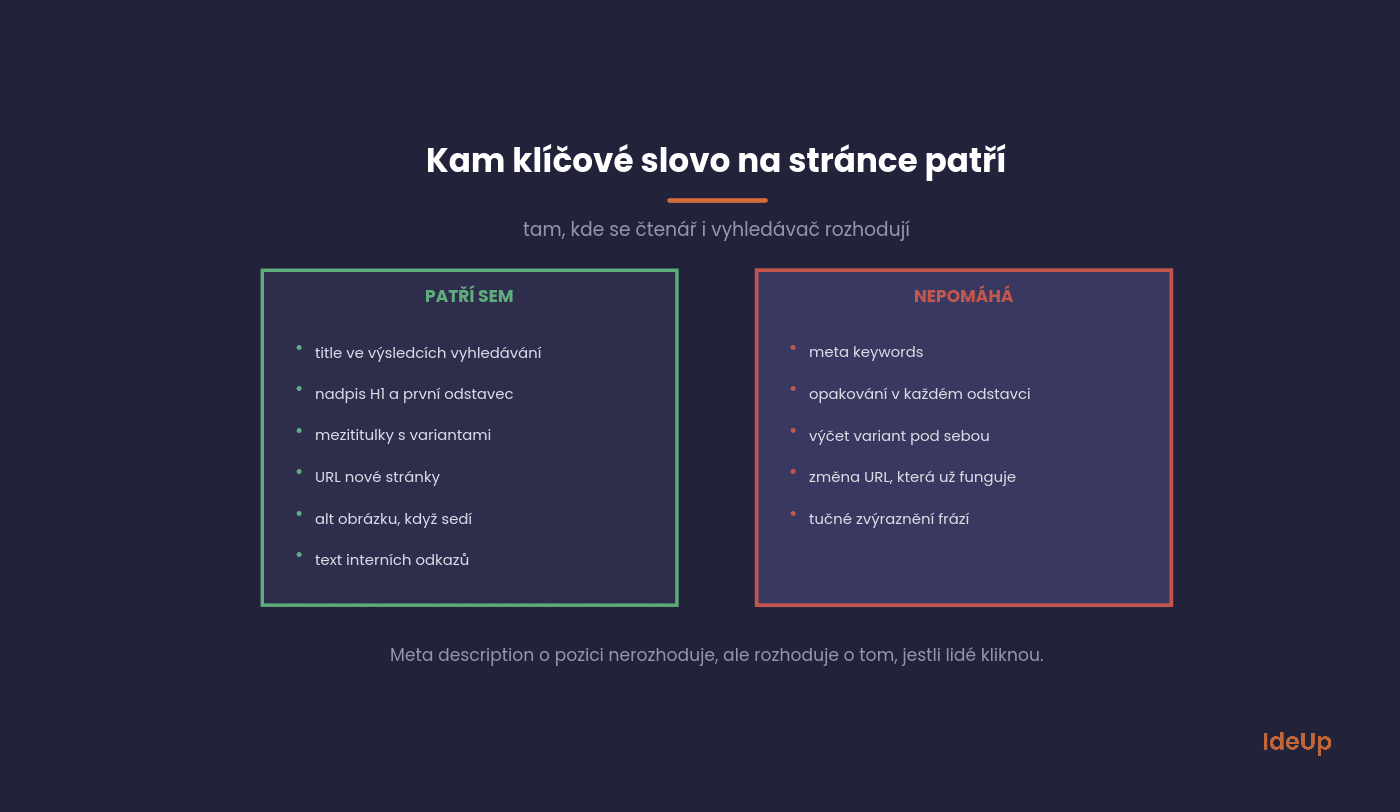
You do not need to put anything in the keywords meta tag, because Google ignores it. And be careful with URLs. When creating a page, the target phrase belongs in the URL, but do not change the address of a page that is already live and has links pointing to it just for that reason.
Each page should have one main keyword plus a group of secondary ones, meaning variants, synonyms and related questions with the same intent. The main keyword belongs in the title, H1 and introduction; the secondary ones go in subheadings and paragraphs. Spread keyword variants naturally through the text: a synonym in a subheading, a question in a section heading, an inflected form in a paragraph. The search engine will recognise them, and the text will not read like a list of phrases.
What is keyword optimisation, step by step
Keyword optimisation means adjusting a page so that it clearly matches one topic and answers it well. It is not about adding more phrases. It usually means rewriting a few key places and filling gaps in the content.
- Choose one main phrase for the page and check that no other page on your website covers the same intent.
- Look at the pages Google currently shows for it and note what they cover, such as definitions, prices or comparisons.
- Write a title and H1 that state the topic plainly.
- Answer the main question in the first paragraph.
- Turn variants and related questions into subheadings.
- Add what is missing, such as an example, a table or a short FAQ.
- Read the text aloud and remove any phrase that sounds forced.
The most common mistakes are trying to fit several unrelated phrases onto one page, changing the wording without improving the content, and copying the structure of competing pages without adding anything of your own.
Why intent matters today, not repetition
Today’s search engines understand language. Google knows that washing machine, washing machines and cheap washing machine are related, and it recognises that a query looking for a guide and a query looking to buy need different pages. So with keywords in SEO, it is not about how many times you repeat the exact phrase. It is about whether the page answers the query.
Repeating phrases actually does harm. In its spam policies (Google Search Central), Google lists repeating the same words so often that it sounds unnatural among prohibited practices. This is called keyword stuffing, and a page that does it risks dropping in the results.
What is keyword stuffing and what is a good keyword density
Keyword density is the number of times a phrase appears, divided by the total number of words and multiplied by 100. A phrase used 5 times in a 500-word text has a density of 1%.
Keyword stuffing is what happens when that number becomes the goal. Typical examples include:
- the same phrase in almost every sentence,
- lists of towns or product names with no context,
- text hidden in the same colour as the background,
- alt text filled with phrases that do not describe the image.
So what is a good keyword density? There is no number to aim for. Write the text for your reader first, then check it. If a phrase stands out when you read it aloud, or if you could replace it with a pronoun or a synonym without losing meaning, do so. A useful, natural text tends to end up with a low density without you having to count.
How to find keywords for your website
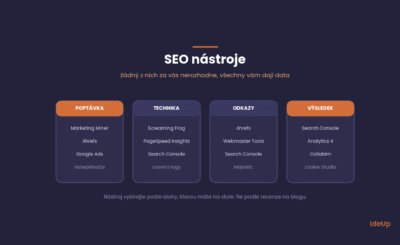
The quickest free way to see which keywords already bring your website impressions is Google Search Console. In the Performance report, on the Queries tab, you will see each query with its number of impressions, clicks and average position. Search Console will not show you other people’s websites; for that you need a paid tool such as Marketing Miner, Ahrefs or Collabim.
More ideas come from the autocomplete suggestions of Google and Seznam (the Czech search engine), searches on your own website and the search terms report from your ad campaigns. Without a running campaign, Keyword Planner in Google Ads shows search volume only as a range and merges similar forms, while the Keyword Suggestions tool (Návrh klíčových slov) in Sklik adds a view of searches on Seznam.
Finding keywords is not the end of the job, though. We describe step by step how to choose keywords that bring customers in our keyword research guide.
Where to start on your website
Open Search Console and look at which queries your main pages appear for. You will often find that a page written about one topic shows up for completely different queries, or that two of your pages are competing for the same queries. Sort the queries by impressions and, for the top twenty, check whether the page Google shows really answers them.
If you want to be sure that your website targets queries that will bring you customers, we will prepare keyword research for you, including a map of which page should target which queries.
Frequently asked questions about what a keyword is
What is a keyword in simple terms?
A keyword is a word or phrase that describes what a person is looking for, such as running shoes or how to choose a laptop. Website owners use keywords to decide which topic each page should cover. One keyword usually stands for many differently worded queries with the same meaning.
What is a long tail keyword?
A long tail keyword is a specific phrase that relatively few people look for, such as waterproof running shoes for beginners. It is usually longer, but what defines it is low demand, not the number of words. Because it is specific, it is often easier for a smaller website to appear for it.
What is a good keyword density?
There is no ideal keyword density, and Google has never published one. Use the main phrase where it naturally fits, such as the title, H1 and first paragraph, and use variants elsewhere. If the text reads naturally, the density is fine.
What is keyword stuffing?
Keyword stuffing means repeating a phrase so often that the text sounds unnatural, or adding phrases that do not belong to the content. Google treats it as spam. A page that does it can lose its position rather than gain one.
USD amounts are approximate, converted at the Czech National Bank rate of 21.75 CZK per USD on 9 October 2026.

Leave A Reply