Almost every SEO meeting sooner or later arrives at one question: “So how many backlinks do we actually have?” Someone opens a tool, a number appears on the screen and there is a moment of silence. Sometimes it is 84, sometimes 12,000. Then comes the more important question, which most companies cannot answer: what are we supposed to do with that number?
At IdeUp we approach it the other way round. First we explain what a link actually is and what Google really gives you for it. Only then do we look at the numbers. The number of backlinks is a metric that looks great in a report but almost never decides on its own whether you will be on the first page.
What a backlink is and why Google counts it as a vote
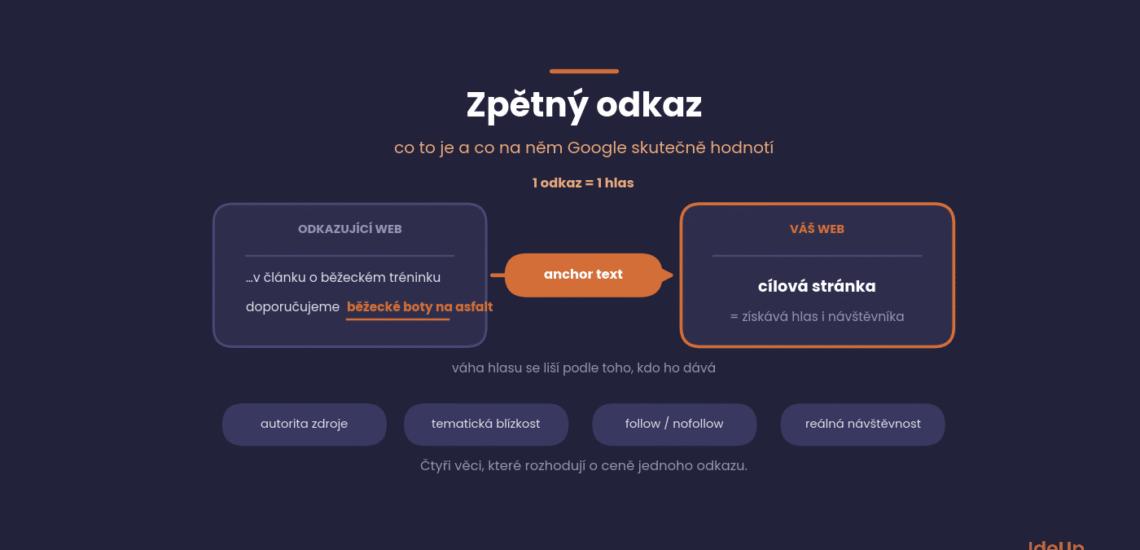
A backlink is a link that leads from someone else’s website to yours. Google has used backlinks as a signal of trust since its early days: when someone links to you, they are showing that your page deserves attention. Put simply, one link is one vote.
But votes do not carry the same weight. A vote from an industry magazine read by ten thousand people every day weighs differently from a vote from a directory where anyone can be listed for 200 CZK (about 9.2 USD). This is exactly where the whole discipline of link building is decided.
Google mainly assesses four things about a single link:
- The authority and trustworthiness of the source. Who is giving the link and what position they hold in the market.
- Topical relevance. A link from a home and living website to a furniture e-shop makes sense. The same link to a boat rental company does not.
- The link attribute. A standard follow link passes on strength, while nofollow and sponsored tell Google that the placement is paid or not vouched for.
- Context and anchor text. In other words, the text the link sits on and the paragraph around it.
A fifth factor, and the one most often forgotten: does anyone actually visit the linking page? A link from a page that nobody reads and that Google has not even indexed is wasted investment, whatever you pay for it.
How to find out the number of backlinks to your website
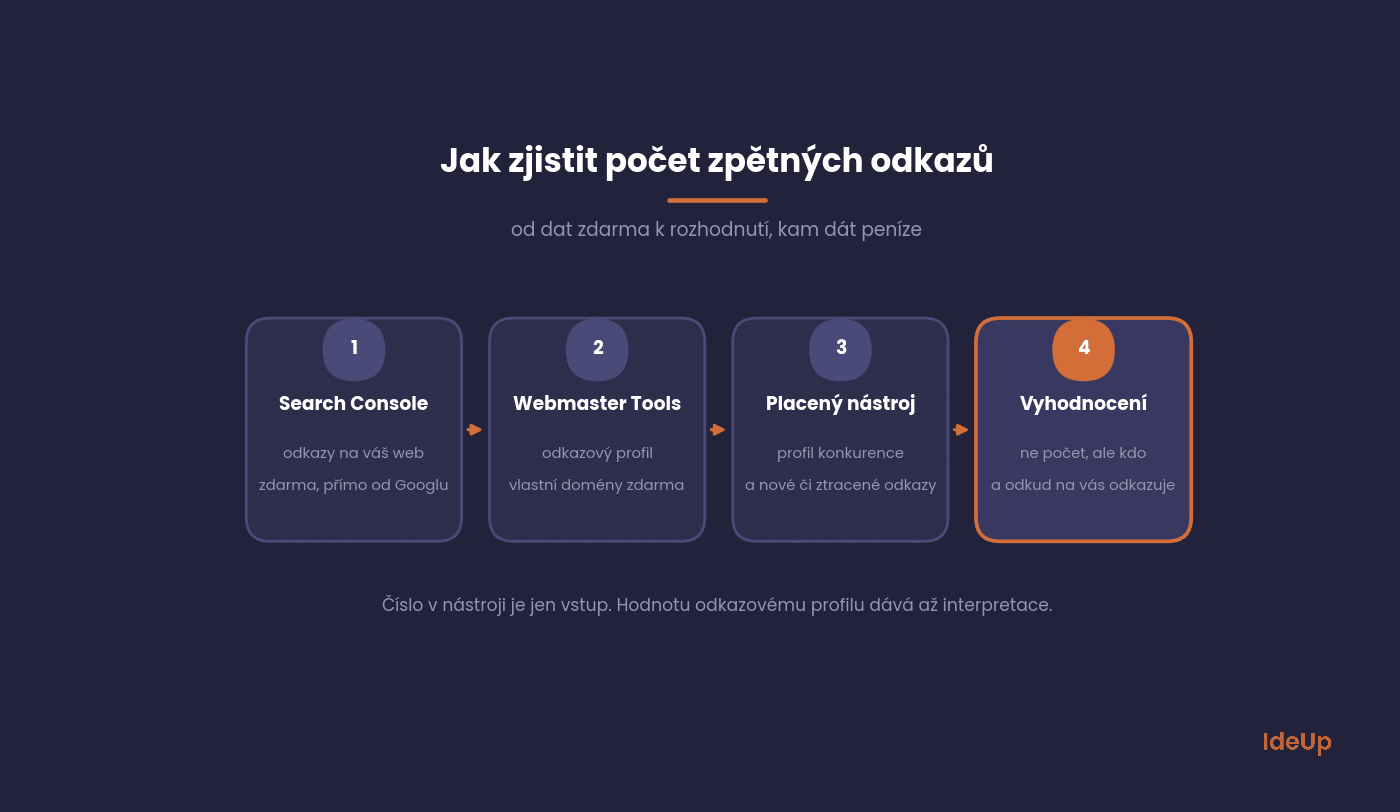
1. Google Search Console (free, straight from the source)
The Links section in Search Console is the only place where Google itself tells you something about your links. Here you will find the top linking domains, the most linked pages on your website and the most common anchor texts. The data is sampled and incomplete, but it has one huge advantage: it is not a third-party estimate.
If you have not set up Search Console yet, start there. Without it you are doing SEO blind, and that applies to everything else too, not just links.
2. Ahrefs Webmaster Tools (free for a verified website)
Ahrefs offers a free version for website owners. Once you verify ownership, you can see your domain’s link profile: the number of links, the number of linking domains, new and lost links, and the distribution of anchor texts. For most smaller companies this is a perfectly sufficient source of data.
3. A paid tool (when you need to look outwards)
For free, you find out what your own website has. Data about competitors costs money. Paid plans from Ahrefs, Semrush or the Czech tool Marketing Miner show you the link profile of any domain, so you can take your competitors apart piece by piece: where they get links from, which of their pages attract links and what has changed for them over the past year. We have a detailed overview of which tool to use for what in a separate article on SEO tools.
4. Evaluation (the step most companies skip)
This is where data becomes a brief. Take your three to five biggest competitors in the search results and compare them with yourself. You are not interested in the total number of links, but in:
- the number of linking domains (one domain that links to you a hundred times is still just one relationship),
- types of sources (media, industry websites, directories, blogs, PR),
- which pages competitors point links to (usually not the homepage, but categories and content),
- the pace at which links are added.
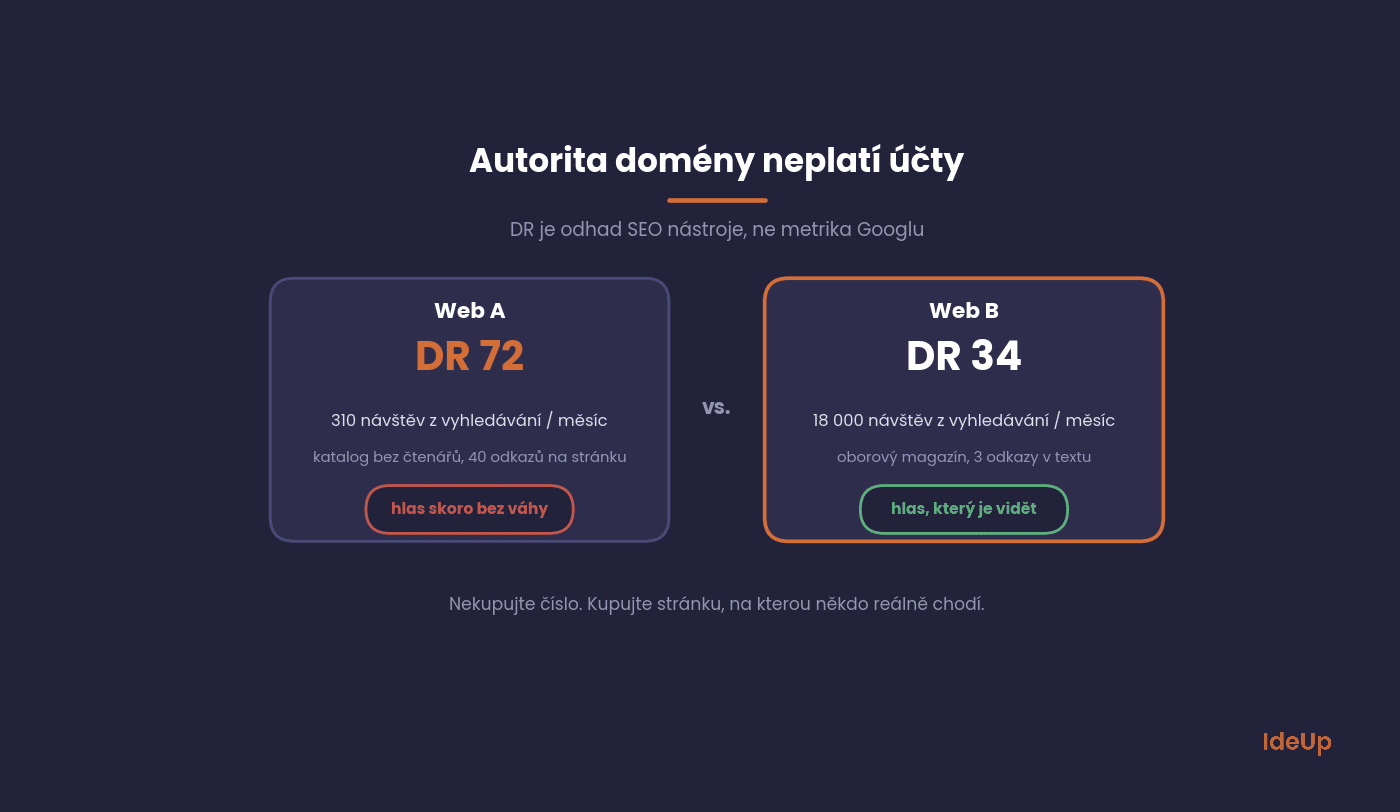
Domain authority is an estimate of a website’s strength on a scale of 0 to 100. In Ahrefs it is called Domain Rating (DR), in Moz Domain Authority (DA), and each tool calculates it in its own way. Now for the important part that adverts selling links do not mention: domain authority is not a Google metric. SEO tools invented it to squeeze the complex reality of the link graph into a single number that can be shown in a report.
It is usable as a quick guide. As a target it is misleading. Patrik Pilous, whom we work with on SEO projects, sums it up in his article on domain authority in one sentence worth remembering: a website with a DR of 70 and a page with no visits will give you less than a website with a DR of 35 and a page that people actually read.
In practice this means that for every link you are considering, you check two numbers at once: the domain’s DR and the organic traffic of the specific page where the link is to be placed. If the traffic is zero, the number next to it does not matter.
The exact formulas are not public, but the principle is the same in every tool. The tool crawls the web and builds its own index of links. It then looks at how many different domains link to a website and how strong those domains are. The result is converted into a score from 0 to 100.
Two properties are worth knowing. First, the scale is logarithmic, so moving from 20 to 30 is far easier than moving from 70 to 80. Second, the score is relative. When the tool expands its index or changes its model, your number can drop even though nothing changed on your website. A falling score is a reason to check your linking domains, not a reason to panic.
There is no universal good score. A local accountancy firm with a score of 25 can be the strongest website in its niche. An online magazine with a score of 50 may be the weakest among its peers. The useful benchmark is the websites you compete with for the same customers.
Compare your score with theirs in the same tool, never across tools. A DR from Ahrefs and a DA from Moz are not interchangeable, even though both use the same scale.
Why the number of links does not work as a KPI
If whoever had the highest number won, link building would be a purchasing discipline handled by the companies with the biggest budgets. It does not work like that, for several reasons.
First, the counts add up very different things. Ten thousand links from the footers of three templates are one technical accident, not ten thousand recommendations.
Second, the risk grows. A quickly bought profile with exact-match anchor texts is the easiest pattern of all to detect and leads to a penalty or to the links being quietly devalued.
Third, and this matters most today, the centre of gravity has shifted. What Google sums up under the abbreviation E-E-A-T is essentially a brand signal: experience, expertise, authoritativeness and trustworthiness. A link is just one way of demonstrating it. Unlinked mentions, direct searches for your brand and the context in which people talk about you all point the same way. In a world where answers are increasingly put together by artificial intelligence (the topic of GEO), this applies twice over: the model chooses whom to cite and reaches for sources it trusts.
What to track instead of the number
When we set up link building reporting for a client at IdeUp, the number of links is usually not in it at all. Instead, we track four things:
- The number of linking domains and how it develops over time. We are interested in the trend, not the current state.
- The share of topically relevant sources. What percentage of new links came from websites related to your field.
- The distribution of anchor texts. A healthy profile mixes branded, generic and descriptive anchors. If half the profile is an exact match for the main keyword, that is a problem, not a success.
- Links to commercial pages. You will almost always get links to your homepage. What is more interesting is whether links also point to categories and service pages, which is where the money is made.
There is also one technical safeguard: check that the linking page is actually indexed. An unindexed page will not pass on a link, however good it looks. Quick check: put the address into Google with the site: operator.
Domain authority rises as a side effect of earning links from websites that already have strength of their own. If you work on the causes, the score follows.
- Create content others want to cite. Original data, practical guides, calculators and templates attract links without you having to ask for each one.
- Reclaim unlinked mentions. Find articles that name your company without linking to it and ask the author to add the link.
- Fix broken links to your website. If other websites link to pages that no longer exist, redirect those addresses to the closest relevant page so the links count again.
- Build relationships in your field. Industry associations, partners, suppliers and trade media are natural sources of relevant links.
- Strengthen internal linking. It does not change the domain score, but it spreads the strength of the links you already have to the pages that need it.
What does not work in the long run is bulk link exchanges, private blog networks and paid links without the correct attribute. They can push the number up quickly and then expose you to the risks described above.
A higher score does not move you up in Google by itself, because Google does not use it. The two tend to move together because both reflect the same thing underneath, the quality of the links pointing to you. That is why a website with a lower score can outrank one with a higher score when its page answers the question better and has relevant links pointing straight to it. Treat the score as a thermometer, not as the heating.
The most common mistakes we see with clients
- Buying “100 links for 5,000 CZK (about 230 USD)” packages. They are cheap because they have no value.
- Chasing DR. The number can be inflated. Page traffic cannot.
- All links pointing to the homepage. The money then has no way to flow through to the pages that earn it.
- Link building without a proper website. Links amplify what you already have. If you have weak on-page factors and thin content, you amplify the weakness.
- Measuring after a month. The effect of a link shows over months, not weeks. Anyone evaluating after thirty days is evaluating noise.
How to turn numbers into a brief
A practical process we use at the start of a collaboration, which you can also do yourself:
- Download your own link profile and those of three competitors.
- Compare the number of linking domains, not links.
- List the domains that link to two or more competitors but not to you. This is your first list of targets.
- For each target, check the page’s traffic and whether it is indexed.
- Set a realistic pace, for example five to ten new domains a month, and keep it up for a year.
The questions we get asked most often
Five questions about links that we hear most often.
How many backlinks do I need to be on the first page?
There is no set number. There is only the gap between you and your competitors in specific search results. In some cases fifteen quality domains are enough, in others you need two hundred. Look for the answer in the profiles of those ranking above you, not in general advice.
How can I find out how many backlinks my competitors have?
Free tools only show your own website. For other domains you need a paid tool (Ahrefs, Semrush, Marketing Miner). There are also free checkers limited to a few queries a day, which are enough for a one-off check.
No. Google does not publish any public domain authority score. DR, DA and similar metrics are estimates by SEO tools based on their own link data.
Are directory links worthwhile?
Mostly only minimally. An industry directory that people actually use makes sense. A directory set up to sell links does not. What counts is traffic, not existence.
Can a link harm me?
Google typically ignores a single bad link. The problem is a pattern: hundreds of links from the same type of source, with identical anchors and at a suspicious pace. That is when you risk losing rankings.
What to do next
The number of backlinks is an input, not a result. It becomes useful when you compare it with your competitors, break it down by domain and source type, and turn it into a decision about where to spend your money.
This is exactly the work we do at IdeUp as part of link building and broader search engine optimisation. If you first want to get clear on where you actually stand, start with SEO consulting. We will analyse your link profile against your competitors, and you will leave with a list of targets, not a number.
It is a score from 0 to 100 that estimates how strong a website’s link profile is compared with other websites. Moz calls it Domain Authority and Ahrefs calls it Domain Rating. Each tool calculates it from its own link data, so the numbers differ between tools.
A good score is one that is higher than the scores of the websites you compete with, not a specific number. Compare yourself with three to five direct competitors in the same tool. The gap between you tells you more than the absolute value.
There is no safe shortcut. The score grows as you earn links from relevant domains over months. Very fast increases usually come from bought or manipulative links, which can raise the number while harming the website.
Not directly, because Google does not use scores from third-party tools. The score often correlates with rankings because both depend on links. The relevance of your page and the quality of the links to that specific page matter more.
USD amounts are approximate, converted at the Czech National Bank rate of 21.75 CZK per USD on 9 October 2026.