The marketing mix is taught at every school, and in practice almost nobody uses it. The four Ps get recited in the exam and then forgotten.
That’s a shame, because as a checklist it is still one of the most useful tools there is. It reveals when marketing is pushing a product that has the wrong price or that cannot be bought anywhere.
This article shows how to use the four Ps as a practical check, where their limits lie and which parts of the extended models are worth using.
The four Ps as a checklist
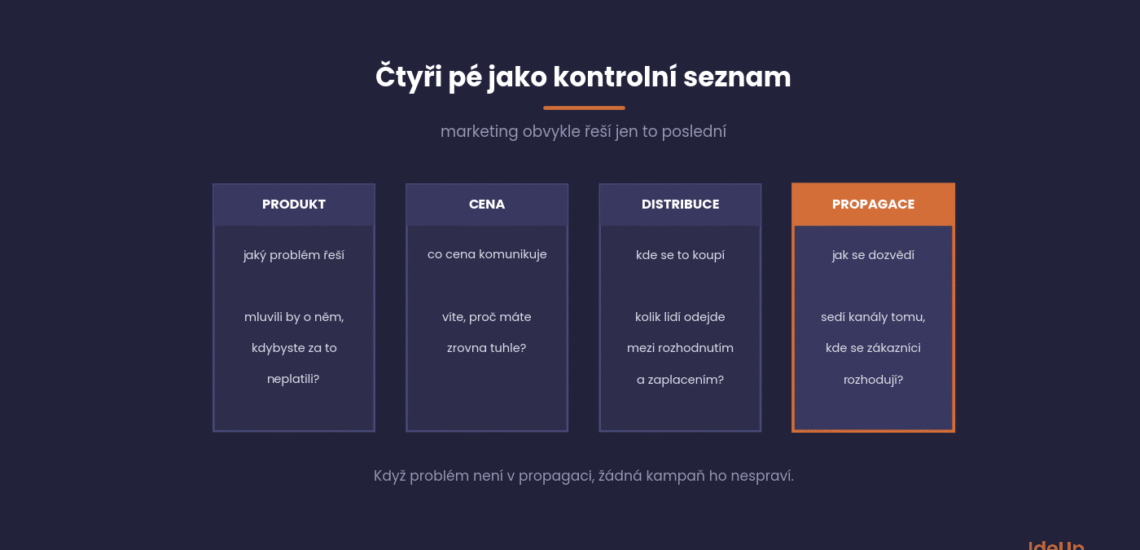
The original model has four components: product, price, place and promotion. In most companies, marketing usually deals only with the last one.
That is exactly why the model is useful. It shows that the problem you are trying to solve with a campaign may lie elsewhere.
Product
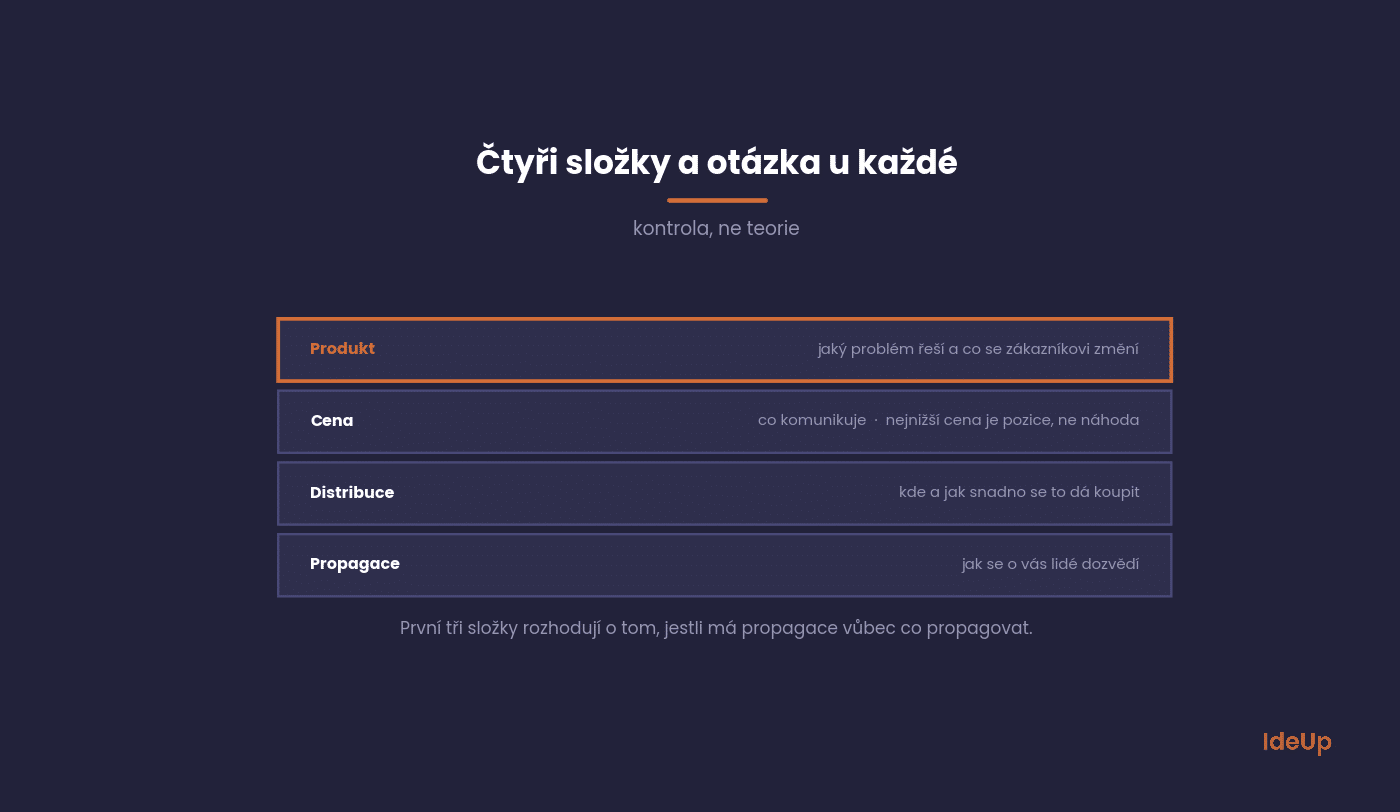
What you actually sell and what problem it solves. Not in terms of features, but in terms of what changes for the customer.
The check question is whether people would talk about the product even if you didn’t pay them to. If not, marketing will always cost more than it needs to.
Price
Not just how much it costs, but what the price communicates. The lowest price on the market is a position, not an accident, and it has consequences for everything else.
The check question is whether you know why your price is what it is. If the answer is “based on the competition”, you don’t have a pricing strategy.
Place
Where and how people can buy it. For an online shop, this also covers how easy the purchase is and which payment methods are available.
The check question is how many people drop off between deciding and paying. This is a topic we cover under conversion rate.
For most companies today, place mainly means the website. How easy it is to buy or send an enquiry through it is something we deal with under websites.
Promotion
How people find out about you. This is where most of what companies call marketing happens.
The check question is whether your channels match where your customers make their decisions. We describe how to find this out under target audience.
Marketing mix definition and why the elements depend on each other
The marketing mix is the set of decisions you make about what you sell, how much you charge, where customers can buy it and how they hear about it. Neil Borden popularised the term, and E. Jerome McCarthy grouped the decisions into the four Ps. In plain terms, it is the combination of levers you control when you bring an offer to market.
The word mix matters more than the list. The elements only work when they tell the same story. A premium price paired with constant discount promotion sends mixed signals, and so does a specialist product sold where nobody looks for it. Customers notice the mismatch even if they can’t name it.
A simple example
Imagine a small software company selling a planning tool to finance teams. The product saves them several hours at every month-end. A price of around $50 per user a month positions it as a professional tool rather than a cheap app. Place means a website with a free trial and the option to talk to someone in sales. Promotion means appearing where finance managers already spend their time. Drop the price to $5 and the other three elements stop making sense.
Where the model falls short
The four Ps date from a time when mostly physical goods were sold through retailers. They don’t fit services and digital products very well.
There are three limitations worth knowing before you use the model as your only guide.
An American overview by HubSpot adds that today the model is used more as a decision-making framework than as a description of what a company has set up.
It takes the company’s point of view. It describes what the company sets up, not what the customer experiences. That is why models emerged that turn this around.
It doesn’t cover services. With services, what matters is who delivers them and what the process looks like. A physical product doesn’t have this problem.
It doesn’t capture the brand. What people think of a company doesn’t fit into the four components. We discuss this under brand building.
For a more detailed analysis of the individual components, see Patrik Pilous’s article on the marketing mix, which goes into more depth on each of them.
The 4 Ps of the marketing mix seen from the customer’s side
The best-known model that turns the company’s view around is the four Cs, proposed by Robert Lauterborn. Each C mirrors one of the Ps.
- Product becomes customer needs. What problem the customer wants solved, not what you have built.
- Price becomes cost. Everything the customer gives up, including time, effort and the risk of switching.
- Place becomes convenience. How easy it is to buy, not where you have chosen to sell.
- Promotion becomes communication. A conversation in both directions rather than a message pushed out.
You don’t need to choose between the two. Asking each check question twice, once from your side and once from the customer’s, often reveals the gap faster than either model alone.
What to use from the extended models
The extended model adds three more components for services. In practice, two of them are mainly worth attention.
The rest is an academic addition that won’t change any decision.
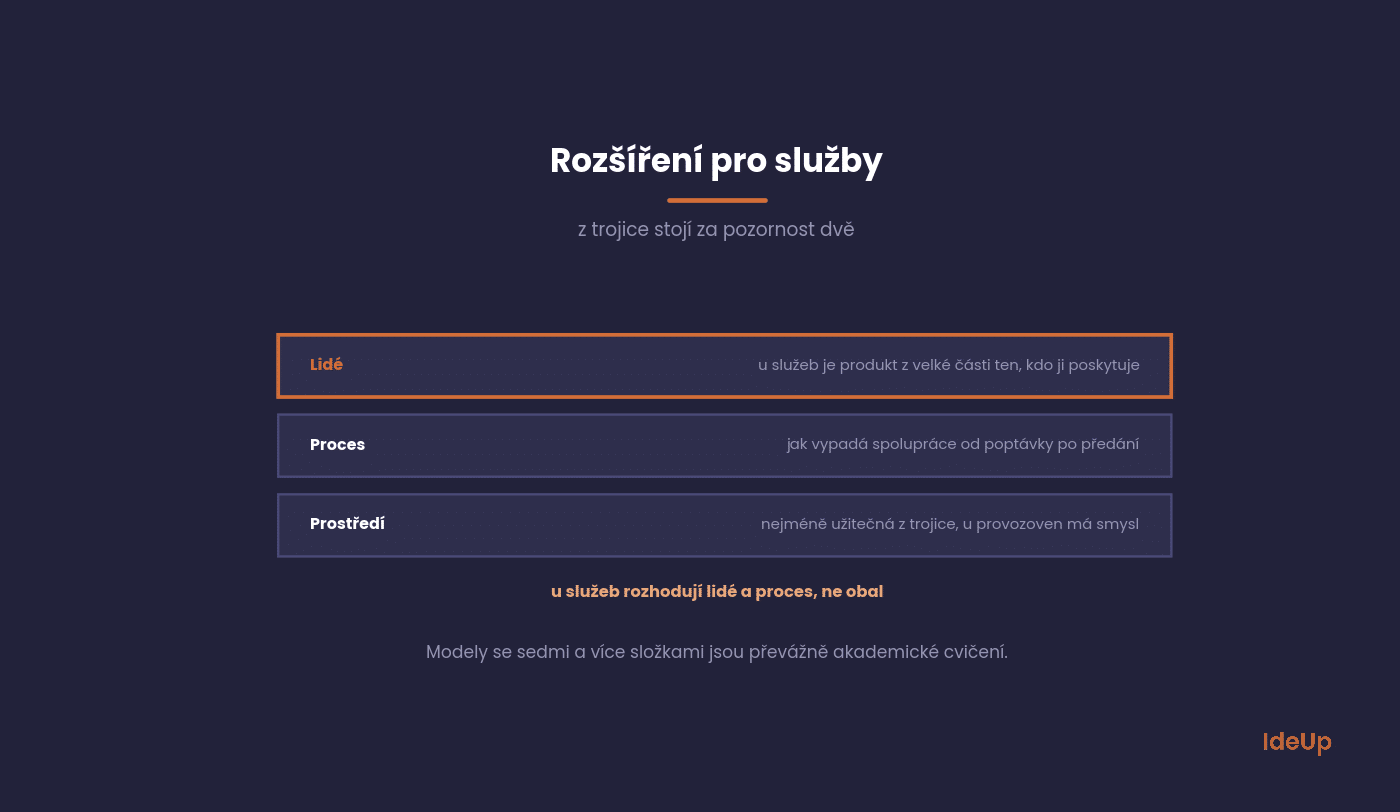
People. With services, the product is largely the person who delivers it. Who talks to the client and how has more influence on the result than any campaign.
Process. What the collaboration looks like from enquiry to handover. With services, the process is part of what the customer is buying.
Physical evidence. The physical or digital environment in which the service takes place. The least useful of the three, but it makes sense for physical premises.
How to use the model in practice
The best use is not writing a document about the marketing mix. It is using it as a half-hour check when something isn’t working.
The process is simple and can be done in a meeting.
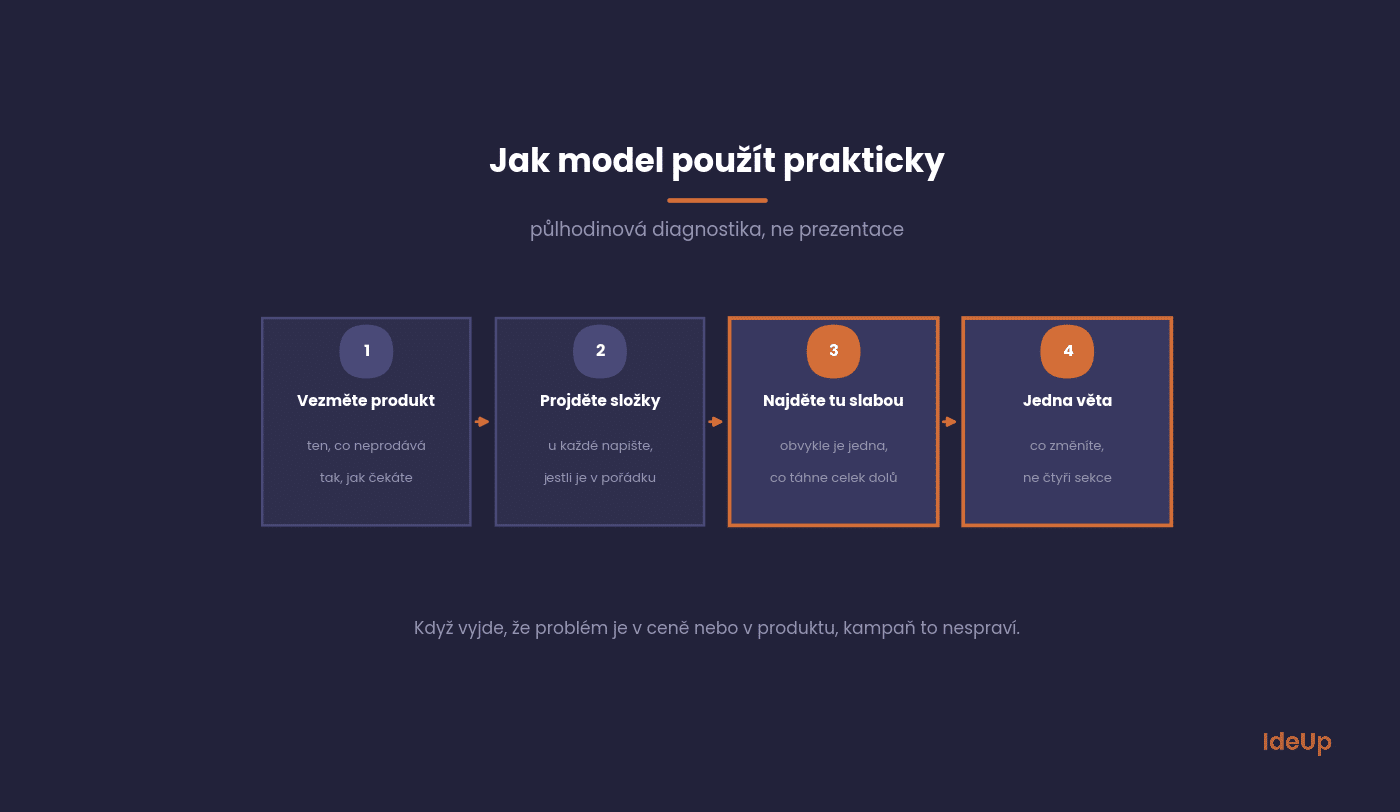
Take a specific product or service that isn’t selling as well as you expect. Go through all four components and note for each one whether it is in order.
For any component that isn’t in order, ask why. You will usually find one that is dragging the whole thing down.
If it turns out the problem is the price or the product, no campaign will fix it. This is the main benefit of the whole exercise.
The output should be one sentence about what you will change. Not a presentation with four sections.
From marketing mix analysis to a marketing mix strategy
The half-hour check tells you what is wrong. A strategy decides how all the elements should look together for a given group of customers. These steps connect the two.
- Pick one customer group and one offer. A single mix for everything you sell rarely works.
- Decide your position first. Are you the cheapest, the most convenient or the most specialised option? The answer shapes every element.
- Set the elements in order. Start with product and price, then place, and leave promotion until last.
- Read the answers side by side. If one element would surprise a customer who knows the other three, adjust it.
- Attach a measure to each element. Margin for price or drop-off before payment for place, so you can tell whether a change worked.
Different offers usually need different mixes. A company that sells both equipment and installation often needs two, with people and process mattering mainly in the second.
The most common mistakes in using it
The model can also be used badly, and then nothing comes of it.
Three mistakes come up most often.
Filling it in for the sake of it. If the four Ps are written up in a presentation and nothing gets decided, it was a waste of time.
Only addressing promotion. The most common case. The company goes through the model and still ends up spending more on advertising.
Working without numbers. Claiming that the price is fine needs evidence. Margins, comparison with competitors, customer reactions.
Questions that come up about the mix
The five questions we get most often, mainly from smaller companies.
The answers apply in general.
Is the marketing mix still relevant?
As a checklist, yes. As a model on which to build an entire strategy, no.
For strategy, it is better to start with the questions we describe under marketing strategy. The mix then serves as a check.
How many Ps should there be?
Four are enough for most companies. For services, add people and process; for everyone else, it only complicates things.
Models with seven or more components are mostly an academic exercise.
Who in the company should handle it?
The owner or managing director together with sales. Marketing alone cannot make decisions about the product or the price.
Incidentally, that is why companies don’t use the model. It goes beyond the remit of the marketing department.
How often should you go through it?
Once a year, and then whenever something stops working. It is not a tool for monthly planning.
It is also useful to go through it before launching a new product.
Indirectly. When the first three components are in order, you need less money for promotion.
Companies with a good product and a sensible price have cheaper marketing. That is no accident.
Where to start in your company
Take a product that is selling worse than you expect and go through all four components for it. Half an hour is enough.
When you come across a component you can’t back up with numbers, you have your first task. It is almost never promotion.
Want to go through it with someone who will ask awkward questions? Take a look at our Services or get in touch via our Contact page.
Frequently asked questions about the marketing mix
What is the marketing mix in simple terms?
It is the combination of decisions you control when bringing an offer to market. These cover the product, its price, where it can be bought and how people learn about it. The aim is for all of them to support the same position.
What are the marketing mix elements?
The classic elements are the four Ps: product, price, place and promotion. For services, the extended model adds people, process and physical evidence. Most companies get the most value from the original four plus people and process where services are involved.
What is a marketing mix strategy?
It is a deliberate plan for how each element should be set for a specific customer group and offer. It starts with a clear position and then adjusts product, price, place and promotion so they reinforce each other. Without that shared position, the elements tend to pull in different directions.
How do you do a marketing mix analysis?
Take one offer and describe each element as it is today, backed by numbers where possible. Then check whether each element supports the position you want and whether the elements are consistent with each other. The result should be a short list of concrete changes, usually starting with the weakest element.