
D2C stands for direct to consumer, meaning selling straight to the end customer without an intermediary. The manufacturer keeps the whole margin and gets the customer data, but has to handle sales, delivery, advertising and complaints on its own.
Most often this means the brand’s own online shop, its own store or a subscription. A Czech example is the footwear brand Vasky, which sells through its online shop and its own stores.
For a manufacturer that currently sells through retailers, the key question is whether selling direct will pay off. The answer depends mainly on how often customers come back, because repeat purchases are what pay for the work a retailer does for you today.
D2C, B2C, B2B and marketplaces, what is the difference
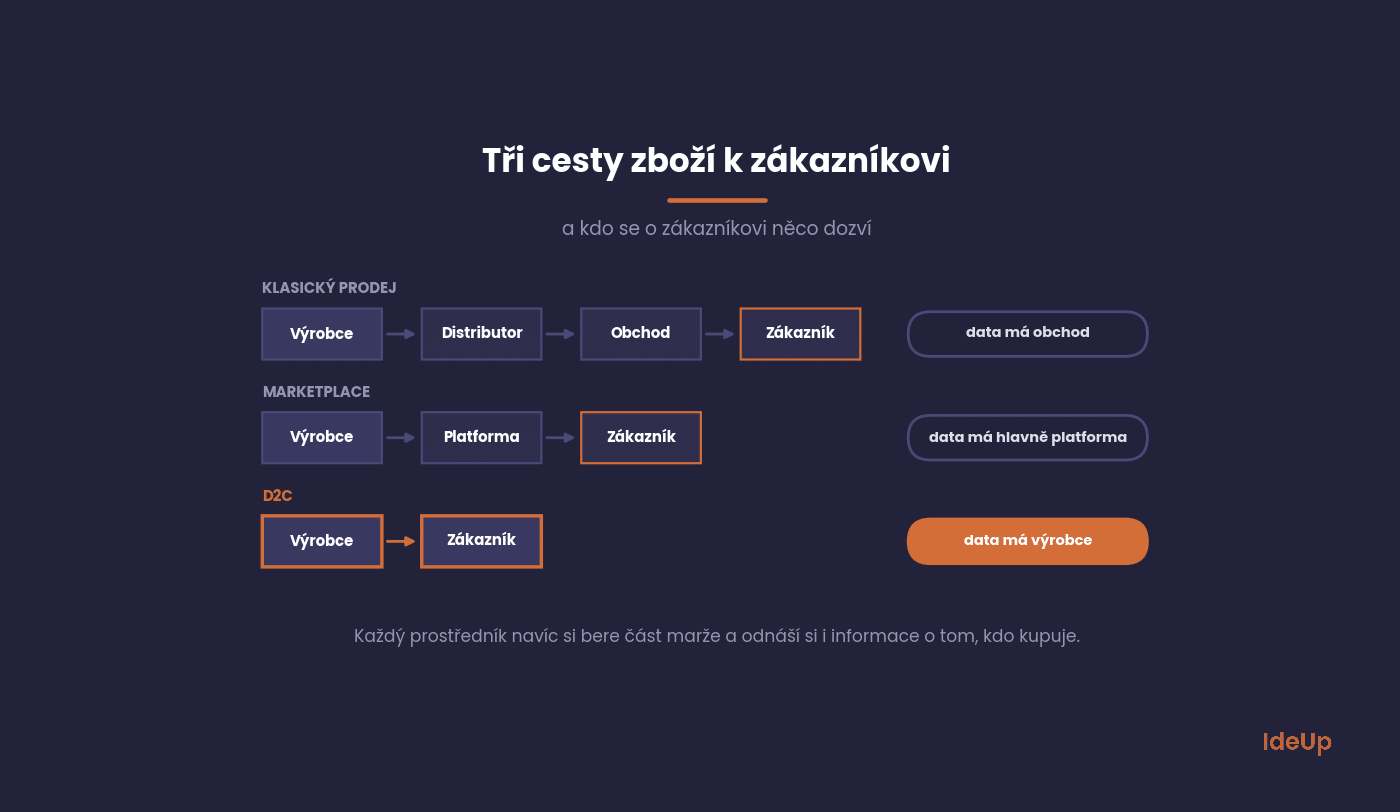
Every D2C sale is also B2C, meaning a sale to a consumer. The difference is who sells. In standard B2C it is a retailer that has bought the goods, in D2C it is the company that made or designed them.
Whoever sells to the customer knows their name, email address and purchase history. A manufacturer selling through a retailer only knows how many units the retailer ordered. It also has no say in how its products are presented, what they sell for or what service the customer receives.
| Model | Who sells to the customer | Who owns the customer data | Example |
|---|---|---|---|
| D2C | the manufacturer itself | the manufacturer | the brand’s online shop |
| B2C through a retailer | an online shop or a retail chain | the retailer | a brand on a drugstore shelf |
| Marketplace | the manufacturer under its own name on a third-party platform | mainly the platform | selling through Allegro or Alza |
| B2B | the manufacturer or a distributor | the seller | supplies to other businesses |
A marketplace is halfway between the two. You sell yourself and set your own price, but the platform takes a commission and sets the rules. The customer stays mainly the platform’s, and large marketplaces usually ban sending marketing messages to buyers. You can test demand there, but you will not build your own brand on it.
How much the manufacturer keeps from one order
The main argument made for D2C is a higher margin. On paper this is true, because you no longer leave the retailer its share. But you take over the retailer’s work, and every part of it costs money.
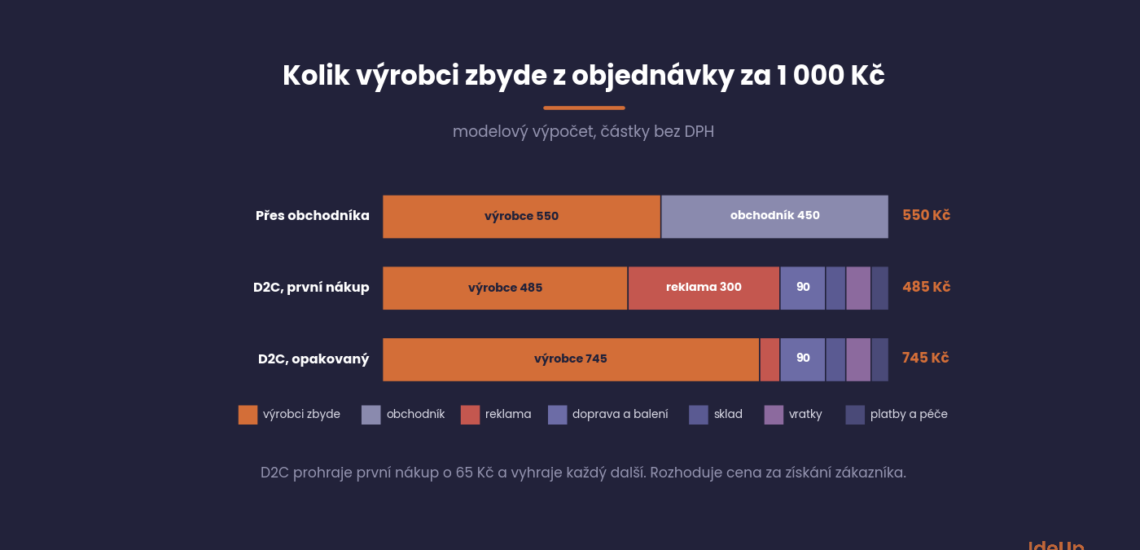
Let us show this with a model. A product sells for 1,000 CZK (about 46 USD) excluding VAT. In the model, the retailer keeps 450 CZK (about 21 USD) and the manufacturer is left with 550 CZK (about 25 USD). In D2C, the manufacturer receives the full 1,000 CZK (about 46 USD) but pays for advertising, delivery, warehousing, returns and payments.
| Item in CZK excluding VAT | Through a retailer | D2C, first purchase | D2C, repeat purchase |
|---|---|---|---|
| Product price | 1 000 | 1 000 | 1 000 |
| Retailer’s margin and costs | 450 | 0 | 0 |
| Customer acquisition (advertising) | 0 | 300 | 40 |
| Delivery and packaging | 0 | 90 | 90 |
| Warehousing and dispatch | 0 | 40 | 40 |
| Average returns and complaints | 0 | 50 | 50 |
| Payments and customer service | 0 | 35 | 35 |
| Manufacturer keeps | 550 | 485 | 745 |
From the first order in D2C, the manufacturer keeps 485 CZK (about 22 USD), which is 65 CZK (about 3 USD) less than through a retailer. The difference comes from the cost of acquiring the customer, 300 CZK (about 14 USD) in the model. On a repeat purchase, where advertising costs 40 CZK (about 1.8 USD), the manufacturer keeps 745 CZK (about 34 USD).
The model is simplified and the figures are assumptions for illustration. With a retailer, you also bear the cost of delivery to its warehouse, bonuses and long payment terms, while in D2C you pay for running the online shop and the people who operate it. Plug in your own figures, the principle stays the same.
Why repeat purchases decide D2C
D2C stands or falls on how many times the customer comes back. You pay for advertising mainly for the first purchase, and every further one is much cheaper.
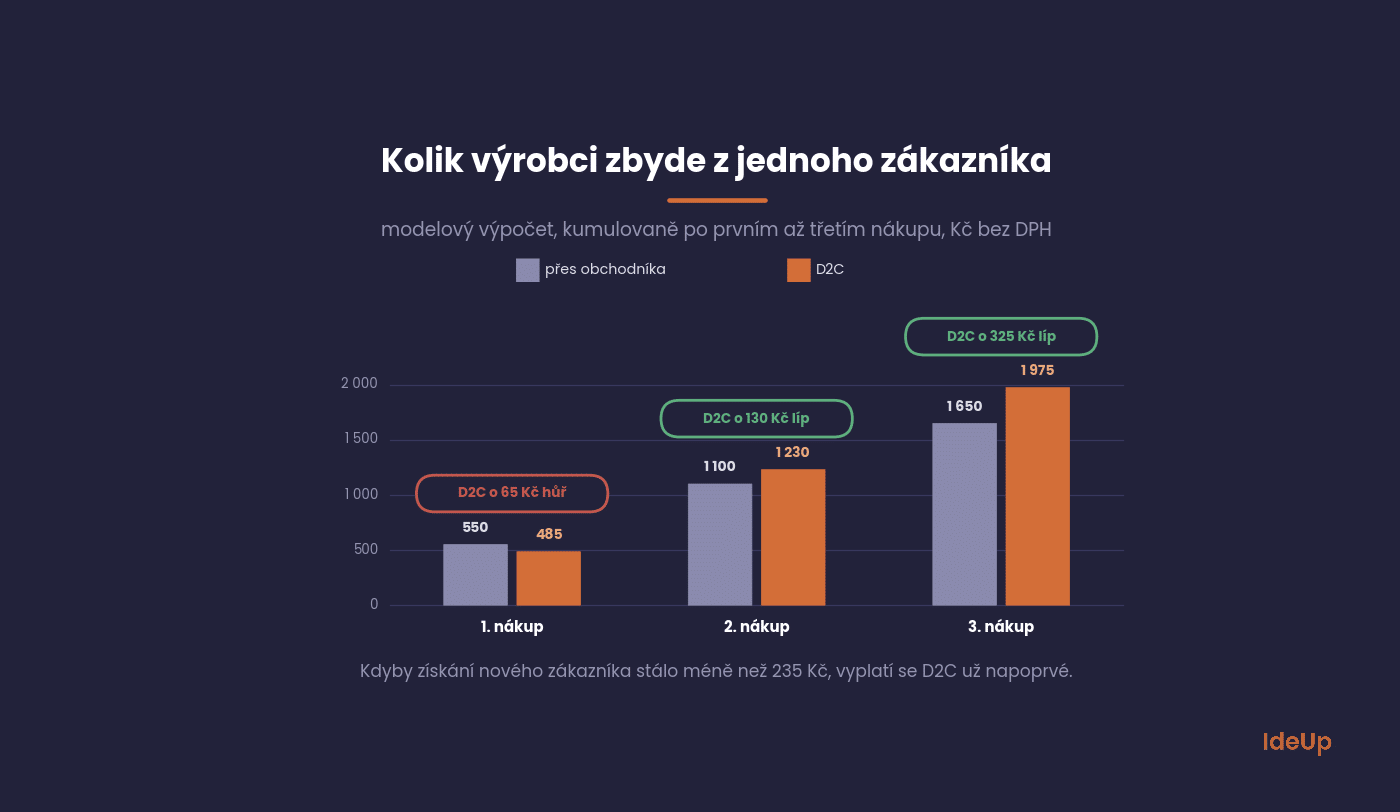
The threshold at which D2C pays off from the very first purchase is 235 CZK (about 11 USD) per acquired customer in the model. If a new customer costs you less than that, D2C earns you more than a retailer from the first purchase. Work out this figure first, before you put any money into your own online shop.
That is why D2C suits products people buy again, such as cosmetics, coffee, food supplements or pet food. With a washing machine, which people buy once every many years, the cost of acquiring the customer has no chance to pay back. We explain how to calculate customer acquisition cost and customer lifetime value in our article on performance marketing for online shops.
Marketing in D2C therefore revolves mainly around getting people to come back. The cheapest way to do this is email marketing, because you write to people who gave you their address themselves, and you do not pay for every impression. This is where D2C has a real advantage over a retailer: the customer’s contact details belong to you.
What a retailer does for you today
When you sell through a retailer, the retailer deals with the customer. In D2C, the whole operation moves to you, from packing and carriers to questions and complaints. Instead of a pallet to a single warehouse, you send lots of small parcels, and you have to receive, inspect and restock returned items. Plan for this before you plan for advertising.
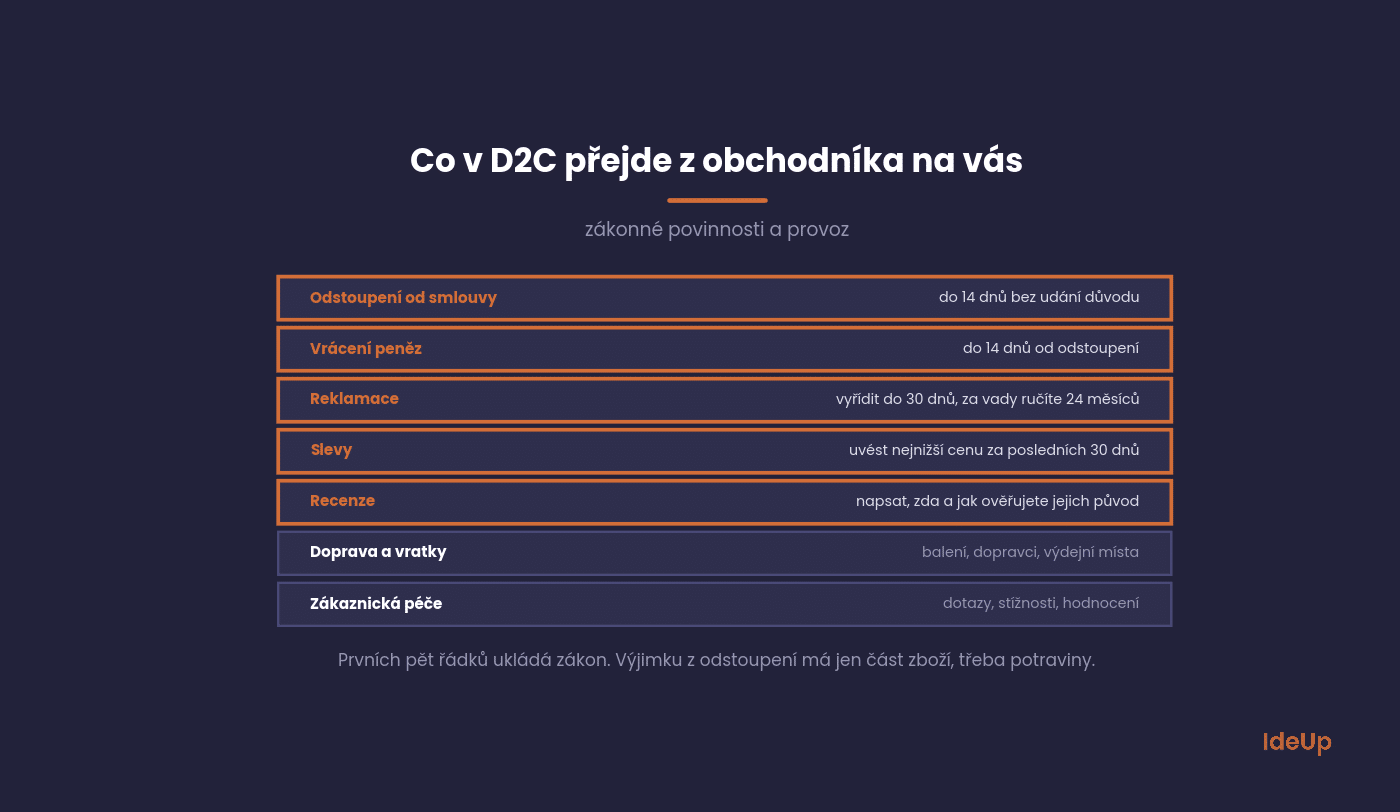
When you sell to consumers at a distance, you also take on legal obligations. The customer can withdraw from the contract within 14 days without giving a reason, and you must refund them within 14 days. Only some goods are exempt, such as perishable food or hygiene products the customer has unsealed.
You must settle a complaint within 30 days, and you are liable for defects that appear within 24 months. For discounts, you must state the lowest price in the previous 30 days, and for reviews, you must say whether and how you check that they were written by real customers. Compliance is monitored by the Czech Trade Inspection Authority (Česká obchodní inspekce).
When you also sell through retailers
Companies that already sell through retailers usually do not want to lose them, so they launch their own online shop alongside them. This creates a conflict. The retailer suddenly competes with its own supplier, which gets the goods at a better price than it does.
Nike shows that this can be taken too far. For several years it cut back on selling through retailers in favour of its own online shop and stores. Elliott Hill, who has led the company since 2024, admitted shortly after taking over that some retail partners felt pushed aside, and he is now rebuilding those relationships.
Retail Dive covered this in detail. A smaller manufacturer does not have Nike’s bargaining power, so it has to think about the conflict before retailers start delisting its products. Four rules reduce the risk.
- Do not undercut your retailers. Your own online shop should charge the same price as they do.
- Give your online shop something extra. The full range, early access to new products, bundles or subscriptions that retailers do not offer.
- Watch your brand advertising. When you and your retailers bid on the same search for your name, you push up each other’s cost per click. But do not ban them from it in your contracts, as EU competition law treats such a ban as a restriction of competition.
- Share what you learn. Offer your retailers insight into what people search for on your online shop and why they return products. They will then see your shop more as a help.
When to try D2C and how to start
D2C makes sense when the product is bought repeatedly, can absorb the cost of delivery, and the brand has something to say to people even without a shelf in a shop. If two of these three conditions are missing, we recommend staying with retailers and putting the money into supporting them.
Start with a small test. Launch an online shop for one product line aimed at people who already know you, and measure customer acquisition cost and the share of repeat purchases for three months. Only with those figures can you decide whether to expand D2C.
Search offers a cheaper route to customers than paid advertising. People searching for your brand or your type of product are customers you do not have to pay for on every visit. We can help you with SEO for your own online shop so that your D2C does not rely on advertising alone.
USD amounts are approximate, converted at the Czech National Bank rate of 21.75 CZK per USD on 9 October 2026.


Leave A Reply