Influencer collaboration is one of the few disciplines where companies still pay for reach. A company pays for 300,000 followers and gets four orders.
It is not that influencer marketing does not work. It is that influencers are chosen by a number that says almost nothing about the result.
This article explains how to choose an influencer, how to set up a collaboration so that it can be evaluated, and when not to do it at all.
Why follower count is misleading
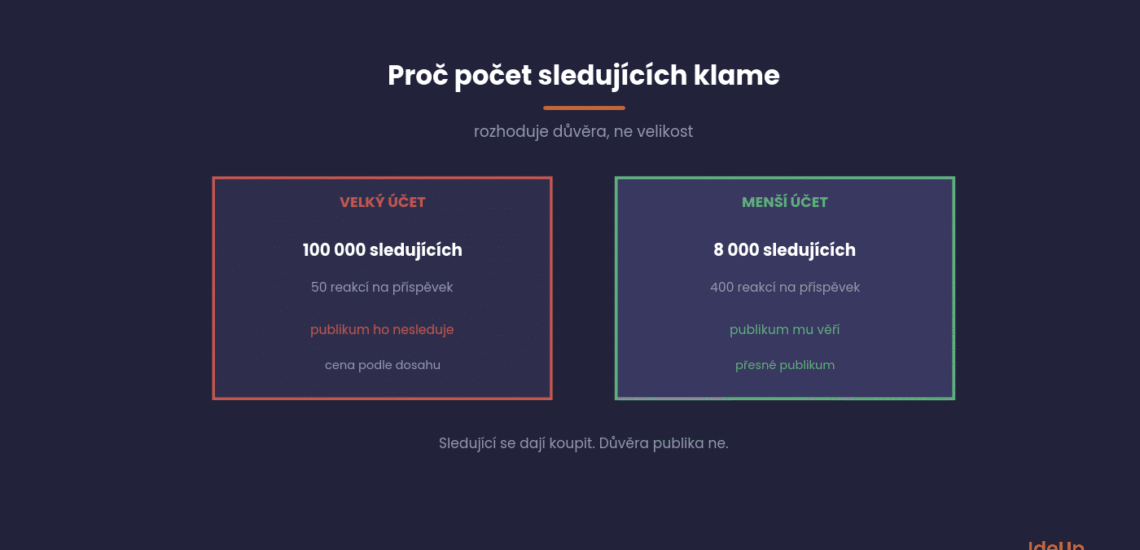
Followers can be bought, gained through competitions or collected with content unrelated to your field. None of these will bring you customers.
What matters is whether the audience trusts the influencer and whether your customers are actually part of it.
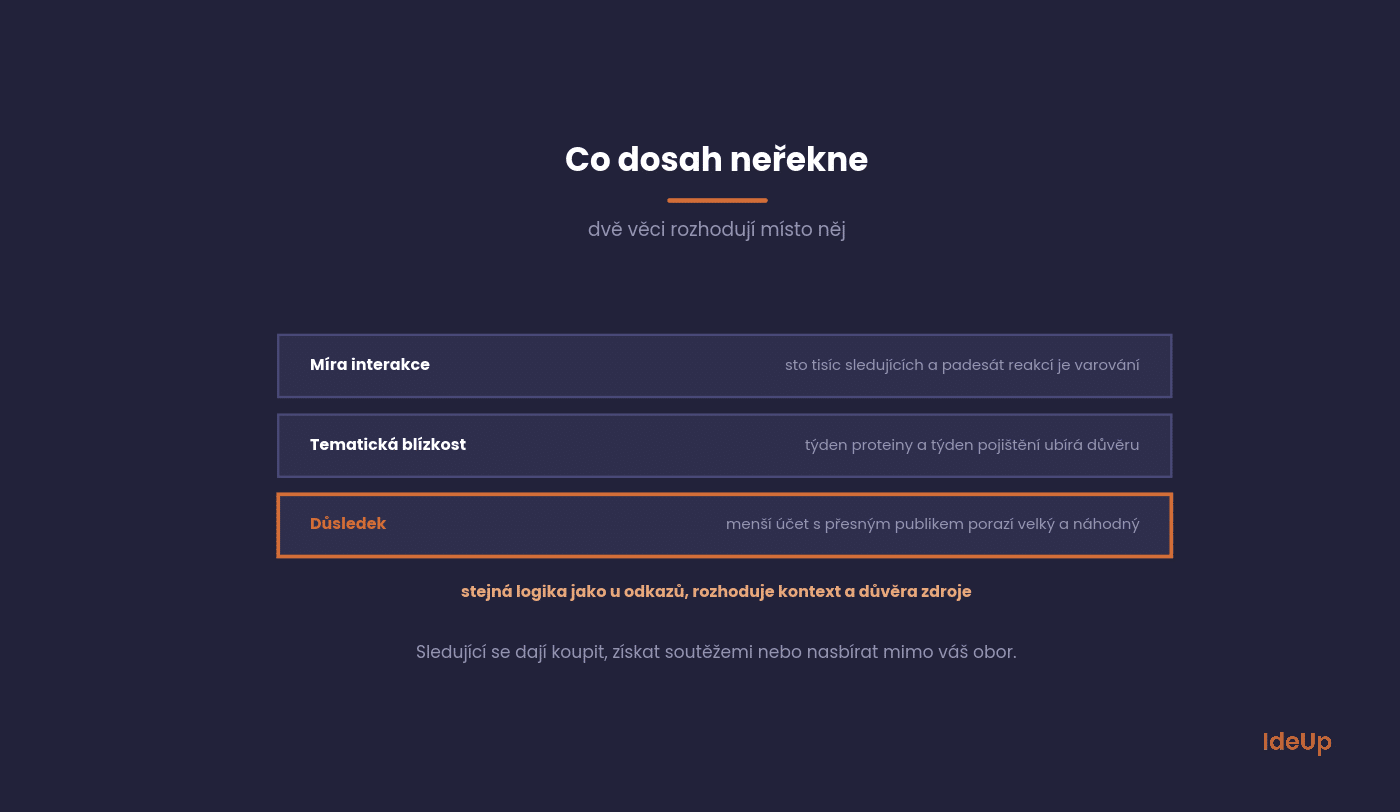
In practice, you can tell by the engagement rate. An account with 100,000 followers and fifty reactions per post has an audience that does not follow it.
The second thing is topical relevance. An influencer who promotes protein one week and insurance the next has lost credibility for both.
It is the same logic as with links. Context and the trust of the source matter, not the size of the number. We cover this in backlinks and domain authority.
What influencer marketing is and how it works
Influencer marketing is a form of marketing in which you pay or otherwise reward a person with an engaged audience to present your product or service to that audience. It differs from advertising because the message comes from someone the audience already listens to, not from your brand.
It works through borrowed trust. Followers act because someone whose judgement they value used the product and found it worth mentioning, not simply because they saw it. Without that trust, you are left with an expensive ad placement.
Collaborations usually take one of four forms.
- Sponsored content. A fixed fee for one or more posts, videos or stories.
- Gifting. You send the product for free, and the creator decides whether to mention it.
- Affiliate deals. The creator earns a commission on each sale made through their link or code.
- Ambassador programmes. A longer partnership in which the creator represents your brand repeatedly.
The form decides who carries the risk. With a fixed fee it is you. With an affiliate deal it is mostly the creator, which is why larger accounts usually ask for a fee.
How to choose
The selection has five steps and none of them is about account size. Together they take an hour per candidate.
It pays off, because one bad collaboration costs more than that time.
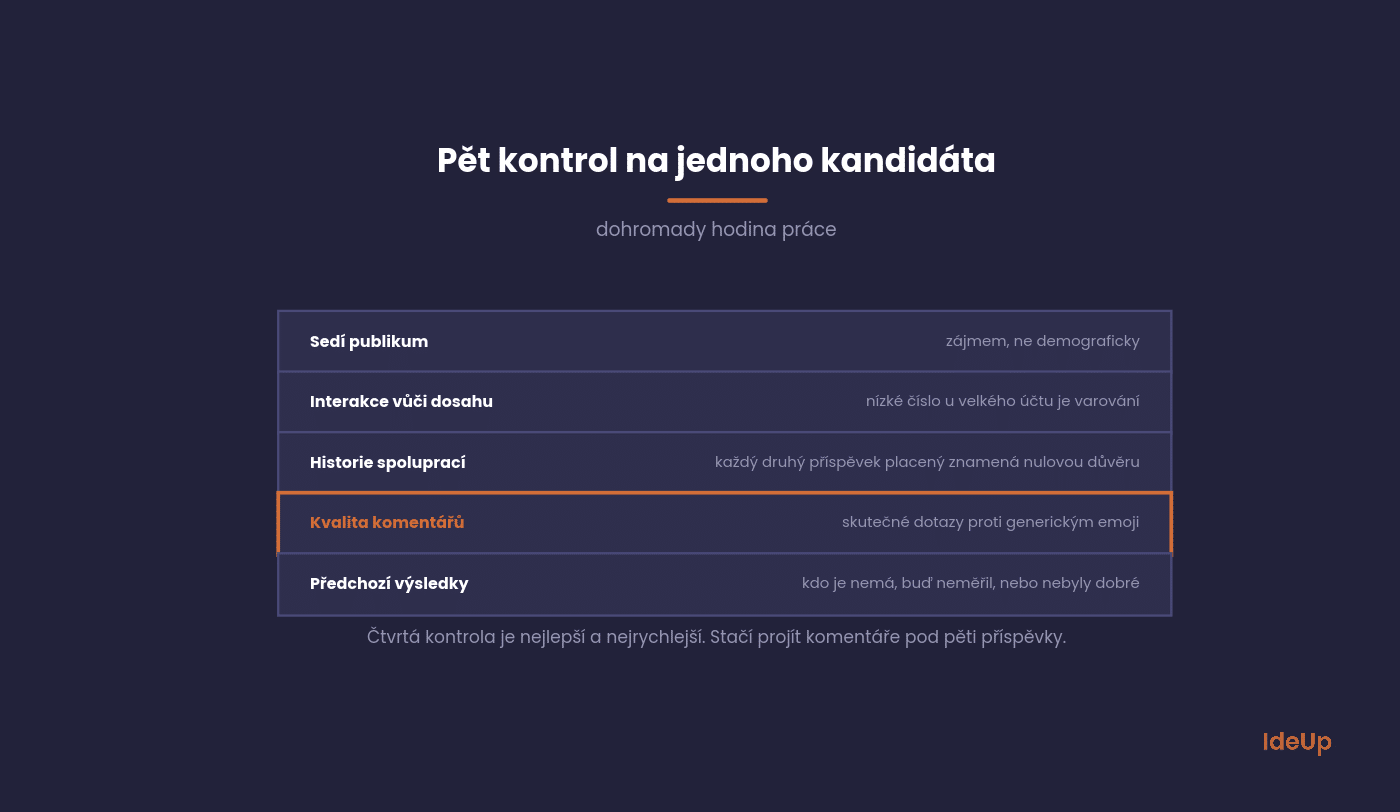
The audience fits. Not demographically, but by interest. Is the account followed by people who could buy from you?
Engagement rate relative to reach. How many people react to a post in proportion to the number of followers. A low figure on a large account is a warning sign.
Collaboration history. How many sponsored posts in the last six months. An account where every other post is paid has no trust.
Comment quality. The best check of all. Real questions and reactions versus generic emojis from the same accounts.
Previous results. Ask for figures from past collaborations. Anyone who does not have them either did not measure them or they were not good.
How to set up a collaboration
The most common mistake is paying for a post and hoping. A collaboration can be set up so that it can be evaluated without losing its natural feel.
Four things belong in the agreement in advance.
A unique link or code. Without it, you will not find out what the collaboration brought. A discount code works even where clicks cannot be measured.
Freedom of format. A word-for-word script kills the credibility you went there for. Specify what should be said, not how.
Disclosure of the collaboration. It is a legal obligation, and the audience will recognise it anyway. Hiding it harms both sides.
A longer collaboration instead of a one-off. Three posts over a quarter work better than one. The audience needs repetition.
Influencer marketing examples for different types of business
The following illustrative examples show how the same principles look in practice.
An online shop with running gear. Instead of one fitness star, it works with three amateur runners who share their training. Each has their own code, and the product appears naturally in their posts over a quarter.
Software for accountants. The company partners with an accountant who shares practical advice with colleagues. She shows how she closes the month with the tool, which her audience can judge better than any advert.
A local restaurant. It invites a regional food creator for a free meal with no obligation and no script. If the experience is good, the mention carries far more weight than a paid one.
A cosmetics brand. It builds a small ambassador group that uses its products for a year, rather than paying one large account for a single post.
All four share the same basis. The audience overlaps with the customers, the results can be tracked and the brand appears more than once.
What it costs and how to calculate it
Prices on the Czech market range from the low thousands of CZK for smaller accounts to hundreds of thousands of CZK for the largest ones. Rates are usually based on reach, which is exactly the metric that misleads.
It is more useful to calculate your own threshold. How much you can afford to pay per order and how many orders you realistically expect from the collaboration.
We describe the calculation logic in performance marketing for e-shops. It applies here too, just with more uncertainty.
Also expect part of the effect to be brand-related and to show later. That is why, with influencers, you track not only direct orders but also changes in branded search.
How to calculate the ROI of influencer marketing
Return on investment compares what a collaboration earned with what it cost. The basic formula is the margin from attributed orders minus total costs, divided by total costs.
Count all costs, not just the fee. That includes free products, the discounts you give through the code and the time spent on the brief and approval.
An illustrative example. You pay a fee of $1,500, send products worth $200 and give away $300 in discounts, so the total is $2,000. The code brings 50 orders with an average margin of $30, which is $1,500. The direct return is minus 25 percent.
That does not automatically mean failure. If these customers buy again, their value over time may cover the gap, and part of the effect arrives later. Work with margin rather than revenue, otherwise every collaboration will look better than it is.
Be careful with published industry averages for returns. Many come from platforms and agencies that sell these services, and they use different methods. Treat them as context, never as a benchmark for your own budget.
What to measure
Evaluation tends to be the weak point. The company pays, the post goes out and nobody knows whether it achieved anything.
Four things are worth tracking, and all of them can be set up in advance.
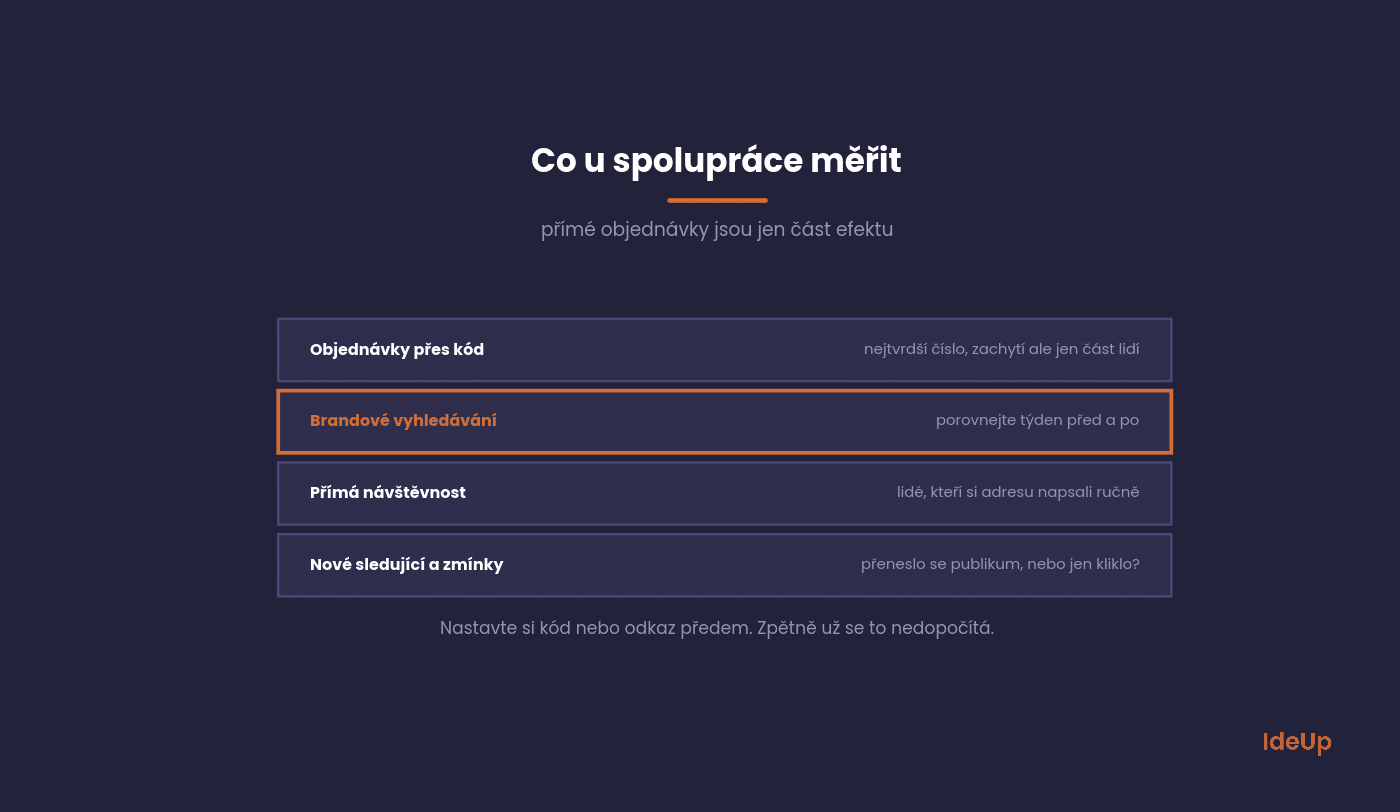
Orders via code or link. The hardest figure, but it captures only some of the people.
Branded search. Compare the week before and after. A rise in searches for your name is the best indicator of the brand effect.
Direct traffic. People who typed the address manually. It grows for the same reason.
New followers and mentions. They show whether the audience carried over or just clicked once.
When not to do it
There are situations where influencer marketing is a waste, and they can be spotted in advance.
Three are the most common.
You have nowhere to convert. If the website does not work on mobile or ordering is complicated, the traffic from the influencer will fizzle out.
You sell to a narrow B2B market. There, direct outreach and expert content are more effective.
You want a one-off result. A single collaboration rarely covers its cost. Plan for repetition, or do not go into it.
Common questions
Five questions we get most often from e-shops and brands.
The answers apply in general, the figures differ by industry.
Are large or small accounts better value
For most Czech companies, smaller accounts with high engagement. The cost per person reached is higher, but the result tends to be better.
Running several smaller collaborations at once also spreads the risk that one will not work.
How to spot bought followers
By the ratio of engagement to follower count and by the comments. Generic comments from the same accounts are a clear signal.
It also helps to look at how fast the account has grown. A sudden jump for no reason is a warning sign.
Should we write a script
Specify the points that should be made and what must not be said. Leave the format to the influencer.
The audience recognises text written by a company within the first sentence and stops listening.
Does it work for services too
It does, but it is harder to measure and the cycle is longer. For professional services, working with someone from the field tends to be more effective than with a general influencer.
It is closer to what we describe in brand building than to a performance channel.
How many collaborations per month
Fewer and repeated rather than many one-offs. Three collaborations with the same people over a quarter work better than ten one-off ones.
What matters is your capacity for evaluation. If you cannot keep up with measuring, you are doing them for nothing.
Where to start
Choose three accounts your customers follow and go through the comments under their last five posts. Within half an hour, you will know whether the audience is real.
Before you agree on your first collaboration, prepare a code or link and write down your current branded search volume. Without it, you will have nothing to compare against.
Prepare the brief for the creator in writing, including what should and should not be said. Copywriting helps with this, because the difference between a recommendation and an advert lies only in the wording.
Want to connect it to the rest of your marketing so the effect does not disappear? Take a look at our services or get in touch via our contact page.
Frequently asked questions about influencer marketing
What is influencer marketing?
Influencer marketing is a collaboration in which a brand pays or rewards a person with an engaged audience to recommend its product or service. Its value lies in the trust the audience has in that person. Without that trust, it is just a more expensive form of advertising.
How do you do influencer marketing?
Start by choosing creators whose audience matches your customers and who have genuine engagement. Agree on a unique code or link, give them freedom over the format and plan several posts rather than one. Then evaluate the results against what you can afford to pay per order.
How do you measure the ROI of influencer marketing?
Subtract the total cost of the collaboration from the margin it generated, then divide the result by the total cost. Include the fee, free products, discounts and your own time. Remember that part of the effect shows up later and is not captured by the code.
Can you rely on influencer marketing stats?
Use them with caution. Many published figures come from companies that sell influencer services, and they measure results in different ways. Your own tracked results from a few collaborations will tell you more than any industry average.