Among performance-driven companies, brand building has a reputation for spending money without measurement. When cuts are needed, it is the first thing to go.
We understand why. A brand is harder to report on than a campaign with proven returns, and its effect arrives later than a quarterly meeting lasts.
This article shows why a brand pays off even for a company that lives on performance, how to measure it without a large budget, and where to start when you have a few thousand CZK a month for brand.
Why this matters for performance companies too
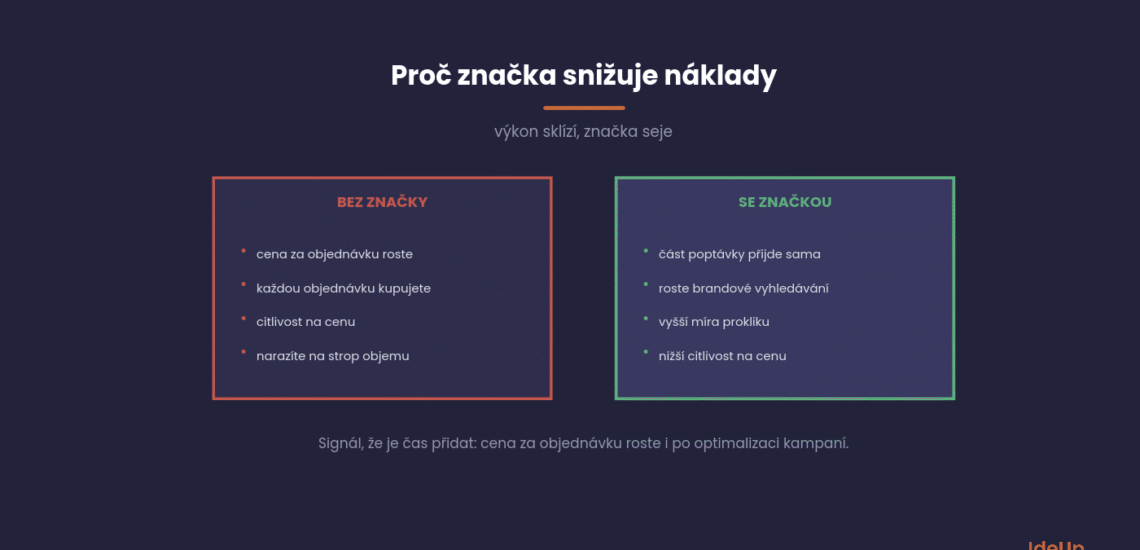
Performance channels harvest demand that already exists. A brand is what creates demand. If you harvest and nobody sows, sooner or later you hit a ceiling.
You will recognise it clearly: cost per order rises year after year even though you optimise your campaigns, and volume stays flat.
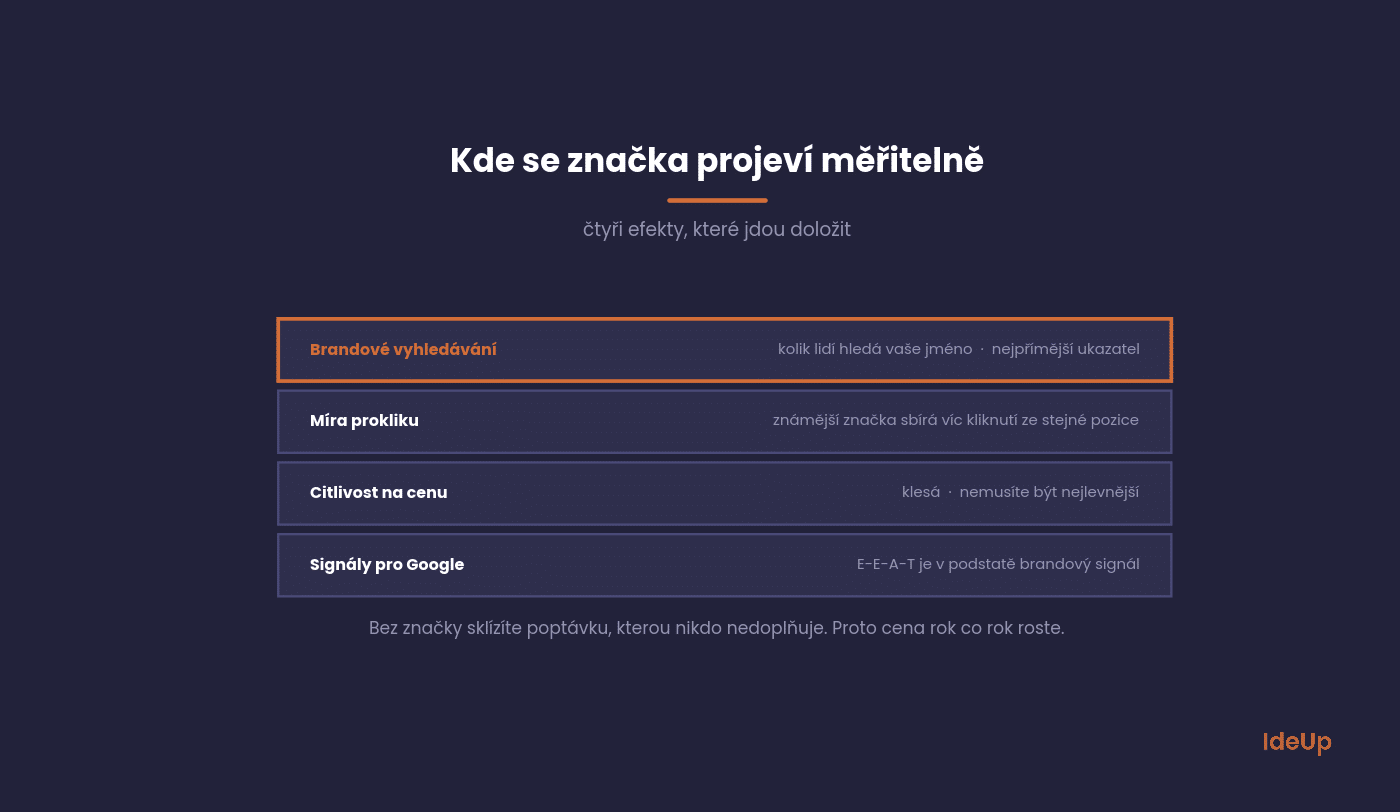
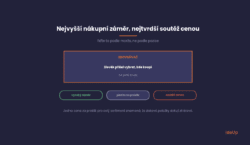
A strong brand shows up in three places you can measure. Direct and branded search grows, click-through rate in search results improves and price sensitivity falls.
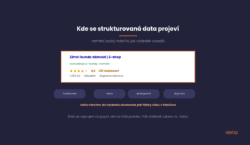
The fourth effect concerns search. What Google sums up as E-E-A-T is essentially a brand signal. Links are just one way of proving it, as we discuss in backlinks and domain authority.
What brand building means in practice
Brand building is the ongoing work of shaping what people think and feel when they hear your company’s name. It covers the promise you make, how you keep it and how consistently you show up wherever customers meet you.
It differs from a single campaign. A campaign has a start date and an end date and aims at a specific response. Building a brand is cumulative. Each interaction adds to or subtracts from a memory that already exists, and the effect compounds over time.
Here is a useful way to think of it. Performance marketing asks people to act now. Brand building makes sure they think of you when they are ready to act.
What a brand is made of
A brand is not a logo or a colour scheme. Those are its packaging. Underneath are three layers that decide whether people remember you and whether they trust you.
Companies usually deal only with the last one.
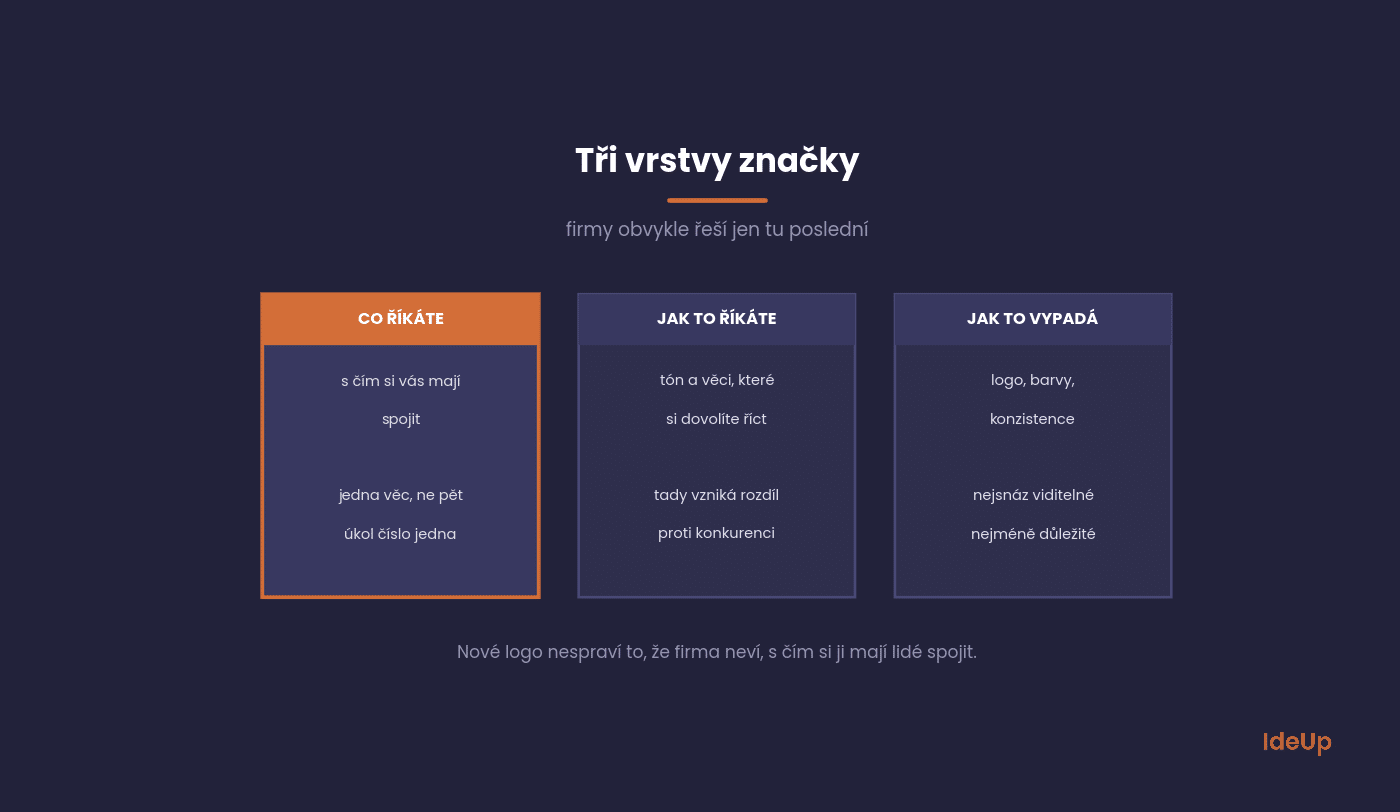
What you say. What people should associate you with. One thing, not five. If you ask your employees and each gives a different answer, this is your number one task.
How you say it. The tone you speak in and the things you dare to say out loud. This is exactly where the difference between a memorable company and an interchangeable one arises.
How it looks. Logo, colours, typography, consistency across materials. Important for recognition, but on its own it will not create a brand.
Building brand recognition, loyalty and equity
These three terms often get mixed up. They describe different stages of the same effect, and each needs slightly different work.
Brand recognition
Recognition means people can identify you from your name, logo or tone without being told who you are. It comes from repetition and consistency. If you change your look or message every year, you reset the counter.
Brand loyalty
Loyalty means customers come back and choose you even when a cheaper or closer option exists. You earn it mainly after the purchase, through delivery, support and the way you handle problems. If you treat existing customers worse than new ones, loyalty erodes quickly.
Brand equity
Brand equity is the extra value your name adds to what you sell. You see it when customers accept a higher price, try a new product because it carries your name, or recommend you without being asked. It is the sum of recognition and loyalty built over years. It is also the part that stays with your company when a campaign stops.
How to measure a brand without a large budget
Awareness surveys cost tens of thousands of CZK and a smaller company will not run them. But there are four indicators you already have for free, and they move in the same direction.
Track them quarterly, not monthly. In monthly data, brand effects get lost in the noise.
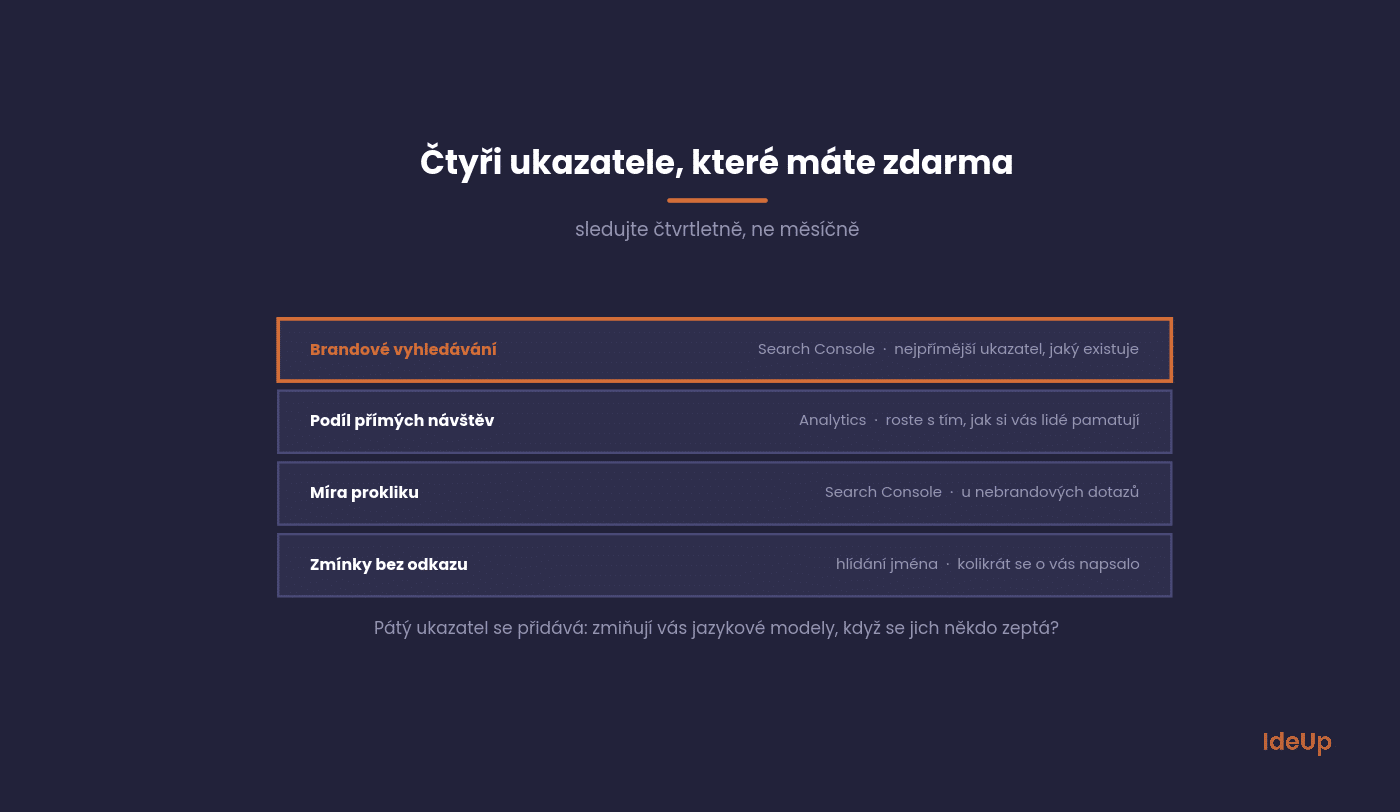
Branded search. How many people search for your name each month. You will find it in Search Console, and it is the most direct indicator there is.
Share of direct visits. People who type your address straight in. It grows as people remember you.
Click-through rate in search results. A better-known brand gets more clicks from the same position. Track it for non-branded queries.
Unlinked mentions. How many times you have been written about somewhere. You track them by monitoring your name in search or with a paid tool.
A fifth indicator is now being added: whether language models mention you when someone asks them about your field. We describe how to find out in AI Overviews.
Where to start on a small budget
A brand is not built through campaigns alone. Most of what makes it up are things you do anyway, just inconsistently.
The following order works for a company with a few thousand CZK a month for brand.
Align what you say. One sentence used by sales, the website and support alike. Zero budget, one workshop.
Be consistent. The same wording, the same prices, the same service description everywhere. Inconsistency costs trust and confuses search engines too.
Publish content with your own data. The cheapest way to build a reputation is to regularly say something that cannot be found elsewhere. That is the core of content marketing.
Show your people. Companies without faces seem interchangeable. An author’s name and photo under an article does more than you would expect.
Collect proof. Testimonials, case studies, figures from projects. Of the whole list, this is what is most often missing and helps the most.
Building a brand online
For most companies today, the first contact with a brand happens on a screen. Your online presence is where the three layers of your brand either come together or fall apart.
- Your website. This is the clearest statement of what you do. A visitor should be able to tell within a few seconds who you serve and why you are different. If they cannot, the rest of your effort leaks away.
- Social profiles. Choose one or two platforms where your customers actually spend time. Keep those active rather than spreading yourself thinly across five.
- Reviews and third-party profiles. What others say about you often carries more weight than what you say yourself. Respond to criticism calmly and in public.
- Emails and support replies. These are brand touchpoints too, and they are the ones companies most often forget to keep consistent.
A common mistake is treating online channels as separate projects run by different people. Customers see one company, so your tone and your promise need to match everywhere.
How much budget to put into brand
The exact ratio depends on your company’s stage and how long you have been on the market. But there is a guideline, and it is simple.
At the start, almost everything goes into performance, because you need revenue and data. In the growth phase, room opens up, and at maturity the brand generates most of the demand.
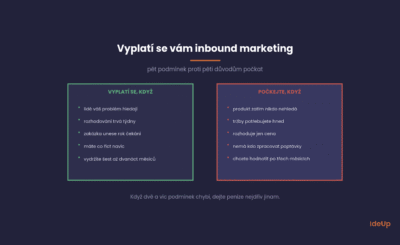
A practical signal that it is time to add more: cost per order in performance channels rises year on year even after optimisation. That is the moment you are paying for a lack of brand.
We discuss budget allocation by stage in more detail in performance marketing for e-shops. The logic applies outside e-commerce too.
What to avoid
The following mistakes cost money and time, and what they all have in common is that they deal with the packaging instead of the substance.
You can spot them because they are decided in a meeting without the customer.
A redesign instead of a decision. A new logo will not fix the fact that the company does not know what people should associate it with.
A slogan that says nothing. “Your satisfaction is our priority” is something your competitors write too. The test is whether anyone else could say it about themselves.
Measuring after a month. Brand effects show up over quarters and years. Monthly data shows noise.
A brand without a product. Marketing can bring people in once. Only their experience with what they bought will bring them back.
Questions that come up about brand
Five questions we get from companies that have so far done only performance.
The answers apply to small and medium-sized companies.
When does it make sense to start?
Once you have a working product and repeat customers. Before that, it is an investment in something that may still change.
But do not wait until cost per order shoots up. By then you are a year too late.
How long does it take?
The first movement in branded search comes within six months to a year, and a significant effect within two to three years.
That is why it cannot be done in bursts. A year of work followed by a break sets things back.
Do we need an agency for this?
Not for deciding what people should associate you with. That has to be settled inside the company.
For visuals and consistent execution, an outside perspective is useful. Choose based on work, not on the pitch.
How do we know our brand is weak?
When people do not mention you of their own accord when deciding, and when you have to buy every order.
A quick test: what percentage of your visits come from branded queries and direct entries. Below 10%, the brand is weak.
Can a brand be built with content alone?
To a large extent, yes, especially in B2B and professional services. Regular content with your own data is the cheapest way to build a reputation.
For consumer goods with short decision-making, content alone is not enough and you also need reach.
Where to start in your company
Ask five people in your company what customers should associate your brand with. If you get five different answers, you have your first task, and it costs nothing but time.
The second step is to check in Search Console how many people search for your name each month, and write that number down. In a year, you will have something to compare it with.
Want to connect it with content and performance so that each supports the other? Take a look at our services or get in touch via our contact page.
Frequently asked questions about brand building
What is brand building?
Brand building is the long-term work of shaping how people perceive your company and what they associate it with. It includes your positioning, tone and visual identity. Above all, it includes the experience customers have with you. The aim is for people to think of you first when they need what you offer.
What are the steps in the brand building process?
Start by defining who you serve and the one thing you want to be known for. Then set the tone and visual identity that express it, apply them consistently at every touchpoint and review the results every quarter. The process does not end. You keep adjusting it as the market and your company change.
How do you build brand loyalty?
Loyalty grows from what happens after the sale. Deliver what you promised, make support easy to reach and treat existing customers at least as well as new ones. Small gestures, such as following up after a purchase, often matter more than loyalty programmes.
What does building a strong brand require?
A strong brand is clear, consistent and backed by a product that keeps its promise. People can say in one sentence what it stands for, recognise it across channels and trust it enough to recommend it. Without a good product experience, no amount of communication will hold a brand up.