
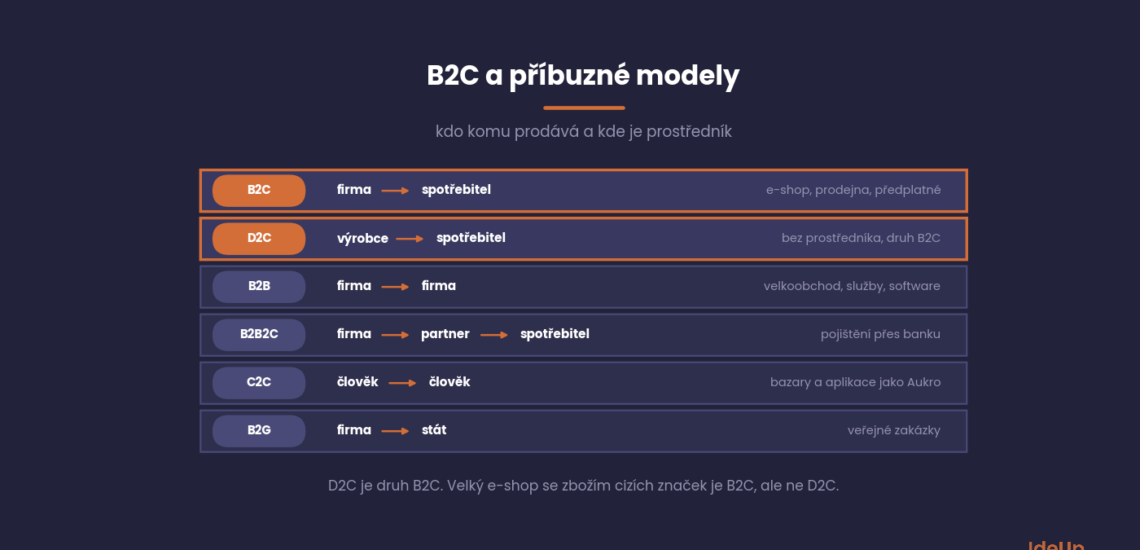
B2C (business to consumer) means a company selling to the end consumer, that is, a person buying for themselves or their household rather than for their business. Typically this is an online shop or a bricks-and-mortar store.
At the opposite end is B2B, where a company sells to another company. The buyer determines which model it is, not the product. A roastery can sell the same coffee to a café as B2B and to you through its own online shop as B2C.
In the Czech Republic, selling to people is governed by stricter rules than selling to companies, mainly the Civil Code (občanský zákoník) and the Consumer Protection Act (zákon o ochraně spotřebitele). The market is large, though. According to data from the Czech Statistical Office (Český statistický úřad, ČSÚ) for 2025, 76.2% of people aged 16 and over bought something online within twelve months, roughly three in four.
How B2C differs from B2B
The main difference is who makes the decision and how. In B2C, everyday goods are bought by one person, often within a few minutes and mainly based on price and reviews. In B2B, several people decide, the purchase goes through approval and takes weeks or months.
There are exceptions on both sides. A household may spend half a year choosing a car or a kitchen, and a sole trader can order office paper in a minute. For marketing, however, the typical purchase is what matters.
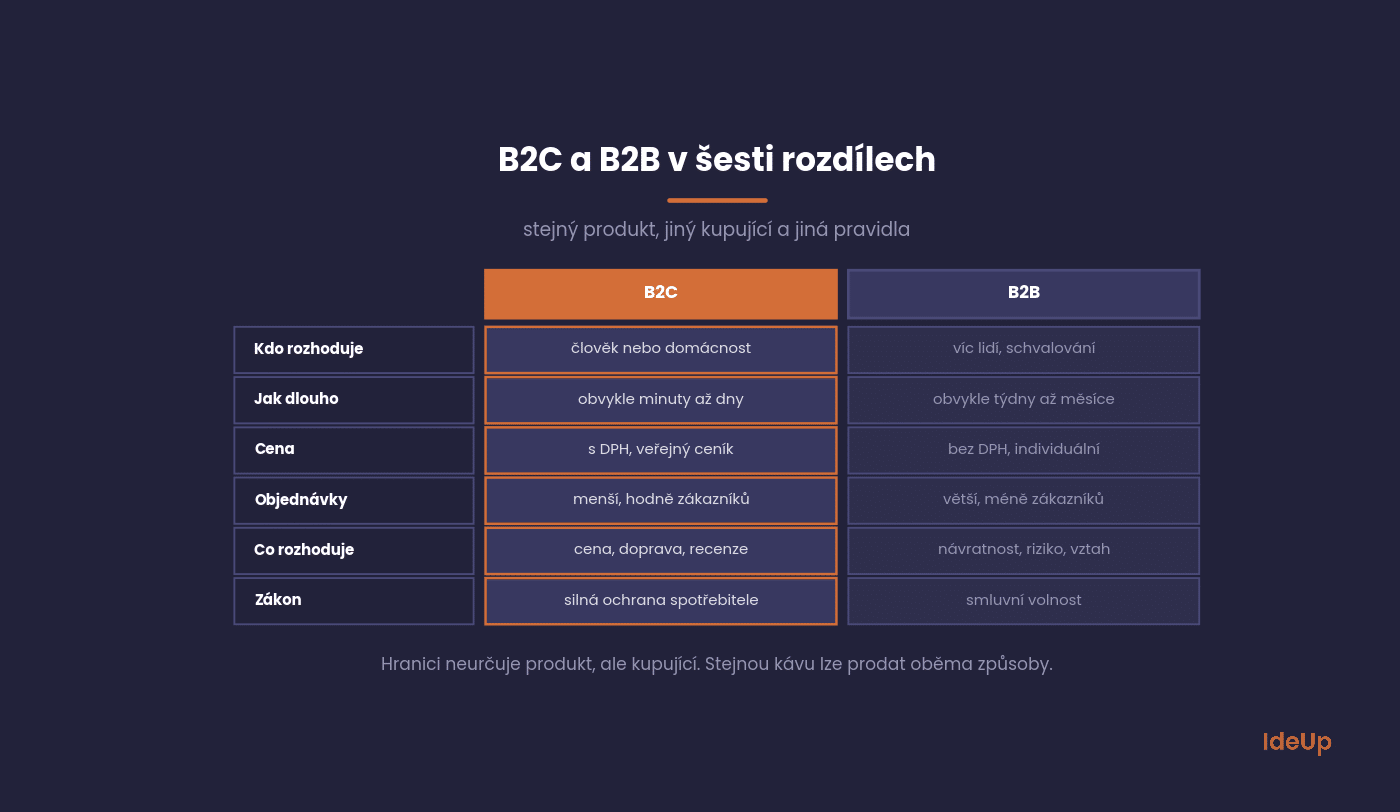
In B2C, there are many smaller orders, so profit depends on how much it costs to acquire a customer and whether they come back. Prices are shown including VAT, because consumers cannot deduct the tax, and communication relies more on the brand. In B2B, you sell to fewer customers for larger amounts, prices tend to be quoted without VAT and individually, and a salesperson often closes the deal in person.
A single website can serve both groups, for example with a price toggle or a wholesale login. At IdeUp, however, we always keep campaigns and copy for businesses and for consumers separate. A business looks for arguments about return on investment and risk, a consumer about price, delivery and reviews, and an ad written for both convinces neither.
B2C, D2C, C2C and other abbreviations
Several related abbreviations are used around B2C. They differ in who sells to whom and whether there is an intermediary between them.
- D2C (direct to consumer) is when a manufacturer sells directly to people through its own online shop, without a retail chain. It is a type of B2C. A large online shop selling other brands’ goods is B2C, but not D2C.
- B2B2C is selling through a partner who has the relationship with the customer. A typical example is insurance offered to you by your bank.
- C2C is selling between people through second-hand marketplaces and apps such as Aukro. The company is only the platform operator.
- B2G is selling to the state and public institutions, usually through public procurement.
A single company often combines several models at once. A manufacturer of packaged food or toiletries, that is, fast-moving goods (FMCG or CPG, consumer packaged goods), sells most of its output B2B through retail chains. When it launches its own online shop, it adds D2C, and each channel then needs its own prices and its own measurement.
Common types of B2C business model
A B2C business model describes how a company earns money from consumers. The model shapes your prices, your costs and which numbers you watch most closely. The most common ones are these.
- Retail, online or in a shop, where you buy goods and resell them with a margin.
- Subscription, where the customer pays regularly, for example for streaming, meal kits or coffee delivered every month.
- Services such as hairdressers, gyms, language schools or online courses.
- Freemium and ad-funded apps, which are free for most users and earn money from paid features or from advertisers.
- Marketplaces, where many shops sell to consumers through one platform and the operator takes a commission.
With one-off purchases, the cost of winning each new customer matters most. With subscriptions, what matters most is how long people stay before they cancel.
What B2C means under the law
Under the Civil Code (občanský zákoník, § 419), a consumer is a person who enters into a contract with a business outside their own business or profession. The law protects them more than a company, and this is where B2C differs most from B2B.
We have picked the five rules that affect marketing most. Your terms and conditions should still be checked by a lawyer.
| Rule | What the law says | What it means for marketing |
|---|---|---|
| 14-day withdrawal | A consumer can cancel a distance purchase without giving a reason within 14 days of receiving the goods (Civil Code, § 1829). You refund the money within 14 days, including the delivery cost, up to the amount of the cheapest delivery option offered (§ 1832). The customer pays for return postage if you informed them of this in advance. Exceptions are set out in § 1837, for example made-to-measure goods or goods that perish quickly. | Include returns, and the delivery costs you refund with them, in your margin calculation. |
| Two years for complaints | A consumer can claim a defect that appears within two years of receiving the goods (§ 2165). If the defect appears within the first year, it is presumed to have existed at the time of receipt (§ 2161). For used goods, a shorter period can be agreed, but no less than one year (§ 2168). | In the first year, it is up to you to prove that the defect arose only after receipt. For goods with a higher failure rate, factor this into the price. |
| All-inclusive price | The price including taxes and fees is material information, and omitting it is a misleading omission (Consumer Protection Act (zákon o ochraně spotřebitele), § 5a). | Show prices including VAT in ads and in feeds for price comparison sites. A price list without VAT is not enough for consumers. |
| Discount from the lowest price | With a discount, you must also state the lowest price at which you offered and sold the goods in the 30 days before the discount (§ 12a). This does not apply to goods that perish quickly. | You cannot raise prices before a promotion and then “discount” them. Next to the discount, the customer will also see the lowest price from the last 30 days. |
| Verified reviews | Anyone who publishes reviews must state whether and how they verify that the reviews were written by people who bought or used the product (§ 5a(5)). | Describe on your website how you verify reviews. If you do not verify them, you must say that too. |
In addition, you must not present rights that the law gives consumers as your own advantage in advertising. The Consumer Protection Act classifies this as a misleading commercial practice in Annex 1. Fourteen days to return goods or two years for complaints therefore do not belong in ads as a benefit. What belongs there is what you offer beyond the law, such as free returns or exchanges without waiting.
For an order placed with a company ID number (IČO), the purpose of the purchase is what counts, under the same § 419. Anyone buying for their business is not a consumer, and the rules in the table do not apply to them. Keep a separate section for these purchases in your terms and conditions, otherwise in a dispute you will end up arguing about which rules apply.
How B2C marketing works
B2C marketing is built on volume. You need a lot of people who know about you, enough of them have to buy, and as many as possible should come back. At each step you can lose more than advertising brings in.
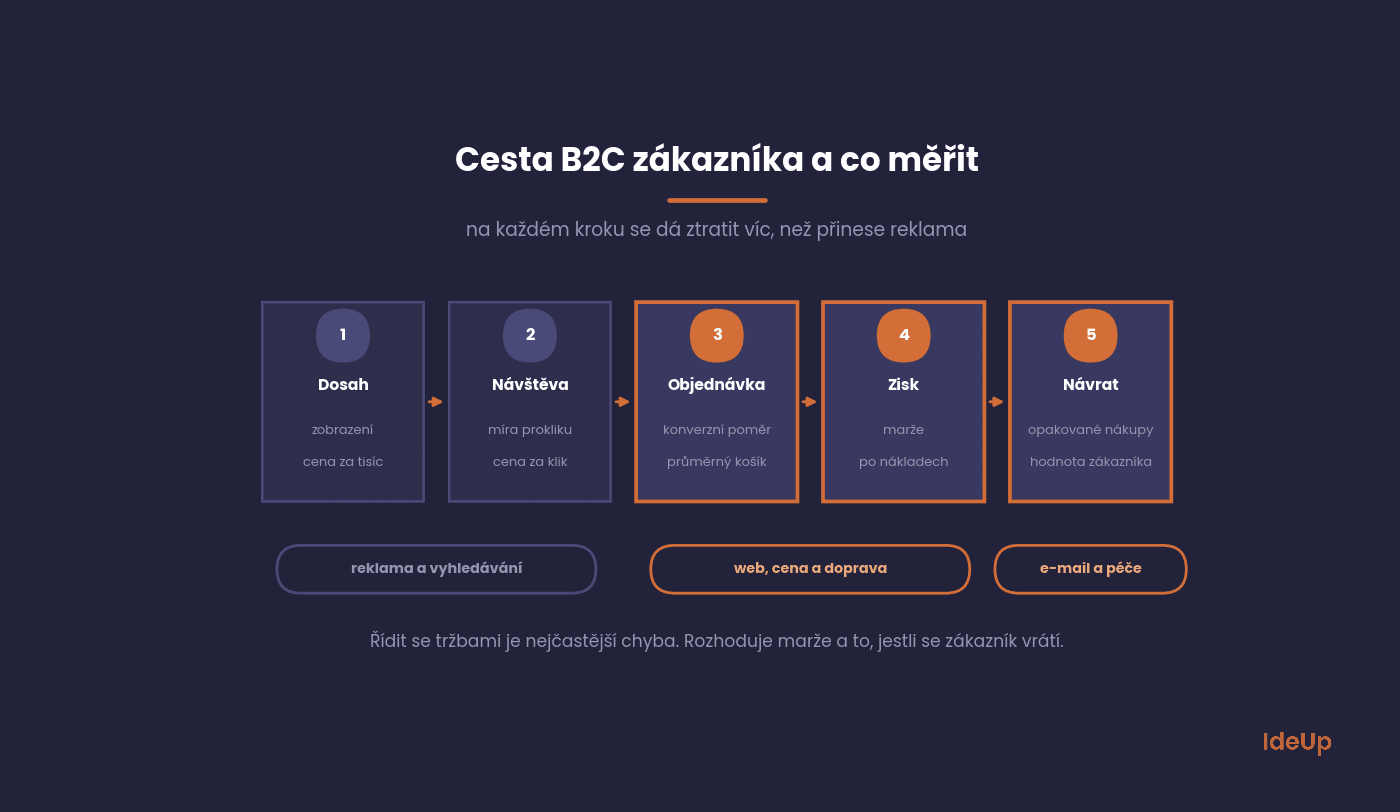
Channels are chosen according to the stage a person is at. People looking for a specific product can be reached in search and on price comparison sites. For people who do not yet know they want the product, social media and video work, and email is the main driver of repeat purchases.
At IdeUp, we set campaign goals based on margin. Why a channel with healthy revenue can end up making a loss is explained in the e-commerce entry. We cover how to set such goals in our guide to performance marketing for online shops, and how to increase revenue without raising the budget in our article on conversion rate.
B2C marketing examples
The same principles look different depending on the product. A few typical cases show how.
- A clothing shop shows short videos of outfits on social media, then reminds people who viewed a product but did not buy it.
- A coffee roastery sends a newsletter with brewing tips and offers a subscription, so one purchase turns into regular orders.
- A gym offers a free trial week and rewards members who bring a friend.
- A furniture seller deals with a longer decision, so it relies on detailed photos, a room planner and reviews from buyers.
Do a quick calculation for each case. If you spend $20 to win a customer and their first order leaves you $15 after costs, you only make a profit once they buy again.
When a B2B company starts selling to people
A company that has sold only to businesses for years usually starts with a shopping cart on its website and prices including VAT. More work, however, goes into terms and conditions, logistics and customer care.
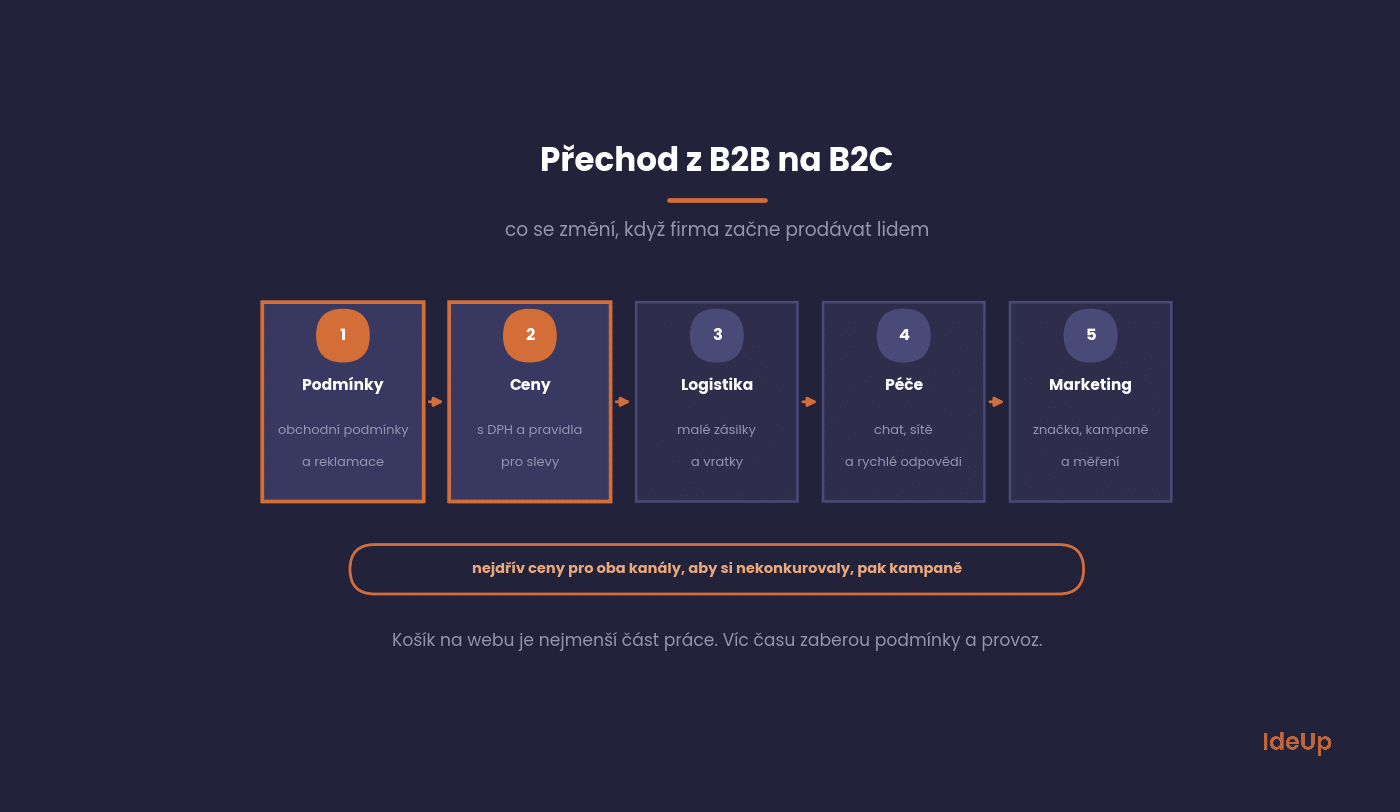
- Terms and conditions and a complaints policy for consumers, separate from the terms for businesses.
- Prices including VAT and discount rules, so that consumer promotions do not undermine partner pricing.
- Logistics for small parcels and returns, including who handles them and at what cost.
- Care for customers who expect quick replies and write via chat and social media.
- Marketing and measurement from the start, with metrics such as cost per order or customer value.
The biggest risk tends to be conflict with your own resellers. When a manufacturer sells to people more cheaply than its resellers do, they may stop stocking its goods.
Sort out the pricing policy for both channels before the first campaign. Your own online shop should not sell below the price you recommend to resellers, and you can keep part of the range or certain pack sizes for online sales only. Tell your trade partners about promotion rules in advance, so they do not find out from a leaflet.
Common mistakes in B2C marketing
Most problems do not come from a bad ad but from what happens around it.
- Constant discounts. Customers learn to wait for the next promotion and stop buying at full price.
- Delivery costs revealed at the last step. People who feel surprised at checkout often leave without ordering.
- A checkout that is hard to use on a phone. Many consumers browse and buy on mobile, so test every step on a small screen.
- Forgetting existing customers. All the budget goes on new people while those who have already bought hear nothing from you.
- Ignoring reviews. A calm, helpful reply to a negative review tells other buyers more than a row of perfect ratings.
Where to start
If you already sell B2C, go through the table of legal rules and compare it with your website and ads. Promotional prices and “benefits” that are only the legal minimum are the quickest to fix.
When moving from B2B, start with prices and terms and conditions, and deal with the website and campaigns afterwards. If you sell to both businesses and people and do not want the two channels to compete, get in touch. We handle the business side as part of our B2B marketing service and set up consumer campaigns alongside it so that they do not undercut your resellers’ prices.
Frequently asked questions about B2C
What does B2C mean?
B2C stands for business to consumer. It describes a company selling goods or services to people who buy for themselves or their household, not for their business. Online shops, supermarkets, cafés and streaming services are typical examples.
What is the difference between B2B and B2C marketing?
B2C marketing targets individuals who often decide quickly, based on price, convenience and reviews. B2B marketing targets companies, where several people are involved and decisions take longer. That is why B2C relies more on the brand and reach, while B2B relies more on personal contact and arguments about return on investment.
What is a B2C business model?
It is the way a company earns money from consumers. Common forms are retail, subscriptions, services, freemium apps and marketplaces. The choice affects whether you focus more on winning new customers or on keeping existing ones.
What are some B2C marketing examples?
A clothing shop promoting outfits through short videos, a roastery offering a coffee subscription and a gym with a free trial week are all B2C marketing. Each tries to win a first purchase cheaply and then turn the buyer into a regular customer.


Leave A Reply